
ABS vs. Polycarbonate: A Comprehensive Guide to Choosing the Right Material for CNC Machining
ABS vs. Polycarbonate: A Comprehensive Guide to Choosing the Right Material for CNC Machining
In my years on the shop floor at PlasticCNCPro, I’ve seen countless projects hit a roadblock simply because of a material mismatch. We often receive inquiries from engineers asking, "Should I use ABS or Polycarbonate for this part?" It’s a classic dilemma. While both are widely used in the industry, they behave very differently under a cutting tool and in the field.
Selecting the wrong plastic isn't just a minor oversight; it leads to fractured prototypes, warped assemblies, or, in the worst cases, costly production failures. At PlasticCNCPro, we specialize in helping our global customers navigate these choices to ensure that the material we machine today performs perfectly in your assembly tomorrow.
Understanding the Contenders: ABS vs. Polycarbonate
What is ABS?
Acrylonitrile Butadiene Styrene (ABS) is a thermoplastic polymer known for its excellent balance of toughness and impact resistance. It’s a "commodity" plastic that is incredibly versatile, easy to machine, and cost-effective. You’ll find it in everything from consumer electronics housings to automotive interior components.
What is Polycarbonate (PC)?
Polycarbonate (PC) is an engineering-grade thermoplastic that plays in a different league. It is renowned for its high impact strength—often described as "bulletproof" in its thicker forms—and its remarkable optical clarity. When your part needs to survive high-stress environments or requires transparency, PC is usually the top contender.
Why the Comparison Matters
Choosing between these two isn't just about price; it’s about mechanical integrity. If you choose ABS for a high-heat structural component, it will fail. If you choose PC for a part that requires extensive chemical resistance or ease of secondary bonding, you might find yourself struggling with unnecessary manufacturing hurdles.
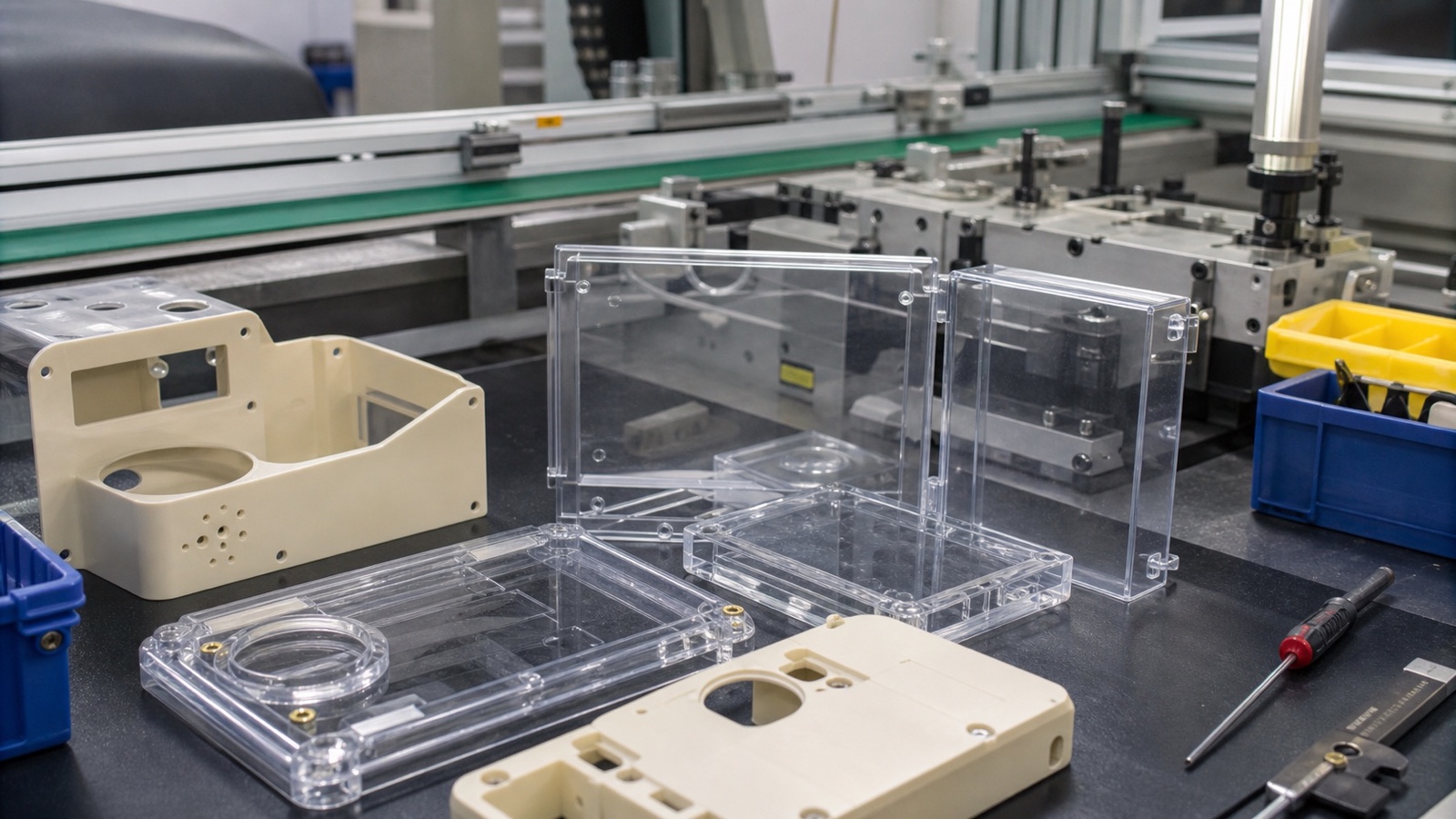
Side-by-Side Mechanical & Physical Comparison
Mechanical Integrity
Polycarbonate is the clear winner for structural applications. It has a significantly higher tensile strength and impact resistance compared to ABS. If your part needs to withstand mechanical shock or heavy loads without deforming, PC provides that "engineering-grade" reliability. ABS, by contrast, is more flexible. It’s great for snap-fits and items that need to absorb energy without shattering, but it lacks the rigidity of PC.
Heat Resistance
If your application involves operating temperatures above 80°C (176°F), ABS will begin to soften and lose its dimensional stability. Polycarbonate has a much higher glass transition temperature, making it the superior choice for high-heat environments or electronics that generate significant internal heat.
Machining Behavior
From our perspective at the CNC console, these materials have distinct "personalities." ABS is relatively easy to machine, but it has a low melting point. If we don’t optimize our spindle speeds and feed rates, the material can gum up the tool. Polycarbonate is rigid and machines cleanly, but it is prone to cracking or stress-crazing if the cutting forces are too aggressive or the tool isn't sharp enough.
Optical & Surface Characteristics
If you need transparency, Polycarbonate is the industry standard—it’s essentially clear like glass. ABS is inherently opaque and typically comes in a natural off-white or black finish. If you need a cosmetic finish that will be plated or painted, ABS is often the better candidate due to its excellent surface adhesion properties.
Chemical and Environmental Resistance
Both materials have their Achilles' heels. ABS is susceptible to certain solvents and can degrade when exposed to harsh oils or greases over extended periods. Polycarbonate, while strong, can be sensitive to specific chemicals like acetone or certain alkaline cleaners, which may cause it to crack.
Regarding UV exposure, standard ABS will yellow and become brittle fairly quickly outdoors. Polycarbonate is also prone to UV degradation, though UV-stabilized grades are available. If your part is destined for the great outdoors, let us know—we can source the correct stabilized material to ensure longevity.
Economic Realities: Performance vs. Cost
ABS is generally more affordable than Polycarbonate. If you are developing a low-cost prototype or a housing that doesn't face extreme stress, ABS helps keep your project budget in check. However, consider the "total cost of ownership." If you have to replace a failed ABS part six months later, the initial savings are lost. Polycarbonate’s higher material cost is an investment in durability and performance.
When to Choose Which? A Selection Matrix
| Feature | Choose ABS If... | Choose Polycarbonate If... |
| :--- | :--- | :--- |
| Budget | You need a cost-effective prototype. | You prioritize long-term performance. |
| Clarity | Opaque/Color is acceptable. | You need glass-like transparency. |
| Environment | The part is indoors/low stress. | The part faces heat or high impact. |
| Machining | You need quick, easy turnarounds. | You need high precision/rigidity. |
The Hybrid Option: If you’re torn between the two, consider ABS/PC blends. These materials combine the processability of ABS with the heat resistance and strength of PC, often providing the "best of both worlds" for specific industrial applications.
Frequently Asked Questions (FAQ)
Is ABS or Polycarbonate easier to machine?
ABS is generally easier to cut, but it requires careful heat management to prevent melting. PC is more rigid and produces excellent surface finishes, but it requires sharp tooling and precise coolant management to avoid stress-cracking.
Which material is more durable for outdoor use?
Neither is naturally great for long-term outdoor exposure without protection. However, with the right UV-stabilized grades, Polycarbonate holds up better mechanically, while ABS is better suited for protected outdoor environments.
Can these materials be recycled?
Both are thermoplastics and are widely recyclable. At PlasticCNCPro, we manage our material scrap responsibly to ensure we minimize waste in our production cycles.
Are there better alternatives to ABS or PC?
Absolutely. For high-wear applications, we often suggest Nylon or Delrin (POM). If you need extreme chemical or heat resistance, we look toward PEEK or PPS.
Conclusion: Making the Best Choice for Your Project
Choosing between ABS and Polycarbonate comes down to your project’s specific demands: Is it a cosmetic prototype, or a structural component in a high-heat machine?
At PlasticCNCPro, we don’t just cut plastic; we help you engineer it. We’ve supported countless industrial equipment and medical device manufacturers in selecting the right polymer for their specific tolerances and functional needs. Before you finalize your CAD design, reach out to us. We can review your geometry and provide a recommendation that balances cost, performance, and manufacturability.
Ready to start your next project? Send your 2D drawings or 3D models to our team at PlasticCNCPro today. Let’s turn your concept into a high-precision reality.