
Cast Nylon vs Extruded Nylon: Which Is Better for Machined Parts?
When a design calls for a nylon component, the first question I ask isn’t "Which nylon grade?" — it’s "How was the nylon produced?" That distinction, cast vs extruded, determines everything from dimensional stability and impact strength to machinability and cost. As an engineer at PlasticCNCPro, I regularly see how this material choice affects machining stability, fit, and service performance across industrial applications. In this article, I’ll break down the real differences between cast and extruded nylon so you can choose the right material for your machined parts with confidence.
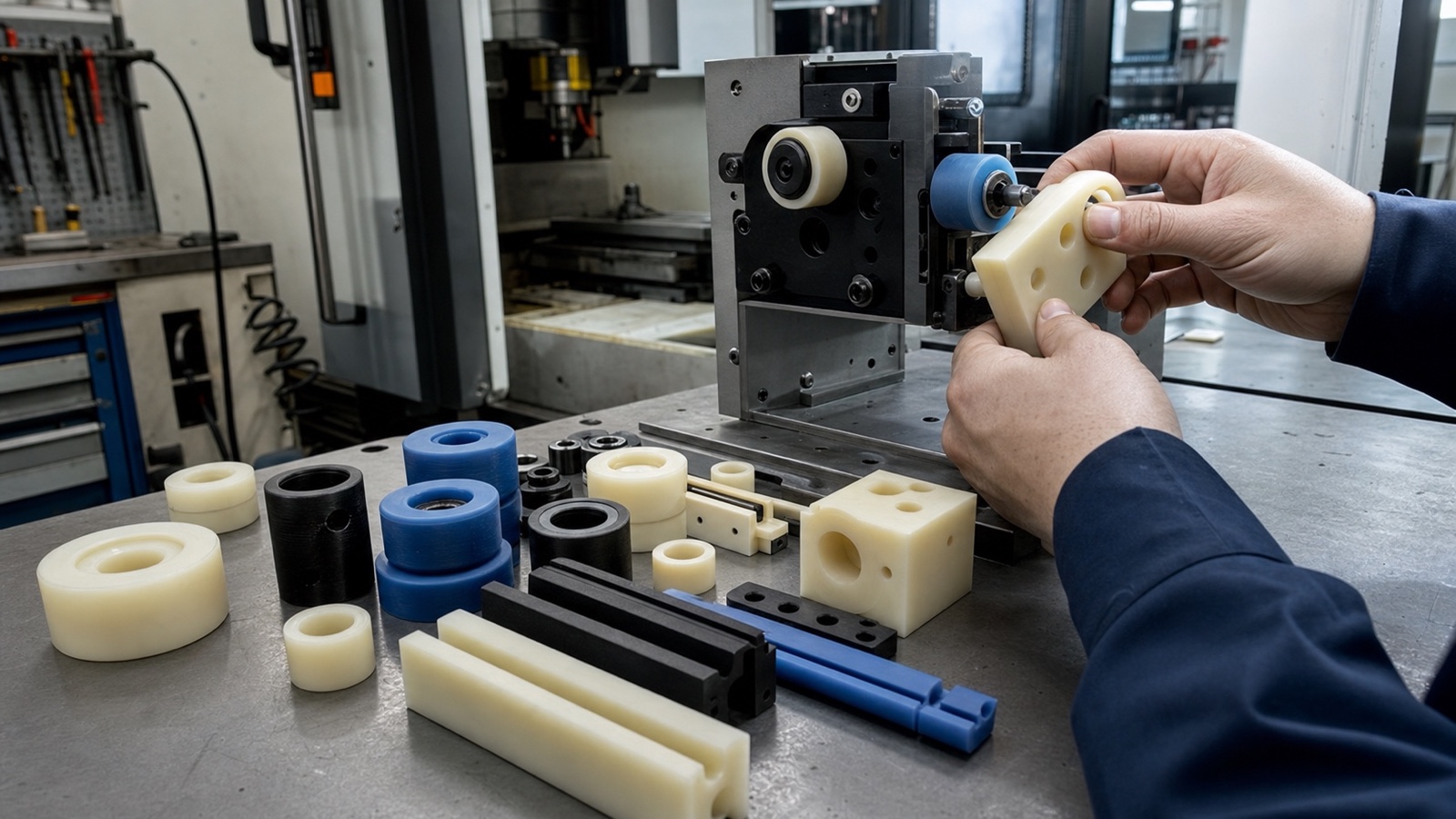
Why the Cast vs Extruded Nylon Decision Matters
Nylon is one of the most popular engineering plastics for CNC machining, and for good reason: it combines excellent mechanical strength, low friction, wear resistance, and self-lubricating properties. But nylon isn’t a single homogeneous material. The manufacturing method used to create the raw stock — casting or extrusion — creates two distinctly different materials with different molecular structures, internal stress profiles, and mechanical behaviors.
Choosing the wrong form of nylon can lead to warped parts, premature wear, dimensional drift after machining, or unnecessary material costs. On the other hand, the right choice can give you a part that outperforms metal in weight, noise, and wear. So let’s dig into what each material actually is, and how the production process shapes its performance in CNC machining.
What Is Cast Nylon?
Cast nylon, sometimes called MC nylon (monomer casting nylon), is produced by a low-pressure casting process. Liquid caprolactam monomer is poured into a mold where it polymerizes directly into the finished shape — a rod, plate, tube, or a near-net shape that closely matches the final part geometry.
Because the polymer is formed directly from monomer in the mold, cast nylon has a very high molecular weight and a relatively stress-free internal structure. This makes it the go-to material for large, thick parts that will be subjected to heavy loads and shock.
How Cast Nylon Is Manufactured
The monomer casting process is fundamentally different from melt processing. Here’s a simplified walkthrough:
- Monomer preparation — Caprolactam is melted and mixed with a catalyst and activator.
- Casting — The mixture is poured into a low-pressure mold, which may be a simple pipe mold or a custom cavity for a near-net shape.
- Polymerization — The monomer polymerizes inside the mold, gradually solidifying into a solid nylon block. This process can take several minutes to a few hours depending on thickness.
- Cooling and demolding — The part is carefully cooled to prevent thermal shock, then removed.
Because the reaction happens at a relatively low temperature and pressure, cast nylon can be produced in very thick cross-sections — up to several hundred millimeters. This also allows manufacturers to create custom blanks and near-net shapes, reducing material waste and machining time for large components.
Key Properties of Cast Nylon
Cast nylon offers several advantages that are particularly valuable for heavy-duty industrial parts:
- Higher impact strength — The high molecular weight gives cast nylon excellent toughness and resistance to cracking under shock loads.
- Superior wear resistance — In abrasive or sliding wear applications, cast nylon typically outlasts extruded nylon.
- Low internal stress — Because the material polymerizes in a mold rather than being forced through a die, cast nylon has much less locked-in stress. This means machined parts are less likely to warp or distort after material removal.
- Excellent machinability for large parts — The stress-free structure allows large, thick sections to be machined without significant deflection or crazing.
What Is Extruded Nylon?
Extruded nylon, on the other hand, is made by a continuous melt extrusion process. Pellets of nylon resin (usually nylon 6 or nylon 66) are melted under high temperature and pressure, then forced through a die to create a continuous profile — rods, sheets, tubes, or custom cross-sections. The profile is then cooled and cut to length.
Because the material is melted and pushed through a die, extruded nylon has a much lower molecular weight and higher internal stress compared to cast nylon. However, it can be produced with exceptionally consistent dimensions and smooth surfaces.
How Extruded Nylon Is Manufactured
The extrusion process is well suited for high-volume production of standard shapes:
- Drying — Nylon pellets are dried to reduce moisture, which would otherwise cause voids or degradation.
- Melting — The dried pellets are melted in an extruder at high temperatures.
- Extrusion — The molten nylon is forced through a die to create the desired cross-section.
- Cooling and sizing — The hot profile is cooled through a water bath or cooling rollers, and pulled through sizing sleeves to maintain accurate dimensions.
- Cutting — The continuous length is cut into standard rod, sheet, or tube lengths.
The process limits shapes to standard profiles, but it offers tighter dimensional consistency and better surface finish than cast nylon in those profiles.
Key Properties of Extruded Nylon
Extruded nylon has its own set of advantages, especially for precision components:
- Predictable dimensional tolerances — Extruded stock has much tighter diameter/thickness tolerances than cast stock, which is critical for machined parts that must fit onto shafts or into housings.
- Higher stiffness — The melt-processing history gives extruded nylon a slightly higher modulus and stiffness, which can be beneficial in certain structural applications.
- Lower cost for standard sizes — The continuous nature of extrusion makes extruded rod and sheet cheaper per kilogram than cast nylon for standard sizes.
- Slightly higher moisture absorption — Due to its lower crystallinity and different molecular orientation, extruded nylon tends to absorb more moisture than cast nylon, which can affect dimensional stability in humid environments.
Cast Nylon vs Extruded Nylon: Key Differences at a Glance
| Property | Cast Nylon | Extruded Nylon |
|----------|------------|----------------|
| Molecular weight | High | Lower |
| Internal stress | Low | Moderate to high |
| Dimensional stability (thick parts) | Excellent | Fair to good |
| Dimensional tolerances (stock) | Loose | Tight |
| Impact strength | Higher | Lower |
| Wear resistance | Superior | Good |
| Stiffness | Slightly lower | Higher |
| Moisture absorption | Lower | Higher |
| Available shapes | Large, custom, near-net | Standard rods, sheets, tubes |
| Cost per kg (standard sizes) | Higher | Lower |
| Best for | Heavy-duty, large parts | Precision, small-to-medium parts |
Molecular Weight and Internal Stress
Molecular weight is one of the most important differences between cast and extruded nylon. Cast nylon has a higher molecular weight because the polymerization occurs directly in the mold, allowing longer polymer chains to form. Longer chains mean more entanglements, which translates to:
- Higher impact resistance
- Better fatigue resistance
- Improved creep resistance under load
- Lower stress cracking
Internal stress is the flip side of the same coin. During extrusion, the molten polymer is forced through a die and rapidly cooled, which "freezes in" orientation and stress. When you machine away material from an extruded rod, that stress can be released, causing the part to warp or bow. Cast nylon, with its low-pressure, slow-cooling process, has much lower internal stress, making it far more stable for machined parts that require flatness or parallelism.
Dimensional Stability and Tolerances
This is where the trade-off becomes clear.
Extruded nylon wins on tight tolerances for the raw stock itself. If your design depends on a tightly controlled stock diameter, extruded nylon is often easier to source consistently. The sizing process ensures consistent cross-sections, which means your CNC lathe will have less material to remove and the part will be easier to keep within tight dimensions.
Cast nylon wins on stability after machining, especially in thick parts. Because the internal stress is low, a cast nylon plate won't distort when you machine a large pocket into it. An extruded plate of the same size might release stress and bow, requiring additional stress-relief processes or a thicker starting blank.
For precision parts under 50 mm with simple geometries, extruded nylon is usually the right choice. For large machine bases, thick wear plates, or parts with deep cuts, cast nylon is far safer.
Mechanical Strength and Wear Resistance
When comparing mechanical properties, it's important to understand that both materials are "nylon" — but cast nylon consistently outperforms in the toughest jobs.
- Impact strength: Cast nylon has better notch impact strength, meaning it can absorb sudden shocks and impacts without cracking. This is why cast nylon is preferred for conveyor components, star wheels, and outrigger pads.
- Wear resistance: In abrasive environments, cast nylon's higher molecular weight and denser structure reduce wear rates. It's more forgiving on counterfaces and maintains a lower coefficient of friction under boundary lubrication.
- Fatigue resistance: Cast nylon handles cyclic loading better over time, resisting crack propagation and deformation.
That said, extruded nylon has slightly higher tensile and flexural modulus in thin sections, which can be advantageous for stiff, thin-walled parts like clips or levers.
Moisture Absorption and Environmental Performance
Nylon is hygroscopic — it absorbs moisture from the air. This affects dimensions, mechanical properties, and electrical insulation.
Cast nylon absorbs less moisture than extruded nylon, primarily because of its more complete polymerization and different crystalline structure. This means cast nylon parts are more dimensionally stable in humid or wet environments. Extruded nylon, with higher moisture uptake, can swell and change dimensions over time, which is a major concern for tight-tolerance precision parts.
However, both materials will absorb moisture, so proper design allowances are needed. In wet or humid service, it's common to specify cast nylon with an impact-modified or heat-stabilized grade, or to machine from stock that has been conditioned to equilibrium moisture content.
Cost, Availability, and Customization
The raw material cost story is straightforward:
- Extruded nylon is cheaper per kilogram for standard rods, sheets, and tubes. The continuous process is efficient, and the volume is high.
- Cast nylon costs more per kilogram because it's a batch process with more labor and slower cycles.
But the total cost of a machined part isn't just material cost. Cast nylon's ability to be produced in near-net shapes can dramatically reduce machining time and material waste. If you need a 200 mm thick wear pad with a custom bore pattern, casting the blank to rough size can be far more economical than machining it from a solid extruded plate.
Availability also differs. Extruded nylon stock is usually easier to source in standard sizes. Cast nylon may require more procurement planning, but it offers flexibility in shape and formulation.
Flexibility with Additives and Fillers
One of cast nylon's biggest advantages is formulation flexibility. Because the polymerization happens in the mold, manufacturers can easily blend in a wide range of additives:
- Oil-filled / internal lubricated — For self-lubricating bearings and bushings in boundary lubrication conditions.
- Impact-modified — For extra toughness in cold or high-shock environments.
- Wear-resistant (with MoS₂, graphite, or PTFE) — For abrasive environments and longer service life.
- Conductive or antistatic — For electronics, ESD-safe, and explosion-sensitive applications.
- Heat-stabilized — For continuous operation at elevated temperatures.
Extruded nylon also offers filled grades (e.g., glass-reinforced nylon 66), but the variety and flexibility are more limited compared to cast nylon.
Machining Performance: Which Nylon Is Easier to Work With?
In our CNC machining facility, we regularly work with both cast and extruded nylon, and each material behaves differently under the tool.
CNC Machining Cast Nylon
Cast nylon is a joy to machine for large parts. Its low internal stress means that after roughing, the part stays where it is. There's less distortion, less spring-back, and fewer problems with the part shifting in the fixture.
Because cast nylon is softer and more ductile than extruded nylon, chip formation is more consistent. The chips tend to be stringy but manageable, and we can achieve excellent surface finishes with standard carbide tooling at moderate speeds.
Key tips for machining cast nylon:
- Use sharp, polished carbide tools to reduce heat buildup.
- Maintain positive rake angles for clean cutting.
- Use high spindle speeds and moderate feed rates.
- For deep drilling, peck drill and use coolant to prevent melting and chip welding.
- Allow for a finishing pass to compensate for any minor thermal expansion in thin sections.
CNC Machining Extruded Nylon
Extruded nylon can be slightly trickier to machine, primarily because of internal stress and moisture content. If the raw stock has high residual stress, removing material can cause the part to warp — especially in profile directions. We often recommend stress-relieving extruded nylon blanks before machining, or using a thicker blank and leaving a skin.
Extruded nylon also tends to absorb moisture, which can make it more "gummy" to cut if the material has reached equilibrium moisture. This affects surface finish and dimensional control.
Key tips for machining extruded nylon:
- Stress-relieve large blanks before machining (heat treatment at 150-170°C, slow cool).
- Maintain proper moisture conditioning to stabilize dimensions post-machining.
- Use sharp tools and avoid excessive heat to prevent local melting.
- For tight tolerances, perform a rough cut, let the part rest, then finish.
Surface Finish and Post-Processing Options
Both materials can be machined to a smooth finish, but cast nylon often responds better to polishing due to its denser, less porous structure. Extruded nylon can have small voids or surface imperfections from the extrusion process, which are rarely an issue on machined surfaces but can appear if the skin is removed.
Straightness is another factor. Extruded rod and bar tend to be very straight and true, which is excellent for turning operations. Cast nylon blanks, since they're not pulled through sizing dies, may have more variation in outer dimensions. However, for most machined parts, the machining process will true up the surfaces anyway.
For painting and adhesive bonding, both materials require surface preparation (like chemical etching or abrasion) due to nylon's low surface energy. Cast nylon's lower moisture absorption may provide a more stable surface for adhesives over time.
Best Applications for Cast Nylon Machined Parts
Cast nylon is the clear winner when the application involves heavy loads, shock, abrasion, or large part geometry.
Bearings, Bushings, and Wear Pads
Cast nylon's low friction, self-lubricating nature, and high impact resistance make it ideal for bearings and bushings in heavy machinery. In slow-speed, high-load rotational or sliding applications, cast nylon with internal lubrication (oil-filled) can replace bronze or metal bearings while also reducing weight and dampening noise.
Wear pads and wear strips are another natural use. In mining, material handling, and packaging equipment, cast nylon wear components last significantly longer than extruded nylon when exposed to abrasive materials.
Large Parts and Complex Geometries
If you need a gear blank that's 500 mm in diameter and 100 mm thick, cast nylon is almost always the right choice. The ability to cast near-net shapes minimizes material waste and machining time. Large thrust washers, star wheels, and chain guides are commonly machined from cast nylon plates.
Heavy-Duty and Metal-Replacement Components
Cast nylon is frequently used as a metal replacement in:
- Outrigger pads for construction equipment
- Valve seats and seals in fluid handling
- Star wheels for bottling lines
- Thrust washers and spacers in gearboxes
- Rollers and idler pulleys for conveyor systems
In these applications, cast nylon reduces weight, eliminates corrosion, lowers noise, and often increases service life due to its self-lubricating properties.
Best Applications for Extruded Nylon Machined Parts
Extruded nylon is the practical choice for precision components, high-volume parts, and cost-sensitive projects.
Precision Parts with Tight Tolerances
For small gears, pulleys, rollers, and spacers with close bore fits, extruded nylon's consistent stock dimensions can make it easier to achieve stable specifications. Because the raw material has a uniform cross-section, less material needs to be removed, reducing the chance of distortion.
Seals, Gaskets, and Standard Components
Extruded rod, sheet, and tube is ideal for machining standard seals, gaskets, and insulation parts. The tight tolerances of the stock ensure that thin cross-sections remain dimensionally accurate. For these components, the slightly higher moisture absorption of extruded nylon is usually acceptable because the parts are small and the dry-as-machined dimensions are what matter.
High-Volume, Cost-Sensitive Production
When you're producing repeat spacers or washers, the lower raw-material cost of extruded nylon can add up quickly. Standard stock sizes are readily available, and the machining process can be optimized for that consistent material.
How to Choose Between Cast and Extruded Nylon
To help you decide, here's a practical decision framework we use with our customers at PlasticCNCPro:
Part Size and Geometry Considerations
- Small precision parts (under 50 mm): Choose extruded nylon. The stock tolerances are tighter, and the material's higher stiffness is beneficial in thin sections.
- Large or complex shapes (over 100 mm, thick walls, deep pockets): Choose cast nylon. Low internal stress prevents warping, and near-net blanks reduce machining costs.
Load, Impact, and Wear Requirements
- High shock, abrasive wear, low-speed bearings: Choose cast nylon. Its higher molecular weight gives superior impact strength and wear resistance.
- Moderate load with tight tolerances: Choose extruded nylon. It offers good mechanical performance with more predictable dimensions.
Production Volume and Budget Considerations
- Low-volume custom parts: Cast nylon can be cost-effective if you use custom blanks or near-net shapes, reducing waste and machining time.
- High-volume standard parts: Extruded nylon's lower per-pound cost and standard sizing make it economical for large runs of identical parts.
Frequently Asked Questions
What Is the Strongest Type of Nylon?
For machined parts, cast nylon 6 generally offers the best overall impact and wear strength due to its high molecular weight and low internal stress. Extruded nylon 66 has higher tensile strength and stiffness in thin sections, but lower impact resistance. Specialty filled grades — such as cast nylon with oil, MoS₂, or glass fillers — can further enhance specific properties like friction, wear, or rigidity.
What Is Cast Nylon Used For?
Cast nylon is commonly used for heavy-duty bushings, rollers, wear plates, sprockets, star wheels, and metal-replacement parts in mining, packaging, automotive, and material-handling industries. It's the material of choice when large, thick parts must withstand shock loading and abrasive wear.
Which Nylon Is Best for CNC Machining?
There's no single "best" nylon — it depends on the application. Cast nylon is best for large, low-stress wear parts with heavy loads. Extruded nylon is best for tight-tolerance, small-to-medium precision components. We often help customers select based on part geometry, operating environment, and production volume.
What Are the Different Types of Nylon?
- Nylon 6: General-purpose, good balance of strength and toughness.
- Nylon 66: Higher heat resistance and stiffness, commonly extruded.
- MC nylon (cast nylon): High molecular weight, excellent wear and impact properties.
- Filled/modified grades: Oil-filled (self-lubricating), wear-resistant (MoS₂, PTFE), conductive (carbon), and heat-stabilized nylons for specialized environments.
Final Verdict: Cast or Extruded Nylon for Your Machined Parts?
Neither cast nylon nor extruded nylon is universally better — the right choice depends on your application requirements, part design, and budget.
- Choose cast nylon for large, heavy-duty, custom parts that need maximum wear and impact resistance, low internal stress, and long-term dimensional stability.
- Choose extruded nylon for smaller, tight-tolerance, high-volume parts where material cost matters and standard stock dimensions align with your design.
At PlasticCNCPro, we machine both materials every day, and we know exactly how each one behaves under the tool. If you're not sure which nylon is the best fit for your component, send us your drawing and application details. We'll recommend the right material — cast or extruded, with or without fillers — and provide a quotation designed to meet your performance and cost targets.
Get in touch with us today with your 2D drawing, 3D file, or project requirements. We'll respond with a material recommendation, manufacturability feedback, and a competitive quotation for your custom machined nylon parts — from prototype to production.
RFQ Support
Send Your Drawing for a Quote
Share your 2D drawing, 3D model, material, quantity, tolerance, surface finish, and application details. Our team will review manufacturability and reply with a practical quotation.
Email: info@plasticcncpro.com
Address: 29 Fuxing Road, Dongguan City, Guangdong Province, China