
HDPE vs PP Melting Point: Key Differences Between Polyethylene and Polypropylene
Introduction: Why Melting Point Matters in Material Selection
Before we talk about tensile strength, chemical resistance, or cost per kilogram, we talk about heat. If you are designing a part that will sit next to a motor, hold boiling liquid, or go through an autoclave, the melting point of the plastic is the first filter you should apply. Get that wrong, and no amount of clever design will save the part.
High-Density Polyethylene (HDPE) and Polypropylene (PP) are the two most widely used commodity thermoplastics in the world. They look similar, they feel similar, and they compete in many of the same applications. But they are not interchangeable. The single most important difference is thermal behavior.
In this article, we’ll break down the exact melting ranges of HDPE and PP, explain the molecular reasons behind the difference, and show you how it affects processing, applications, and cost. We’ll also give you a practical framework for choosing the right material for your project.
At a glance: HDPE melts around 120–130°C (248–266°F). PP melts around 160–170°C (320–338°F). That 30–40°C gap determines which parts survive hot environments and which ones fail.
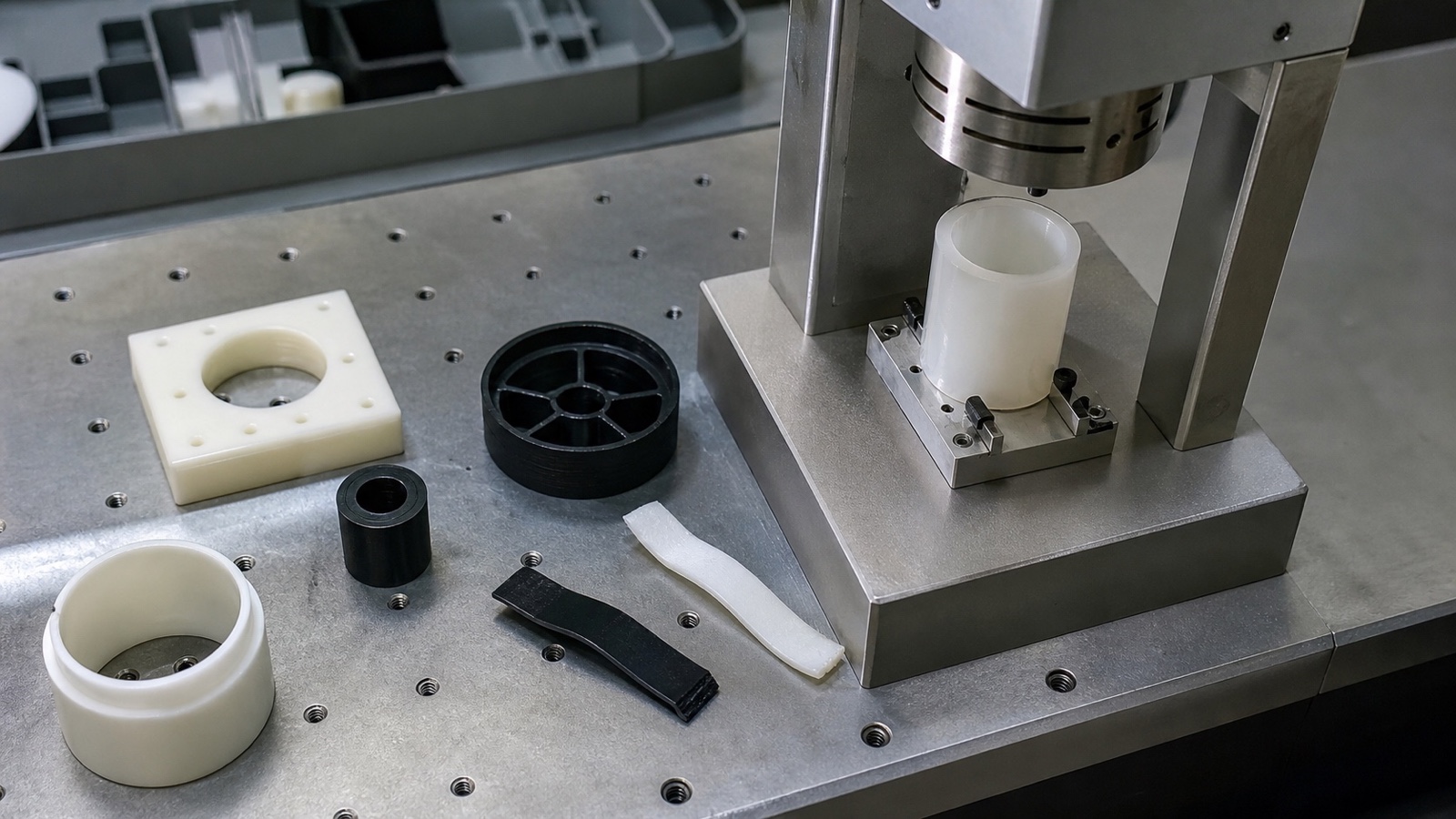
HDPE Melting Point vs PP Melting Point: The Direct Comparison
Exact Melting Point Ranges
The commonly accepted melting ranges are:
- HDPE: 120–130°C (248–266°F)
- PP: 160–170°C (320–338°F)
These are not absolute constants. The exact melting point of a given grade depends on its molecular weight distribution, degree of crystallinity, and the additives used. Test method matters too — differential scanning calorimetry (DSC) will give you a specific peak melting temperature, while a simple ASTM heat-deflection test gives you a different, more application-oriented number.
But for practical engineering purposes, PP’s melting point is roughly 30–40°C higher than HDPE’s. That is not a minor detail. It means PP can withstand hotter environments, longer exposure to elevated temperatures, and more demanding thermal cycles without losing dimensional stability.
Why the Difference Matters in Practice
The melting point gap directly influences where each material is used:
- PP is the default choice for hot-fill food packaging, sterilizable medical devices, dishwasher-safe containers, and under-hood automotive parts where underhood temperatures can exceed 100°C.
- HDPE is perfectly adequate for cold-water piping, blow-molded bottles, chemical drums, cutting boards, and general-purpose containers that see normal room-temperature service.
We often see customers try to substitute HDPE for PP because they have HDPE stock available or because HDPE is cheaper. If the application runs continuously at 80°C or occasionally spikes to 110°C, that substitution can be a disaster. HDPE will soften, creep, and may eventually deform. PP will hold its shape.
Always verify the thermal requirements of your application before switching materials. The melting point is the first guardrail, but you should also check heat deflection temperature under load, because a plastic softens well before it actually melts.
Why Do HDPE and PP Have Different Melting Points? (Molecular Structure)
The melting point difference is not random. It comes down to molecular architecture — how the polymer chains are built and how tightly they pack together.
HDPE: A Simple, Linear Chain
HDPE is made from ethylene monomers. Each ethylene molecule is a simple two-carbon unit, and during polymerization the units link into long, essentially linear chains with very little branching.
Because the chains are so straight and uniform, they can pack tightly together. That tight packing produces high crystallinity. Crystalline regions have regular, ordered arrangements of polymer chains, and those regions require a well-defined amount of heat energy to break apart. That’s why HDPE has a relatively sharp, reproducible melting peak rather than a broad softening range.
PP: A Polymorphic Polymer
PP is made from propylene monomers. Propylene has an extra methyl group (-CH3) attached to every other carbon in the chain. That methyl group changes everything.
The methyl groups can be arranged in different spatial orientations, a property called tacticity. In isotactic PP, all methyl groups point the same way along the chain. This regularity allows the chains to form a helical structure and crystallize, giving PP its stiffness and its higher melting point. Syndiotactic PP has alternating methyl groups, and atactic PP has random arrangement — atactic PP is essentially amorphous and rarely used as a structural material.
But the key point is this: the methyl group acts as a physical obstacle. It restricts chain mobility and makes it harder for the polymer chains to slip past one another. To transition PP from a solid crystalline state to a molten state, you must supply more thermal energy. That’s why PP melts significantly higher than HDPE.
Crystallinity and Thermal Behavior
Crystallinity levels also differ:
- HDPE: roughly 70–80% crystalline
- PP: roughly 40–60% crystalline, depending on grade and processing
Higher crystallinity in HDPE gives it a sharp melting point. PP, with a broader distribution of crystal sizes, tends to melt over a slightly wider temperature range. You’ll notice this in processing: PP softens gradually before it flows, while HDPE transitions more abruptly.
Engineers should also pay attention to the glass transition temperature (Tg), the point where the amorphous regions go from glassy to rubbery. HDPE’s Tg is around -120°C, well below typical service temperatures. PP’s Tg is around -10 to 0°C, which is why PP becomes brittle near freezing and shatters more easily in cold environments. Melting point tells you when the part fails completely; Tg tells you when it starts losing impact toughness.
Physical and Mechanical Properties: A Side-by-Side Comparison
Density and Weight
- HDPE: 0.94–0.97 g/cm³
- PP: 0.90–0.91 g/cm³
PP is one of the lightest commodity polymers. In automotive and packaging applications, that weight saving adds up. If you are designing large parts, the density difference can mean several percent reduction in part weight for the same volume.
Stiffness and Flexibility
PP is stiffer and has better flexural modulus than HDPE. But stiffness comes at a price: PP has lower impact strength at low temperatures. HDPE remains ductile and impact-resistant even in cold environments, which is why it is used for outdoor tanks, playground equipment, and kayaks. HDPE also has higher elongation at break, so it stretches further before failing.
Tensile Strength and Creep Resistance
PP generally exhibits higher tensile strength at room temperature, and it has excellent fatigue resistance. That’s why PP is the classic material for living hinges — the thin plastic hinge on a flip-top cap or a toolbox lid. PP can flex millions of times without cracking.
HDPE, by contrast, performs better in continuous-load, creep-prone applications. Under a sustained static load, HDPE resists slow deformation better than PP in many cases. If you are designing a structural support that will carry weight for years, don’t pick based on melting point alone. Test creep behavior under your expected load and temperature.
Optical Clarity
HDPE is naturally translucent or milky, but it can be processed into optically clear films and containers with careful control. PP is also naturally translucent, but it can be made highly transparent using nucleating agents and clarification additives. That’s why you see clear PP food containers, while clear HDPE is rarer.
Surface Hardness and Scratch Resistance
Both materials are relatively soft compared to engineering plastics like POM or nylon. HDPE has a Shore D hardness of roughly 60–66; PP is similar, around 70–75 depending on grade. PP tends to have slightly better surface hardness and scratch resistance, but neither material should be used where abrasive wear or repeated scratching is a primary concern.
Chemical Resistance and Environmental Performance
Chemical Resistance Overview
Both HDPE and PP are highly resistant to acids, bases, and most organic solvents at room temperature. That’s why both are used for chemical storage containers and labware.
The difference appears at elevated temperature. PP maintains its chemical resistance at higher service temperatures, which is why it is used in hot chemical processing environments, battery cases, and pipes carrying hot aggressive fluids. HDPE is excellent with alcohols, oils, and dilute chemicals at moderate temperatures, but it will soften and swell more quickly when exposed to aggressive solvents above 60°C.
Both materials are vulnerable to strong oxidizing agents like concentrated sulfuric acid, nitric acid, and halogens. If your process involves those chemicals, neither HDPE nor PP is a safe choice — you’d need PVDF, PTFE, or another fluoropolymer.
UV Stability and Outdoor Longevity
Unstabilized HDPE and PP both degrade under prolonged UV exposure. Sunlight causes chain scission and oxidation, leading to surface crazing, discoloration, and loss of mechanical strength.
The standard solution is to add UV stabilizers:
- Carbon black masterbatch is the most common and cost-effective UV protectant, which is why black HDPE water tanks survive decades outdoors.
- Hindered amine light stabilizers (HALS) are used when color retention matters.
- UV absorbers protect thin-walled products like films and bottles.
If you are machining outdoor parts from HDPE or PP, ask your material supplier whether the sheet or rod is UV-stabilized. Unstabilized white or natural grades will not last outdoors.
Food Contact Safety
Both HDPE and PP are approved for food contact in most standard grades. You’ll find HDPE in milk jugs, cutting boards, and food storage containers. PP is common in microwaveable meal trays, bottle caps, and reusable food containers.
The thermal advantage of PP matters here. PP can withstand repeated microwave and dishwasher cycles without warping or degrading. HDPE has a lower heat deflection temperature, so it is not recommended for hot-fill or repeated microwave use. For cold storage and everyday food contact, HDPE is perfectly safe and more cost-effective.
Moisture and Water Absorption
Both materials have extremely low water absorption — typically less than 0.01–0.03%. Unlike nylon or PET, HDPE and PP will not swell, change dimensions, or lose mechanical properties in humid environments. That makes them excellent for marine components, washdown equipment, and outdoor enclosures.
Manufacturing and Processing: How Melting Point Affects Fabrication
The melting point difference isn’t just a spec-sheet number. It drives real processing decisions, energy costs, and tooling behavior.
Injection Molding
Recommended melt temperatures:
- HDPE: 180–280°C
- PP: 200–300°C
PP requires higher barrel temperatures, which means more energy consumption and potential for thermal degradation if residence time is long. PP also has a relatively high mold shrinkage — typically 1.5–2.5% — compared to HDPE’s 1.5–4%. However, PP’s lower specific heat and lower thermal conductivity can mean faster cooling in some sections, so the overall cycle time comparison depends on part geometry.
Both materials are easy to injection mold compared to engineering plastics. HDPE tends to have better flow for thin-walled parts, while PP offers better dimensional stability and warpage resistance in thicker sections if processed correctly.
Extrusion and Blow Molding
HDPE dominates blow-molded bottles and pipe extrusion. Its melt strength and resistance to environmental stress cracking make it ideal for large-diameter pipes, tanks, and containers.
PP is more common in sheet extrusion, thermoforming, and biaxially oriented film. Its wider processing window and higher melt strength allow thermoforming deep-draw packaging and engineering sheet.
3D Printing
Both HDPE and PP are difficult to 3D print reliably. They have high shrinkage, poor bed adhesion, and a strong tendency to warp.
PP is the worst of the two. It warps aggressively as it crystallizes, and it is notoriously difficult to get to stick to print beds. Part of the challenge is that PP is chemically resistant to most adhesives and release agents, so typical bed treatments don’t work. Heated enclosures, specialized PP build plates, and careful geometry design are essential.
HDPE has similar issues but is slightly more forgiving. Neither is a beginner-friendly printing material. If you need functional parts with tight dimensions, we generally recommend machining HDPE or PP from sheet or rod rather than printing them, precisely because machining avoids the warpage and adhesion issues altogether.
CNC Machining
Both HDPE and PP machine well with standard metalworking tools, but they behave differently from metals and even from engineering plastics.
Because these are soft, low-melting materials, the biggest risk is localized melting. The combination of high cutting speed and poor heat dissipation can cause the chips to weld back onto the part or the tool. We always recommend:
- Sharp tooling with positive rake angles
- Adequate coolant or compressed air
- Controlled feed rates to keep chips small
- Chip breaking strategies to prevent stringy swarf
HDPE tends to produce long, stringy chips that can wrap around the tool. PP produces a slightly more brittle chip, which is easier to manage. Both can be machined to tight tolerances when the stock is properly supported. For most machined parts, HDPE and PP are interchangeable in process, but the material’s coefficient of thermal expansion is high, so final dimensions should be measured at controlled temperatures.
At PlasticCNCPro, we machine HDPE and PP as part of broader precision plastic CNC work. Our process focus is practical: fixture the stock properly, control heat at the tool edge, reduce burring, and review the drawing before material selection becomes an expensive mistake.
Welding and Joining
Both HDPE and PP can be welded using hot-air, extrusion, ultrasonic, spin, or butt welding techniques.
Hot-air welding temperatures are higher for PP — typically 250–300°C at the nozzle — while HDPE is welded at 200–260°C. If you are welding PP to PP, you must use PP welding rod. If you are welding HDPE, use HDPE rod.
A critical warning: do not weld HDPE directly to PP. The two polymers are chemically incompatible, and their melt temperatures are different. A weld between them will be weak, brittle, and unreliable. If you need to join HDPE and PP components, use mechanical fasteners, adhesive designed for polyolefins (after surface treatment), or design a mechanical interlock.
Industrial and Consumer Applications: Which Material Wins Where?
HDPE Primary Applications
HDPE is the workhorse of heavy-duty and outdoor applications:
- Piping systems for water, gas, and drainage
- Geotextiles and landfill liners
- Water storage tanks and chemical drums
- Bottle crates and industrial packaging
- Cutting boards and food storage containers
- Kayaks and playground equipment
- Corrosion-resistant ductwork and fume hoods
PP Primary Applications
PP’s thermal resistance and fatigue resistance make it the preferred choice for:
- Automotive bumpers, interior trims, and battery cases
- Under-hood components that see elevated temperatures
- Reusable food packaging, microwave containers, and bottle caps
- Medical syringes, specimen containers, and sterilizable labware
- Living hinges on flip-top caps and toolboxes
- Carpet fibers and woven bags
- Hot-water plumbing systems in some regions
Application Overlaps
There is a large overlap zone where both HDPE and PP are viable: storage bins, chairs, crates, and protective packaging. In these applications, the choice often comes down to temperature exposure and cost. If the product will be stacked in a warehouse and never see heat, HDPE is cheaper and more impact-resistant. If it will be washed in hot water, filled with hot product, or used in direct sunlight, PP’s higher melting point gives it the edge.
For applications such as reusable crates or fixtures that may be washed with hot water or exposed to steam-cleaning conditions, PP is often the more conservative choice. HDPE can soften or warp when the service temperature approaches its practical limit, so collect real operating-temperature data before finalizing a material.
HDPE vs PP in Emerging Industries
- Electric vehicles: PP is increasingly used in battery housings and thermal management components because it withstands the heat generated by high-voltage batteries. HDPE is used for lightweight structural brackets and cable protection.
- Medical devices: PP dominates sterilizable single-use devices. HDPE is used for non-sterilized labware and equipment housings.
- Sustainable packaging: Both materials are recyclable, and brands use both in mono-material packaging designs. HDPE is common in opaque bottles; PP is the go-to for hot-fill and microwavable trays.
Cost Comparison and Selection Criteria
Raw Material Cost
Historically, HDPE resin has been slightly cheaper than PP resin on commodity polymer markets, but the prices fluctuate with oil and gas feedstock costs. In many regions, the gap is small — often only a few cents per kilogram. In high volumes, that small gap can add up, but it should rarely be the deciding factor.
Processing Cost
PP’s higher melting point means higher processing temperatures and more energy consumption in injection molding, extrusion, and welding. HDPE’s lower viscosity can lead to faster cycle times and less energy per part. However, PP’s lower density means you get more parts per kilogram of resin. You have to do a total-cost analysis for your specific part geometry and production volume.
Long-Term Performance and Maintenance
A cheaper material that fails after six months is not cheaper. Consider the full lifecycle:
- Will the part be exposed to continuous heat? If yes, PP is likely worth the premium.
- Will the part be outdoors in direct sunlight? Both need UV stabilizers; price the stabilized grades.
- Will the part carry a constant load? Check creep data for both.
- Will the part be recycled after use? Check local recycling acceptance for #2 and #5 plastics.
How to Choose: A Simple Decision Framework
We guide our customers through a short set of questions:
- What is the maximum continuous service temperature?
Above 80°C, choose PP. Below 60°C, HDPE is fine.
- What chemicals will it contact, and at what temperature?
For hot aggressive chemicals, PP or a higher-performance material like PVDF may be required.
- What mechanical loads and impact requirements exist?
If impact at low temperatures matters, HDPE wins. If stiffness and fatigue resistance matter, PP wins.
- What is the production quantity and process?
For machining prototypes and low-volume parts, both materials are easy to source and machine.
- What are the environmental and sustainability goals?
Both are recyclable; check your local recycling infrastructure.
Choose HDPE when:
- The part operates at room temperature or below 60°C
- Impact resistance and ductility are critical
- The part will be in contact with water or chemicals long-term
- You need the lowest-cost option
- Outdoor use is planned, and you can use a UV-stabilized grade
Choose PP when:
- The part will see sustained temperatures above 80°C
- The part needs to withstand autoclaving or hot-fill processes
- You need living hinges or excellent fatigue resistance
- You need a lighter part with good stiffness
- The part will contact food and must survive dishwasher or microwave use
Recycling and Sustainability
Recyclability of HDPE and PP
Both HDPE and PP are highly recyclable. HDPE is resin code #2, and PP is resin code #5. Both can be granulated, washed, melted, and recompounded into new products.
In practice, HDPE has a more mature recycling stream. Most curbside programs accept #2 bottles, and there is a well-established market for recycled HDPE. PP is catching up, especially as new sorting technologies (near-infrared sorters) improve separation. Some regions still don’t accept #5 curbside, so check local guidelines.
Melting Point Challenges in Recycling
The melting point difference creates a serious challenge in recycling. If HDPE and PP are mixed in a single bale, the recycler must separate them before melt-processing. At the melt temperature required for PP, HDPE would become highly fluid and could degrade, while PP may not be fully melted at HDPE’s processing temperature. The result is a contaminated, weak, and visually inconsistent recycled resin.
This is why sorting at the source and in recycling facilities matters. Designers can help by making each part from a single polymer, avoiding laminates or incompatible labels, and clearly marking the resin type.
Circular Economy Trends
Many brands are committing to recycled-content mandates. We are seeing growing demand for PCR (post-consumer recycled) HDPE and PP in packaging, automotive, and industrial products. Chemical recycling — which breaks polymers back into monomers or feedstock — is emerging as a complement to mechanical recycling, especially for contaminated or mixed plastics. Both HDPE and PP are expected to remain mainstays of the circular economy due to their versatility and existing recovery infrastructure.
Advantages and Disadvantages at a Glance
HDPE Pros and Cons
Pros:
- Lower cost per part in most cases
- Excellent chemical resistance at room temperature
- Outstanding impact resistance and ductility
- Lower processing temperature, easier to mold and extrude
- Well-established recycling stream
- Low moisture absorption
Cons:
- Lower melting point (~120–130°C)
- Poor UV resistance unless stabilized
- Higher creep under sustained load in some conditions
- Opaque or translucent appearance without additives
PP Pros and Cons
Pros:
- Higher melting point (~160–170°C)
- Better stiffness and tensile strength
- Excellent fatigue resistance for living hinges
- Wider temperature range for hot-fill and sterilization
- Available in clarified, high-transparency grades
- Good chemical resistance at elevated temperatures
Cons:
- Brittle at low temperatures
- Prone to warpage in injection molding
- Difficult to bond with adhesives without surface treatment
- Higher processing temperature and energy requirements
- Slightly more expensive than HDPE on average
Summary Comparison
| Property | HDPE | PP |
|---|---|---|
| Melting Point | 120–130°C | 160–170°C |
| Density | 0.94–0.97 g/cm³ | 0.90–0.91 g/cm³ |
| Stiffness | Moderate | Higher |
| Impact Strength | Excellent | Good at room temp, brittle at low temp |
| Clarity | Opaque/translucent | Can be clarified to high transparency |
| Fatigue Resistance | Good | Excellent (living hinges) |
| Chemical Resistance | Excellent at RT | Excellent at higher temps |
| Typical Applications | Pipes, tanks, bottles, cutting boards | Automotive, food packaging, medical, hinges |
| Relative Cost | Lower | Slightly higher |
Frequently Asked Questions (FAQ)
What is the exact melting point of HDPE?
HDPE melts in the range of 120–130°C (248–266°F), depending on grade and crystallinity. The peak melting temperature measured by DSC is typically around 130°C for standard injection-molding grades.
What is the exact melting point of PP?
PP melts in the range of 160–170°C (320–338°F). Isotactic homopolymer PP typically melts around 165°C, while copolymers may melt slightly lower depending on comonomer content.
Which is better for high-temperature applications, HDPE or PP?
PP is better. Its melting point is roughly 30–40°C higher, and it retains stiffness and chemical resistance at sustained temperatures above 80°C. HDPE should not be used in continuous service above 60–70°C unless the loads are very low.
Can HDPE and PP be welded together?
No. HDPE and PP are chemically incompatible, and their melt temperatures differ. A direct weld will be weak and unreliable. Use mechanical fastening or adhesives designed for polyolefins (with appropriate surface treatment such as corona or flame treatment) if you need to join the two materials.
Are HDPE and PP recyclable?
Yes. HDPE is resin code #2, and PP is code #5. Both can be mechanically recycled. HDPE has broader curbside acceptance in many regions, while PP recycling is expanding with improved sorting technology.
Which plastic is safer for food storage, HDPE or PP?
Both are FDA-approved for food contact in standard grades. HDPE is excellent for cold storage and room-temperature use. PP is preferred for hot foods, microwave reheating, and dishwasher cycles because it can withstand higher temperatures without warping or leaching.
Does PP melt faster than HDPE?
“Faster” is the wrong way to think about it. PP melts at a higher temperature than HDPE, meaning it needs more heat to melt. Under identical heat input, PP will take longer to reach its melting point and transition state. At a given processing temperature, PP may flow differently than HDPE.
HDPE vs PP for 3D printing: which warps more?
PP warps more. It has high crystallization shrinkage and is extremely difficult to bond to a print bed. HDPE also warps and is challenging, but PP is generally considered the harder material to print reliably. For both, a heated enclosure and specialized bed surfaces are essential.
Conclusion
The single most important takeaway is this: PP melts 30–40°C higher than HDPE, and that gap drives material selection across industries. If you need a part that will survive heat, sterilization, or hot-fill processes, PP is the safer choice. If you need a tough, economical part for room-temperature service, HDPE is the proven workhorse.
But melting point is only one piece of the puzzle. Pair it with mechanical loads, chemical exposure, cost targets, and sustainability goals. The material that wins on paper may not win in the field, so always test under real service conditions.
At PlasticCNCPro, we work with HDPE, PP, and many other engineering plastics for prototype and low-volume CNC-machined components. We help buyers and engineers evaluate material suitability before machining starts, because a wrong material decision can become expensive once the part is already in service.
HDPE and PP are complementary materials, not interchangeable ones. Understand your application’s thermal demands first, and the right choice becomes obvious.
If you’re working on a design that needs a custom plastic part, send us your drawing, 3D model, or project requirements. We’ll help you select the right grade, provide a production recommendation, and machine parts that perform. Contact PlasticCNCPro today for a fast, engineering-focused quotation.
RFQ Support
Send Your Drawing for a Quote
Share your 2D drawing, 3D model, material, quantity, tolerance, surface finish, and application details. Our team will review manufacturability and reply with a practical quotation.
Email: info@plasticcncpro.com
Address: 29 Fuxing Road, Dongguan City, Guangdong Province, China