
PEEK vs PEI: Melting Point, Glass Transition Temperature, and Service Temperature
When a design calls for a high-performance polymer, two names come up more often than any others: PEEK and PEI. Both are amber-colored, both are expensive, and both can survive environments that would destroy ordinary engineering plastics. But they are fundamentally different materials, and choosing between them without understanding their thermal behavior is a recipe for field failures.
I've spent years machining and qualifying both materials for customers in aerospace, semiconductor, medical, and chemical-processing industries. One of the most common misconceptions I hear is that "PEI has a higher glass transition temperature, so it must handle more heat than PEEK." That's only half the story. In this article, I'll break down the thermal properties of PEEK and PEI — glass transition temperature, melting point, and continuous service temperature — and give you a practical framework for choosing between them.
Understanding the Core Thermal Properties: Tg and Tm
Before we compare materials, we need to agree on what we're measuring. Two thermal transitions matter most for engineering thermoplastics: the glass transition temperature (Tg) and the melting point (Tm).
Glass Transition Temperature (Tg)
The glass transition temperature is the temperature at which an amorphous polymer transitions from a rigid, glassy state to a rubbery, flexible state. Below Tg, polymer chains are frozen in place. The material behaves like a stiff solid — it can carry load, hold a tolerance, and resist creep. Above Tg, the polymer chains gain enough thermal energy to move past one another. The material becomes rubbery, its modulus drops sharply, and it begins to creep under sustained load.
For engineers, Tg is the practical ceiling for dimensional stability. If your part must hold a tight tolerance at temperature, you want to stay well below Tg.
Melting Point (Tm)
The melting point is the temperature at which the crystalline regions of a semi-crystalline polymer melt and transition to a disordered liquid. Semi-crystalline polymers have a two-phase structure: ordered crystalline regions held together by secondary bonds, surrounded by an amorphous matrix. When you heat the material past Tm, those crystalline regions break down and the polymer becomes a viscous liquid.
Tm matters for two reasons. First, it sets the absolute upper limit for processing — you need to melt the polymer to injection mold or extrude it. Second, it determines a fundamental ceiling for short-term temperature excursions. The crystalline structure keeps the material mechanically useful even above its Tg, which is why semi-crystalline polymers like PEEK can serve at temperatures far above their Tg.
Why the Difference Matters in Practice
Here's the key engineering distinction: Tg controls dimensional stability and mechanical behavior, while Tm determines the ultimate thermal resistance of crystalline materials.
An amorphous polymer like PEI loses its structural integrity as soon as you approach its Tg. It never melts — it just gets progressively softer and more compliant. A semi-crystalline polymer like PEEK, by contrast, has a load-bearing crystalline skeleton that remains intact even when its amorphous regions have passed through Tg. That's why PEEK's continuous service temperature can exceed its own Tg by more than 100°C.
A simple analogy: imagine a block of ice with pockets of syrup embedded inside. Tg is the temperature at which the syrup softens and flows. The ice crystals — the crystalline regions — keep the block's shape until they melt at Tm. For an amorphous polymer, there is no ice; the whole block is syrup. Heat it past Tg, and the whole structure softens together.
That difference is the single most important thermal concept in this article. Let's see how it plays out in each material.
PEEK Thermal Properties: Tg, Tm, and Service Temperature
PEEK (polyether ether ketone) is the workhorse of high-performance thermoplastics. It's a semi-crystalline polymer with an aromatic backbone that gives it exceptional thermal, chemical, and mechanical resistance.
Glass Transition Temperature
PEEK's glass transition temperature is approximately 143°C (289°F). Below this temperature, PEEK is rigid and dimensionally stable. Above it, the amorphous regions begin to soften, and the flexural modulus drops noticeably. But here's the critical point: because PEEK is only about 65–70% amorphous, the crystalline regions continue to carry load even as the amorphous phase softens.
Melting Point
PEEK's melting point is approximately 343°C (649°F), which is typical for a semi-crystalline thermoplastic. This high melting point is what enables PEEK's remarkable short-term temperature resistance. Even when the material is exposed to temperatures far above its Tg, the crystalline structure maintains mechanical integrity.
Continuous Service Temperature
The continuous service temperature of PEEK is rated up to 250°C (482°F) for long-term use, with short-term excursions up to 300°C+ possible in certain grades. Many datasheets show PEEK retaining roughly 50% of its mechanical properties at 250°C. In practice, we've seen machined PEEK components perform reliably in continuous duty at 220–240°C for years, particularly in sealing and bearing applications.
The Role of Crystallinity
PEEK typically achieves 30–35% crystallinity in properly processed parts. This semi-crystalline structure gives PEEK excellent creep resistance and helps it retain mechanical properties near its Tg. The crystalline lamellae act as physical crosslinks, preventing the molecular chain sliding that would otherwise occur in an amorphous material at similar temperatures.
One thing we watch carefully at our shop is crystallinity loss in machined PEEK. If you anneal the material improperly after machining, or if you heat it above Tg and cool it too quickly, you can reduce crystallinity and compromise its thermal and chemical resistance. For critical applications, we always recommend a controlled annealing cycle.
How Reinforcements Change the Picture
Reinforced PEEK grades push thermal performance even further. A 30% glass-fiber PEEK (such as Victrex 450GL30) increases heat deflection temperature (HDT) from roughly 152°C for unfilled material to over 315°C. Carbon-fiber-reinforced PEEK offers similar thermal improvements with added stiffness and lower friction. If your application involves heavy loads at high temperatures, a reinforced grade is often the answer.
PEI Thermal Properties: Tg, Amorphous Nature, and Service Temperature
PEI (polyetherimide) is another aromatic high-performance thermoplastic, best known commercially as SABIC's ULTEM. It is a fully amorphous polymer — a fact that shapes everything about its thermal behavior.
Glass Transition Temperature
PEI has a glass transition temperature of approximately 217°C (423°F) — among the highest of all amorphous thermoplastics. This is a genuinely impressive number. It means PEI remains rigid and dimensionally stable at temperatures where most thermoplastics, including PEEK, have long since softened.
No True Melting Point
Because PEI is fully amorphous, it has no true melting point. It doesn't undergo a sharp crystalline melt like PEEK. Instead, it softens gradually as temperature increases past its Tg, turning from a rigid solid into a rubbery, then viscous, material.
This has two practical implications. First, PEI cannot rely on crystalline structure to hold parts together at high temperatures — once you're past Tg, the material loses stiffness quickly. Second, PEI's processing window is defined by its flow characteristics rather than a melting transition. It processes, but it never "melts" in the classical thermodynamic sense.
Continuous Service Temperature
The continuous service temperature of PEI is typically 170–200°C (338–392°F), depending on grade and mechanical loading. Unfilled ULTEM 1000 is often rated for continuous service around 170°C. Under light loads and with careful design, some grades can operate at 200°C continuously. But compared to PEEK's 250°C rating, PEI's thermal envelope is meaningfully more constrained for load-bearing applications.
High Tg and Dimensional Stability
PEI's high Tg gives it an edge that matters for precision applications: excellent dimensional stability at elevated temperatures. Because the material stays in its glassy state well past 200°C, it resists creep and holds tight tolerances at temperatures that would cause amorphous PEEK's softer regions to relax.
I've worked on semiconductor wafer-handling components made from PEI that hold positional tolerances of ±0.025 mm at 180°C operating temperatures. PEEK would struggle with that application not because it would melt, but because its creep rate near and above its Tg would allow the part to gradually drift out of tolerance.
Reinforced PEI Grades
Reinforced PEI grades offer improved strength and stiffness at temperature. ULTEM 2300, for example, is PEI with 30% glass fiber. Its tensile modulus jumps from around 3.5 GPa for unfilled material to over 9 GPa, and its HDT rises from roughly 200°C to about 227°C. Glass-reinforced PEI is a strong candidate for structural brackets and housings that must hold shape at elevated temperatures without the cost premium of PEEK.
PEEK vs PEI: Side-by-Side Thermal Comparison
Let's put the numbers side by side so you can see the full picture at a glance.
| Property | PEEK (Unfilled) | PEI / ULTEM (Unfilled) |
|---|---|---|
| Glass Transition Temperature (Tg) | ~143°C (289°F) | ~217°C (423°F) |
| Melting Point (Tm) | ~343°C (649°F) | N/A — amorphous |
| Continuous Service Temperature | Up to 250°C (482°F) | 170–200°C (338–392°F) |
| Heat Deflection Temperature (HDT at 1.82 MPa) | ~152°C | ~200°C |
| HDT — 30% Glass Reinforced | ~315°C | ~227°C |
| Thermal Degradation Onset | ~500°C+ | ~450°C+ |
| Crystallinity | Semi-crystalline (30–35%) | Fully amorphous |
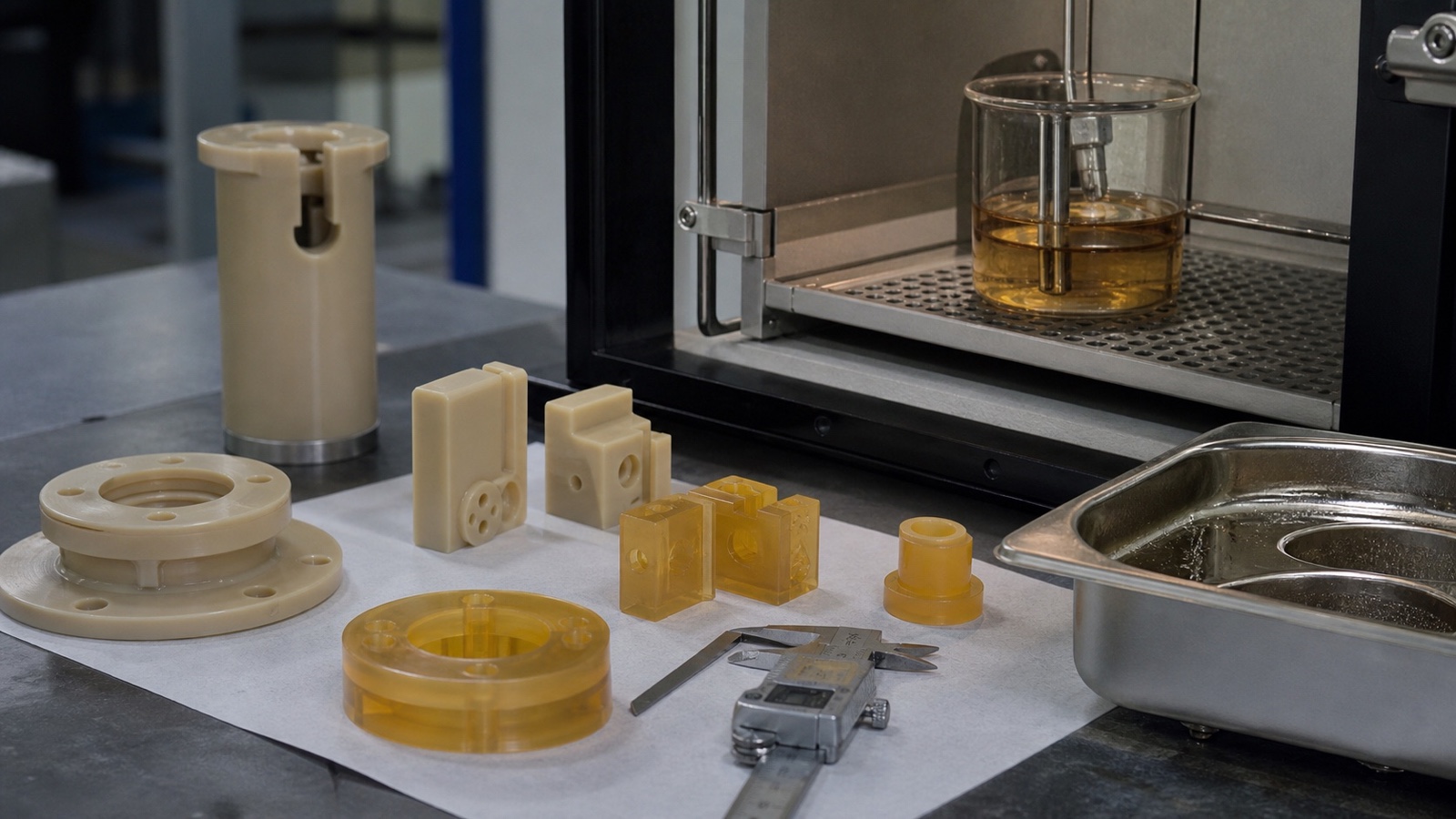
Here are the key takeaways from this comparison:
- PEI has a higher Tg, but PEEK has a much higher continuous service temperature. This is not a contradiction — it's a direct consequence of PEEK's crystalline structure. PEEK's crystalline skeleton continues to carry load far above its Tg; PEI has no such skeleton.
- PEEK outperforms PEI above 200°C in load-bearing applications. If your part carries mechanical load continuously at temperatures above 200°C, PEEK is the correct choice.
- PEI's high Tg offers an advantage in short-term thermal spikes and precision dimensional stability near 200°C. If your part must hold tight tolerances at 180°C without experiencing creep — and the load is moderate — PEI may actually serve you better than PEEK.
This last point surprises many engineers. The "better" material isn't the one with the higher ultimate temperature; it's the one that matches your actual thermal duty cycle.
Beyond Thermal Properties: Key Comparison Factors
Thermal performance is critical, but it's rarely the only consideration. Here's how PEEK and PEI compare across the other factors that matter in real engineering applications.
Mechanical Strength and Stiffness
At room temperature, PEI is slightly stiffer and stronger than unfilled PEEK. Standard PEI has a tensile strength of roughly 105 MPa and a flexural modulus around 3.5 GPa. Unfilled PEEK offers about 95 MPa tensile strength and a flexural modulus of 3.8 GPa. But the story flips at elevated temperatures.
As PEEK approaches and passes its Tg, its modulus drops — but because of the crystalline structure, it retains a much larger fraction of its room-temperature stiffness at 200°C than PEI does. At 200°C, PEEK typically retains around 50% of its flexural modulus, while PEI retains only about 25–30%.
For impact resistance and fatigue, PEEK is the clear winner. Its high toughness and excellent fatigue resistance make it the material of choice for dynamic applications like gears, bearings, and reciprocating seals. PEI is more brittle in comparison — it's a great structural material, but I wouldn't spec it for a heavily loaded rotating component.
Chemical and Hydrolysis Resistance
PEEK's chemical resistance is outstanding. It withstands nearly all organic and inorganic chemicals, resists hydrolysis even in hot water and steam, and survives repeated autoclave cycles without degradation. This makes it the standard material for medical devices, oil-and-gas seals, and chemical-processing components that face aggressive environments.
PEI has good chemical resistance but with notable gaps. It's attacked by chlorinated solvents (like methylene chloride), strong bases, and some aromatic hydrocarbons. It also has lower hydrolysis resistance than PEEK in continuous hot-water service, though it handles intermittent steam sterilization acceptably.
The rule of thumb we use: if the part will see steam, aggressive solvents, or corrosive chemicals on a continuous basis, PEEK is the safer choice.
Dimensional Stability and Creep
PEI's high Tg gives it inherently low creep at moderate temperatures. At 150°C, under moderate load, PEI exhibits less creep than unfilled PEEK, which is already well above its Tg at that point. This is why PEI dominates in precision applications like electrical connectors, wafer cassettes, and other components that need dimensional stability in the 150–200°C range.
PEEK, however, has superior creep resistance at sustained high temperatures and under continuous mechanical load. Because its crystalline structure carries load regardless of the amorphous phase's Tg, PEEK maintains its dimensions better than PEI at temperatures above 200°C.
The practical guidance: for precision at 150–200°C, PEI wins. For load-bearing stability above 200°C, PEEK wins.
Flammability and Electrical Insulation
Both PEEK and PEI are inherently flame-retardant with UL94 V-0 ratings at thin wall sections. Both produce low smoke and low toxic gas emissions during combustion, which is why both are approved for aircraft interior applications.
For electrical insulation, PEI is exceptional. Its dielectric strength approaches 33 kV/mm, and it maintains these properties across a wide temperature range. You'll find PEI in high-voltage insulators, RF connectors, and microwave components where stable dielectric performance at elevated temperatures is non-negotiable. PEEK also has strong electrical properties and can serve in similar applications, but PEI's combination of high Tg and stable dielectric behavior makes it the more common choice for precision electrical components.
Machinability and Processing
This is where practical manufacturing experience matters. Both materials are available as stock shapes and can be CNC machined. But they behave differently under the cutter.
PEI is generally easier to machine than PEEK. It machines more like a rigid engineering plastic — predictable chip formation, good surface finish, minimal burring. We routinely hold tight tolerances on ULTEM parts with standard carbide tooling.
PEEK, by contrast, is more demanding to machine. Its toughness and low thermal conductivity mean it tends to smear, generate heat, and close in on the tool. We use sharp positive-rake tooling, high coolant flow, and carefully controlled feeds to prevent work-hardening and dimensional drift. Machining PEEK well requires experience that many general machine shops simply don't have.
For injection molding and extrusion, PEEK requires melt temperatures around 350–400°C and — critically — controlled cooling to achieve the desired crystallinity. If you cool PEEK too fast, you get an amorphous skin that undermines its thermal and chemical resistance. PEI processes around 340–400°C but avoids crystallization-related warpage entirely, making it somewhat more forgiving in the mold.
One trend we're watching closely is additive manufacturing. Both PEEK and PEI are increasingly used in fused filament fabrication (FFF) for high-performance parts. Researchers are even exploring PEEK/PEI blends to balance printability with thermal performance. If you're 3D-printing functional prototypes in these materials for aerospace or medical applications, understand that your part's crystallinity — and therefore its thermal performance — will differ from machined or injection-molded stock.
Cost and Market Availability
Cost is often the deciding factor. PEEK is significantly more expensive than PEI — typically 2 to 3 times the price per kilogram. PEEK's production is complex, supply chains are constrained, and demand from aerospace and medical sectors keeps prices high. PEI, while still a premium material, is more affordable and more broadly available.
For applications that don't require PEEK's extreme chemical or thermal resistance, PEI offers a cost-effective path into high-temperature performance. Many of our medical-device customers use PEI for sterilization-resistant housings and instrument components because it performs well in autoclave cycles at a fraction of PEEK's cost.
How to Choose Between PEEK and PEI for Your Application
Choosing between these materials isn't about picking the "best" polymer — it's about matching the material to your thermal duty cycle, mechanical loads, chemical environment, and budget.
Choose PEEK when:
- Continuous service temperature exceeds 200°C, or the part faces high mechanical loads at elevated temperature.
- The application involves aggressive chemical exposure, steam, or repeated sterilization. PEEK routinely survives autoclave cycling, hot caustic cleaning, and solvent exposure that would degrade PEI.
- The design requires low wear and high fatigue resistance. Gears, bearings, seals, valve seats, and pump components are PEEK terrain.
- You need long-term reliability in hostile environments, where the cost of failure far exceeds the premium for PEEK.
Choose PEI when:
- The operating temperature stays below 180–200°C but requires tight dimensional stability and high stiffness. PEI's high Tg makes it excellent for precision components at these temperatures.
- The part is for electrical insulation or RF/microwave applications. PEI's dielectric stability at temperature is exceptional.
- Budget constraints favor a lower-cost high-performance alternative. PEI gives you a large fraction of PEEK's performance at a fraction of the price.
- The part is primarily structural rather than dynamic — housings, brackets, manifolds, and covers that need stiffness and flame resistance.
Case Study: Aerospace Components (ULTEM vs PEEK)
The aerospace industry illustrates these trade-offs perfectly. PlasticCNCPro machines parts for both commercial and defense aerospace customers, and we see this material decision play out regularly.
Interior aircraft components — brackets, ducting, seat parts, overhead console fittings — overwhelmingly use PEI (ULTEM). The reasons: ULTEM is self-extinguishing, produces low smoke and toxic gas in a fire, holds tight tolerances, and costs far less than PEEK. For a seat bracket that will never see more than 80°C, paying for PEEK's 250°C capability is pure waste.
But move into the engine bay or hydraulic systems, and the calculation changes completely. A hydraulic manifold seal that sits near an engine core may see 220–260°C continuously, plus exposure to phosphate-ester hydraulic fluid and hot air. PEI cannot survive that environment. PEEK is the only realistic choice. It maintains its mechanical properties at temperature, resists the aggressive fluid, and keeps sealing under pressure.
The lesson we give every customer: the correct material choice depends on the precise thermal and mechanical duty cycle, not just Tg or Tm alone. A material with a higher Tg but no crystalline structure can fail where a lower-Tg semi-crystalline material thrives — and vice versa.
Frequently Asked Questions (FAQ)
What is the glass transition temperature of PEEK?
PEEK's glass transition temperature is approximately 143°C (289°F). Below this temperature, PEEK is rigid and dimensionally stable. Above it, molecular mobility increases and modulus drops, though the crystalline regions remain stable until near its melting point of 343°C.
What is the operating temperature of PEEK?
PEEK's continuous service is rated up to 250°C (482°F), with short-term excursions up to 300°C+ possible in certain grades. The actual safe limit depends on the mechanical stress the part carries and the chemical environment it faces. An unloaded PEEK part can tolerate higher temperatures than a heavily loaded bearing race.
What is the glass transition temperature of polyetherimide (PEI)?
PEI's glass transition temperature is approximately 217°C (423°F). This high Tg makes PEI one of the most dimensionally stable amorphous thermoplastics at elevated temperatures, and it's the primary reason PEI excels in precision applications up to 200°C.
Is PEEK harder than Delrin?
Yes. PEEK has a higher hardness (Shore D ~85–90) and far superior strength, stiffness, and thermal resistance compared to Delrin (acetal). Delrin is a lower-cost engineering plastic with a continuous-use temperature of roughly 90–100°C. If your application exceeds that range, PEEK (or PEI) is the right upgrade path.
Does PEI have a melting point?
No. PEI is amorphous and lacks a true melting point. It softens progressively above its Tg and can be processed in a melt state, but it never undergoes a sharp crystalline phase transition like PEEK does at 343°C.
Conclusion
The PEEK vs. PEI decision comes down to understanding what each material's thermal properties actually mean in service.
PEI's high Tg of 217°C gives it exceptional dimensional stability and stiffness at temperatures up to roughly 200°C — remarkable for an amorphous polymer. But because PEI is fully amorphous, it has no crystalline structure to fall back on beyond that point.
PEEK's Tg of 143°C is lower, but its crystalline nature — anchored by a melting point of 343°C — allows it to carry load and resist creep at continuous service temperatures up to 250°C, far beyond its glass transition.
Neither number alone tells you which material to choose. The right answer depends on your full thermal duty cycle: the operating temperature, the mechanical loads, the chemical environment, and the budget. PEI is often the smarter economic choice for precision parts below 200°C. PEEK is the only choice for demanding applications above that threshold.
At PlasticCNCPro, we machine both PEEK and PEI daily — along with PAI, PPSU, PTFE, and a full range of high-performance polymers. We've helped hundreds of customers across aerospace, semiconductor, medical, automotive, and chemical-processing industries select the right material for their application, and we've learned that the datasheet is only the beginning. Actual part performance depends on processing, annealing, machining quality, and the real-world duty cycle.
Whether you're prototyping a one-off component or planning a production run, our engineering team can help you evaluate PEEK, PEI, or any other high-performance polymer for your specific requirements. We'll review your design, discuss your thermal and mechanical duty cycle, and recommend a material that balances performance with cost.
Ready to source precision-machined PEEK or PEI parts? Send us your drawing, 3D model, or project requirements today for a quotation and material recommendation. Our team will respond with clear engineering feedback, competitive pricing, and a production plan tailored to your application.