
POM vs Nylon: Which Is Better for CNC Machined Parts?
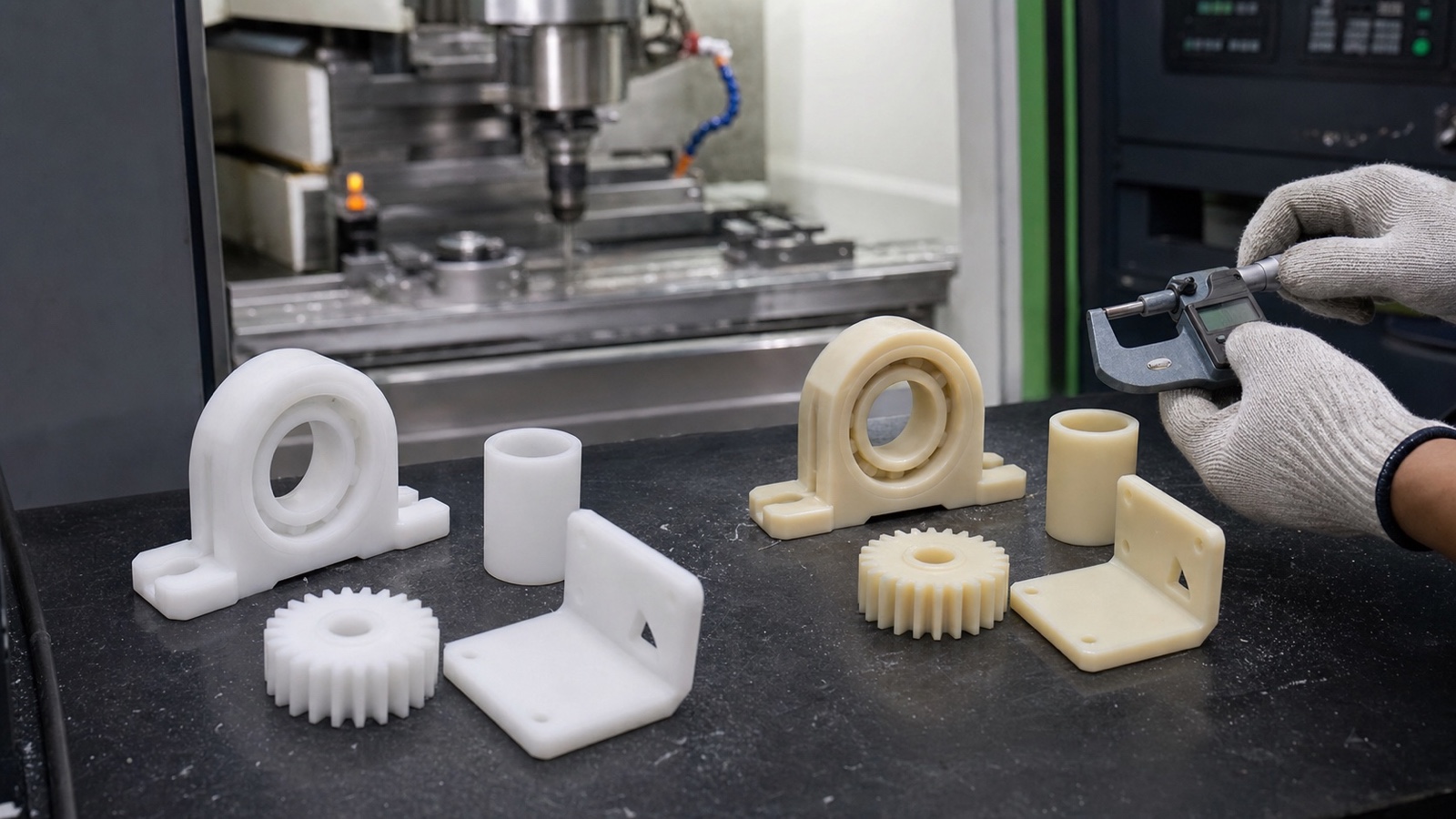
Quick Answer: POM vs Nylon – Which Plastic Wins?
If you're here because you're deciding between POM (acetal) and Nylon for your next CNC machining project, the short answer is: it depends on what matters most to you. POM offers exceptional dimensional stability, low moisture absorption, and outstanding machinability – making it a natural choice for precision parts that must hold tight tolerances even in humid conditions. Nylon, on the other hand, delivers higher tensile strength, toughness, and wear resistance, but it's hygroscopic and can swell or warp when exposed to moisture.
Here’s the quick verdict: Choose POM when dimensional stability and easy machining are critical. Choose Nylon when you need high load-bearing capacity, impact resistance, or higher temperature performance.
At PlasticCNCPro, we’ve machined thousands of parts from both materials, and I’ve seen engineers make the wrong choice because they didn’t fully understand these differences. This article will give you a practical, side-by-side comparison so you can pick the right material for your application.
---
1. Material Overview: What Are POM and Nylon?
1.1 POM (Acetal / Delrin) – Properties and Variations
POM, also known as acetal or Delrin (a DuPont brand), is a semi-crystalline engineering thermoplastic. It comes in two primary variants:
- Homopolymer (Delrin): Higher crystallinity, stiffness, and tensile strength. Good fatigue resistance, but less stable in the presence of strong acids or bases.
- Copolymer (POM-C): Better thermal stability and chemical resistance, especially against alkalis and hot water. Slightly lower mechanical properties, but often preferred for applications involving continuous exposure to water or steam.
Key properties we rely on at PlasticCNCPro:
- Low coefficient of friction – excellent for sliding parts.
- High stiffness and good strength – suitable for gears, bearings, and structural components.
- Very low moisture absorption (<0.2%) – dimensions remain stable even in high humidity.
- Excellent machinability – chips cleanly, minimal burrs, can hold tolerances of ±0.001″ with care.
We often recommend POM for precision components where consistent dimensions over time are non-negotiable.
1.2 Nylon (Polyamide / PA) – Types and Characteristics
Nylon is a family of polyamides with several common grades:
- Nylon 6: Good balance of strength, toughness, and cost. Absorbs moisture more than Nylon 6/6.
- Nylon 6/6: Higher melting point and better mechanical properties. Most common for engineering applications.
- Filled variants: Adding glass fibers increases strength and stiffness; oil or MoS2 improves lubricity and wear resistance.
Key properties:
- High tensile and impact strength – especially in dry conditions.
- Good wear resistance – self-lubricating, but absorption can affect friction.
- Hygroscopic – can absorb up to 8% water by weight, causing swelling, warping, and loss of mechanical properties.
- Higher operating temperature – continuous use up to 120–150°C (depending on grade).
I’ve seen many engineers choose Nylon for its impressive dry-state strength, only to face trouble when the part absorbs moisture and changes shape. That’s why understanding your operating environment matters.
---
2. Head-to-Head Comparison: POM vs Nylon for CNC Machining
2.1 Strength and Stiffness
| Property | POM | Nylon (dry) |
|----------|-----|-------------|
| Tensile strength | ~60–70 MPa | ~80–90 MPa |
| Flexural modulus | ~2.6 GPa | ~2.8–3.1 GPa |
| Impact strength (Izod) | ~6 kJ/m² | ~10–20 kJ/m² |
POM offers high stiffness and good strength for most mechanical applications, but Nylon is stronger – especially when dry. However, Nylon’s strength drops significantly when wet (up to 30–40% reduction). So if your part will operate in a humid environment, POM may actually outperform Nylon in real-world conditions.
Addressing the PAA: “Is POM stronger than nylon?” – No. Nylon has superior tensile and impact strength in dry conditions. But POM’s strength is more consistent over time because it doesn’t absorb moisture.
2.2 Moisture Absorption and Dimensional Stability
This is the single biggest differentiator.
- POM: Absorbs less than 0.2% water. A part that is machined to ±0.002″ will stay that way even after sitting in a humid warehouse for months.
- Nylon: Can absorb up to 8% water. That means a 100 mm Nylon part could swell by 0.5–1.0 mm, ruining fits, interfering with bearings, and making tight tolerances impossible.
I’ve had customers send us Nylon gears that seized up after three days in a humid factory. Switching to POM solved the problem immediately.
Addressing the PAA: “Is Delrin tougher than nylon?” – No. Delrin (POM) has lower impact toughness than Nylon 6/6. But Delrin holds its toughness over time, while Nylon’s toughness can increase with moisture (plasticization) but at the cost of dimensional stability.
2.3 Friction and Wear Resistance
Both materials offer good self-lubrication, but the mechanics differ:
- POM: Coefficient of friction against steel is ~0.2–0.3. Excellent for dry-running gears and bearings. Wear resistance is good, but not as high as some filled Nylons.
- Nylon: Dry friction coefficient ~0.2–0.4, but moisture absorption can increase friction due to swelling. Oil-filled or MoS2-filled Nylons can dramatically extend wear life for heavy-load applications.
For light to moderate loads in dry environments, POM is often the better choice. For high loads or abrasive conditions, filled Nylon wins.
2.4 Machinability (Ease of CNC Machining)
If you’re sourcing CNC machined parts, this is critical.
- POM: Exceptional. It cuts cleanly, produces tight curls rather than dust, and holds sharp edges. We routinely achieve tolerances of ±0.001″ on POM with proper setup. No pre-drying required, no warpage after cutting. It’s one of the easiest plastics to machine.
- Nylon: More difficult. It can chip or crack if tools are dull. It absorbs coolant, which can cause swelling during machining. Pre-drying is mandatory (80°C for 2–4 hours) to avoid moisture-driven distortions. Tolerances are harder to hold – ±0.005″ is typical; ±0.002″ possible with experienced hands and controlled environment.
At PlasticCNCPro, we prefer POM when customers need fast turnaround and tight tolerances. Nylon requires more process control.
2.5 Chemical Resistance
| Chemical | POM | Nylon |
|----------|-----|-------|
| Hydrocarbons (oils, fuels) | Excellent | Good |
| Weak acids | Good | Poor |
| Strong acids | Poor | Poor |
| Alkalis | Good (copolymer better) | Good |
| UV resistance | Poor (both) | Poor (both) |
| Hydrolysis | Copolymer resists better | Poor in hot water |
For fuel systems, pumps, and chemical processing equipment, POM (especially copolymer) is often a safer bet. Nylon degrades in strong acids and can hydrolyze in hot water.
2.6 Thermal Properties
- POM: Continuous service temperature ~100°C (212°F), peak ~140°C. Melting point ~175°C. Good for most indoor mechanical applications.
- Nylon: Nylon 6/6 has melting point ~260°C, continuous use up to 120–150°C. Better heat resistance for underhood automotive or near-engine parts.
If your part will see sustained temperatures above 100°C, Nylon is the clear winner.
2.7 Cost and Availability
- POM (homopolymer): ~$3–5/kg in raw bar stock. Copolymer is slightly more.
- Nylon 6/6: ~$4–7/kg. Filled grades are more expensive.
In terms of machined part cost, both materials are comparable. However, Nylon often requires more machining time and pre-drying, which can increase overall cost. For small production runs, POM is typically more economical.
---
3. Applications: When to Choose POM vs Nylon
3.1 Best Applications for POM
- Precision gears and bearings – where low friction and constant dimensions matter.
- Pump impellers and valve seats – resistant to fuels and solvents.
- Electrical insulators – good dielectric properties.
- Food processing equipment – FDA-approved grades available.
- Parts exposed to humid or wet environments – think marine, outdoor, or wash-down areas.
Real-world example: A customer needed bushings for a conveyor system operating in a food plant with frequent steam cleaning. Nylon bushings swelled and seized. We switched to POM-C copolymer – zero issues.
3.2 Best Applications for Nylon
- High-load gears and rollers – especially if weight reduction is needed.
- Impact-prone components – such as wear pads for hammer mills.
- Automotive underhood parts – where heat resistance is required.
- Conveyor system chain guides – good abrasion resistance.
Real-world example: A robotic arm manufacturer needed a lightweight, impact-resistant arm component. Nylon 6/6 with 30% glass reinforcement provided the strength and stiffness required, while saving weight over metal.
3.3 Industry-Specific Recommendations
- Automotive: Nylon for underhood (engine covers, intake manifolds); POM for interior/fuel system components (fuel sender parts, window guides).
- Medical/Pharmaceutical: POM (FDA grades) for stable parts like surgical instrument handles; Nylon for items that must withstand autoclave sterilization (but watch for moisture).
- Electronics: POM for precision connectors and switches; Nylon for cable ties, wire clips, and housings where strength is needed.
---
4. CNC Machining Considerations for Both Materials
4.1 General Best Practices for Machining Plastics
Regardless of material, these principles apply:
- Use sharp tools – carbide is preferred.
- Adequate coolant or air blast to prevent melting.
- Proper chip evacuation – fine chips can cause friction and re-welding.
- Avoid heavy cuts that generate excessive heat.
- Consider stress relief if thick sections are involved.
4.2 Machining POM – Tips and Pitfalls
- Tools: Carbide end mills, high RPM (8000–18000).
- Chip control: Cuts easily, but can produce long stringy chips – use chip breakers.
- Heat: POM expands ~0.1 mm per 100 mm per 10°C. Keep coolant flow steady.
- Burrs: Minimal; a light deburr pass is usually enough.
- Tolerances: With proper setup, ±0.001″ is achievable.
Pitfall: Running too slow with a dull tool can cause frictional heating and thermal expansion, leading to out-of-tolerance parts. We always rough and finish separately when tolerances are tight.
4.3 Machining Nylon – Pre-Drying and Process Control
- Pre-drying is mandatory. Bake Nylon bars at 80°C for 2–4 hours before machining. If you skip this, you risk warping, cracking, and poor surface finish.
- Coolant: Use water-soluble coolant; avoid letting Nylon soak too long. Dry-machining with air blast is also possible.
- Feed rates: Moderate – too high can cause chipping, too low can cause work-hardening.
- Post-machining: Parts may continue to absorb moisture and change dimensions. Consider balancing moisture content before final machining if the application is critical.
Pitfall: A customer once sent us Nylon parts that were not pre-dried. After machining, they warped within 24 hours. We now pre-dry every Nylon lot and store parts in sealed bags with desiccant.
---
5. Decision Guide: How to Choose Between POM and Nylon
Here’s a simple checklist I use with our customers at PlasticCNCPro:
- Need tight tolerances (±0.003″ or better)? → POM
- Part will be exposed to moisture or humidity? → POM
- High load or impact expected? → Nylon
- Operating temperature above 100°C? → Nylon (up to 150°C)
- Low noise / dry lubrication needed? → POM for light duty; filled Nylon for heavy duty.
- Contact with food or pharmaceuticals? → POM (FDA grade)
- Cost-sensitive project? → POM (usually cheaper to machine)
If you’re still unsure, send us your drawing and application details. We review dozens of designs every week and can recommend the best material based on our experience.
---
6. Frequently Asked Questions
Is POM stronger than nylon?
No. Nylon has higher tensile and impact strength in dry conditions. However, POM maintains its strength better in humid environments.
What plastic is best for mechanical parts?
It depends. For precision, low friction, and dimensional stability, choose POM. For strength, toughness, and wear resistance under high loads, choose Nylon.
Is Delrin tougher than nylon?
No. Nylon 6/6 is tougher and more impact-resistant than Delrin (POM homopolymer). Delrin is more rigid and dimensionally stable.
Is POM more durable than PTFE?
POM is harder and stronger than PTFE. PTFE has a lower coefficient of friction but much lower wear resistance and mechanical strength. For load-bearing parts, POM is superior.
Does Nylon need drying before CNC machining?
Yes, always. Pre-dry Nylon at 80°C for 2–4 hours before machining to prevent warping, cracking, and poor surface finish.
Can POM achieve tight tolerances?
Absolutely. ±0.002–0.005″ is routine. With careful setup, we achieve ±0.001″ on POM consistently.
Which material is better for gears exposed to moisture?
POM. Nylon will swell, change gear tooth profile, and cause noise or binding. POM stays accurate.
---
7. Conclusion
Choosing between POM and Nylon for CNC machined parts comes down to understanding your application’s environment and performance requirements. POM is the safer default for precision parts that must stay dimensionally stable, especially in humid or wet conditions. It’s also easier to machine and generally more cost-effective for tight-tolerance work. Nylon is the better choice when you need higher strength, impact resistance, or temperature capability, but you must account for its moisture sensitivity.
At PlasticCNCPro, we’ve machined both materials for thousands of projects across industries. We help our customers avoid costly mistakes by recommending the right material for each job. If you’re working on a custom plastic part and need expert guidance, we’d be happy to help.
Send us your drawing, 3D model, or project requirements – along with your application details, quantity, and tolerance needs. We’ll provide a quotation, material recommendation, and production timeline. Whether it’s a prototype or repeat production, we’ll deliver precision plastic parts that perform.
Contact us today:
Email: info@plasticcncpro.com
Web: www.plasticcncpro.com
Let’s get your parts made right, the first time.
RFQ Support
Send Your Drawing for a Quote
Share your 2D drawing, 3D model, material, quantity, tolerance, surface finish, and application details. Our team will review manufacturability and reply with a practical quotation.
Email: info@plasticcncpro.com
Address: 29 Fuxing Road, Dongguan City, Guangdong Province, China