
POM vs PET: Which Engineering Plastic Fits Precision Parts?
In the world of precision engineering, selecting the right material can make or break the performance of a component. Engineering plastics, like Polyoxymethylene (POM) and Polyethylene Terephthalate (PET), are among the top choices for manufacturing precision parts. But how do you decide which one is the best fit for your application? As a senior application engineer at PlasticCNCPro, I’ll guide you through the key differences between POM and PET to help you make an informed decision.
---
What Are Engineering Plastics?
Engineering plastics are a category of high-performance materials designed to withstand mechanical, thermal, and chemical stresses. Unlike commodity plastics used in consumer goods, these materials are tailored for industrial applications where strength, precision, and durability are critical.
At PlasticCNCPro, we specialize in machining these engineering plastics into custom precision parts for industries like aerospace, automotive, medical, and electronics. Whether you need a lightweight yet rigid component or a material that can endure harsh chemical environments, engineering plastics provide a versatile solution.
---
Overview of POM and PET
What Is POM?
Polyoxymethylene (POM), often referred to as Acetal, is a crystalline thermoplastic known for its high mechanical strength, dimensional stability, and low friction. Its chemical structure consists of repeating -CH2O- units, giving it exceptional rigidity and creep resistance.
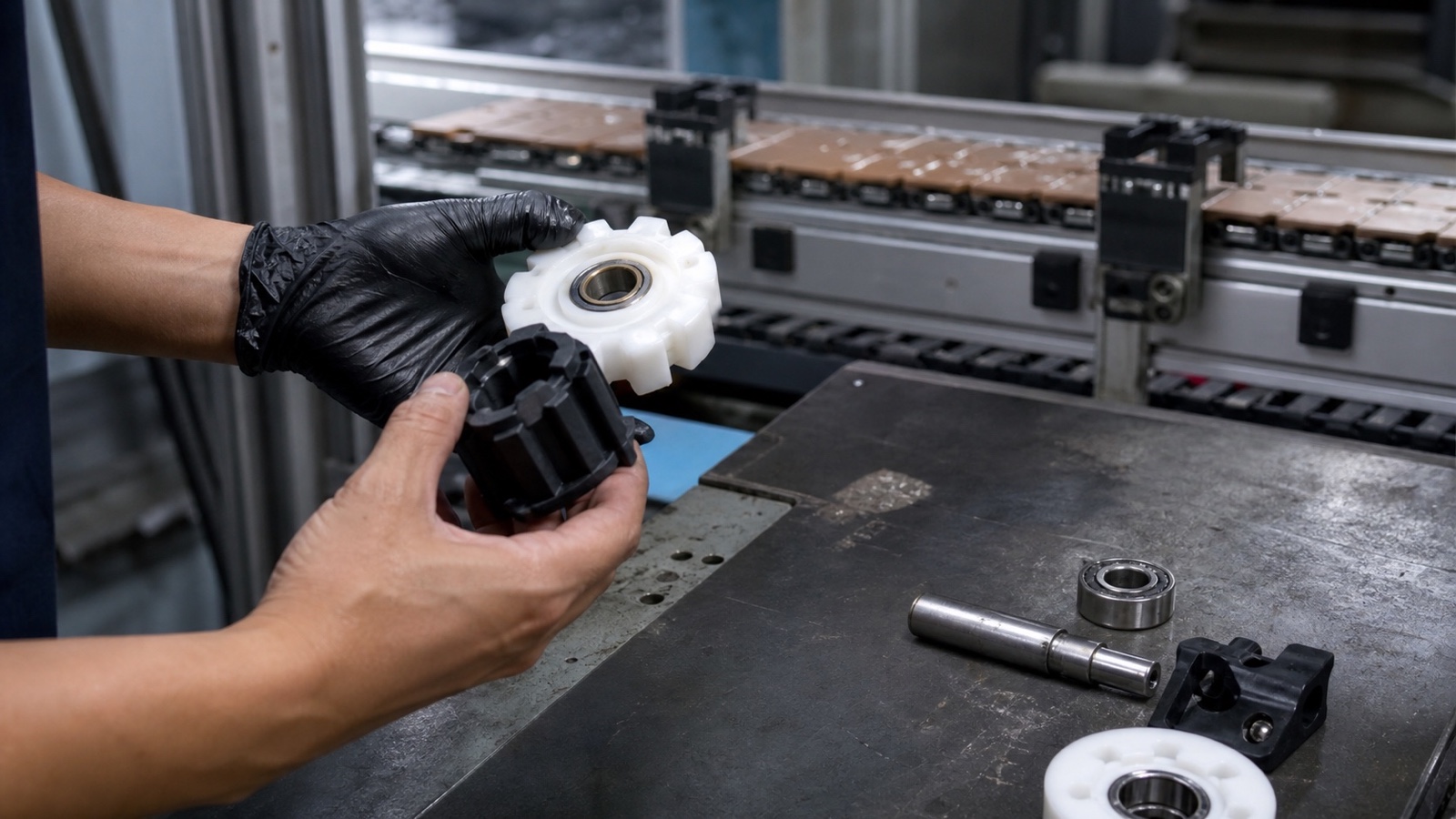
POM is available in two forms: homopolymer (e.g., DuPont’s Delrin) and copolymer. While homopolymer POM offers slightly better mechanical properties, copolymer POM provides superior resistance to thermal degradation and chemicals. This makes it a go-to material for gears, bearings, bushings, and other sliding components where precision and wear resistance matter.
---
What Is PET?
Polyethylene Terephthalate (PET) is another crystalline thermoplastic with excellent mechanical properties and chemical resistance. Known for its strength and rigidity, PET is widely used in both industrial and consumer applications. Its chemical structure, composed of ester linkages, contributes to its thermal stability and resistance to wear.
Beyond its use in beverage bottles and food containers, industrial-grade PET stands out in high-temperature environments. It is commonly used for electrical insulators, seals, and precision parts where dimensional stability is critical under variable conditions.
---
POM vs PET: Performance Comparison
When choosing between POM and PET for precision parts, it’s essential to evaluate their performance across several critical factors.
Mechanical Properties
POM is renowned for its toughness and excellent load-bearing capabilities. It has a high tensile strength and rigidity, making it ideal for applications that demand structural integrity under stress. PET, while also strong, has slightly lower impact resistance compared to POM. However, PET compensates with better creep resistance, which makes it a great option in applications requiring long-term dimensional stability under constant load.
---
Friction and Wear Resistance
POM excels in low-friction applications due to its naturally lubricious surface. This makes it a preferred choice for gears and sliding mechanisms where smooth motion is essential. PET, on the other hand, offers superior wear resistance in environments where the component is subjected to repeated sliding or abrasive forces. For instance, PET often outperforms POM in conveyor belts and high-speed machinery.
---
Dimensional Stability and Moisture Absorption
One of POM's standout features is its exceptional dimensional stability, even in high-humidity environments. It also has very low moisture absorption, ensuring that tight tolerances are maintained over time. PET has a slightly higher moisture absorption rate, which could impact its performance in precision parts exposed to varying levels of humidity. However, for dry or controlled environments, PET’s dimensional stability is on par with POM.
---
Thermal and Chemical Properties
PET outshines POM in terms of thermal performance, with higher resistance to heat and better stability at elevated temperatures. This makes PET a better choice for high-temperature applications, such as electrical insulators or components near heat sources. Both materials exhibit good chemical resistance, but POM is more resistant to organic solvents and fuels, making it suitable for automotive and chemical processing industries.
---
Electrical Insulation
Both POM and PET are excellent electrical insulators, but PET has a slight edge in high-temperature conditions or applications requiring higher dielectric strength. This makes PET a preferred choice for electronics and electrical components, while POM remains a reliable option for general-purpose insulation.
---
POM vs PET: Machining and Manufacturing
CNC Machining Capabilities
At PlasticCNCPro, we’ve machined both POM and PET extensively, and each material offers unique machining characteristics. POM is easier to machine due to its low melting point, resulting in smooth edges and tight tolerances. PET, while slightly harder to machine, delivers a superior surface finish when processed correctly. Both materials are compatible with CNC milling, turning, and drilling, though PET may require more precise control to avoid heat buildup.
---
Cost and Availability
Cost is often a decisive factor in material selection. POM is generally less expensive and more readily available than PET, making it a cost-effective choice for high-volume or budget-sensitive projects. However, the specific application requirements, such as thermal or wear resistance, may justify the higher cost of PET in certain cases.
---
Typical Applications of POM and PET
POM Applications
POM’s unique properties make it indispensable in industries such as automotive, electronics, and medical devices. Common applications include:
- Gears, bearings, and bushings
- Sliding components
- Lock mechanisms
- Valve bodies
- Insulating parts in electronics
---
PET Applications
PET is widely used in both industrial and consumer applications, particularly in high-temperature or chemical-exposure environments. Typical uses include:
- Electrical insulators
- Food and beverage containers
- Conveyor system components
- High-precision seals
- Aerospace and automotive parts
---
POM vs PET: Choosing the Right Material for Your Application
Selecting between POM and PET depends on your specific application needs. Here are some key considerations:
- Mechanical Requirements: For high-impact or load-bearing applications, POM may be the better choice. For applications requiring long-term dimensional stability under stress, consider PET.
- Environmental Conditions: If your part will face high humidity or exposure to fuels, POM's low moisture absorption and chemical resistance make it ideal. Conversely, PET works better in high-temperature settings.
- Cost: If budget constraints are a priority, POM is generally more affordable and widely available.
At PlasticCNCPro, we can help you evaluate these factors to select the material that best suits your project.
---
Frequently Asked Questions
Is POM plastic the same as Delrin?
Delrin is a brand name for POM homopolymer produced by DuPont. While all Delrin is POM, not all POM is Delrin. Other manufacturers produce POM under different trade names, often offering copolymer versions with slightly different properties.
---
What is POM plastic used for?
POM is commonly used in applications requiring high strength, low friction, and excellent dimensional stability, such as gears, bearings, bushings, and sliding components.
---
What are some alternatives to POM material?
Alternatives to POM include Nylon (for increased flexibility), Polycarbonate (for transparency), and UHMW-PE (for superior impact resistance).
---
Is POM plastic strong?
Yes, POM is one of the strongest engineering plastics, offering excellent tensile strength, rigidity, and resistance to wear and fatigue.
---
Final Thoughts: POM vs PET for Precision Parts
Both POM and PET are excellent choices for precision parts, each excelling in different areas. POM stands out for its low friction, dimensional stability, and affordability, making it perfect for a variety of industrial applications. PET, on the other hand, is better suited for high-temperature and high-wear applications, thanks to its superior thermal and wear resistance.
If you’re unsure which material is right for your project, we at PlasticCNCPro are here to help. With our expertise in machining engineering plastics, we can guide you through material selection and deliver precision parts tailored to your requirements.
---
Ready to get started? Contact PlasticCNCPro today with your drawings, specifications, and project details, and let us help you find the perfect solution for your precision plastic parts.
RFQ Support
Send Your Drawing for a Quote
Share your 2D drawing, 3D model, material, quantity, tolerance, surface finish, and application details. Our team will review manufacturability and reply with a practical quotation.
Email: info@plasticcncpro.com
Address: 29 Fuxing Road, Dongguan City, Guangdong Province, China