
POM vs UHMW-PE: Which Is Better for Low-Friction Components?
Introduction: Two Heavyweights in the Low-Friction Arena
Few debates in the engineering plastics world generate as much heat as POM vs UHMW-PE. Walk into any machine shop or design review, and you'll find engineers arguing passionately over which of these two materials deserves the spot in a sliding, wear, or bearing application. Both are go-to choices when you need low friction, good wear characteristics, and reliable long-term performance — but they achieve those goals in fundamentally different ways.
Let's be clear about what we're comparing. POM, or polyoxymethylene, is better known to many as acetal — think Delrin or acetal copolymer. It's a stiff, strong, dimensionally stable engineering thermoplastic that machines beautifully. UHMW-PE, or ultra-high molecular weight polyethylene, is a different beast entirely: a tough, slippery, almost rubbery polymer with incredibly long molecular chains that give it unmatched abrasion resistance.
The core thesis of this article is simple: there is no universal winner. The right choice depends on load, environment, precision requirements, and manufacturing constraints. Selecting the wrong material can lead to premature wear, field failures, and avoidable rework. In this guide, we'll compare their properties head-to-head, explore real-world applications, and give you a practical decision framework you can use on your next project.
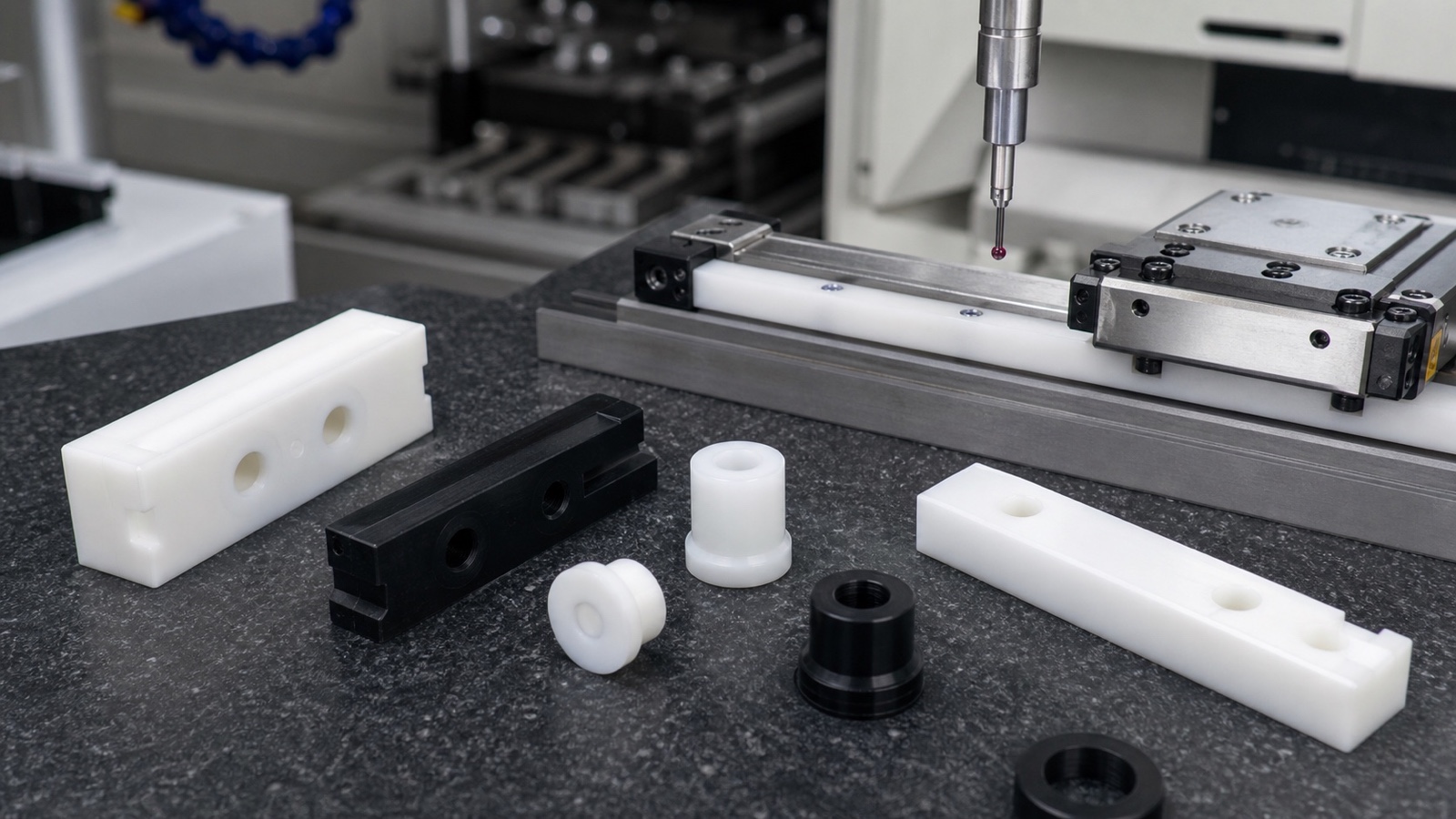
Acronyms Decoded: What Are POM and UHMW-PE?
POM (Acetal) Explained
POM is a semicrystalline thermoplastic polymer made from formaldehyde. Its name, polyoxymethylene, comes from its repeating oxymethylene unit (-CH₂-O-). What matters to engineers, though, is its behavior: POM offers an excellent balance of stiffness, strength, fatigue resistance, and dimensional stability.
You'll often see POM split into two variants: homopolymer and copolymer. Homopolymer acetal (like Delrin) has slightly better mechanical properties and a lower coefficient of friction, but it's more prone to attack by strong acids and can have a more pronounced centerline porosity in thicker cross-sections. Copolymer acetal (like Acetron or POM-C) offers better chemical resistance and thermal stability, making it easier to machine in large parts without internal voids. Both are common, and the choice usually comes down to the application's chemical environment and processing requirements.
At the molecular level, POM's short, tightly packed crystalline chains are what give it its rigidity. The crystalline regions act like physical crosslinks, providing dimensional stability and creep resistance — properties that make POM a favorite for precision gears, bearings, and sliding components with tight clearances.
UHMW-PE Explained
UHMW-PE is a polyethylene with a molecular weight typically between 3.5 million and 7.5 million grams per mole. That's orders of magnitude higher than standard HDPE, which usually sits below 500,000. Those extremely long molecular chains are the secret to UHMW-PE's extraordinary toughness and abrasion resistance. They get entangled with one another, forming a network that absorbs impact energy and resists micro-cutting.
It's important to clarify: UHMW-PE is not just "heavy-duty HDPE." The ultra-high molecular weight changes its mechanical behavior dramatically. While HDPE is a workhorse commodity plastic, UHMW-PE is a high-performance material that outperforms steel on abrasion in many applications.
In practice, UHMW-PE is usually supplied as large stock sheets, rods, and profile shapes. These are cut, machined, or formed into liners, wear strips, guides, and other large flat components. Because of how it's made — typically compression molding or ram extrusion — UHMW-PE stock has a more limited range of shapes and sizes compared to POM. That matters during sourcing, especially if your component has an unusual geometry.
Head-to-Head Property Comparison Chart
Let's cut straight to the numbers. The table below summarizes the key mechanical, thermal, and physical properties of POM and UHMW-PE. These are typical ranges from standard datasheets — always verify with your specific grade and supplier.
| Property | POM (Acetal) | UHMW-PE |
|---|---|---|
| Coefficient of friction (against steel, dry) | 0.20 – 0.35 | 0.10 – 0.15 |
| Wear resistance (abrasive environment) | Good | Excellent |
| Impact strength (notched Izod) | 5 – 8 kJ/m² | No break (typically >100 kJ/m²) |
| Tensile strength | 60 – 70 MPa | 20 – 30 MPa |
| Stiffness (flexural modulus) | 2,500 – 3,200 MPa | 600 – 900 MPa |
| Max continuous service temperature | 90 – 100 °C (194 – 212 °F) | 80 – 82 °C (176 – 180 °F) |
| Chemical resistance | Good (resists solvents, fuels; attacked by strong acids/bases) | Excellent (resists most acids, alkalis, solvents) |
| Water absorption (24h) | 0.2 – 0.4% | <0.01% |
| Machinability rating | Excellent | Fair (challenging) |
How to read this table: Both materials have a low coefficient of friction — around 0.10–0.20 range depending on conditions — but they get there differently. POM's friction is stable and load-bearing; UHMW-PE's is lower at light loads thanks to its self-lubricating surface. UHMW-PE dominates on impact and abrasion; POM dominates on stiffness, strength, temperature, and machinability. The "right" choice depends on which column matters most for your part.
Coefficient of Friction: Which Plastic Is Truly the Slipperiest?
A common question is, "Which plastic has the lowest coefficient of friction?" The textbook answer is PTFE (Teflon), with a coefficient as low as 0.05–0.10. But PTFE has serious drawbacks: it wears quickly and cold-flows under load, making it unsuitable for many structural or high-wear applications.
So, among practical engineering thermoplastics, POM and UHMW-PE are the stars. But which is slipperier? The answer is nuanced.
UHMW-PE’s Self-Lubricating Surface
UHMW-PE's low friction comes from its molecular structure. The long, entangled polymer chains create a very smooth, low-adhesion surface. When UHMW-PE slides against steel or another surface, the friction is low because there's little chemical affinity between the polymer and the counterpart — and the surface remains slippery even without lubrication.
That's why you'll find UHMW-PE everywhere in bulk material handling: chute liners, guide rails, conveyor wear strips, and hopper liners. It's also why UHMW-PE is often used in applications where contamination — sand, dust, powders — is present. The material simply doesn't grip, and its slight compliance helps it tolerate some particulate without scoring the mating surface.
POM’s Friction Profile Under Load
POM's coefficient of friction is somewhat higher than UHMW-PE at low loads, but it holds up better under pressure and speed. This is where engineers use PV (pressure-velocity) limits — the product of pressure and sliding velocity that a material can withstand before excessive wear or heat generation occurs. POM typically handles significantly higher PV values than UHMW-PE, meaning it's the better choice for bushings and bearings subjected to continuous sliding under moderate-to-high loads.
In practice, POM's friction stays predictable over a wide range of operating conditions. It also resists deformation under load, so the contact area doesn't grow and multiply frictional forces the way a softer material might. If your component runs at high speeds with constant loading, POM is usually the safer bet.
Wear Resistance and Abrasion: The Toughness Test
Another common question is, "Is UHMW low friction?" Yes, absolutely — but low friction and abrasion resistance are two separate properties. A material can be slippery but still wear quickly if the contact involves hard, sharp particles. UHMW-PE happens to excel at both, but for different reasons.
Why UHMW-PE Outperforms Steel on Abrasion
UHMW-PE's wear resistance is legendary. The micro-mechanism comes down to those long, entangled polymer chains. When abrasive particles try to cut or gouge the surface, the polymer chains absorb the energy and deflect rather than fracture. The material effectively "rebounds" after impact, resisting micro-cutting and keeping the surface intact.
In many abrasive environments, UHMW-PE actually outperforms steel. Steel is hard, but a sharp, hard grit can slowly scratch and cut it. UHMW-PE, on the other hand, resists the cutting action by yielding locally without tearing. Mining hopper liners, truck bed liners, conveyor scrapers, and dredging components are all classic UHMW-PE applications. In these conditions, UHMW-PE can last several times longer than steel — and at a fraction of the weight.
POM’s Wear Mode: Smooth but Less Forgiving
POM is a good wear material, but its wear mode is different. It wears via adhesive and abrasive mechanisms, meaning it can transfer material to the mating surface and generate fine wear debris over time. That's fine for precision wear components like bushings, cams, and gear teeth, where the contact is clean, well-lubricated (or dry but smooth), and controlled.
But put POM in an abrasive environment — say, a chute carrying crushed stone or a guide rail exposed to sand — and it will wear far faster than UHMW-PE. POM simply doesn't have the impact-absorbing, micro-cutting-resistant surface that UHMW-PE offers.
That said, POM can be upgraded. Glass-filled and PTFE-filled POM grades significantly improve wear resistance and reduce friction. PTFE-filled acetal, for example, offers a coefficient of friction in the 0.10–0.15 range with much better wear characteristics than unfilled POM. These modified grades blur the performance gap and are worth considering if you need POM's stiffness but want a bit more wear life.
Impact Strength and Toughness: What Happens When Components Take a Hit?
If there's one area where UHMW-PE runs away from POM, it's impact strength. UHMW-PE's notched Izod impact strength is so high that standard tests often report "no break." It's one of the toughest plastics available, even at cryogenic temperatures. Hit it with a hammer, drop it, slam it into a frame — it will bounce, bend, or deform but rarely shatter.
POM, by contrast, is rigid and relatively brittle. It has decent impact strength for a crystalline plastic, but under a sharp impact or at low temperatures, it can crack or fracture. That's not a knock on POM — it's simply not designed to absorb large impact energies. It's designed to hold dimensional accuracy under load.
So, what does that mean for real components?
Choose UHMW-PE for anything that sees physical abuse: star wheels, bumpers, guide rails, dock fenders, or liner panels that get hit by products or equipment. UHMW-PE's toughness means it survives contact without cracking, and its low friction means the impacting object slides off instead of transferring all its energy.
Choose POM when you need rigidity and creep resistance more than impact toughness. Gears, pulleys, precision housings, valve seats, and sliding mechanism parts all benefit from POM's stiffness. In these applications, the part isn't taking big hits — it's maintaining geometry and transmitting loads.
Chemical Resistance and Environmental Limits
UHMW-PE — The Chemical Champion
UHMW-PE is one of the most chemically resistant plastics available. It's unaffected by most acids, alkalis, organic solvents, and aqueous solutions. It also absorbs virtually no water — less than 0.01% in 24 hours — which means it doesn't swell, warp, or lose dimensional stability in wet or humid conditions.
The biggest environmental limitation for UHMW-PE is temperature. Its maximum continuous service temperature is only about 180°F (82°C). Above that, the material softens significantly, and creep becomes a concern. If your application runs hot, UHMW-PE is likely out. But for cold, wet, and chemically aggressive environments, UHMW-PE is nearly unbeatable.
POM — Good but Not Invincible
POM offers excellent resistance to many solvents, fuels, and weak alkalis, which makes it a staple in automotive fuel system components, pump parts, and chemical processing equipment. However, it's attacked by strong acids and strong bases. Prolonged exposure to hydrochloric acid, nitric acid, or concentrated caustic solutions will cause surface degradation and cracking.
POM also has very low moisture absorption — typically 0.2–0.4% — which is one of its biggest advantages. It remains dimensionally stable in humid conditions where nylon, for example, would swell. That's why POM is the go-to for precision parts in changing humidity environments, from camera mechanisms to food processing valves.
One caution: POM is susceptible to UV degradation unless it's stabilized with carbon black or UV additives. Outdoor applications or exposure to intense sunlight will cause POM to chalk, lose strength, and eventually crack. If your component sees outdoor UV, use a UV-stabilized grade or switch to a more resistant material.
Machinability and Manufacturing: Where POM Runs Away With the Race
Another common question is, "What are the downsides of UHMWPE?" Machinability is near the top of the list. Both materials can be machined, but there's a stark difference in how they behave in a CNC mill or lathe.
POM: The Machinist's Dream
POM is one of the most machinable plastics in existence. It cuts cleanly, produces tight, well-defined chips, and holds tight tolerances with ease. Achievable tolerances depend on part geometry, stock condition, tooling, thermal control, and inspection method. The material has a low coefficient of thermal expansion relative to most plastics, so it doesn't move as much during cutting. It also gives an excellent surface finish — shiny, smooth, and free of fuzz or burrs when tooling is sharp.
POM is ideal for CNC milling, turning, gear hobbing, drilling, and tapping. It's also stable after machining, meaning parts don't continue to shrink or warp after they're cut. That makes POM the default choice for precision components where consistency from part to part is critical.
UHMW-PE: Slippery and Difficult to Machine
UHMW-PE is a machinist's challenge. Because it's soft, flexible, and has a low coefficient of friction, it tends to deform under cutting forces instead of shearing cleanly. The material also has poor thermal conductivity, so heat builds up at the cut. The result is tearing, melting, and stringy chips that wrap around tools and create a mess.
To machine UHMW-PE successfully, you need very sharp tooling, positive rake angles, and plenty of coolant. Speeds should be moderate, and feed rates need to be high enough to cut rather than rub. Achieving a decent surface finish requires skilled setup and often a final pass with a fine-tipped tool. Even then, tight tolerances are difficult to hold because the material wants to flex and spring back.
UHMW-PE can be machined, but it generally takes more time and setup attention than POM. If your UHMW-PE part has complex geometry or tight tolerances, brace yourself for higher machining costs.
For larger, simpler parts, there are alternatives. UHMW-PE is often formed by compression molding, profile extrusion, or near-net shaping, which significantly reduces machining. If you're designing a large liner or wear strip, consider specifying custom extruded or molded profiles to minimize post-processing.
Application Selection Matrix: Which Material Wins in Real-World Components?
Theory is nice, but engineers need answers for specific parts. Here is a quick-reference decision guide based on the material properties and application constraints discussed above.
Gears and Gear Components
Winner: POM. Gears require stiffness, tooth strength, dimensional accuracy, and good machinability — all areas where POM excels. POM gears hold their tooth profile under load, resist wear, and run quietly. UHMW-PE gears are only realistic for light-load, low-speed, non-precision applications where noise and impact absorption matter more than accuracy. In those rare cases, UHMW-PE's compliance can be an advantage, but it won't hold a tolerance envelope like POM.
Bushings, Bearings, and Precision Sliding Fits
Winner: POM (for precision and load); UHMW-PE (for dirty, low-load, or wet conditions). POM's higher PV limit and dimensional stability make it the better choice for loaded bushings and close-clearance sliding fits. UHMW-PE is best when the environment is contaminated with abrasive particles, the loads are light, and precise clearances aren't critical. UHMW-PE's tolerance for contamination means it might keep working long after a POM bushing would be scored and worn.
Conveyor Wear Strips and Sliding Guides
Winner: UHMW-PE. It offers outstanding low friction, exceptional wear resistance against moving product, and comes in economical sheets and strips that are easy to mount. UHMW-PE handles the sliding contact with low squeal and longer life, especially in dirty or wet conveyor environments. POM also works for wear strips, but the cost is generally higher and the benefit is marginal unless you need very tight guiding tolerances.
Impact Protection and Liner Applications
Winner: UHMW-PE. There's no contest. UHMW-PE's impact strength and abrasion resistance make it ideal for hopper liners, chute liners, truck bed liners, and any component that takes repeated hits or slides against abrasive materials. POM would crack or wear away far too quickly in these roles.
Food Processing and Pharmaceutical Applications
Both materials have FDA-compliant grades, so the choice depends on the specific component. UHMW-PE is widely used for food contact surfaces — cutting boards, wear guides, scrapers — because it's inert, non-toxic, and chemically resistant. POM is preferred for precision valve and pump components in food and pharmaceutical machinery because of its dimensional stability and machinability. The current trend toward food-safe, chemical-free plastic components favors both materials, but each has its niche.
Cost Analysis and DFM Considerations
Raw Material Costs
UHMW-PE is generally cheaper than POM on a per-pound basis. Its cost is close to HDPE, making it a very economical choice for large wear parts. POM is moderately priced — more expensive than polyethylene, but far less than high-performance polymers like PEEK.
But raw material cost is only half the story.
Total Cost of Ownership
The total cost of a component includes machining time, tooling wear, tolerances, inspection, and lifecycle maintenance. For precision components, POM often wins on total cost because it's so easy to machine. You can produce a tight-tolerance POM part faster and with less scrap than the same part in UHMW-PE, which means lower labor and overhead costs per part.
For large wear parts, UHMW-PE wins because the raw material is inexpensive and the component's simple shape can often be cut from sheet or plate with minimal machining. Even if a bit more effort goes into cutting, the low material cost and long service life offset the processing expense.
The key is to evaluate the whole cost picture, not just the per-pound price. A UHMW-PE part that takes 30% longer to machine might still be cheaper than a POM part if the raw material cost difference is large and the tolerances are loose. Conversely, a complex POM part with tight tolerances will almost certainly be cheaper in UHMW-PE only if you don't need the tight tolerances.
Design for Manufacturability (DFM) Tips
If you're designing with POM:
- Maintain wall thicknesses of at least 0.060 inches for small parts, thicker for large ones.
- Add draft angles of 0.5–1° for molded parts, but for machined parts, draft is unnecessary unless the part comes from a mold.
- Avoid sharp internal corners — specify generous radii to reduce stress concentrations.
- POM is generally better suited to tighter tolerances than UHMW-PE, but achievable values depend on geometry and process control.
If you're designing with UHMW-PE:
- Expect higher thermal expansion — roughly 2–3x that of steel. Provide generous clearances in sliding fits.
- Account for creep and cold flow under sustained load; use proper support and avoid thin unsupported sections.
- Avoid assigning unnecessarily tight tolerances, since machining UHMW-PE to tight specifications is difficult and expensive.
- Consider near-net shapes: extruded profiles, compression-molded sheets, or machined-from-sheet designs that minimize cutting.
Current Trends and Emerging Grades to Watch
The plastics industry never stands still. Recycled and reprocessed UHMW-PE grades are available for some non-critical wear applications. But for critical components — medical, aerospace, food contact — virgin material remains essential because recycled grades can contain contaminants and have less consistent molecular weight.
POM grades are also evolving. PTFE-filled and oil-filled acetal offer improved wear and friction characteristics, while impact-modified POM reduces brittleness without sacrificing too much stiffness. These hybrid grades blur the line between POM and UHMW-PE and may offer the best of both worlds for specific applications.
Cross-linked UHMW-PE is another trend worth watching, especially in medical (orthopedic bearings) and high-wear industrial uses. Cross-linking improves creep resistance and extends wear life even further, though it raises cost.
Sustainability is also pushing both materials forward. Lightweighting — replacing steel with engineered plastics — continues to grow across automotive, material handling, and packaging equipment. Both POM and UHMW-PE are recyclable, and their long service life reduces replacement frequency, which contributes to a lower overall environmental footprint.
Key Takeaways
At the end of the day, choosing between POM and UHMW-PE comes down to what matters most for your component:
- Need stiffness, precision, and machinability? → Choose POM.
- Need abrasion resistance and impact toughness? → Choose UHMW-PE.
- Need low friction? → Both work, but UHMW-PE is slipperier at low loads; POM holds up better at high loads and speeds.
Here's a quick checklist to guide your decision:
- What are the loads? High loads → POM; low loads → either.
- Is there abrasive contamination? Likely → UHMW-PE.
- Will the part see impacts? Yes → UHMW-PE.
- Do you need tight tolerances? Yes → POM.
- What's the temperature? Above 180°F continuous → POM (or another material).
- Is the environment chemical-heavy? UHMW-PE is more broadly resistant, but POM handles most fuels and solvents.
- What's your manufacturing route? Complex machined geometry → POM; simple cut-from-sheet → UHMW-PE.
Finally, always consult the latest datasheets and testing data from your material suppliers before finalizing a selection. General guidance cannot replace real-world validation. Prototype testing is advisable for critical components before committing to full production.
Frequently Asked Questions
Which plastic has the lowest coefficient of friction?
PTFE (Teflon) has the lowest coefficient of friction among common plastics, typically around 0.05–0.10. Among engineering thermoplastics, UHMW-PE and POM are both excellent, with UHMW-PE slightly lower at light loads. However, PTFE's poor wear resistance and cold flow limit its use in load-bearing applications.
Is UHMW low friction?
Yes. UHMW-PE's coefficient of friction against steel is typically around 0.10–0.15, which is why it's used extensively for wear strips, guide rails, and conveyor liners. Its self-lubricating surface remains slippery even without external lubrication.
What are the downsides of UHMWPE?
The main downsides are poor machinability, low stiffness, high thermal expansion, low creep resistance, and a limited temperature range (approximately 180°F / 82°C continuous). It's also challenging to hold tight tolerances because the material deforms under cutting forces.
What is harder than UHMW?
If "harder" means stiffer, then POM, nylon, PEEK, and most metals are all much stiffer than UHMW-PE. If you mean scratch hardness, UHMW-PE is relatively soft compared to POM and metals. UHMW-PE's advantage isn't hardness — it's toughness and abrasion resistance.
Which is better for CNC machined plastic gears?
POM (acetal) is the clear winner for machined gears. It offers better dimensional stability, higher tooth strength, lower thermal expansion, and far superior machinability compared to UHMW-PE. UHMW-PE gears are only suitable for light-duty, non-precision applications where silent operation and flexibility are more important than accuracy.
Can UHMW replace POM in existing designs?
Rarely. Swapping in UHMW-PE usually requires redesigning clearances, load assumptions, and tolerances because UHMW-PE is much softer and less dimensionally stable than POM. If the original POM part worked, the safer choice is to stick with POM or a filled POM grade.
Final Verdict: Choosing the Right Material for Your Low-Friction Component
Choose POM (Acetal) When…
- You need tight tolerances, precision sliding fits, gears, or complex machined geometry.
- Loads and speeds are high and the environment is dry or mildly aggressive.
- You need good creep resistance and long-term dimensional stability.
POM is often the better fit for custom CNC-machined parts that require precision, consistency, and structural integrity. It's also the faster, more cost-effective option to machine when your part is complex.
Choose UHMW-PE When…
- Components are large, flat, or simple — liners, wear strips, chute liners, guides.
- Abrasive contamination or impact is likely.
- You need a low-cost, replaceable wear surface and can tolerate looser tolerances.
UHMW-PE shines when toughness, abrasion resistance, and low friction matter more than precision. Its low raw material cost and long service life make it the ideal choice for bulk material handling and impact-prone environments.
---
PlasticCNCPro supports CNC machining projects involving both POM and UHMW-PE, subject to drawing and application review.
If you're designing a low-friction component and are unsure which material fits the application, send your drawing, 3D model, material requirements, quantity, and operating conditions for an engineering review and quotation.
Contact PlasticCNCPro for a project review and quotation. Material selection and manufacturability recommendations depend on the drawing and application requirements.