
PVDF Melting Point: Is It Suitable for Hot Chemical Applications?
Introduction — Why PVDF Melting Point Matters in Chemical Processing
When an engineer sends me a drawing for a pump housing, a pipe fitting, or a valve body that will live in hot acid service, the first question I ask isn't about tolerances or surface finish. It's about temperature. Specifically: What is the hottest temperature this component will see, and for how long?
That question drives everything downstream — material selection, wall thickness, joining method, and safety margin. And for PVDF (polyvinylidene fluoride), one of the most popular high-performance fluoropolymers in chemical processing, the answer always starts with its melting point.
PVDF has earned a strong reputation in aggressive environments: it resists a wide range of acids, bases, and halogens, and it offers mechanical strength that most other fluoropolymers simply can't match. But the melting point — roughly 160°C to 172°C depending on the grade — can be misleading. Just because PVDF doesn't melt until 170°C doesn't mean you can run it at 160°C in hot caustic or concentrated sulfuric acid.
So, does PVDF's thermal performance hold up in hot chemical service? Yes — but only within a clearly defined envelope of temperature, chemical concentration, mechanical stress, and time. In this article, I'll walk you through the exact melting point data, how chemical resistance degrades as temperature rises, how PVDF compares with PTFE and PFA, and how to select the right grade for your application. I'll also share practical design limits we use at PlasticCNCPro when machining PVDF parts for pumps, valves, and fluid-handling systems.
PVDF Melting Point: The Exact Numbers You Need to Know
PVDF is a semi-crystalline thermoplastic fluoropolymer. For standard homopolymer grades, the melting point typically falls in the range of 160°C to 172°C (320°F to 342°F). Most commercial grades land between 165°C and 172°C.
That range exists because PVDF's crystal structure depends on the polymerization method, the molecular weight distribution, and the thermal history of the material. A slowly cooled, highly crystalline part will have a sharper, higher melting peak than a rapidly quenched one. When we machine PVDF from extruded sheet or rod, the supplier's data sheet usually quotes a melting point of about 171°C for homopolymer.
But that number is only the thermodynamic melting point — the temperature at which the crystalline domains transition to a melt. It is not the maximum usable temperature for a load-bearing part, and it is certainly not a safe operating temperature for chemical service.
Homopolymer vs. Copolymer Melting Ranges
There are two main families of PVDF you'll encounter:
- Homopolymer: typically melts at 165–172°C. This is the standard choice for chemical piping, valves, and pump components. It offers the highest crystallinity, best chemical resistance, and greatest stiffness.
- Copolymer (typically with hexafluoropropylene, HFP): melts at a slightly lower range of 155–165°C. The comonomer disrupts the perfect crystal lattice, lowering the melting point and reducing stiffness. In exchange, you get improved flexibility, better impact resistance, and significantly better resistance to stress cracking — particularly in weld lines and sharp corners.
Why would anyone trade away thermal performance? Because in real-world piping systems, stress cracking can be a more common failure mode than thermal softening. For example, a copolymer PVDF tank lined with welded sheet will tolerate thermal cycling better than a homopolymer version, especially when the welds are subject to residual stress. But if your priority is maximum chemical resistance at high temperature, homopolymer is the safer bet.
Why Melting Point Alone Is Not the Design Criterion
Here's the trap I see engineers fall into: they see "melting point 170°C" on a datasheet and assume the part will be fine at 150°C with a 20-degree margin. Then the part creeps, warps, or cracks within months.
The truth is that PVDF components fail well below the melting point due to a combination of:
- Softening: as temperature rises, the amorphous regions of the polymer begin to move, and modulus drops sharply. Flexural modulus at 100°C may be only a fraction of its room-temperature value.
- Creep: under continuous load, PVDF will continue to deform over time. At 120°C, creep rates can be orders of magnitude higher than at 20°C.
- Chemical attack: chemical compatibility charts are always temperature-dependent. A chemical that's perfectly compatible at 40°C may cause swelling, cracking, or chain scission at 120°C.
That's why the industry uses a concept called "maximum continuous service temperature" — for PVDF homopolymer, that's typically around 150°C in air under low mechanical stress. In hot chemical media, the practical limit is usually 110–140°C, depending on the chemical and concentration.
Thermal Properties Beyond the Melting Point
Melting point is just one data point in the thermal profile of PVDF. To design safely, you also need to understand the glass transition, continuous service limits, peak tolerance, and decomposition behavior.
Glass Transition Temperature (Tg)
PVDF's glass transition temperature is approximately -35°C to -40°C. That's well below room temperature, which explains why PVDF is tough and ductile at ambient conditions rather than brittle like some other fluoropolymers. It also gives PVDF decent impact resistance at low temperatures, though it becomes more sensitive to notch propagation as it approaches Tg.
For chemical processing applications, a low Tg is generally a plus: the part stays flexible enough to absorb mechanical shock and thermal expansion without cracking.
Continuous Service Temperature Limits
As I mentioned, continuous service temperature depends heavily on environment:
- In air (no chemical contact): homopolymer PVDF can be used continuously at 140–150°C. We've seen it used in cable trays, cable ties, and halogen lamp holders at these temperatures.
- In hot chemical media: the safe limit drops. For many acids and oxidizing media, we recommend 110–130°C as a practical ceiling. Some suppliers quote 120°C for PVDF in hot hydrochloric acid.
- Copolymer: continuous limits are typically 10–15°C lower than the homopolymer.
Mechanical load reduces these numbers significantly. A PVDF pipe carrying 150 psi at 100°C needs a much thicker wall than the same pipe at room temperature, and above 120°C, pressure ratings become very conservative.
Peak Temperature Tolerance and Upset Conditions
Short excursions toward 160°C — for example, a steam bump in a heat exchanger or a temporary loss of cooling — may be tolerated without immediate failure, provided the pressure is low and the duration is short. But repeated thermal cycling into that range accelerates microstructural damage, reduces crystallinity over time, and can lead to premature failure at weld lines.
If you know your process will experience frequent upsets above 140°C, I would strongly consider PFA or ETFE instead of PVDF.
Thermal Degradation and Decomposition Onset
PVDF begins to degrade at around 350–400°C, releasing hydrogen fluoride (HF) gas — which is highly toxic and corrosive. This has two major implications:
- Processing safety: If you're injection molding or extruding PVDF, you must never let the melt temperature exceed roughly 300°C, and even prolonged residence at 280°C can generate trace HF. Every PVDF processor we know runs with good venting and strict temperature control.
- Fire safety: In a fire, PVDF will decompose and emit HF. That's true of PTFE and PFA as well, but it's worth planning for — especially in facilities handling large amounts of PVDF piping.
Chemical Resistance at Elevated Temperatures
The core question for this article: Can PVDF handle hot chemicals? The short answer is yes, but only within what I like to call the "chemical compatibility envelope" — a three-dimensional space defined by chemical type, concentration, and temperature.
How Temperature Alters Chemical Compatibility
Most chemical compatibility charts list resistance at 20°C, 60°C, and sometimes 100°C. What they're showing you is that the rate of chemical attack increases with temperature. A good rule of thumb in polymer engineering: a 10°C rise roughly doubles the rate of chemical degradation. That means a chemical that causes negligible swelling at 40°C might cause significant embrittlement at 100°C.
At PlasticCNCPro, when we're selecting a material for a customer's hot chemical application, we don't just ask "what chemical?" — we ask "at what temperature, concentration, and pressure?" That's the only way to determine whether PVDF is appropriate.
PVDF Resistance to Acids, Bases, and Solvents
- Strong acids: PVDF is excellent in hydrochloric acid, phosphoric acid, and moderate concentrations of sulfuric acid up to about 120–140°C. Even concentrated sulfuric acid (up to 98%) is acceptable at 60°C, but at higher temperatures you need to check the concentration-temperature curve carefully.
- Strong bases: PVDF handles sodium hydroxide and potassium hydroxide at moderate temperatures and concentrations. However, above about 60°C, concentrated caustic solutions can cause caustic stress cracking — especially at weld lines and areas of residual stress. For hot concentrated NaOH, we typically recommend E-CTFE (Halar) or PFA instead.
- Organic solvents: PVDF swells in ketones (like acetone and MEK), esters, and some amines. It is not suitable for hot acetone, methyl ethyl ketone, or dimethylformamide. In hydrocarbon solvents and alcohols, it generally performs well.
The Influence of Pressure on Temperature Limits
Pressure makes everything worse. When PVDF is used in a pipe or a pressure vessel, the hoop stress creates a continuous tensile load on the polymer chains. As temperature rises, the material's resistance to creep drops, so the permissible stress (and hence pressure) must be derated drastically.
For PVDF piping systems, the standard engineering practice is:
- Below 80°C: you can use full rated pressure for the given SDR class.
- Above 80°C: pressure ratings drop significantly. At 120°C, you might be limited to 40–50% of the room-temperature pressure rating.
- Near 140°C: pressure capability is minimal; use for gravity flow or vent lines only.
If you need a PVDF-lined steel pipe, the steel jacket can provide the pressure containment while PVDF provides liner chemical resistance — that's how you get high pressure simultaneously with temperatures near 140°C.
Oxidizers and Specialty Chemicals
PVDF is resistant to many oxidizing agents, including bromine, chlorine dioxide, and hydrogen peroxide at moderate temperatures. However, hot fuming nitric acid, hot oleum (>10% SO₃), and certain strong oxidizing media can attack PVDF above 50–60°C. Always verify with a reputable compatibility chart or perform a coupon test under actual process conditions.
PVDF vs. PTFE vs. PFA: Which Wins for Hot Chemical Applications?
If you're designing for hot chemicals, you have three main fluoropolymer candidates: PVDF, PTFE, and PFA. Each has its own strengths, and the right choice depends on your specific operating conditions.
Melting Point Comparison
| Material | Melting Point | Processability |
|----------|----------------|----------------|
| PVDF | 160–172°C | Thermoplastic; can be welded, injection molded, extruded |
| PTFE | ~327°C | Non-melt-processable; needs paste extrusion, sintering, or ram pressing |
| PFA | ~305°C | Melt-processable; can be injection molded and welded |
This table immediately tells you why PTFE and PFA dominate ultra-high-temperature service. Their melting points are far above PVDF's, so they retain structural integrity at temperatures where PVDF would be a puddle.
Chemical Resistance Comparison
PTFE and PFA are perfluorinated (contain only C–F bonds), which makes them nearly inert to almost every chemical. They are resistant to essentially all acids, bases, and solvents up to very high temperatures. PVDF, by contrast, has alternating CH₂ and CF₂ groups, which makes it more susceptible to attack by strong bases, ketones, and certain oxidizers.
In practical terms:
- If your process runs above 150°C in chemical service, choose PFA (if you need melt processability) or PTFE (if you can tolerate the fabrication complexity).
- If your process runs 110–150°C and the chemicals are within PVDF's compatibility envelope, PVDF is often the smarter engineering choice because of its mechanical strength and weldability.
- If you're running below 100°C, PVDF will typically outperform PTFE/PFA from a mechanical standpoint and cost standpoint.
Mechanical and Fabrication Trade-offs
- PVDF: Outstanding mechanical strength and creep resistance among fluoropolymers. It can be CNC machined to tight tolerances, welded, and fused. It's stiff enough for structural components like pump impellers and valve bodies. Its permeability is higher than PFA but lower than PTFE.
- PTFE: Excellent chemical resistance, but soft, with poor wear resistance and high creep under load. PTFE is not weldable; joining requires mechanical clamping or specialized skived-tape wrapping. It also has high permeability to gases and some liquids, which can be an issue in dynamic sealing applications.
- PFA: Essentially the chemical resistance of PTFE with melt processability. PFA parts can be welded and injection molded. However, PFA has lower mechanical strength and stiffness than PVDF, and it costs significantly more. For lined pipe, PFA is often preferred because of its low permeability and high temperature rating.
Cost and Value Ranking
From a value perspective, PVDF is the most economical for mid-temperature service. PFA is typically more expensive than PVDF (often 2–3× on a per-part basis), and PTFE fabrication is costly due to the special secondary machining and handling steps required.
Here's a quick decision table I use in our plant:
| Application | Suggested Material |
|---|---|
| Hot HCl piping at 120°C, low pressure | PVDF |
| Hot NaOH (>50%) at 90°C | PFA or E-CTFE |
| Hot concentrated sulfuric acid at 140°C | PFA or PVDF-lined steel |
| Ultrapure hot DI water at 100°C | PVDF (ultrapure grade) |
| Hot fuming nitric acid | PTFE or PFA |
| High-pressure steam at 160°C | PTFE-lined steel or PFA with metal jacket |
| Wear-resistant valve seat at 80°C chemical service | PVDF (with fillers if needed) |
Applications Where PVDF Excels in Hot Chemical Environments
Let me ground this in real applications. At PlasticCNCPro, we machine PVDF parts for a variety of industries. Here's where PVDF really shines.
Chemical Piping and Lined Vessels
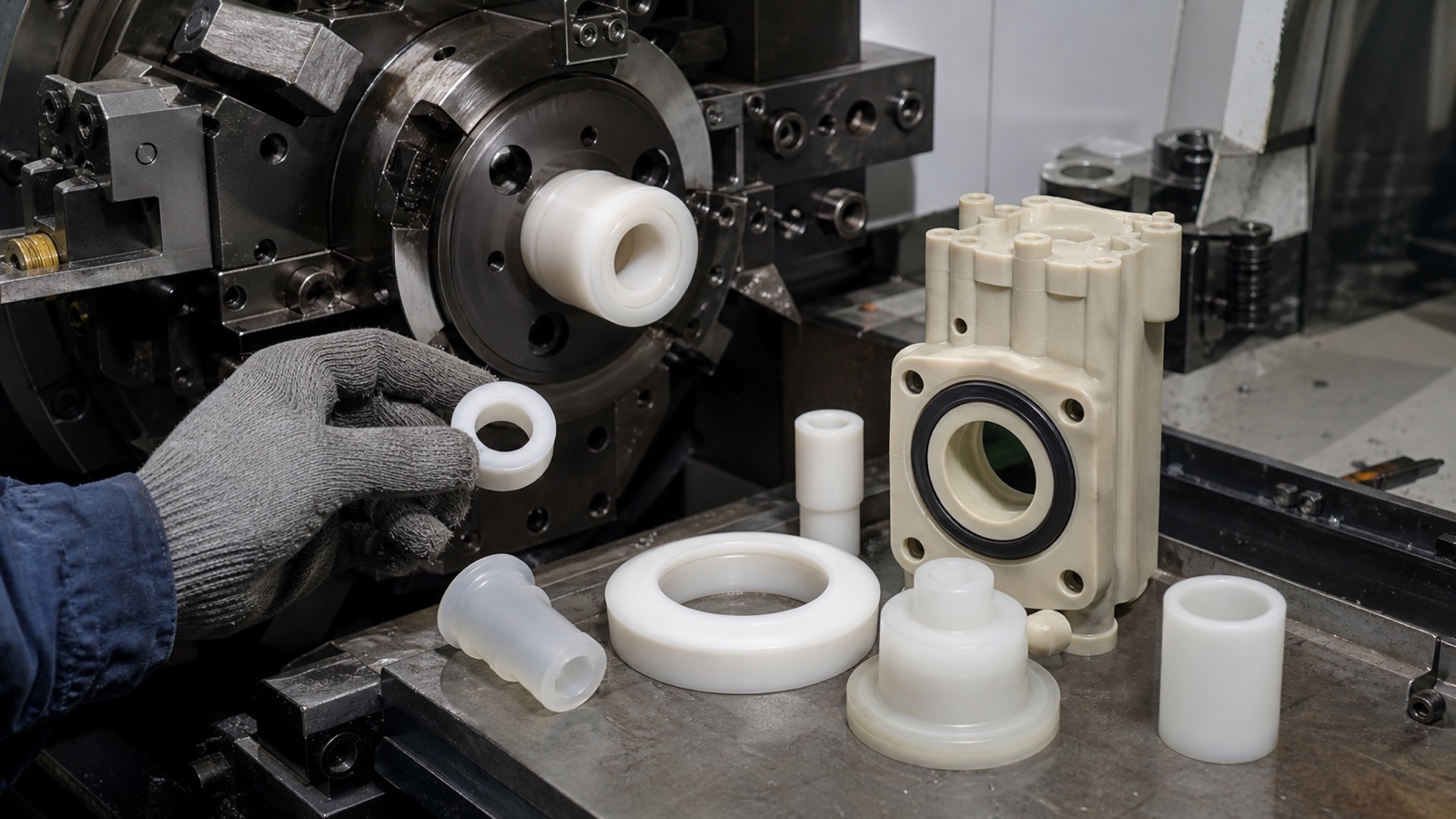
PVDF piping, fittings, flanges, and vessel linings are widely used to handle hot acids, brines, halogens, and chlorinated hydrocarbons at temperatures up to 120–140°C. Typical machined PVDF parts in this environment include pipe spools, reducer bushings, pump connectors, valve seats, and custom fittings. PVDF homopolymer is often selected when the application needs chemical resistance plus enough mechanical strength to support the part geometry under moderate temperature and pressure.
Semiconductor and High-Purity Processing
In semiconductor fabs, PVDF is a workhorse for hot deionized (DI) water, aggressive etch chemistries, and high-purity wet benches. The material's low extractable levels, smooth surface finish, and weldability make it well suited for high-purity piping at temperatures up to 100–120°C. For these applications, we specify ultrapure PVDF grades that have minimal additive content and low metal-ion leaching.
Water Treatment and Desalination
PVDF hollow-fiber membranes are common in industrial effluent treatment and desalination pre-treatment. These membranes can handle hot feed streams (often 60–80°C) that would damage polyolefin membranes. In these systems, PVDF's thermal and chemical stability ensures long membrane life, even when cleaning with hot chlorine or sodium hydroxide solutions.
Lithium-Ion Battery Production
PVDF is widely used as a binder in lithium-ion battery electrodes. Here, the melting point and thermal stability directly affect the drying and coating processes. PVDF binders must withstand the drying oven temperatures (typically 120–140°C) without sintering or degrading. Understanding the exact melting point of your PVDF grade helps set drying temperatures that evaporate solvent while maintaining binder integrity.
Pulp & Paper and Metal Finishing
The pulp and paper industry uses PVDF for pump parts, valves, and piping exposed to hot chlorine dioxide, sodium chlorate, and bleach solutions. Metal finishing lines use PVDF for pickling acid tanks and plating bath components, where temperatures often reach 70–90°C and the media are aggressive.
Processing PVDF for Optimal Performance
The way PVDF is processed has a huge impact on its final performance in hot chemical service. If you machine parts from cast sheet versus annealed extruded rod, the crystalline structure can differ. If you weld PVDF poorly, you create a weak leak path.
Melt Processing Temperature Windows
- Injection molding: Barrel temperatures typically run 190–250°C. Mold temperature is usually 60–100°C. We advise customers that high melt temperatures improve flow but reduce impact strength due to a higher crystalline form.
- Extrusion: Melt temperatures of 200–260°C are common, depending on the equipment and extruder screw design.
The crucial rule is never exceed about 300°C in the melt. Not only does this risk thermal degradation and HF release, but it also creates microstructural defects that reduce long-term chemical resistance. Processing too hot can also cause the polymer to degrade at the molecular level, which means the part might pass visual inspection but fail prematurely in service.
Welding and Joining PVDF
PVDF is one of the few fluoropolymers that can be reliably welded. We weld PVDF using:
- Butt fusion for pipe joints, typically at 230–260°C.
- Hot-gas welding for sheet linings and fabricated tanks.
After welding, a proper stress-relief annealing step (usually 120–150°C for a period of time depending on wall thickness) helps reduce residual stresses at the weld zone. Annealed parts show much better resistance to environmental stress cracking — particularly in hot acid or caustic service.
Additives and Heat Stabilizers
PVDF grades may contain heat stabilizers, antioxidants, and processing aids. Some of these additives (like acid scavengers) improve long-term thermal stability in hot chemical environments. However, for semiconductor and battery applications, additives can leach out and contaminate process fluids. In those cases, use a controlled purity grade with minimal additives — and understand that the operating temperature window may be slightly lower.
When Is PVDF NOT Suitable? Limitations and Failure Modes
I'm a big believer in saying no when a material isn't right. Here's when I advise customers against PVDF.
Above 150°C in Chemical Service
If your process runs continuously above 150°C and the chemical is aggressive, PVDF is not your material. The polymer will soften, creep, and eventually lose structural integrity. Switch to PFA, PTFE, or a PVDF-lined steel system where the metal handles the load.
Caustic Environments at High Temperature
Hot, concentrated NaOH (say 30% at 90°C) is a classic PVDF killer. It causes dehydrofluorination — stripping hydrogen fluoride from the polymer chain — which leads to discoloration, embrittlement, and cracking. For hot caustic service, E-CTFE (ETFE copolymer) or PFA are better choices.
Common PVDF Failure Modes to Watch
Here are three failure modes to watch for during design review:
Case 1: Weld line cracking in hot acid service. A PVDF piping system carrying 30% HCl at 110°C failed at a butt-fusion weld after six months. The weld was under residual stress from improper fusion parameters, and the acid preferentially attacked the amorphous weld zone. Solution: use copolymer PVDF, specify higher-quality welding procedures, and anneal the fabricated spools.
Case 2: PVDF piping collapse under vacuum at elevated temperature. A PVDF line rated for 150°C in air was used in a service where the line could see a transient vacuum upsets. At 130°C, the reduced modulus made the pipe vulnerable to buckling under external pressure. The pipe collapsed. In this case, PVDF should have been supported with a steel jacket or the operating pressure requirements revisited.
Case 3: Embrittlement of PVDF cable ties in hot chlorinated water. A customer used PVDF cable ties to secure sensors inside a hot water tank sanitized with chlorine at 80°C. The combination of chlorine, heat, and UV exposure caused severe embrittlement within months. The cable ties cracked off. In this low-stress application, PTFE or PFA cable ties would have lasted much longer.
Safety Margins in Design
For PVDF in hot chemical service, I recommend a safety margin of 15–25% below the rated maximum temperature on the datasheet. For example, if the compatibility chart says "resistant up to 120°C," design for a maximum continuous temperature of 95–105°C. Also account for:
- Chemical concentration spikes
- Cyclic thermal loading (fatigue)
- UV exposure on outside surfaces
- Mechanical stress from pipe supports, vibration, or water hammer
How to Select the Right PVDF Grade for Hot Chemical Service
Here's a practical selection framework we use with our machining customers:
Step 1 — Define Operating Temperature, Chemical Media, and Pressure
Write down the highest temperature that will ever occur in the system, including process upsets and steam-cleaning cycles. Then list the chemicals and their concentrations at that temperature. Finally, determine the static pressure and any transient loads (vacuum, water hammer). Base your material selection on the worst-case scenario, not the normal operating condition.
Step 2 — Choose Homopolymer vs. Copolymer
If your main concern is maximum thermal and chemical performance, go with homopolymer. If your part has complex geometry, sharp corners, welded joints, or requires high impact resistance, consider copolymer — even if it means reducing the operating temperature by 10°C.
Step 3 — Specify Purity and Additive Levels
For semiconductor, pharmaceutical, or food-contact applications, specify an ultrapure grade with low extractables. For general industrial chemical service, a standard grade with heat stabilizers is fine — and may actually perform better at high temperature.
Step 4 — Verify Supplier Documentation
Never rely solely on a marketing datasheet. Request:
- Material certificates (chemical composition, density, melt flow rate)
- Thermal aging data (e.g., tensile retention after 10,000 hours at 120°C)
- Chemical compatibility charts from the resin manufacturer
- Weld procedure specifications if you're welding the material
For any PVDF project, keep the material documentation tied to the purchased batch and confirm it matches the resin grade specified on the drawing or purchase order.
Emerging Trends in PVDF Thermal Performance
PVDF isn't standing still. Here are a few trends we're watching.
Nanocomposite Reinforcements
By incorporating nano-clay, carbon nanotubes, or graphene fillers, PVDF's heat deflection temperature (HDT) and thermal conductivity can be improved. These composites are especially interesting for applications that require both thermal robustness and dimensional stability, such as pump impellers in hot chemical service. However, filler particles can affect weldability and chemical resistance, so testing is essential.
Cross-Linked and Copolymerized PVDF Systems
New copolymers with perfluoroalkyl vinyl ethers (PAVE) are being developed to extend the high-temperature service range of PVDF while retaining melt processability. These systems bridge the gap between PVDF and PFA, offering improved thermal stability without a huge cost jump.
Recycling and Sustainability
Mechanical recycling of PVDF process scrap is already common, but the thermal stability of regrind is a concern. Repeated melt processing can reduce molecular weight and alter crystallinity, lowering the melting point and chemical resistance. Most processors limit regrind content to 10–25% for high-performance applications. We always ask customers whether recycled content is acceptable before machining parts from potentially reground stock.
Conclusion
Let's return to the headline question: Is PVDF suitable for hot chemical applications?
The answer is: Yes, but only within a defined thermal and chemical envelope. PVDF's melting point of 160–172°C is a valuable upstream reference, but the usable limit in hot chemical service is typically 110–150°C, depending on chemical media, concentration, stress, and grade. PVDF is not a universal replacement for PTFE or PFA at extreme temperatures. What it offers is a unique balance: strong mechanical performance, excellent chemical resistance in many hot acids and halogens, weldability, and a favorable price point.
The key to long service life is matching the grade, processing route, and design safety margins to your most severe operating conditions — not to the datasheet melting point. That means defining the worst-case temperature, selecting homopolymer or copolymer thoughtfully, specifying the right purity level, and building in a 15–25% safety margin.
PlasticCNCPro supports PVDF precision parts such as pump components, valve bodies, pipe fittings, wear rings, and custom fluid-handling components for chemical processing, semiconductor, and water treatment applications. We know how the material performs under real-world hot chemical conditions, and we'll help you choose the right grade for your application.
If you have a project that involves PVDF — or any other engineering plastic — send us your drawing, 3D model, and operating conditions. We can review the material selection, provide a detailed quote, and manufacture the part to the drawing requirements your application calls for.
Contact PlasticCNCPro today for a free material selection review and quotation. We are ready to help you build reliable parts that stand up to the heat.
Frequently Asked Questions (FAQ)
How hot can PVDF get before it melts?
PVDF melts at approximately 160–172°C (homopolymer) or 155–165°C (copolymer). However, the material softens, creeps, and loses mechanical strength well below the melting point, so it should not be used at temperatures above about 150°C even in air.
Is PVDF chemical resistant to acid at high temperatures?
Yes, PVDF is resistant to many acids (e.g., hydrochloric, phosphoric, and moderate sulfuric acid) at temperatures up to 120–140°C, depending on concentration and pressure. Always verify with an up-to-date compatibility chart for your exact chemical mixture.
What temperature can PVDF withstand continuously?
In air, PVDF homopolymer can typically serve at 140–150°C under low mechanical stress. In hot chemical media, the continuous service limit is generally 110–130°C. Copolymer grades are usually 10–15°C lower.
What is the difference between PVDF and PTFE melting point?
PTFE melts at approximately 327°C, which is far higher than PVDF's 160–172°C. PTFE also cannot be melt-processed like PVDF; it requires ram pressing, paste extrusion, or sintering.
Can PVDF be used for hot water applications?
Yes, PVDF can handle hot water up to about 80°C at full pressure rating. Above 80°C, the pressure rating must be derated significantly. For continuous hot water above 95°C, consider PFA or a steel-lined system.
Does PVDF degrade at high temperature?
PVDF starts to decompose at approximately 350–400°C, releasing hydrogen fluoride (HF) gas. During processing, melt temperatures above 300°C must be avoided to prevent degradation and HF emission.
Is PVDF suitable for hot NaOH?
Only at moderate temperatures and concentrations. Hot, concentrated caustic can cause dehydrofluorination and stress cracking. For sodium hydroxide above about 60°C, PFA or E-CTFE are safer choices.
What alternatives exist to PVDF for hot chemical applications?
For higher temperatures or more aggressive chemicals, consider PFA (melt-processable), PTFE (non-melt-processable), E-CTFE (Halar), or PVDF-lined steel. Each offers different trade-offs in thermal rating, chemical resistance, mechanical strength, and cost.
RFQ Support
Send Your Drawing for a Quote
Share your 2D drawing, 3D model, material, quantity, tolerance, surface finish, and application details. Our team will review manufacturability and reply with a practical quotation.
Email: info@plasticcncpro.com
Address: 29 Fuxing Road, Dongguan City, Guangdong Province, China