
Engineering Materials Guide
HDPE vs PP: Best Plastic for CNC Machined Industrial Parts
HDPE and polypropylene are both lightweight, chemically resistant thermoplastics, but they behave differently under load, heat, impact, and machining. We compare their practical performance so engineers, purchasing teams, and OEMs can select a dependable material for custom industrial parts.
The better material is not determined by price alone. We normally start with the part’s load, operating temperature, chemical exposure, impact risk, dimensional requirements, and production quantity.
What Is HDPE?
High-density polyethylene, or HDPE, is a polyethylene thermoplastic built from long molecular chains with relatively few branches. Its linear structure allows the chains to pack more closely than in lower-density polyethylene, producing a strong, lightweight material with useful stiffness and impact resistance.
In industrial machining, we commonly encounter natural, black, and application-specific HDPE grades. The exact grade can influence hardness, wear behavior, color, UV stability, and dimensional response. For custom parts, we confirm the requested grade rather than treating every sheet, rod, or block labeled “HDPE” as identical.
Molecular structure
The relatively linear chain structure supports higher density and practical mechanical strength while retaining polyethylene’s low moisture absorption.
Machining relevance
HDPE is often selected for low-friction guides, wear components, fluid-handling parts, and impact-sensitive assemblies that do not require high-temperature rigidity.
What Is Polypropylene (PP)?
Polypropylene is a thermoplastic polymer made from propylene. Compared with HDPE, PP generally offers a higher practical temperature range and lower density, with good chemical resistance and a useful balance of stiffness and fatigue performance.
Two broad material families matter when specifying machined parts. PP homopolymer is typically stiffer and stronger in many room-temperature applications, while PP copolymer is modified to improve impact performance and toughness. Copolymer grades can be a better choice where the part may experience shock or lower temperatures.
For CNC work, PP is relevant for chemical-processing components, laboratory hardware, food-processing fixtures, tank accessories, and parts exposed to temperatures that are too demanding for some polyethylene designs.
Key Similarities Between HDPE and PP
HDPE and PP belong to the polyolefin family, so they share several properties that make them attractive for industrial components. Both are lightweight, electrically insulating in many applications, and naturally resistant to moisture absorption.
Low moisture absorption
Neither material readily absorbs water, helping parts retain more consistent behavior in damp environments than hygroscopic plastics.
Broad chemical resistance
Both can perform well against many aqueous acids, bases, salts, and industrial chemicals, subject to concentration, temperature, and exposure time.
Lightweight construction
Their low density can reduce handling weight in guards, guides, covers, fluid components, and custom machine fixtures.
Critical Differences: HDPE vs PP
The selection becomes clearer when we compare the properties that most often cause a part to succeed or fail. The values below are directional engineering guidance; the actual result depends on grade, geometry, support, load duration, temperature, and machining condition.
| Property | HDPE | PP | Practical implication |
|---|---|---|---|
| Stiffness | Moderate | Moderate to higher, depending on grade | PP may hold shape better as temperature rises. |
| Impact behavior | Very useful, especially in cold conditions | Good; copolymer grades improve toughness | HDPE is often favored for impact and low-temperature abuse. |
| Fatigue resistance | Good in suitable designs | Good, particularly for repeated flexing | PP can suit living-hinge-like or cyclic flexure concepts. |
| Temperature capability | Lower than PP for continuous heat | Generally better for elevated service temperatures | PP is usually the first comparison for warm chemical service. |
| Dimensional stability | Can creep under sustained load | Also susceptible to creep and thermal expansion | Use ribs, support, controlled tolerances, and design review. |
Machinability and CNC Processing
Both materials can be CNC milled, turned, drilled, tapped, and slotted. We treat them as soft, thermally sensitive engineering thermoplastics rather than machining them like aluminum or steel. Sharp tooling, secure workholding, controlled heat, and effective chip removal are important for a clean result.
HDPE is generally forgiving to cut, but its flexibility and tendency to deform under clamping can affect thin walls, small holes, and tight fits. PP can produce stringy chips and may also move when heat accumulates. On both materials, the finished tolerance is influenced by part size, wall thickness, stress relief, and the time between machining and inspection.
Machining behavior
Use sharp tools and avoid rubbing. A stable setup, appropriate cutting conditions, and air or other suitable chip-clearing methods help limit heat and recutting.
Tolerance planning
We review tolerances against material movement and functional need. A tight drawing tolerance does not automatically produce a stable assembly if the design ignores thermal expansion or creep.
Is HDPE plastic machinable?
Yes. HDPE plastic is machinable and is regularly used for custom CNC components. The practical question is not whether it can be cut, but whether the selected grade, geometry, tolerance, and surface requirement are appropriate for the application.
Machining note
For thin plates, deep pockets, long unsupported walls, or interference fits, we recommend sharing the complete drawing and operating conditions before production. We can then assess workholding, machining sequence, inspection timing, and whether a different polymer would be more stable.
Chemical and Environmental Resistance
HDPE and PP are attractive in fluid-handling and chemical-processing equipment because they resist many acids, bases, salts, and water-based chemicals. However, “chemical resistant” is not the same as universally resistant. Concentration, temperature, stress, exposure duration, and the presence of oxidizing agents can change the outcome.
PP is often preferred when the part sees elevated temperature or certain aggressive chemical environments. HDPE can be especially practical where impact resistance, low-temperature toughness, and economical wear performance matter. For either material, we recommend checking a compatibility reference for the exact chemical and service condition.
Outdoor use requires additional attention. Unmodified polyolefins can degrade under prolonged UV exposure. A UV-stabilized grade, protective design, or a different material may be needed for long-term outdoor service. We also consider color and surface condition because weathering may affect appearance before it affects function.
Temperature Performance and Limitations
Temperature affects more than melting. As thermoplastics become warmer, they generally lose stiffness and become more vulnerable to creep. Heat deflection behavior, sustained load, wall thickness, and support conditions therefore matter when designing a machined component.
PP generally provides a higher continuous service temperature range than HDPE and is commonly considered when a part must remain functional in warm equipment or chemical service. HDPE is usually a stronger candidate for cold environments and impact-prone handling because it retains useful toughness at low temperatures.
Temperature review checklist
- 1
Record the real service temperature. Include startup, shutdown, cleaning, and short-duration peaks.
- 2
Identify the load duration. A brief load and a constant load can produce very different creep behavior.
- 3
Review chemical-temperature interaction. Some chemicals become more aggressive as temperature rises.
Is PP better than HDPE?
PP is generally better than HDPE for elevated-temperature applications when the part also meets the required chemical, load, impact, and dimensional requirements. It is not automatically better overall. HDPE may be the safer choice when the part faces cold temperatures, repeated impact, sliding contact, or a strong need for economical toughness.
Cost, Availability, and Sustainability
HDPE and PP are both widely available commodity thermoplastics, which usually makes them more economical than high-performance polymers. Actual project cost depends on stock form, grade, color, part size, machining time, tolerance, inspection requirements, quantity, and shipping—not only the raw material price.
For prototypes and low-volume production, CNC machining can avoid tooling investment and provide parts directly from plate, sheet, rod, or block stock. We help customers compare the material decision with the production method so that a lower material price does not create higher costs through rework, premature wear, or dimensional failure.
Both polymers are part of ongoing recycling and sustainability discussions. Recyclability depends on grade purity, contamination, local collection systems, and the ability to separate material streams. For industrial buyers, a practical sustainability review should include scrap control, part life, repairability, material identification, and whether recycled content is technically suitable for the application.
Industrial Applications for Machined Parts
We see HDPE and PP used across equipment manufacturing, fluid handling, laboratory systems, automation, food-processing machinery, and replacement-part programs. CNC machining is particularly useful when the required quantity is too low for molding, the geometry is custom, or a design must be validated before production release.
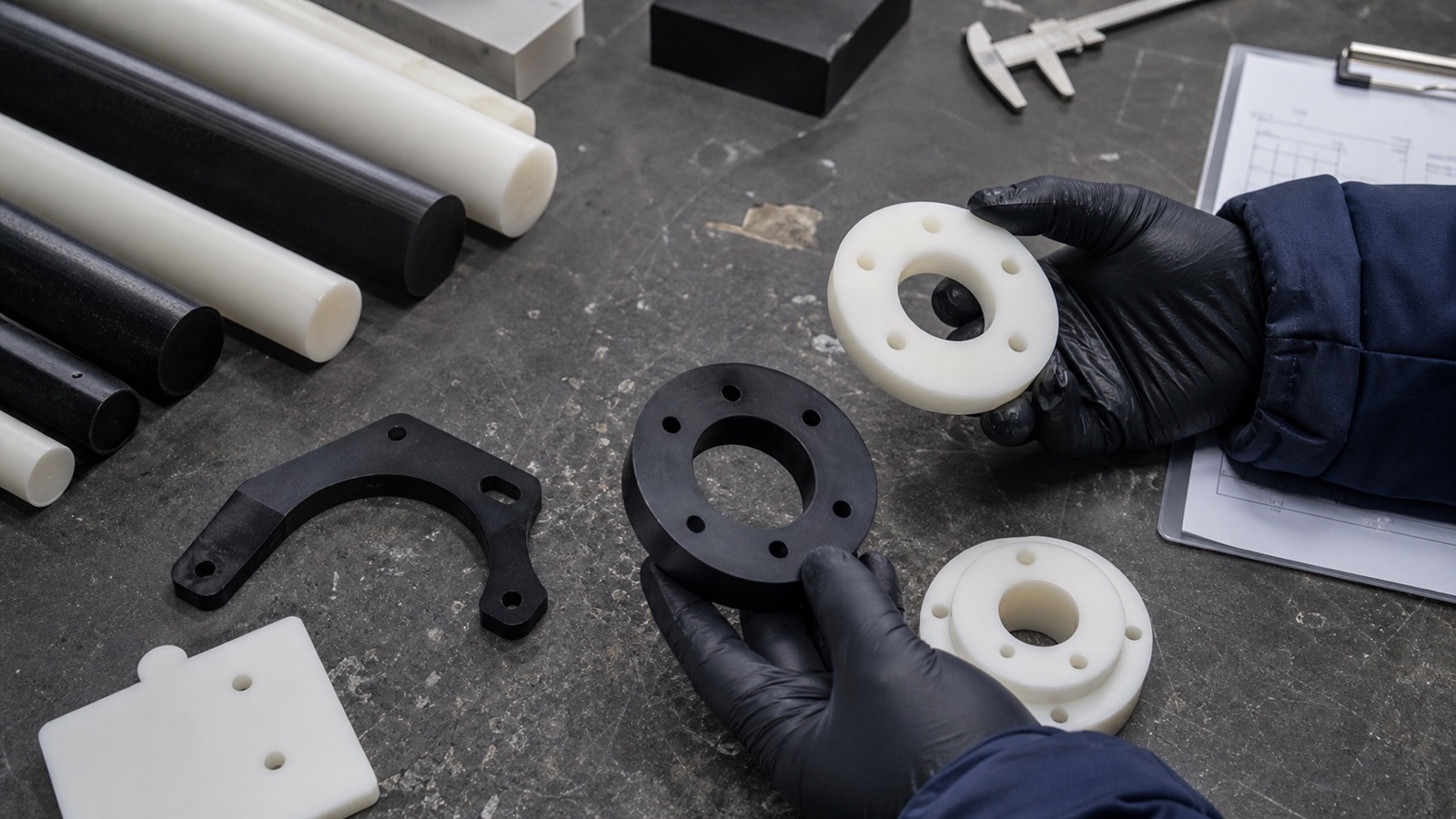
Chemical tanks and fluid-handling components
Machined flanges, covers, spacers, fittings, valve components, and pump-related parts can benefit from polyolefin chemical resistance. PP is often considered for warmer or more oxidizing service, while HDPE is useful where toughness and impact resistance are central.
Food-processing components
Guides, blocks, change parts, guards, and fixtures may use HDPE or PP when low moisture absorption, cleanability, and low weight are important. The required grade and end-use compliance must be confirmed for the application.
Wear pads, guides, and machine interfaces
HDPE is often selected for sliding guides, wear strips, bumpers, rollers, and low-load contact surfaces where impact tolerance and economical replacement are valuable.
Structural and equipment parts
PP can suit custom supports, covers, brackets, laboratory hardware, and chemical-equipment structures when greater temperature capability is needed and the design controls creep and deflection.
When to Choose HDPE for Machined Parts
We usually recommend evaluating HDPE first when the part must tolerate impact, cold conditions, moisture, or sliding contact without the cost of a higher-performance polymer.
Cold or impact-critical environment: choose HDPE when toughness at low temperature and resistance to handling damage are priorities.
Wear and sliding component: consider HDPE for guides, pads, liners, bumpers, and low-load contact parts.
Lightweight chemical-resistant part: HDPE can be effective for room-temperature fluid-handling components where its temperature limitations are acceptable.
When to Choose PP for Machined Parts
PP becomes a strong candidate when the operating temperature is higher, repeated flexing matters, or the chemical environment favors polypropylene. We still check impact requirements because homopolymer and copolymer grades behave differently.
Typical PP decision signals
The part operates at a temperature where HDPE would lose too much stiffness.
The component belongs to a warm chemical, laboratory, or fluid-processing system.
Repeated flexure or fatigue behavior is more important than maximum impact toughness.
The design can accommodate thermal expansion and long-term creep.
Common Disadvantages and Alternatives
Neither HDPE nor PP is a universal replacement for engineering plastics. Both can creep under sustained load, expand noticeably with temperature, and become difficult to hold to demanding dimensional requirements when the design is thin, large, or poorly supported.
When a part needs substantially higher stiffness, strength, wear performance, or dimensional stability, we may review alternatives such as POM/Delrin, nylon, filled materials, or high-performance polymers. The correct choice depends on the complete duty cycle and not on a single headline property.
What is the disadvantage of HDPE?
The main disadvantages of HDPE are its limited stiffness at higher temperatures, susceptibility to creep under sustained load, relatively high thermal expansion, and lower dimensional stability than materials such as Delrin. It may also require careful workholding because clamping can distort a flexible component.
Is HDPE stronger than Delrin?
In typical machined-part comparisons, Delrin is generally stiffer and more dimensionally stable than HDPE, making it preferable for precision gears, bushings, structural fixtures, and close-fitting components. HDPE can be the better practical material for impact resistance, low-temperature toughness, chemical exposure, low weight, or economical wear parts. “Stronger” therefore depends on whether we mean stiffness, tensile behavior, impact resistance, or long-term performance under a specific load.
Design perspective
If a part must hold a tight fit while carrying a constant load, compare creep and dimensional stability—not only short-term strength. If it must absorb impact in a cold or wet environment, HDPE may remain the more suitable choice.
Frequently Asked Questions
Is PP better than HDPE?
PP is generally better for higher-temperature service and some aggressive chemical applications. HDPE is often better for cold temperatures, impact, sliding wear, and economical lightweight components. The operating conditions decide the answer.
Is HDPE plastic machinable?
Yes. HDPE can be CNC milled, turned, drilled, tapped, and slotted. Sharp tooling, controlled heat, secure but gentle workholding, and realistic tolerance planning help produce consistent results.
What is the disadvantage of HDPE?
HDPE has lower stiffness at elevated temperature, can creep under sustained load, and may move more than a precision engineering plastic. Its flexibility can also complicate the machining and inspection of thin or large parts.
Is HDPE stronger than Delrin?
Not in every sense. Delrin is typically stiffer and more dimensionally stable, while HDPE can offer better impact tolerance, cold performance, chemical resistance, and cost effectiveness for suitable applications.
Plan the right material before production
Send us your HDPE or PP machining requirement
At PlasticCNCPro, we support global B2B customers with CNC milling, turning, drilling, tapping, threading, slotting, and custom machining for prototypes, low-volume parts, and repeat production. Share your 2D drawing, 3D model, sample, quantity, tolerance, and application details so we can review material suitability and manufacturability.