
How Plastic Density Affects CNC Machining Cost
From raw stock purchase weight to feed rates, tool deflection, and thermal expansion, polymer mass density dictates every financial variable on the shop floor. Here is a manufacturing engineer’s breakdown of how plastic density impacts your project budget.
Key Engineering Takeaway
Plastic density affects unit machining cost twice: first in the procurement of extrusion billet by weight, and second on the CNC spindle through cut resistance, chip packing behavior, and workpiece rigidity under high clamping forces.
What Is Plastic Density and Why It Matters in CNC
Plastic density represents the mass per unit volume of a polymer, typically measured in grams per cubic centimeter (g/cm³) or pounds per cubic inch (lb/in³). In practical CNC engineering at PlasticCNCPro, density tells us how tightly packed the polymer chains are, whether the structure is amorphous or semi-crystalline, and how much raw material mass is enclosed within the finished envelope dimensions.
Many design engineers mistakenly view density as merely a weight consideration for end-use assemblies. In custom milling and turning, however, density directly drives raw billet procurement pricing, influences shear zone thermodynamics during chip formation, dictates cutter deflection, and governs how parts behave when subjected to pneumatic vice or chuck clamping.
Can Plastic Be CNC Machined?
Yes, virtually all industrial thermoplastics and several thermosets can be precision CNC machined. At our Dongguan facility, we routinely perform high-speed 3-axis, 4-axis, and 5-axis CNC milling, precision CNC turning, threading, multi-axis drilling, and custom contouring across more than 30 polymer formulations.
Unlike metals, plastics possess low thermal conductivity, high coefficients of thermal expansion (CTE), and low moduli of elasticity. Density serves as our starting benchmark to determine whether a plastic can sustain crisp edge retention or if it will gum up cutter flutes and deform under tool engagement pressure.
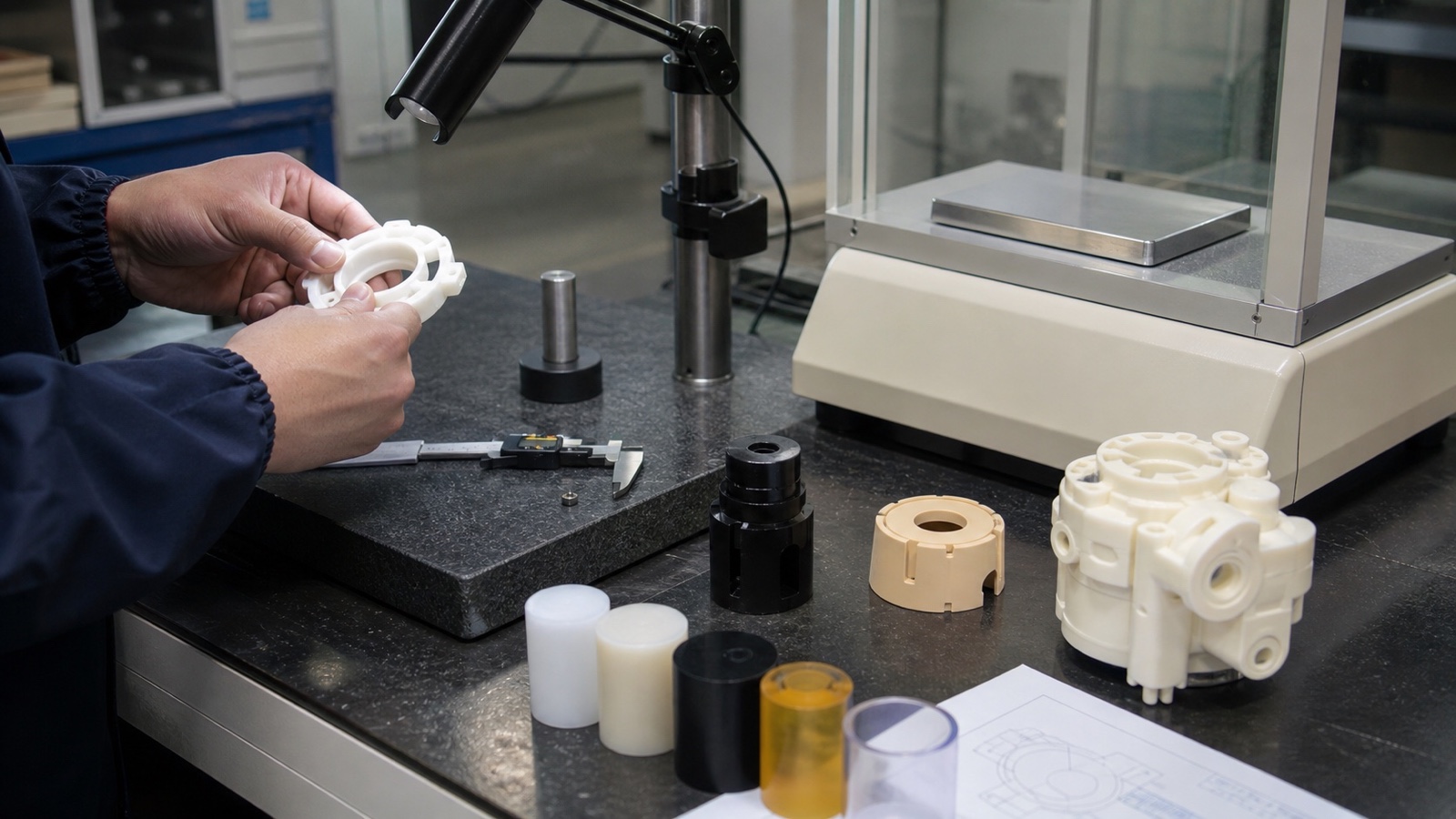
How Plastic Density Influences Material Costs
Material suppliers sell extruded rods, slabs, and compression-molded plates strictly by weight (price per kilogram or pound). This purchasing model establishes a linear multiplier: a denser plastic requires you to purchase significantly more physical mass for the exact same physical block size.
Consider a solid rectangular block measuring 100 mm × 100 mm × 100 mm (1,000 cm³). In Polypropylene (PP, ~0.905 g/cm³), the raw block weighs 0.905 kg. In virgin PTFE (~2.18 g/cm³), that identical volume weighs 2.18 kg—over 2.4 times more mass. When high density intersects with premium resins like PEEK or fluoropolymers, raw stock accounts for up to 60% to 75% of the total machined part cost.
Raw Stock Availability Factor
Standard low- and medium-density polymers (PE, POM, ABS) are continuously extruded in extensive thickness increments, reducing roughing scrap. High-density, high-performance polymers (PTFE, PEEK, PVDF) are frequently produced in limited plate increments, requiring machinists to purchase oversized billets and machine away costly mass.
Impact of Density on Machining Time and Cycle Efficiency
Machining cycle time governs unit cost. Heavier, denser polymers exhibit tighter molecular chains and greater mass resistance, which directly dictates permissible feed rates ($V_f$), spindle speeds ($n$), and depth of cut ($a_p$).
When cutting light polyolefins (HDPE, LDPE, PP), cutters can plow through material at high feeds and high surface feet per minute (SFM). However, dense, high-strength crystalline polymers such as PEEK, high-grade PVDF, or mineral-filled Nylons require conservative parameters to avoid tool deflection, tool chatter, or spindle overloading. Slower cycles translate directly into higher hourly machine center billing.
Tolerances, Dimensional Stability, and Density Effects
Achieving tight dimensional repeatability (such as ±0.02 mm / ±0.0008") is heavily governed by material density and molecular packing:
- Low-density compliance: Materials like LDPE and soft PP have low flexural moduli. Clamping pressure from standard vises readily flexes the part, causing it to bounce back out of tolerance once unclamped. Specialized custom vacuum fixtures or low-pressure soft jaws are often necessary.
- Medium-density stability: Acetal (POM-C) and PBT hit a sweet spot. Balanced density and high internal stiffness allow for clean shear cutting, flat surfaces, and reliable holding of bearing bores.
- High-density internal stress & creep: Dense polymers like PTFE exhibit cold flow and creep under sustained mechanical load. Meanwhile, thick extruded PEEK plates contain high residual stresses requiring multi-stage intermediate annealing bake cycles between roughing and finishing to prevent warping.
How to Calculate CNC Machining Cost for Different Plastic Densities
When estimating custom component quotes at PlasticCNCPro, we use an engineering cost model that directly factors density into the raw billet cost, cycle parameters, and tooling amortization:
Parametric Cost Estimation Formula
Total Cost = Mc + Cm + Tw + Sp
• Mc (Material Cost): Billet Volume (cm³) × Density (g/cm³) × Stock Base Price ($/g)
• Cm (Machining Cost): Machine Cycle Time (hrs) × Hourly Spindle Rate ($/hr)
• Tw (Tooling & Consumables): Cutter Wear Rate × Tool Unit Replacement Cost
• Sp (Setup & Secondary): Fixture Milling + CAM Programming + Annealing Cycles / Batch Size
Execution Steps in Estimating
Compute outer envelope volume plus 3–5mm facing margins; multiply by density to calculate purchased stock mass.
Derive feed rate and SFM based on density and crystallinity; calculate actual roughing and finish pass run-times.
Apply tool life factors and necessary stress-relief thermal cycles dictated by polymer density category.
What Are the Typical Costs Associated with Plastic Manufacturing?
Machined plastic parts show considerable cost variance depending on whether you are running high-rate low-density prototypes or tight-tolerance high-density production runs. The table below illustrates typical per-part pricing benchmarks for medium-complexity components (approx. 80 mm × 60 mm × 30 mm envelope):
| Density Class | Representative Plastics | Density (g/cm³) | Prototype (1–5 pcs) | Production (100–500 pcs) |
|---|---|---|---|---|
| Low Density | HDPE, LDPE, PP | 0.90 – 0.96 | $25 – $55 | $6 – $16 |
| Medium Density | ABS, POM (Acetal), Nylon 6, PC | 1.04 – 1.42 | $35 – $75 | $9 – $24 |
| High Density | PEEK, PVDF, Virgin PTFE | 1.32 – 2.20 | $90 – $240+ | $32 – $110+ |
*Pricing estimates reflect typical engineering tolerances (ISO 2768-m). Specialized tight tolerances (±0.01 mm), custom surface polishes, or cleanroom packaging alter final production quotes.
Top Plastics by Density and Their CNC Cost Implications
Understanding where common polymers fall on the density scale enables engineers to make cost-effective material substitutions during early design phases:
Low-Density Options (HDPE, LDPE, PP)
0.90–0.96 g/cm³Polyolefins offer the lowest raw material cost per volume. Fast roughing and high feed rates lower cycle times. However, their softness, low thermal deflection limits, and flexible structure make micro-tolerances difficult without custom fixturing.
Best for: Tanks, fluid manifolds, chute wear liners, and low-stress chemical fixtures.
Medium-Density Options (ABS, Acrylic, Nylon)
1.04–1.42 g/cm³The gold standard for general CNC manufacturing. POM-C (Delrin) and ABS machine exceptionally well, generating crisp chips and holding tight dimensions without excessive tool wear. Nylon offers great strength but demands moisture management during machining.
Best for: Precision gears, electronic enclosures, robotic joints, and functional prototypes.
High-Density Options (PEEK, PTFE, UHMW)
0.93–2.20 g/cm³While UHMW possesses low density (~0.93 g/cm³), its extreme molecular weight and gummy behavior group it with high-difficulty polymers. Dense fluoropolymers like PTFE (2.15–2.20 g/cm³) and high-performance polyketones like PEEK (1.32 g/cm³) carry substantial price tags. PTFE is extremely dense and requires sharp tools to prevent smear deformation, while PEEK demands controlled feeds, stress-relief annealing, and premium carbide tooling to avoid edge chipping.
Best for: Semiconductor wafer rings, medical implants, aerospace bushings, and severe chemical seals.
How to Reduce CNC Machining Costs When Density Varies
As a machining partner, we actively review customer CAD models and 2D drawings to find cost-down opportunities. When working with materials of diverse densities, consider these strategies:
1. Re-Evaluate High-Density Resins
If your component does not encounter continuous temperatures over 140°C or aggressive acids, swapping from PEEK (1.32 g/cm³) or PTFE (2.20 g/cm³) to Acetal/POM (1.41 g/cm³) or PET-P can drop total part costs by 40% to 65%.
2. Core Out Heavy Sections in CAD
In injection molding, coring out thick sections avoids sink marks. In CNC machining high-density plastics, selective pocketing reduces raw material stock size if you can orient the stock efficiently. Conversely, ensure wall thicknesses stay above 1.5 mm to prevent warping under cutter load.
3. Consolidate Orders to Minimize Extrusion Drop-Off Scrap
High-density engineering billets have substantial cut-off waste when ordering small runs. Grouping repeat parts into batch runs allows us to nest multiple components inside continuous extruded plate lengths, significantly lowering the allocated material cost per part.
4. Relax Non-Critical Tolerances on Soft, Low-Density Parts
Demanding ±0.02 mm on low-density polyolefins like HDPE drives costs up exponentially due to the fixturing and slow passes required. Specifying ±0.1 mm on non-mating features allows high-feed cutters to run unhindered.
Frequently Asked Questions
What plastic is easiest to machine?
POM (Polyoxymethylene, commonly known as Delrin or Acetal) is widely regarded as the easiest plastic to machine. Its medium density (~1.41 g/cm³), excellent dimensional stability, natural lubricity, and brittle chip formation enable high spindle speeds, clean surface finishes, and zero burring without extensive coolant.
What is the best plastic for tight tolerance machining?
For ultra-tight tolerances, semi-crystalline engineering polymers with low moisture absorption and moderate density perform best. POM-C, PEEK, and reinforced Torlon (PAI) are top choices. Glass-fiber or carbon-fiber-filled grades (such as PEEK-GF30) offer even greater dimensional stability under temperature changes, though they increase tool wear.
How does tolerance precision impact CNC plastic machining cost?
Tighter tolerances increase costs exponentially across all plastic densities. Moving from a standard commercial tolerance of ±0.1 mm down to ±0.01 mm can double part cost. This requires slowed finishing feed rates, specialized temperature-controlled inspection, multiple stress-relief annealing steps, and custom soft clamping fixtures.
Is CNC plastic machining cheaper than injection molding?
CNC machining is significantly more economical for prototypes, small batches, and low-to-mid volume runs (typically 1 to 2,000 parts), as it bypasses the high tooling fees ($5,000–$50,000+) and long lead times of injection mold tooling. For large production volumes (over 5,000–10,000 units), injection molding offers a lower per-piece cost.
Optimize Your Plastic CNC Machining Project
Need advice on selecting the right polymer density or reducing unit machining costs on your next project? Send our engineering team your 2D drawings (PDF/DWG) and 3D CAD files (STEP/IGES) for a thorough manufacturability review and competitive quotation.