
Engineering guide · PlasticCNCPro
Low-Density Plastics for Lightweight CNC Machined Components: Benefits, Materials & Machining Guide
We explain how low-density plastics such as LDPE and polypropylene can reduce component weight while supporting corrosion resistance, design flexibility, and practical CNC manufacturability for global B2B applications.
The right lightweight plastic is not selected by density alone. We match weight targets with stiffness, impact behavior, temperature, chemical exposure, tolerances, and the realities of CNC machining.
What Are Low-Density Plastics and Why Use Them for CNC?
Low-density plastics generally have a density below 1.0 g/cm³. That places many polyethylene and polypropylene grades below water and well below common metals. For a component with the same external dimensions, replacing a metal with a low-density polymer can significantly reduce handling weight, moving mass, and the load placed on surrounding mechanisms.
This matters when engineers are developing equipment that must be moved frequently, mounted on a lightweight structure, or operated by a motor with limited power. It also matters in assemblies where corrosion resistance, electrical insulation, low friction, or quiet operation is more important than maximum structural strength.
Weight-sensitive design
Lightweight covers, guides, brackets, rollers, spacers, and protective parts can reduce system mass without introducing corrosion from a metal surface.
Growing engineering demand
Aerospace, automotive, consumer products, automation, and mobile equipment increasingly require compact components that are easier to transport and integrate.
Top Low-Density Plastics for CNC Machining
LDPE and PP are common starting points, but the best choice depends on the part geometry and the working environment. We review the intended load, temperature, fluid exposure, surface contact, and dimensional requirements before recommending a resin.
LDPE (Low-Density Polyethylene)
LDPE is a lightweight, flexible polyethylene with good resistance to moisture and many common chemicals. Its relatively soft and ductile behavior can be useful for compliant components, protective pieces, low-load guides, and parts that need to tolerate minor impact without cracking.
LDPE can be CNC machined, but its flexibility and tendency to deform under clamping or cutting pressure require careful process control. Sharp tools, a stable workholding method, controlled heat generation, and conservative finishing passes help maintain the intended geometry.
Best fit
Choose LDPE when low weight, flexibility, moisture resistance, and low-load impact tolerance are more important than high stiffness or tight long-term dimensional stability.
Polypropylene (PP)
Polypropylene is another low-density thermoplastic valued for its low weight, chemical resistance, and useful impact performance. It is often a stronger candidate than LDPE when a part needs more rigidity while retaining a lightweight construction.
We machine PP using CNC milling, turning, drilling, tapping, slotting, and related operations according to the component geometry. Because PP can flex during cutting and can accumulate heat, tool sharpness, chip evacuation, and workholding are important for clean edges and repeatable dimensions.
Typical use cases include fluid-handling components, protective covers, lightweight fixtures, packaging-machine parts, laboratory equipment elements, and custom guides where chemical exposure or moisture makes metal less attractive.
Other Low-Density Options, Including Foamed or Modified Grades
Certain foamed, cellular, filled, or modified grades can reduce mass further or provide a more targeted balance of stiffness, cushioning, insulation, wear resistance, or acoustic performance. These materials should not be treated as direct substitutes for solid LDPE or PP without checking the grade-specific datasheet and machining behavior.
A modified grade may outperform a standard resin when the part requires improved wear, reduced friction, electrical behavior, or dimensional control. However, the lower density may come with reduced strength or a different surface response, so prototype testing is valuable before repeat production.
Benefits of Low-Density Plastics for Lightweight Components
For product and manufacturing engineers, the value of low-density plastics is usually broader than a lower part mass. The material can change how the entire assembly is designed, operated, and maintained.
Weight reduction
Lower mass can simplify installation, reduce operator fatigue, and decrease the inertia of moving assemblies.
Corrosion and moisture resistance
Polyolefins can be useful in wet or chemically exposed environments where a metal component would require coating or replacement.
Potential cost savings
Material cost, secondary corrosion protection, handling, and assembly requirements can all influence total cost. We evaluate the complete part rather than unit price alone.
Design flexibility
CNC machining supports prototypes, complex custom geometries, low-volume orders, replacement parts, and design validation before a molding investment.
CNC Machining Processes Optimized for Low-Density Plastics
Low-density thermoplastics are not machined like aluminum or steel. They are more likely to flex, smear, melt, or pull away from a fixture if the process generates excessive heat or cutting force. Our engineering review focuses on both the drawing and the material behavior.
Select sharp, suitable tooling
Sharp cutting edges and suitable flute geometry help shear the polymer instead of rubbing it. Tool selection should reflect the resin, wall thickness, feature size, and required surface finish.
Balance feeds, speeds, and chip load
There is no single universal feed rate for every low-density plastic. We aim for an effective chip load that clears material rather than repeatedly rubbing the surface and building heat.
Control heat and clear chips
Air blast, suitable coolant practices, and effective chip evacuation can help prevent re-cutting and melting. The correct cooling approach depends on the polymer, machine setup, and part requirements.
Support flexible geometries
Thin walls and tall slender features may deflect under tool pressure. We use appropriate workholding, staged passes, and finishing operations to reduce deformation.
Inspect after stabilization
Plastic parts can respond to temperature and release from clamping forces after machining. Inspection planning should identify critical dimensions and the appropriate measurement condition.
Machining warning
Aggressive cutting is not automatically faster with soft polymers. If the tool rubs, the surface can heat and deform before the operator sees a dimensional problem. A stable setup and controlled chip evacuation are often more important than simply increasing spindle speed.
Is HDPE Plastic Machinable? Understanding Density Differences
Yes, HDPE plastic is machinable. High-density polyethylene is commonly processed by CNC milling, turning, drilling, and related operations. Compared with LDPE, HDPE is denser and generally stiffer, so it can offer better support for many guides, wear components, fixtures, and fluid-handling parts.
The density difference does not make HDPE a metal replacement in every structural application, but it can make HDPE easier to hold and less flexible than LDPE during machining. It still requires attention to heat, tool sharpness, burrs, and post-machining dimensional behavior.
| Consideration | LDPE | HDPE |
|---|---|---|
| Relative density | Lower-density polyethylene | Higher-density polyethylene |
| Typical behavior | More flexible and compliant | More rigid and supportive |
| Weight-critical use | Useful where minimum mass and flexibility matter | Useful where added stiffness justifies the modest density increase |
| Machining focus | Prevent deflection and clamping distortion | Control heat, burrs, and dimensional stability |
What Is a Strong Lightweight Plastic for CNC Parts?
For many CNC parts, PP provides a more useful balance of strength, stiffness, impact resistance, and low density than LDPE. HDPE can be the better choice when increased rigidity and wear support are needed, although it is not as light as LDPE or PP. The best strength-to-weight result depends on the loading direction, support conditions, feature thickness, and operating temperature.
For example, a PP cover or lightweight fixture may resist routine handling impacts while keeping the assembly easy to move. An LDPE bumper may absorb contact more compliantly but would not be the first choice for a dimensionally stable load-bearing bracket. A higher-performance polymer may be appropriate when temperature, wear, or chemical requirements outweigh the initial density advantage.
Engineering takeaway
Define “strong” in terms of the real failure mode: bending, impact, abrasion, thread pullout, creep, chemical attack, or dimensional drift. This produces a better material decision than comparing tensile strength alone.
What Is the Best Plastic for CNC Machining When Weight Matters?
There is no universal best plastic. We recommend narrowing the decision through four questions:
What mechanical job must the part perform?
For a flexible protector, LDPE may be suitable. For a light but more rigid cover, guide, or fixture, PP or HDPE may be more practical.
What environment will it see?
Review moisture, chemicals, temperature, friction, UV exposure, cleanliness, and contact with other materials before selecting a grade.
How precise must the component be?
Flexible materials and thin geometries require a more careful tolerance strategy. Critical dimensions should be identified on the drawing before quotation.
What is the production plan?
CNC machining is especially useful for prototypes, low-volume production, complex geometries, and replacement parts. For larger volumes, we can help compare a machined route with future manufacturing options.
Common Applications of Lightweight CNC Machined Plastic Parts
Low-density polymer components are used where weight, corrosion resistance, safe contact, or flexible design is important. At PlasticCNCPro, we support custom parts for industrial equipment, automation, laboratory systems, transportation, packaging, and other B2B applications.
- Automotive interiors: lightweight guides, covers, spacers, clips, and protective components.
- Drone and mobile equipment components: non-structural housings, guards, spacers, and low-mass fixtures where every gram affects handling.
- Medical and laboratory devices: custom guides, covers, holders, and fluid-contact support parts subject to application-specific material requirements.
- Packaging equipment: wear guides, changeover parts, spacers, and lightweight handling components.
- Industrial fixtures and automation: jigs, assembly aids, protective covers, rollers, guides, and custom replacement parts.
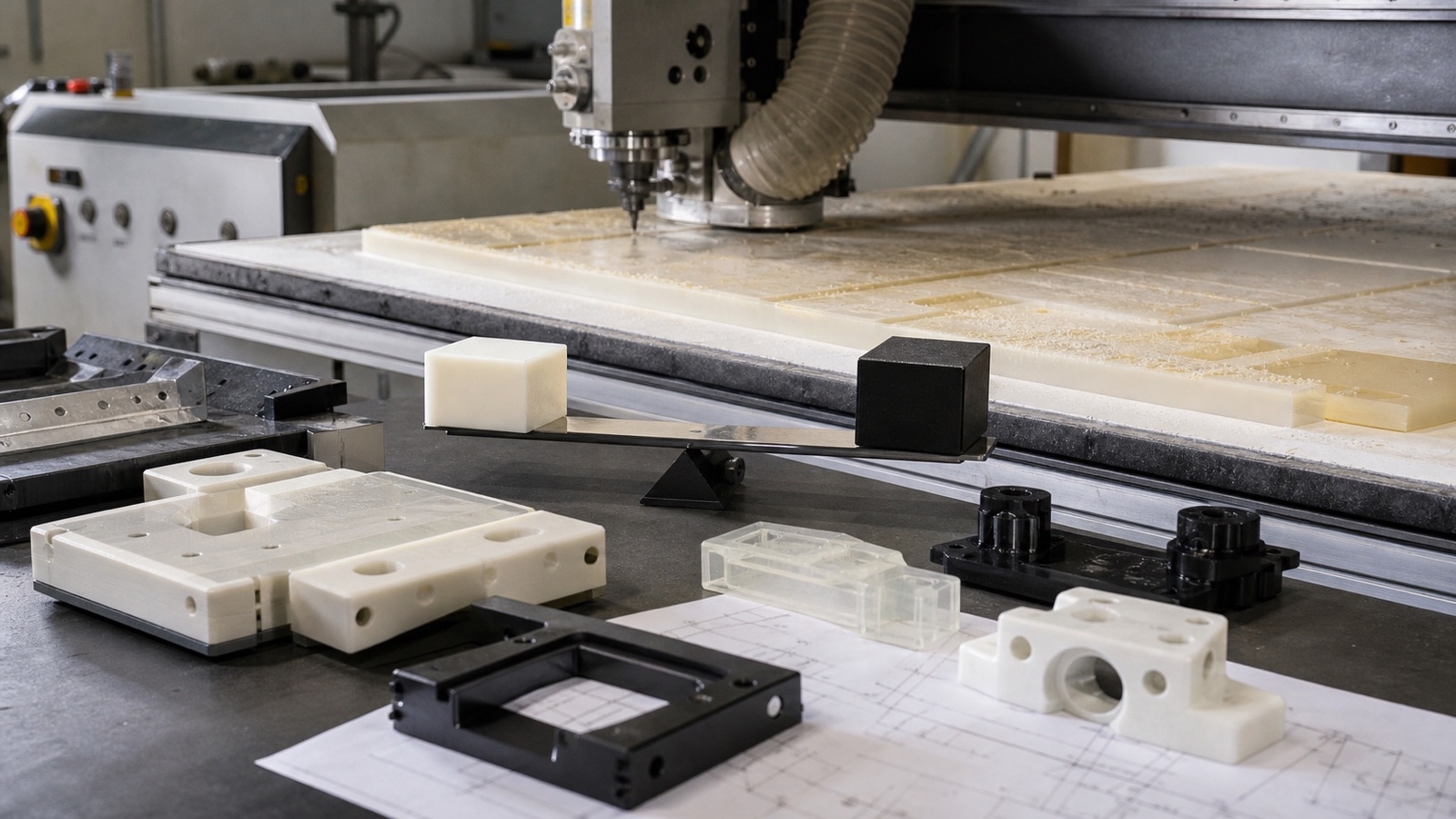
Factors to Consider When Selecting Low-Density Plastics
A lightweight material is only successful if it remains reliable through the full service life of the component. We suggest reviewing the following points with the design and sourcing teams:
Mechanical properties: Check stiffness, impact resistance, compressive loading, wear, creep, and thread or insert performance.
Thermal behavior: Confirm the service temperature and consider heat created by friction, nearby equipment, or machining.
Chemical and environmental resistance: Evaluate oils, cleaning agents, water, solvents, humidity, UV exposure, and process fluids.
Machinability and tolerances: Discuss thin walls, deep pockets, small holes, threads, clamping, burr control, and inspection requirements before production.
Compliance and sustainability: Where relevant, specify regulatory, food-contact, medical, flame-retardant, antistatic, or other grade requirements. Also consider material efficiency, service life, recyclability, and the impact of replacing heavier components.
PlasticCNCPro machines commodity plastics, engineering plastics, high-performance polymers, fluoropolymers, and filled materials. We can help compare options based on strength, dimensional stability, chemical resistance, temperature, electrical behavior, friction, wear, and cost.
FAQ
What is the best plastic for CNC machining?
The best plastic depends on the part requirements. POM, nylon, HDPE, PP, LDPE, ABS, PC, PTFE, PEEK, and other engineering polymers each solve different combinations of strength, friction, temperature, chemical resistance, dimensional stability, and cost. We select the material after reviewing the drawing and application.
Is CNC machinist a dying trade?
No. CNC technology changes the work, but precision machining still depends on engineering judgment, process planning, material knowledge, inspection, and communication. Machining difficult plastics consistently requires practical experience in addition to digital manufacturing tools.
What is a strong lightweight plastic?
PP is often a useful general candidate when low density, impact resistance, and practical rigidity are needed. HDPE can provide more support when a modest increase in density is acceptable, while LDPE is better suited to flexible, compliant, or lower-load parts. The geometry and service environment remain decisive.
Is HDPE plastic machinable?
Yes. HDPE can be CNC milled, turned, drilled, tapped, and finished with suitable tooling and process control. Its greater stiffness compared with LDPE can help with workholding, but heat, burrs, deflection, and dimensional stability still need to be managed.
Discuss your component
Let’s select a lightweight material that works in production
We at PlasticCNCPro support prototypes, low-volume production, and repeat manufacturing from our facility in Dongguan, China. Send your 2D drawing, 3D model, sample, material requirement, quantity, tolerance, and application details. We will review manufacturability, material suitability, machining requirements, and inspection needs.