
Engineering materials guide
Natural POM vs ESD POM for Electronics: Key Differences and Best Uses
Natural POM and ESD POM can both deliver precise, low-friction plastic components, but they solve different electrical problems. We compare their composition, performance, machining behavior, cost, and best applications so your electronics equipment project starts with the right material decision.
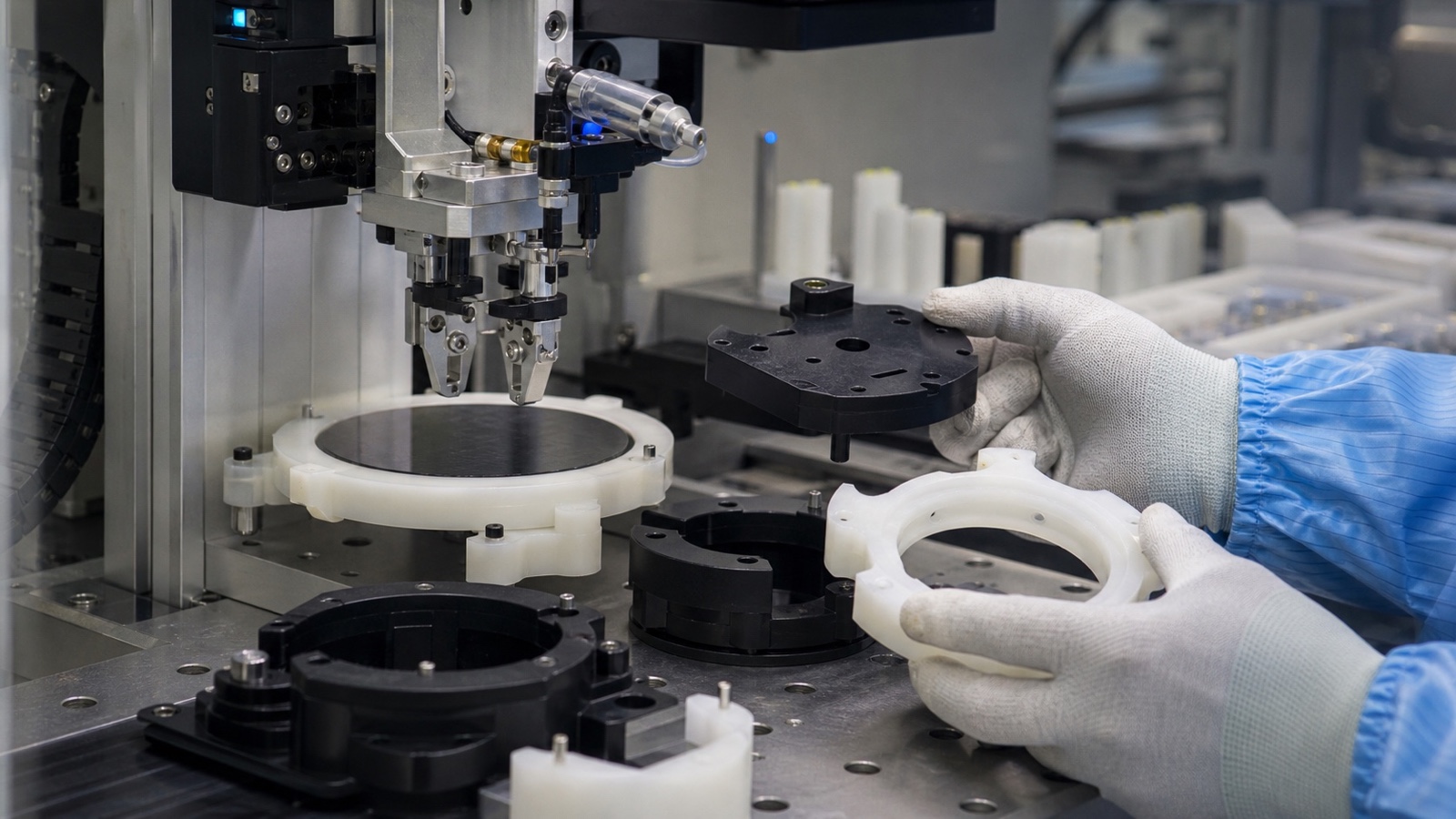
For custom electronic equipment, the best polymer is not always the one with the highest mechanical specification. The correct choice must also control static behavior, preserve dimensions, machine consistently, and fit the production quantity.
What Is POM Plastic?
POM, or polyoxymethylene, is an engineering thermoplastic commonly called acetal. It has a highly crystalline structure that gives it a useful combination of stiffness, strength, low friction, wear resistance, and dimensional consistency. These characteristics make it suitable for precision parts such as guides, bushings, rollers, gears, sliding elements, fixtures, and insulation components.
In the market, Delrin is a well-known trade name associated with an acetal homopolymer grade. POM also includes copolymer grades and other manufacturer-specific formulations. When we quote or machine a POM component, we confirm the requested grade rather than treating every acetal material as identical.
Design note
“POM” identifies a material family. Natural, antistatic, dissipative, conductive, filled, and wear-modified grades can behave differently during machining and service.
Natural POM vs ESD POM: Core Differences
Natural POM is normally selected for its mechanical and tribological performance while retaining strong electrical insulation. ESD POM is modified to reduce the tendency of a surface to accumulate and release static electricity suddenly. This distinction matters in equipment that handles exposed electronic components, wafers, sensors, circuit assemblies, or electrostatic-sensitive devices.
Natural POM
An unmodified or standard acetal grade generally provides high electrical insulation, low moisture uptake compared with many nylons, good stiffness, and clean machinability. It is a strong general-purpose option when static control is not a primary requirement.
ESD POM
An ESD grade contains a formulation or additive package that gives the material controlled static dissipation. The exact electrical behavior depends on the grade, so the required surface resistivity range should be stated on the drawing or purchase specification.
The additives used to create dissipative behavior can influence color, friction, stiffness, wear, thermal response, surface finish, and tool wear. We therefore recommend evaluating the complete grade datasheet instead of assuming that ESD POM has exactly the same performance as natural POM.
Electrical Properties Comparison
The primary electrical difference is static behavior. Natural POM is typically an insulating material: charge can remain on its surface and may discharge when the part contacts another object. ESD POM is designed to let charge dissipate in a controlled manner, reducing the risk of a rapid electrostatic event.
| Criterion | Natural POM | ESD POM |
|---|---|---|
| Surface behavior | Usually insulating; charge may build up | Controlled dissipation through a modified formulation |
| Static-sensitive work | Suitable only where insulation is acceptable and static risk is controlled separately | Better suited to fixtures, guides, and handling parts near sensitive electronics |
| Specification method | Mechanical, dimensional, and insulating requirements | Grade-specific surface or volume resistivity and ESD performance requirements |
Important qualification
Do not approve ESD POM based only on the label. Confirm the required resistivity range, test method, environmental conditions, and whether the finished machined surface must be verified.
Mechanical and Thermal Properties
Natural POM often offers a straightforward balance of strength, stiffness, low friction, and dimensional stability. ESD POM can remain mechanically capable, but the additive system may change the balance slightly. The actual outcome depends on the manufacturer, grade, filler content, and processing history.
For precision electronics equipment, we review more than tensile strength. We consider clamp loads, sliding contact, repeated cycling, heat generated by friction, thermal expansion, moisture exposure, and the dimensional tolerance required after machining. If a component must maintain a tight fit over temperature changes, the selected grade and the part geometry are equally important.
Is POM Plastic Strong?
Yes. POM is considered a strong engineering plastic for many precision applications. Its stiffness helps parts resist deflection, and its wear performance supports repeated movement in guides, bushings, rollers, and mechanisms. It also has useful impact resistance for properly designed components, although it should not automatically replace a tougher or more temperature-resistant polymer in every application.
Natural POM and ESD POM can both be durable over long service periods when loads, temperatures, chemical exposure, and tolerances are properly matched to the grade. For a loaded part, we assess the following before recommending material:
Load and deflection
Check whether the part must carry a sustained load or maintain alignment under repeated force.
Impact and fatigue
Consider drops, intermittent shocks, fast cycling, and stress concentrations around holes or sharp corners.
Environmental durability
Review temperature, moisture, chemicals, friction, and the dimensional change permitted by the assembly.
Advantages and Disadvantages of Natural POM and ESD POM
Neither grade is universally better. Natural POM is often the efficient choice for mechanically demanding insulating parts, while ESD POM earns its premium when uncontrolled charge could damage components, interrupt testing, or create a safety and reliability concern.
Natural POM advantages
- Good strength, stiffness, wear resistance, and low-friction performance.
- Generally straightforward to CNC machine with a clean, consistent finish.
- Useful dimensional stability for precision mechanisms and fixtures.
ESD POM advantages
- Reduces uncontrolled static accumulation and supports controlled dissipation.
- Supports handling fixtures and machine components used around sensitive electronics.
- Retains the useful machinability of an acetal-based engineering plastic.
Limitations to plan for
Natural POM can be unsuitable where static must be controlled. ESD POM can cost more and may have different mechanical, surface, color, or machining behavior because of its additives. Both materials can be affected by temperature, geometry, and environmental conditions, and POM should not be selected without checking chemical compatibility and service requirements.
Manufacturing POM: CNC Machining and Injection Molding
POM can be processed by CNC machining and injection molding. The right process depends on quantity, geometry, tooling investment, required tolerances, and how quickly the design may change.
Confirm the grade
Identify natural, ESD, copolymer, homopolymer, or filled material and state the electrical requirement where static control is needed.
Review the design for machining
We examine wall thickness, deep pockets, small holes, threads, sharp internal corners, clamping, and the datum structure needed to hold dimensions.
Control heat and deformation
Cutting conditions, tool sharpness, workholding, and staged machining help reduce heat-related movement and stress in precision parts.
Inspect the finished component
Dimensional inspection should be matched to the drawing, while ESD projects may also require verification of the finished surface or material batch.
Injection molding becomes more attractive as volume increases and the geometry is stable enough to justify tooling. CNC machining is especially practical for prototypes, replacement parts, complex low-volume components, and designs that need revision before production release. At PlasticCNCPro, we support CNC milling, turning, drilling, tapping, threading, slotting, and complex custom machining for engineering polymer parts.
Applications in Electronics Equipment
The better material depends on whether the part is primarily a mechanical element, an electrical insulator, or a controlled interface with static-sensitive equipment.
Where natural POM often works well
Natural POM is a practical choice for non-static-critical housings, mechanical spacers, cable and component guides, gears, bushings, rollers, alignment parts, and general-purpose fixtures where insulation, stiffness, wear resistance, and clean machining are priorities.
Where ESD POM often works well
ESD POM is more appropriate for handling fixtures, trays, nests, guides, transfer components, test equipment interfaces, and automation parts that contact or move near electrostatic-sensitive devices. It is particularly relevant when a component must combine acetal-like mechanical behavior with controlled static dissipation.
Application check
A dissipative plastic component is only one part of an ESD-control strategy. Review grounding, adjacent materials, operator procedures, environmental conditions, and the complete equipment design.
Is POM Plastic Expensive?
POM is usually positioned above commodity plastics because it provides engineering-level mechanical and wear performance. The final part cost depends on the material grade, stock size, part volume, geometry, tolerance, machining time, inspection requirements, and packaging.
ESD POM commonly carries a premium over standard natural POM because the formulation is specialized and the electrical performance may require additional material verification. That premium can be justified when a static event could damage expensive electronics, reduce yield, or create repeated equipment downtime.
For low-volume or prototype work, CNC machining can avoid the upfront tooling cost associated with injection molding. We compare material cost with the broader total cost of ownership: machining time, scrap risk, assembly reliability, component protection, and the cost of changing a design after tooling is made.
Natural POM vs Other Thermoplastics: PP, Nylon, and PEEK
POM is not automatically the best electronics plastic. We compare it with the actual operating conditions and the customer’s manufacturing plan.
| Material | Typical advantage | Potential limitation in this comparison |
|---|---|---|
| POM | Stiff, low friction, wear-resistant, and well suited to precision machining | Natural grade is insulating; service temperature and chemical compatibility must be checked |
| PP | Low density, broad chemical resistance, and economical material options | Generally less stiff and less dimensionally stable for precision mechanical parts |
| Nylon | Good toughness and useful mechanical performance across many applications | Moisture absorption can affect dimensions and electrical behavior |
| PEEK | High-performance option for demanding temperature, chemical, and mechanical conditions | Higher material and machining cost than POM for applications that do not need its extreme performance |
FAQ
Is POM a better material than PP?
For precision mechanical parts, POM is often better when stiffness, low friction, wear resistance, and dimensional consistency are important. PP may be preferable when low density, chemical resistance, flexibility, or lower material cost is the primary requirement. The application, not the material name alone, determines the better choice.
Is POM plastic the same as Delrin?
Delrin is a trade name associated with an acetal homopolymer grade, while POM is the broader material family known as polyoxymethylene or acetal. Different POM grades can vary in composition and performance, so the exact grade should be confirmed before manufacturing.
Is POM plastic strong?
Yes. POM provides strong and stiff performance for many precision components, along with good wear resistance and useful impact behavior. Long-term durability still depends on load, geometry, temperature, chemicals, friction, and the selected grade.
Is POM plastic expensive?
POM generally costs more than commodity plastics such as PP because it is an engineering material. ESD POM may cost more than natural POM, but the premium can be worthwhile when controlled static dissipation protects sensitive electronics or improves process reliability.
Plan your next component
Need help choosing natural POM or ESD POM?
Send PlasticCNCPro your 2D drawing, 3D model, sample, quantity, tolerance, and application details. We can review the material choice, machining approach, dimensional requirements, and production route for prototypes, low-volume parts, and repeat manufacturing.
Request an engineering quotation