
Engineering materials guide
PBT vs. Nylon: Which Plastic Is Best for Electrical Components?
Choosing between PBT and Nylon for electrical parts? We compare moisture absorption, thermal stability, dielectric strength, mechanical performance, processing, and cost so you can select a material with confidence.
1. Introduction: The Critical Role of Material Selection in Electronics
Electrical components are expected to insulate conductors, withstand heat, retain their dimensions, and remain reliable over years of service. A material that performs well in a dry laboratory may behave differently after exposure to humidity, thermal cycling, chemical cleaners, or repeated assembly loads.
PBT, or polybutylene terephthalate, and Nylon, or polyamide, particularly PA6 and PA66, are two widely used engineering thermoplastics for electrical and industrial parts. Both can be reinforced and modified for demanding applications, but they respond differently to water, temperature, mechanical stress, and molding conditions.
Why insulation is only the starting point
A component must also hold terminals, preserve creepage and clearance geometry, resist heat, and remain compatible with the surrounding assembly.
The application decides the winner
For a humid, high-voltage connector, PBT may be the stronger choice. For a loaded latch or flexible housing feature, Nylon may provide better toughness.
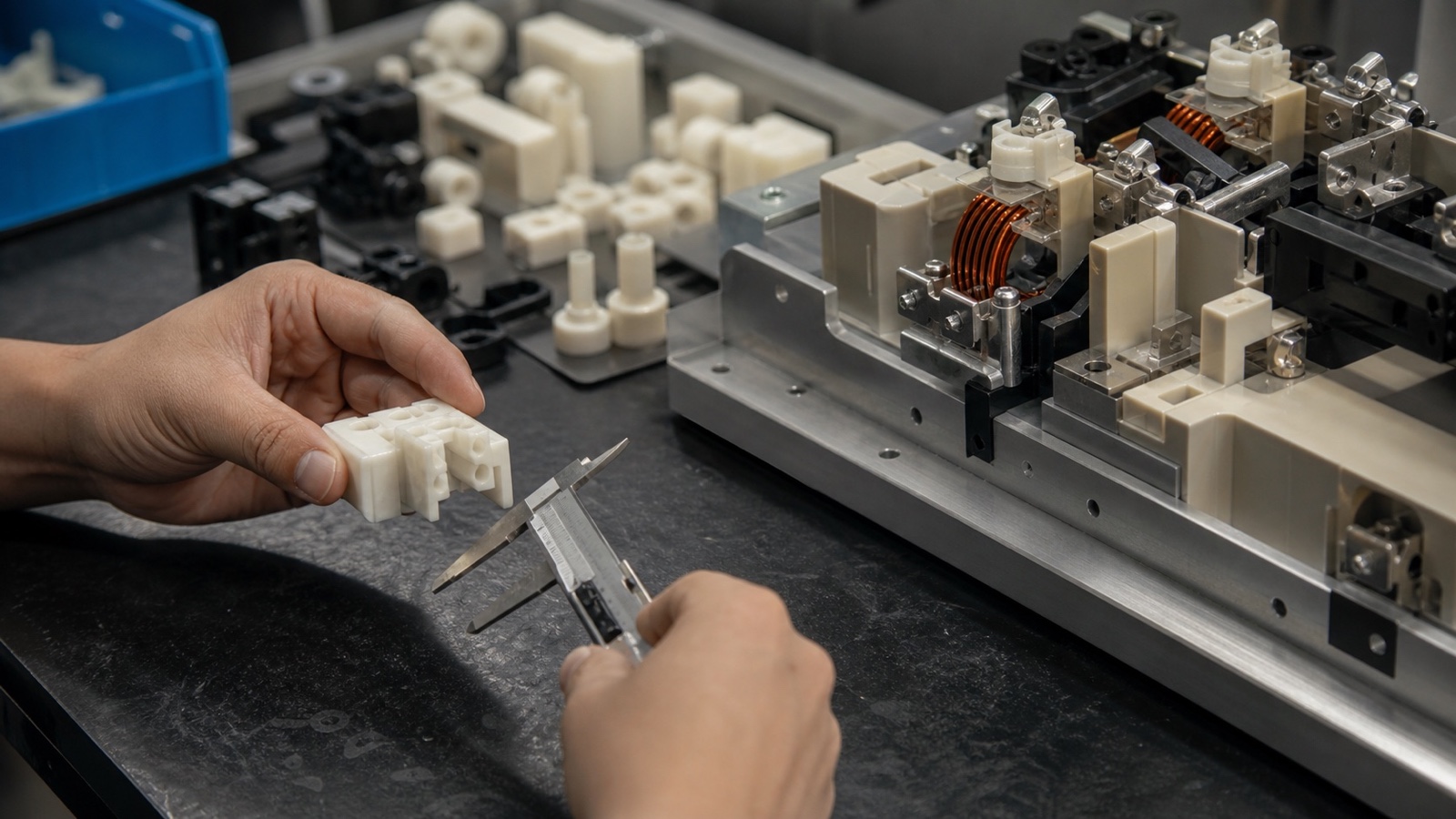
Our practical rule is simple: choose the polymer that preserves the component’s critical function after moisture, heat, electrical loading, and assembly stress are considered together.
2. Defining the Contenders: What Are PBT and Nylon?
PBT and Nylon are semi-crystalline engineering thermoplastics. Their performance can vary substantially by grade, molding condition, reinforcement level, and flame-retardant package, so we recommend comparing specific grades rather than relying only on the family name.
What is PBT?
PBT is a semi-crystalline polyester known for strong electrical insulation, low moisture absorption, good chemical resistance, and useful dimensional stability. These characteristics make it common in connector bodies, switch components, relay housings, sensor brackets, and other parts where insulation geometry must remain consistent.
What is Nylon?
Nylon is a polyamide family that includes PA6 and PA66. It is valued for high mechanical strength, toughness, wear resistance, and fatigue performance. Nylon is often a strong candidate for clips, gears, bushings, cable-management parts, and housings that experience impact or repeated movement.
Grade matters
Glass-fiber reinforcement can increase stiffness, strength, heat resistance, and dimensional stability in both PBT and Nylon. It can also affect anisotropy, surface appearance, flow behavior, and shrinkage, so the reinforcement percentage must be evaluated with the part design.
3. The “Deal-Breaker”: Moisture Absorption and Dimensional Stability
Moisture is one of the clearest differences between Nylon and PBT. Nylon is hygroscopic: it absorbs water from the surrounding air. That absorbed moisture can change dimensions, reduce stiffness, alter impact behavior, and shift electrical properties such as insulation resistance.
The effect is especially important for precision electrical parts. A small change in a terminal cavity, latch position, or creepage path can influence assembly fit and electrical reliability. Nylon may still be suitable, but conditioning, storage, and environmental validation must be part of the design process.
What we check during material selection
-
1
Humidity exposure
Define whether the part will operate indoors, outdoors, in a washdown area, or in a controlled cabinet.
-
2
Critical dimensions
Identify terminal locations, mating features, snap fits, and insulation distances that cannot drift.
-
3
Conditioned testing
Test representative parts at expected moisture states instead of approving only dry, newly manufactured samples.
PBT generally absorbs much less moisture than Nylon, which makes it the safer starting point for high-precision electrical components in humid environments. This does not eliminate thermal expansion or process variation, but it reduces one major source of dimensional and electrical drift.
4. Electrical Performance Comparison
Dielectric strength describes how much electric field a material can withstand before breakdown under defined test conditions. Volume resistivity indicates how strongly the material resists current passing through its bulk. Both properties depend on grade, moisture, temperature, test method, and part geometry.
PBT is often preferred for high-voltage connectors, switches, relay housings, and terminal supports because its low moisture uptake helps maintain more consistent insulating behavior. Nylon can also provide effective insulation, but absorbed moisture may influence its electrical performance and should be considered in qualification testing.
Engineering caution
Do not approve a material from dielectric strength alone. Review the actual grade’s volume resistivity, comparative tracking behavior where relevant, flame rating, wall thickness, moisture condition, and the finished component’s creepage and clearance design.
5. Heat Resistance and Flame Retardancy
Both PBT and Nylon are available in grades designed for elevated operating temperatures. Actual continuous-use performance depends on the polymer grade, reinforcement, load, exposure time, and surrounding environment. A glass-filled grade may retain stiffness better than an unfilled grade, but it may also introduce directional shrinkage and a more pronounced molded surface texture.
For electrical housings, UL94 flame-retardant ratings are often a key requirement. The rating is grade- and thickness-specific, so a resin’s advertised rating should not be treated as universal for every wall thickness or geometry. We recommend confirming the supplier’s documentation for the exact grade and design condition.
If the component passes through reflow soldering, the selected material must tolerate the relevant thermal profile without unacceptable warpage, loss of fit, or electrical degradation. Both PBT and Nylon have grades used around electrical assembly processes, but reflow suitability must be verified for the specific resin and part design rather than assumed from the polymer family.
6. Mechanical Strength vs. Toughness
PBT is stiff and strong, particularly when reinforced with glass fiber. It holds electrical features firmly and can provide a stable platform for terminals and fasteners. However, some PBT grades can be more brittle than Nylon when exposed to impact, sharp stress concentrations, or low-temperature service.
Nylon generally offers superior impact resistance, toughness, and fatigue life. For snap-fit tabs, hinges, cable clips, or parts that are repeatedly flexed during maintenance, Nylon often has the advantage. Its moisture sensitivity still matters: conditioning can change the balance between stiffness and toughness, as well as the fit of moving features.
PBT tends to suit
Rigid electrical supports, precision connector bodies, switch carriers, and parts where stable geometry is more important than impact absorption.
Nylon tends to suit
Flexible retention features, protective housings exposed to handling, wear components, and mechanisms subject to repeated loading.
7. Processing and Injection Molding Considerations
Both materials can be injection molded efficiently when the resin is properly dried, the mold is designed for the grade, and processing conditions are controlled. Nylon typically demands closer moisture management before processing because residual water can lead to surface defects, reduced molecular weight, and inconsistent properties.
PBT often offers predictable molding behavior and relatively low moisture absorption, which can simplify production of tight-tolerance electrical parts. Its cycle time and dimensional outcome still depend on wall thickness, cooling design, glass-fiber content, gate location, and post-molding conditions.
Mold shrinkage is a critical consideration. Nylon’s shrinkage can be more sensitive to moisture, orientation, and processing conditions, while reinforced grades can shrink differently along and across the flow direction. PBT is not shrinkage-free, but its lower moisture sensitivity often makes dimensional control more predictable for precision electrical geometry.
A practical development sequence
- 1
Define the environment. Record temperature, humidity, voltage, chemicals, mechanical loads, and assembly method.
- 2
Select a specific grade. Confirm reinforcement, flame rating, electrical data, and processing requirements.
- 3
Validate finished parts. Measure fit, insulation, warpage, and mechanical retention after conditioning.
8. PBT vs. Nylon: Side-by-Side Property Comparison Table
The table below provides a directional engineering comparison. Exact values vary by PA6, PA66, unfilled or glass-filled formulation, flame-retardant package, test method, and conditioning state.
| Property | PBT | Nylon PA6/PA66 | Design implication |
|---|---|---|---|
| Moisture absorption | Low | Higher; hygroscopic | PBT generally holds dimensions and electrical behavior more consistently in humidity. |
| Dielectric strength | Strong and generally consistent | Effective, but moisture-sensitive | PBT is often favored for precision high-voltage insulation. |
| Tensile strength | Good; higher with glass fiber | High; grade and conditioning dependent | Nylon often provides greater toughness; reinforced grades change the comparison. |
| Thermal resistance | Good, with stable electrical performance | Good; moisture and grade affect results | Confirm continuous-use and reflow requirements for the exact grade. |
| Cost | Competitive engineering resin | Often competitive; varies by grade | Total cost includes drying, conditioning, tooling, rejects, and qualification. |
9. Choosing the Right Material: Decision Framework
The best decision starts with the component’s failure risks. Ask whether the part is more likely to fail because it absorbs moisture and loses dimensional or electrical stability, or because it needs to survive impact, flexing, wear, and repeated assembly.
Choose PBT if
You need low water absorption, stable dielectric performance, tight dimensional control, chemical resistance, and reliable insulation geometry in humid or variable environments.
Choose Nylon if
You need maximum mechanical strength, high impact resistance, wear performance, fatigue life, or a component that must flex repeatedly without cracking.
10. Frequently Asked Questions
What are the disadvantages of PBT?
PBT can be more brittle than Nylon in some grades, especially when impact or sharp stress concentrations are present. It can also be sensitive to strong bases and must be evaluated against the chemicals used in cleaning or service. Glass-filled and flame-retardant formulations may further change toughness, surface finish, and processing behavior.
What is the best plastic for electrical insulation?
There is no universal best plastic. PBT is often an excellent choice where voltage, humidity, dimensional precision, and stable insulation are priorities. Nylon can be appropriate where mechanical toughness and repeated movement dominate. The final choice should use the specific grade’s electrical data and the finished part’s environmental test results.
Is PBT plastic safe?
PBT is widely used in electrical goods, but safety and compliance depend on the exact formulation, additives, manufacturing controls, and intended market. For electrical products, confirm the supplier’s documentation and whether the selected grade meets applicable requirements such as RoHS and REACH. Flame-retardant status and other regulatory needs must also be checked for the exact grade.
Can you replace one with another without changing the mold?
Not safely in every case. PBT and Nylon have different shrinkage behavior, moisture response, flow characteristics, stiffness, and thermal expansion. A direct substitution may affect fit, warpage, terminal retention, snap-fit force, and insulation distances. We recommend a material trial, dimensional inspection, and functional validation before approving a substitution.
11. Conclusion: Making an Informed Engineering Choice
There is no single “best” plastic for every electrical component. PBT is usually the stronger starting point when low moisture absorption, stable dielectric behavior, and tight dimensional control are essential. Nylon is often the better fit when impact resistance, mechanical strength, wear, and repeated flexing are the dominant requirements.
Before full-scale production, we recommend testing prototype or pilot parts in the real service environment. Check dimensions after conditioning, insulation performance, terminal retention, thermal exposure, flame behavior where required, and resistance to assembly loads.
At PlasticCNCPro, we help global engineering and purchasing teams evaluate machined plastic prototypes and low-volume parts in materials including Nylon, PBT, reinforced polymers, and other engineering plastics. When you are comparing a flame-retardant PBT grade with reinforced PA66, the right choice should be based on the drawing, tolerance, environment, and functional test plan—not only material price.
Discuss your component
Need help choosing PBT, Nylon, or another engineering polymer?
Send us your 2D drawing, 3D model, sample, material requirement, quantity, tolerance, and application details. We can review material suitability and manufacturability for prototypes, low-volume production, or repeat custom plastic parts.