
PEEK vs LCP: Which High-Performance Polymer Is Better for Precision Parts?
A deep engineering evaluation comparing polyetheretherketone (PEEK) and liquid crystal polymer (LCP). We examine mechanical anisotropy, thermal endurance, chemical resilience, and CNC machinability to help you specify the right polymer for tight-tolerance components.
Introduction to PEEK and LCP
In our precision machine shop in Dongguan, our engineering team regularly encounters design specifications pushing the boundaries of temperature, chemical aggression, and geometric tolerance. When conventional engineering plastics such as POM, Nylon, or polycarbonate fail under extreme environments, design teams routinely turn to ultra-polymers. At the very top of this hierarchy sit Polyetheretherketone (PEEK) and Liquid Crystal Polymer (LCP).
While both materials inhabit the ultra-performance tier, their underlying macromolecular architecture produces distinctly different engineering behavior. PEEK is a semi-crystalline aromatic polyketone featuring a backbone of ketone and ether links. This linear aromatic construction yields high thermodynamic stability, uniform isotropic behavior in unreinforced stock, and exceptional toughness across cryogenic to continuous high-temperature envelopes.
LCP, on the other hand, consists of rigid, rod-like aromatic polyester molecules that spontaneously align into ordered, crystalline-like domains in the liquid or melt phase (a nematic mesophase). This rigid-rod morphology gives LCP incredible flow characteristics and self-reinforcing mechanical strength in the orientation vector, but it introduces distinct directional anisotropy that must be factored into part geometry and tooling passes.
PEEK delivers isotropic mechanical strength, exceptional fatigue endurance, and sliding wear resistance for structural components. LCP delivers unmatched thin-wall flow, high-frequency dielectric stability, and zero-flash moldability for miniaturized microelectronics.
Mechanical Properties Comparison
When our machinists dial in feed rates and cutters for custom components, the mechanical profile dictates clamping strategy, heat dissipation, and tool path selection. Tensile strength, flexural modulus, and long-term creep under static loads differ sharply between these two polymers.
| Property (Standard Units) | Virgin PEEK (Unfilled) | Standard Glass-Filled LCP (30-40%) |
|---|---|---|
| Tensile Strength (MPa) | 95 – 105 | 130 – 195 (Flow direction) |
| Tensile Modulus (GPa) | 3.8 – 4.2 | 10 – 15 (Flow direction) |
| Elongation at Break (%) | 30 – 45% (High ductility) | 1.5 – 3.0% (Rigid & brittle) |
| Flexural Modulus (GPa) | 3.9 – 4.1 | 12 – 18 |
| Notched Izod Impact (kJ/m²) | 6.0 – 8.0 | 2.0 – 4.5 |
| Coefficient of Dynamic Friction | 0.30 – 0.38 (Excellent tribology) | 0.40 – 0.52 (Abrasive when filled) |
Anisotropy vs. Isotropic Reliability
The fundamental mechanical divergence lies in orientation dependency. Unreinforced extruded PEEK round rod or plate stock exhibits predictable, isotropic behavior: tensile resistance remains uniform whether stress is applied parallel or perpendicular to the extrusion axis. In contrast, LCP’s rigid-rod polymer chains align sharply along the melt-flow vector during processing.
This flow orientation yields exceptional stiffness along the longitudinal vector, but transverse tensile strength can drop by 50% or more. For CNC machining, turning or milling LCP billet stock requires careful planning around grain-like orientation to avoid shear delamination under aggressive cuts.
Tribological Wear and Dynamic Friction
When dynamic mechanical load, cycling contact, or continuous sliding occurs—such as in rotary pump bushings, thrust washers, or valve seals—PEEK is vastly superior. PEEK forms a stable, uniform transfer film against steel and ceramic mating faces. LCP is rarely used as a dynamic sliding bearing; without specialized internal lubricants, its fibrous surface structure can shed micro-debris and suffer erratic friction coefficients.
Thermal and Chemical Resistance
Precision parts intended for semiconductor wafer handling, aerospace propulsion controls, or surgical tools must withstand severe chemical exposure and elevated thermal spikes without swelling, softening, or releasing volatile outgassing compounds.
PEEK Thermal & Chemical Profile
- Continuous Service: Up to 250°C (482°F) without significant thermal degradation.
- Glass Transition (Tg): ~143°C (289°F); drops in modulus above Tg require filled grades.
- Chemical Attack: Resistant to hydrocarbons, halogenated solvents, alkalis, and automotive fluids. Attacked only by concentrated sulfuric or fuming nitric acid.
- Sterilization: Endures over 2,000+ autoclave steam cycles, EtO, and gamma irradiation without loss of tensile integrity.
LCP Thermal & Chemical Profile
- Continuous Service: 200°C – 240°C depending on specific base monomer grade.
- Peak Deflection (HDT): Heat deflection temperatures reach 280°C – 310°C (0.45 MPa), readily surviving lead-free SMT solder reflow at 260°C.
- Chemical Attack: Outstanding inertness across aromatic fuels, alcohols, and acids; vulnerable to boiling strong alkaline caustic baths.
- Moisture Absorption: Exceptional barrier properties; absorbs less than 0.02% water at equilibrium, eliminating swelling.
Processing and Flow Characteristics
Selecting between PEEK and LCP requires evaluating how the parts will actually be fabricated. Whether injection molding millions of components or CNC milling custom low-volume runs, melt behavior and machinability dictate feasibility.
Molding Behavior: The Ultra-Thin Wall Dominance of LCP
In high-volume injection molding, LCP is unmatched for thin-walled geometry. Because the polymer chains are already ordered in the melt, LCP exhibits extreme shear-thinning. Under injection pressure, its viscosity plummets, allowing melt flow lengths over 200 mm through wall thicknesses as narrow as 0.15 mm without flash. Mold shrinkage along the flow direction is almost negligible (0.0% to 0.1%), delivering micro-feature repeatability across multi-cavity tooling.
PEEK, by comparison, has a viscous, honey-like melt requiring barrel temperatures between 370°C and 400°C and mold temperatures held tightly above 160°C. If PEEK cools too quickly inside thin-wall mold features, it quenches into an amorphous, low-crystallinity state with compromised chemical and mechanical performance. Filling micro-pitch walls below 0.5 mm in PEEK is technically difficult and demands specialized high-tonnage tooling.
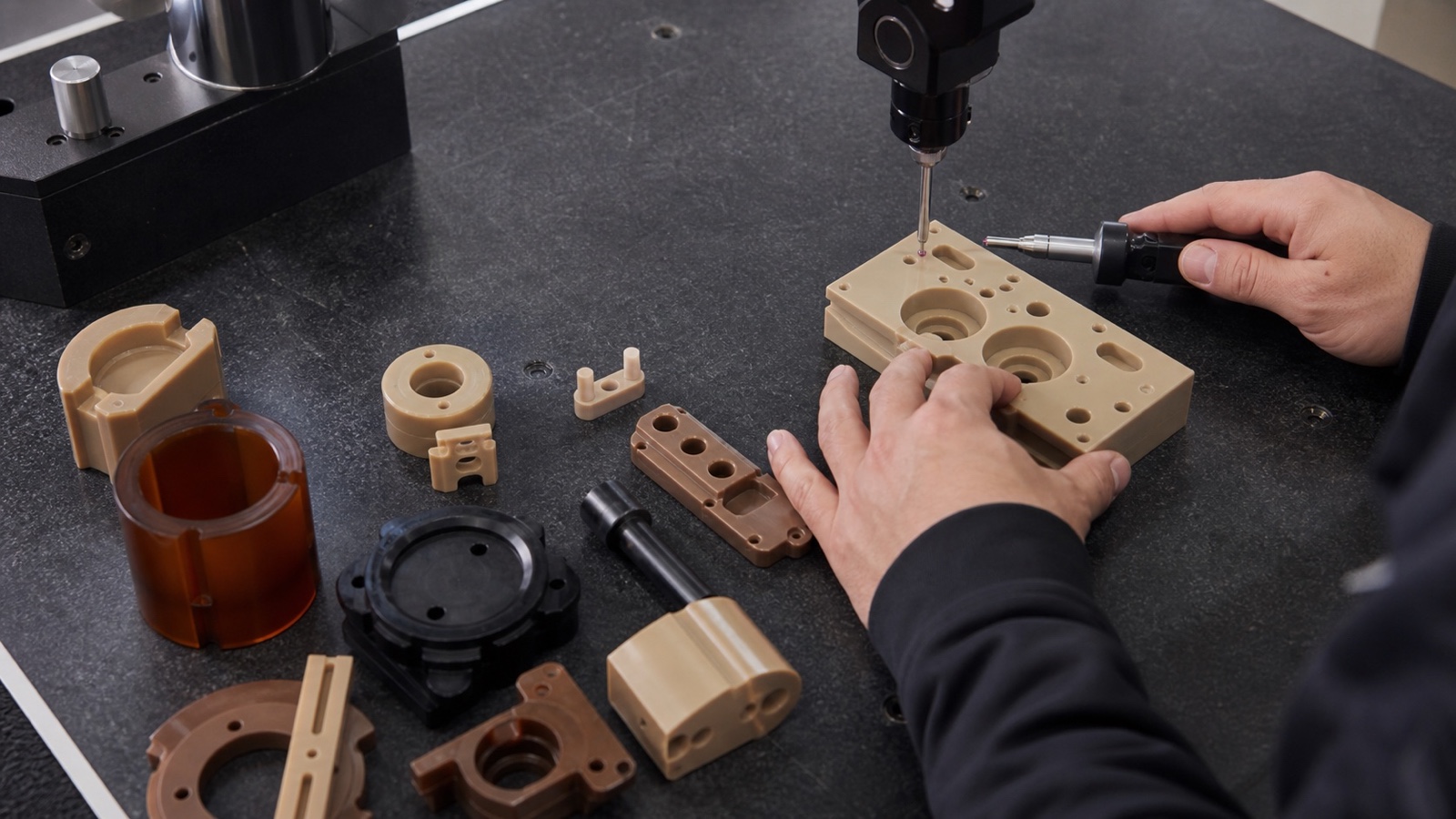
At PlasticCNCPro, we frequently machine complex PEEK geometries with tight tolerances down to ±0.01 mm. Virgin PEEK machines smoothly with continuous chips, comparable to dense brass or POM, though it demands intermediate stress-relief annealing between roughing and finishing passes to prevent residual stress distortion.
Machining LCP stock requires sharper, polished diamond or carbide tooling. Because of its fibrous molecular alignment, improper tool paths or dull cutting edges can induce micro-fibrillation (surface fuzzing) or laminar peeling along cut borders.
Cost, Availability, and Practical Limitations
Project budgets and manufacturing constraints often dictate material trade-offs. Neither PEEK nor LCP is a general-purpose commodity plastic; both carry premium cost structures that must be economically justified by part life cycles.
PEEK Practical Limitations
Raw PEEK resin prices typically range from $80 to over $130 per kilogram for standard grades, with certified medical implantable stock reaching several thousand dollars per kilogram.
Unfilled PEEK exhibits notch sensitivity: sharp internal corners create stress concentration zones where premature fatigue cracking can propagate under cyclic mechanical loads.
LCP Practical Limitations
Standard glass- or mineral-filled LCP compound costs approximately $25 to $45 per kilogram—substantially lower than PEEK resin, though still premium compared to standard PPS or PBT.
LCP parts possess weak weld lines (knit lines) in injection molding. Where two melt streams converge around a core pin, the rigid molecules do not interpenetrate well, reducing local mechanical strength by up to 50–70%.
Best Applications for Precision Parts
Deciding which polymer to specify hinges on whether the part requires structural multi-axis load bearing or microscopic dielectric precision. Here are the primary sectors where each material excels in production.
Where PEEK Excels
PEEK is the undisputed benchmark when components face severe mechanical forces, sliding friction, high-pressure steam, or harsh chemical exposure.
- High-pressure valve seats, compressor plates, and poppets
- Semiconductor wafer chuck rings, CMP retaining rings, and test sockets
- Medical spinal fusion cages, orthopedic implants, and endoscopy blocks
- Aerospace wire conduit brackets, bushings, and fuel system connectors
Where LCP Excels
LCP dominates miniaturized electronics where lead-free surface mount reflow resistance and ultra-thin, intricate geometry are compulsory.
- High-density fine-pitch electrical connectors (0.35 mm pitch)
- 5G millimeter-wave antenna modules and RF transceiver frames
- Micro-coil bobbins, camera module lens holders, and sensor housings
- Automotive ignition components and high-temperature sensor bobbins
How to Choose Between PEEK and LCP
When reviewing customer CAD files and RFQs at PlasticCNCPro, we use an engineering decision framework to evaluate whether PEEK or LCP matches the component’s operational demands.
Evaluate Component Wall Thickness & Feature Scale
If the part features walls under 0.40 mm or micro-slots across multi-pin grids, LCP is mandatory if molding. For machined prototypes, PEEK is generally easier to carve from stock without edge delamination.
Identify Multi-Axis Stress and Bearing Demands
If the part experiences rotational wear, multi-directional shear, or impact loading, specify PEEK. LCP’s directional stiffness cannot tolerate heavy non-axial torque or dynamic sliding friction.
Review Thermal Exposure Cycle
For continuous, steady thermal exposure above 220°C, choose PEEK. For brief, severe thermal spikes—such as passing through an infrared or vapor-phase SMT reflow oven at 260°C—filled LCP handles the cycle with zero dimensional drift.
Compare Production Volume and Tooling Investment
For custom prototypes, low-to-mid batch production (10 to 5,000 pieces), or complex geometries where mold tooling costs are unfeasible, CNC machining PEEK is frequently the most cost-effective path. For millions of identical thin-walled electronic connectors, LCP injection tooling offers unmatched unit economy.
- Add Internal Radii: Always include at least 0.5 mm inside corner radii to eliminate notch sensitivity in PEEK parts.
- Factor Moisture and Thermal Expansion: Although both polymers feature negligible water absorption, ensure thermal coefficients (CLTE) match mating aluminum or steel assemblies across operating temperature ranges.
- Post-Machining Annealing: For ultra-tight PEEK tolerances (±0.01 mm), request intermediate stress relief annealing between roughing and finishing passes to relieve locked-in extrusion stresses.
Frequently Asked Questions
What are the downsides of PEEK material?
The primary disadvantages of PEEK are its high raw material cost (often exceeding $100/kg), notch sensitivity in unreinforced grades, high processing temperatures (around 400°C), and sensitivity to concentrated oxidizing acids like sulfuric and nitric acid. Machining thin sections also demands careful stress-relief annealing to prevent warping.
Is PEEK harder than Delrin?
Yes. Virgin PEEK exhibits a Rockwell M hardness around M99 to M105 (Rockwell R 126), compared to Delrin (polyoxymethylene / POM-H), which typically rates around Rockwell M88 to M94 (Rockwell R 120). PEEK also retains its surface hardness and tensile modulus far better than Delrin at temperatures above 80°C.
Is Ultem a better material than PEEK?
Neither is universally "better"; it depends on your application. Ultem (Polyetherimide / PEI) is an amorphous thermoplastic offering higher dielectric strength, natural amber translucency, and substantially lower raw material cost than PEEK. However, PEEK offers far superior fatigue life, higher continuous service temperature (250°C vs 170°C for Ultem), higher wear resistance, and vastly greater chemical resistance against aggressive solvents.
What can dissolve PEEK?
PEEK is practically insoluble in all common industrial solvents, alcohols, hydraulic fluids, and fuels at ambient and elevated temperatures. The only chemical reagents capable of actively dissolving or degrading PEEK are concentrated sulfuric acid (which sulfonates and dissolves it), hydrofluoric acid, fuming nitric acid, and chlorine or bromine at elevated temperatures.
Request a Precision Polymer Quote
Whether you need high-precision CNC machined PEEK parts, LCP components, or material guidance for extreme operating conditions, our engineering team in Dongguan is ready to review your 2D drawings and 3D CAD models.