
Plastic Density vs Mechanical Strength: Is Heavier Always Stronger?
In precision CNC machining, engineers often assume that a denser, heavier polymer naturally delivers higher mechanical integrity. But in advanced engineering plastics, weight and load-bearing performance operate under vastly different rules than metals. Here is how physical density actually correlates with structural strength on the factory floor.
Key Machining Principle
“In polymer engineering, high density is governed by atomic mass and molecular packing—not load-bearing capacity. PTFE is nearly twice as dense as PEEK, yet PEEK yields four times the mechanical strength. True engineering strength lies in polymer chain architecture, crystallinity, and intermolecular bonding, not mass.”
Understanding Plastic Density and Its Role in Material Selection
When hardware designers transition from structural steel or aluminum to engineering polymers, an intuitive cognitive bias often carries over: the idea that mass equates to ruggedness. In metallurgy, denser alloys typically correlate with solid structural integrity. In our precision CNC facility in Dongguan, we frequently review client drawings where an over-dense resin was specified purely under the mistaken belief that a heavier block yields a more durable machined part.
Density in plastics (ρ, measured in g/cm³) reflects the molecular weight of the constituent polymer chains and how tightly those repeating units crystallize together. PTFE (fluoropolymer) incorporates heavy fluorine atoms along its carbon backbone, resulting in a dense 2.15 to 2.20 g/cm³. Conversely, UHMW-PE consists purely of carbon and hydrogen atoms, yielding a buoyant 0.93 to 0.94 g/cm³.
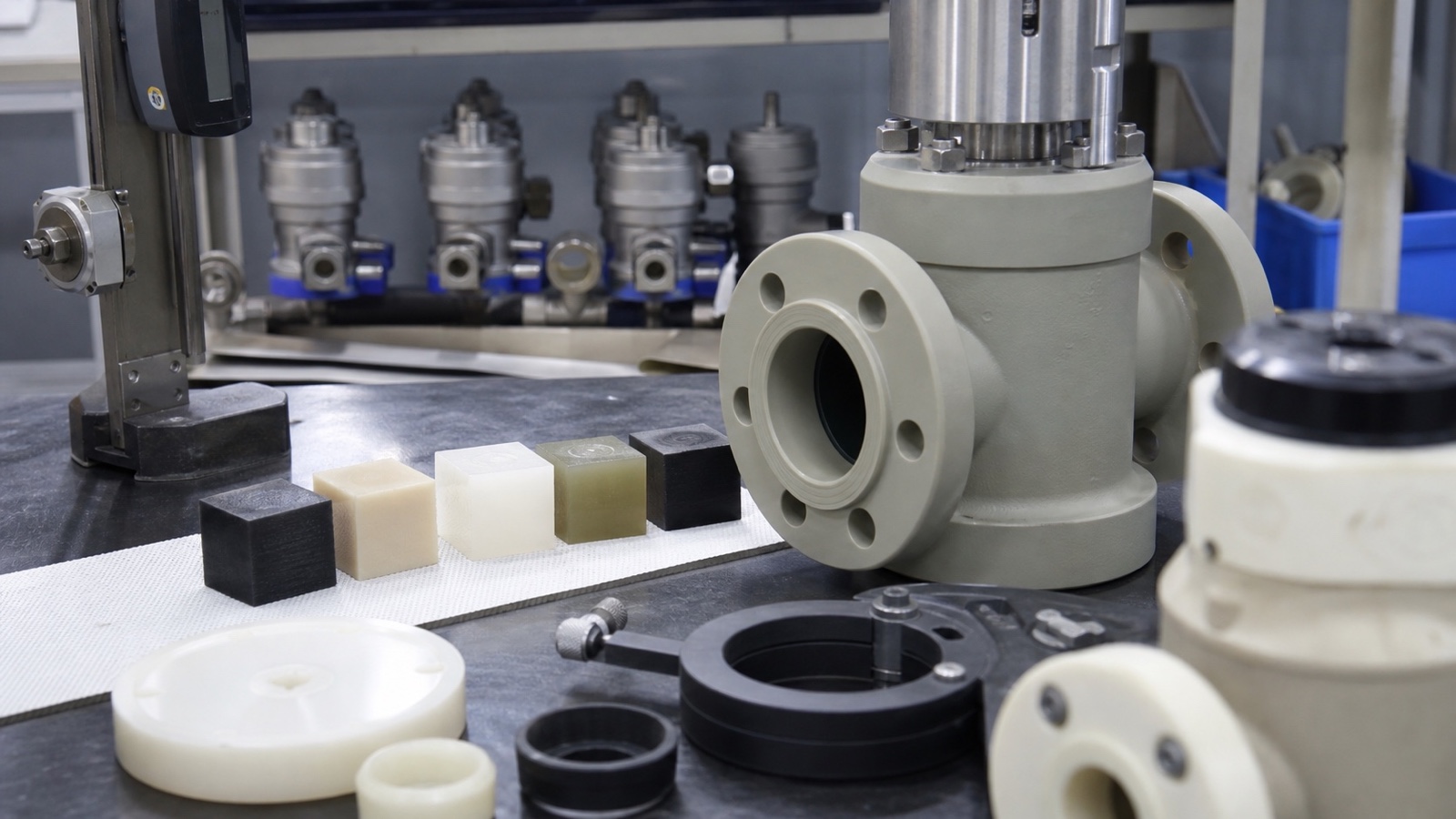
Density directly influences real-world engineering constraints:
Lower density cuts mass in moving automation components, lowering motor torque requirements and kinetic vibration.
Specific gravity dictates whether internal valves, floats, and impellers sink or float in subsea, wastewater, or chemical baths.
Engineering polymers are purchased by kilogram but machined by volume; heavier stock significantly raises per-part material cost.
Core Mechanical Properties That Define Strength
"Strength" is not a singular engineering metric. When we evaluate an aerospace housing, an end-effector gripper, or a high-pressure manifold, we isolate the exact operational stresses the part must sustain without yield or catastrophic failure.
Tensile and Flexural Strength
Tensile Strength quantifies the maximum longitudinal pull an engineering plastic withstands before elongating permanently or fracturing (ASTM D638). Unfilled high-performance PEEK delivers tensile figures up to 100–110 MPa, while standard commodity Polyethylene rests between 20 and 30 MPa.
Flexural Strength (ASTM D790) evaluates how well a machined structural beam resists bending moments. For gears, guide tracks, and robotic arm fingers, flexural strength dictates whether a part snaps under continuous offset mechanical loads. Dense fluoropolymers flex under minuscule loads with modest flexural yields (~30 MPa), whereas Torlon PAI or carbon-fiber-reinforced PEI sustain flexural loads exceeding 170 to 220 MPa without plastic deformation.
Stiffness, Hardness, and Toughness
Designers must balance modulus against fracture resilience. Increasing stiffness often trades away toughness:
Modulus of Elasticity (Stiffness)
Indicates resistance to elastic deflection under applied force. Carbon-filled PEEK achieves a modulus upwards of 10 GPa, maintaining sub-millimeter tolerances under severe mechanical pressure.
Surface Hardness (Rockwell / Shore D)
Determines indentation and abrasive marring resistance. High surface hardness (e.g., Acetal/Delrin at Rockwell M88) prevents localized galling in continuous sliding bushings.
Impact Toughness (Izod / Charpy)
Measures energy absorption during sudden shock. UHMW-PE exhibits virtually unbreakable Izod impact resistance, absorbing heavy impacts without brittle failure despite lower tensile yield.
Does Higher Density Improve Mechanical Strength?
The short answer from our machining benches is a definitive no. In polymers, higher density does not automatically translate to greater load-bearing strength, higher stiffness, or superior wear resistance.
To disprove the density-strength proportionality, we can compare standard production plastics machined daily in our workshops:
| Polymer Grade | Density (g/cm³) | Tensile Strength (MPa) | Tensile Modulus (GPa) | Impact / Ductility Note |
|---|---|---|---|---|
| PTFE (Virgin) | 2.15 – 2.20 | 20 – 35 | 0.4 – 0.6 | Heaviest unfilled plastic; creeps under load; low tensile yield |
| POM-C (Acetal) | 1.41 | 65 – 70 | 2.8 – 3.2 | Medium density; rigid, dimensionally stable; low friction |
| PEEK (Virgin 450G) | 1.30 – 1.32 | 100 – 110 | 3.8 – 4.2 | 40% lighter than PTFE; triple the tensile strength; rigid |
| PAI (Torlon 4203) | 1.41 – 1.45 | 150 – 190 | 4.5 – 5.0 | Ultra-high tensile and compressive strength at extreme temp |
| UHMW-PE | 0.93 – 0.94 | 22 – 30 | 0.7 – 0.9 | Floats in water; lowest tensile; highest impact toughness |
Virgin PTFE has a density of roughly 2.18 g/cm³, yet easily succumbs to cold-flow deformation under merely 15 MPa of compressive clamp load. Unfilled PEEK, with a density of only 1.31 g/cm³, supports over 100 MPa. Evaluating resin selection purely by mass leads to over-engineered, heavy, yet mechanically inadequate parts.
Strength-to-Weight Ratio: The Real Performance Metric
In advanced aerospace, autonomous robotics, medical diagnostics, and automotive powertrains, the determining design figure is specific strength (tensile strength divided by density). Maximizing specific strength allows systems to slash payload weight, eliminate inertia lag, reduce power consumption, and maintain structural safety margins.
When structural plastics compete against metals like brass, zinc, or stainless steel, their strength-to-weight ratio transforms the engineering economics:
Aerospace Structural Brackets
Replacing 7075 aluminum brackets with 30% carbon-fiber PEEK (CF-PEEK) cuts part mass by approximately 50%. While raw aluminum boasts higher absolute tensile strength, CF-PEEK's density of 1.44 g/cm³ gives it comparable specific strength alongside exceptional vibration dampening and chemical resistance against hydraulic fluids.
High-Speed Robotics & Pick-and-Place
In dynamic end-effectors cycling 100 times per minute, every gram of deadweight increases motor thermal loads and settling times. By machining end-grippers from Torlon PAI or unfilled Polyoxymethylene (POM) instead of 304 stainless steel, inertia drops by more than 80% without sacrificing cyclic fatigue life.
Top High-Strength Plastics and Their Density Profiles
To assist engineering and procurement teams in identifying optimal materials, here are the dominant high-strength thermoplastics machined at PlasticCNCPro, mapped across their tensile and density profiles.
Torlon PAI (Polyamide-imide)
Density: ~1.41 - 1.45 g/cm³The undisputed champion of melt-processable thermoplastics for pure mechanical strength. Torlon offers tensile values up to 190 MPa and compressive strength over 220 MPa, retaining high modulus up to 260°C.
PEEK (Polyetheretherketone)
Density: ~1.30 - 1.32 g/cm³Combining balanced tensile strength (~105 MPa unfilled, ~220 MPa carbon-filled), low moisture uptake, broad chemical inertness, and continuous service temperatures of 250°C. It is our most requested polymer for critical semiconductor and fluid handling components.
Ultem PEI (Polyetherimide)
Density: ~1.27 - 1.28 g/cm³An amber, semi-transparent amorphous thermoplastic with tensile strength approaching 105 MPa and exceptional dielectric resistance. PEI bridges the cost-performance gap between standard engineering resins and PEEK.
Nylon 6/6 (Polyamide)
Density: ~1.14 - 1.15 g/cm³A workhorse engineering polymer delivering 75–85 MPa tensile strength at an exceptionally low density. Outstanding cyclic wear resistance, though hygroscopic expansion must be accounted for during machining.
Polycarbonate (PC)
Density: ~1.20 g/cm³Offers 65–70 MPa tensile strength combined with unparalleled optical transparency and impact absorption, ideal for sight glasses, safety shields, and internal manifold blocks.
Is There a Plastic as Strong as Metal?
Yes, especially when reinforced with chopped or continuous fibers. While unfilled engineering plastics cannot match the absolute tensile strength of hardened tool steel (~1,500 MPa), 30% to 50% carbon-fiber-reinforced PAI and PEEK achieve tensile yields exceeding 230 to 280 MPa.
When compared to common industrial metals like die-cast zinc alloys (~200–280 MPa tensile, density 6.6 g/cm³) or standard architectural aluminum 6063-T6 (~215 MPa tensile, density 2.7 g/cm³), advanced carbon-reinforced polymers equal or surpass their mechanical performance while weighing half to a quarter as much, all without risk of galvanic corrosion.
What Material Has the Best Strength-to-Weight Ratio?
Across synthetic polymers, continuous-fiber carbon-reinforced thermoplastic composites (such as UD-PEEK tapes or fabric layups) yield the highest strength-to-weight figures, with specific tensile metrics easily outclassing grade 5 titanium (Ti-6Al-4V).
For monolithic parts machined from solid stock on CNC machining centers, 30% Carbon-Fiber Reinforced PEEK and Torlon 5030 (PAI with 30% glass fiber) represent the pinnacle of specific strength, providing high flexural rigidity and minimal thermal expansion under severe stress.
What Is the Strongest Plastic on Earth?
From a bulk machinable polymer perspective, Torlon Polyamide-imide (PAI) is widely considered the strongest unfilled thermoplastic commercially available, sustaining tensile stresses of up to 190 MPa and compressive loads over 220 MPa at ambient temperatures.
If fiber-reinforced grades are considered, Carbon-Fiber PAI and Custom Carbon-PEEK formulations push tensile figures beyond 250 MPa. However, their practical limitations include high raw material costs, cutter tool wear during CNC routing and turning, and strict post-curing cycles required to relieve internal molding stresses.
Density Comparisons Across Plastic Types
Engineering resins fall into distinct density brackets based on their chemical families. Recognizing these structural categories prevents costly mismatches during prototype and production stages:
Polyolefins (0.89 – 0.96 g/cm³)
Polypropylene (PP), HDPE, and UHMW-PE float in water. They excel in chemical tanks, wear strips, and chute liners due to low friction and low density, but they exhibit low tensile strength and high thermal deflection under load.
Standard Engineering Thermoplastics (1.12 – 1.45 g/cm³)
Nylon (PA), Polycarbonate (PC), Acetal (POM), PBT, and PET. This is the sweet spot for the majority of industrial CNC parts—combining balanced strength, dimensional predictability, high machinability, and economical weight profiles.
High-Performance Polyarylethers & Imides (1.27 – 1.45 g/cm³)
PEEK, PEI, PPS, PSU, and PAI. Moderate in mass but at the absolute top of the strength, continuous heat resistance, and modulus curves. Ideal for mission-critical parts replacing metals in demanding environments.
Fluoropolymers (1.75 – 2.20 g/cm³)
PVDF, ECTFE, and PTFE. Denser than all other engineering polymers, heavily loaded with halogen atoms. They deliver unmatched chemical inertness and cryogenic-to-high thermal stability, yet their mechanical tensile and yield strengths remain modest.
Practical Implications for Design and Manufacturing
When specifying materials for CNC-machined components, understanding that density does not equal strength directly shapes cost control, quality assurance, and manufacturing success:
Purchasing Economics by the Kilogram
Stock shapes (rods, plates, hollow bars) are sold by weight. A 50mm thick slab of PTFE (~2.18 g/cm³) costs vastly more per unit volume than a slab of Acetal (~1.41 g/cm³), solely due to density. If high chemical resistance isn't required, choosing a denser material simply inflates the bill of materials.
Machining Tool Deflection & Clamping Rigidity
High density does not guarantee clamping resistance. PTFE parts will easily crush or cold-flow under standard vice pressure, requiring custom soft jaws and light passes. In contrast, stiffer polymers like PEEK and POM hold aggressive feeds and tight tolerances without shifting or creeping.
Thermal Dissipation and Stress Relief
Dense polymers often feature low thermal conductivity. Without high-pressure coolant and balanced spindle speeds, localized heat buildup during CNC milling leads to internal stress crystallization, warpage, or post-machining dimensional drift. We frequently integrate multi-stage intermediate annealing cycles for high-rigidity resins like PEEK and Torlon to ensure dimensional stability.
Frequently Asked Questions
What is stronger, 4 mil or 6 mil plastic?
Assuming identical resin composition (such as low-density polyethylene sheet or film), 6 mil plastic (0.006 inches thick) is approximately 50% thicker and substantially stronger than 4 mil plastic (0.004 inches). It provides higher puncture resistance, greater tear strength, and higher absolute tensile resistance under tensile strain simply because there is more cross-sectional material to carry the load.
How do additives influence both density and strength?
Additives alter both parameters significantly. Glass fiber reinforcement (e.g., PEEK-GF30) increases both density (from ~1.31 to ~1.51 g/cm³) and flexural strength dramatically. Carbon fiber reinforcement increases tensile strength and modulus even higher, while maintaining a lower density (~1.44 g/cm³) than glass. Conversely, mineral or barium sulfate fillers increase density heavily for X-ray opacity or sound dampening, but often reduce impact toughness and elongation.
Can lightweight plastics replace metal in structural parts?
Yes, repeatedly. In aerospace brackets, surgical instruments, subsea robotics, and industrial pump gears, replacing aluminum, bronze, or stainless steel with reinforced PEEK, Torlon PAI, or POM reduces weight by 40% to 70%. These engineering polymers eliminate galvanic corrosion, damp acoustic resonance, and remove the need for external lubrication while meeting all operational load-bearing specifications.
Need Engineering Support for Polymer Material Selection?
At PlasticCNCPro in Dongguan, we combine practical CNC machining experience with a comprehensive understanding of polymer material science. Whether you are balancing weight, chemical resistance, wear life, or tight dimensional tolerances (±0.01 mm), our engineering team reviews your CAD files, drawings, and operating conditions to recommend the optimal engineering plastic.
From one-off functional prototypes to repeat low-volume and series production, we deliver certified quality, smooth finishes, and dependable global export service.
Request an Engineering Review & Quotation
Upload your 2D drawings (PDF / DWG) or 3D models (STEP / IGES) along with your resin preferences and tolerances. Our engineering team responds with manufacturability feedback and transparent pricing within 24 hours.