
PMMA vs PETG for Machined Parts: Clarity, Strength & Machinability Compared
Selecting the optimal transparent polymer for precision CNC machining requires balancing optical transmission, fracture toughness, chip formation dynamics, and chemical resilience. As machining engineers at PlasticCNCPro, we evaluate how polymethyl methacrylate (PMMA) and polyethylene terephthalate glycol (PETG) perform across subtractive milling, turning, and tight-tolerance finishing.
Key Takeaway: If pure optical transmission, glass-like polishing, and dimensional rigidity are your primary drivers, PMMA is unmatched. If your part encounters cyclical mechanical shock, requires snap fits, or demands higher fracture toughness without micro-chipping, PETG is the superior engineering selection.
What Are PMMA and PETG?
In our daily CNC milling and turning operations at our Dongguan facility, clear polymer components represent a substantial portion of fluid-handling, optical, and diagnostic hardware. While both PMMA and PETG serve as transparent engineering thermoplastics, their underlying chemical morphology dictates divergent behaviors under high-speed cutting tools.
PMMA (Polymethyl Methacrylate) is commonly known under commercial trade names like Plexiglas, Perspex, or Lucite, confirming that PMMA is chemically identical to acrylic. It is a rigid, synthetic polymer derived from methyl methacrylate monomers. It possesses an amorphous molecular structure that yields exceptional optical clarity, UV resilience, and surface hardness, though it exhibits inherent brittleness when subjected to sharp impact or uneven mechanical clamping.
PETG (Polyethylene Terephthalate Glycol-Modified) is a copolyester created by introducing cyclohexanedimethanol (CHDM) into standard PET polymer chains. This glycol modification inhibits crystallization during extrusion and machining, eliminating internal hazing while retaining the ductile flexibility, toughness, and chemical resistance typical of polyesters. Although predominantly recognized in thermoforming and 3D printing filaments, thick-gauge extruded and cast PETG billets are widely machined for rugged industrial components.
Optical Clarity Comparison
When a mechanical engineer specifies a "clear" plastic, optical criteria can mean anything from rudimentary fluid inspection to laser-transmission collimation. The transmission and surface scatter differences between PMMA and PETG are stark:
Glass-Grade Transmission
PMMA transmits up to 92% of visible light, surpassing conventional soda-lime glass (~90%). Its refractive index (1.49) and minimal haze (<0.5%) make it the benchmark for light guides, lenses, and fluidic analysis chambers. Diamond-tooled and vapor-polished PMMA components achieve near-flawless transparency.
Translucent Utility
PETG transmits approximately 88% to 90% of visible light. While transparent in thin cross-sections, thick machined billets often exhibit a faint blue-gray tint and higher internal haze (1.0% to 2.5%). It cannot be polished to diamond-quality optical perfection as effectively as PMMA.
When surface optical polishing is required post-CNC milling, PMMA responds exceptionally well to diamond fly-cutting, flame polishing, and manual buffing with aluminum oxide compounds. PETG tends to smear under high-friction buffing wheels due to its lower glass transition temperature, making true optical clarity harder to achieve post-machining.
Mechanical Properties: Strength, Impact Resistance, and Durability
The trade-off between PMMA and PETG mirrors the classical engineering balance between stiffness and ductility. PMMA delivers high tensile and flexural modulus but fails catastrophically when subjected to crack propagation or localized shock. Conversely, PETG absorbs energy through plastic deformation before reaching ultimate fracture.
| Property (Typical Nominal Values) | PMMA (Cast Acrylic) | PETG (Engineering Grade) | Polycarbonate (PC Reference) |
|---|---|---|---|
| Tensile Strength (Yield / Break) | 70 – 75 MPa | 48 – 53 MPa | 65 – 72 MPa |
| Flexural Modulus (Stiffness) | 3,100 – 3,300 MPa | 2,000 – 2,200 MPa | 2,300 – 2,400 MPa |
| Izod Notched Impact Strength | 16 – 22 J/m (Brittle) | 80 – 115 J/m (Tough) | 600 – 850 J/m (Extreme) |
| Rockwell Hardness | M90 – M95 (Scratch Resistant) | R105 – R115 (Softer) | M70 / R118 |
| Glass Transition Temp (Tg) | 105 °C | 80 °C | 145 °C |
| Light Transmission Rate | 92% | 88% – 90% | 87% – 89% |
Is PETG Stronger Than Polycarbonate?
A frequent question we resolve during project reviews is whether PETG matches or exceeds polycarbonate (PC). The technical answer is unambiguous: no, PETG is not stronger than polycarbonate. Polycarbonate provides notched impact ratings exceeding 600 J/m—making it virtually unbreakable in bullet-resistant barriers and high-velocity machine shrouds—whereas PETG averages 80 to 115 J/m. However, PETG is approximately 4 to 5 times more impact-resistant than PMMA, making it a cost-effective intermediate that avoids the micro-fissuring and crazing vulnerabilities of acrylic without incurring polycarbonate's elevated raw stock expense and machining friction heat.
Machinability for CNC and Precision Parts
Machining transparent plastics demands rigorous thermal and swarf management. Unlike metals, which dissipate heat through thick chips, thermoplastics possess low thermal conductivity. Trapped cutting heat quickly induces localized softening, gumming, or internal stress that leads to delayed micro-cracking.
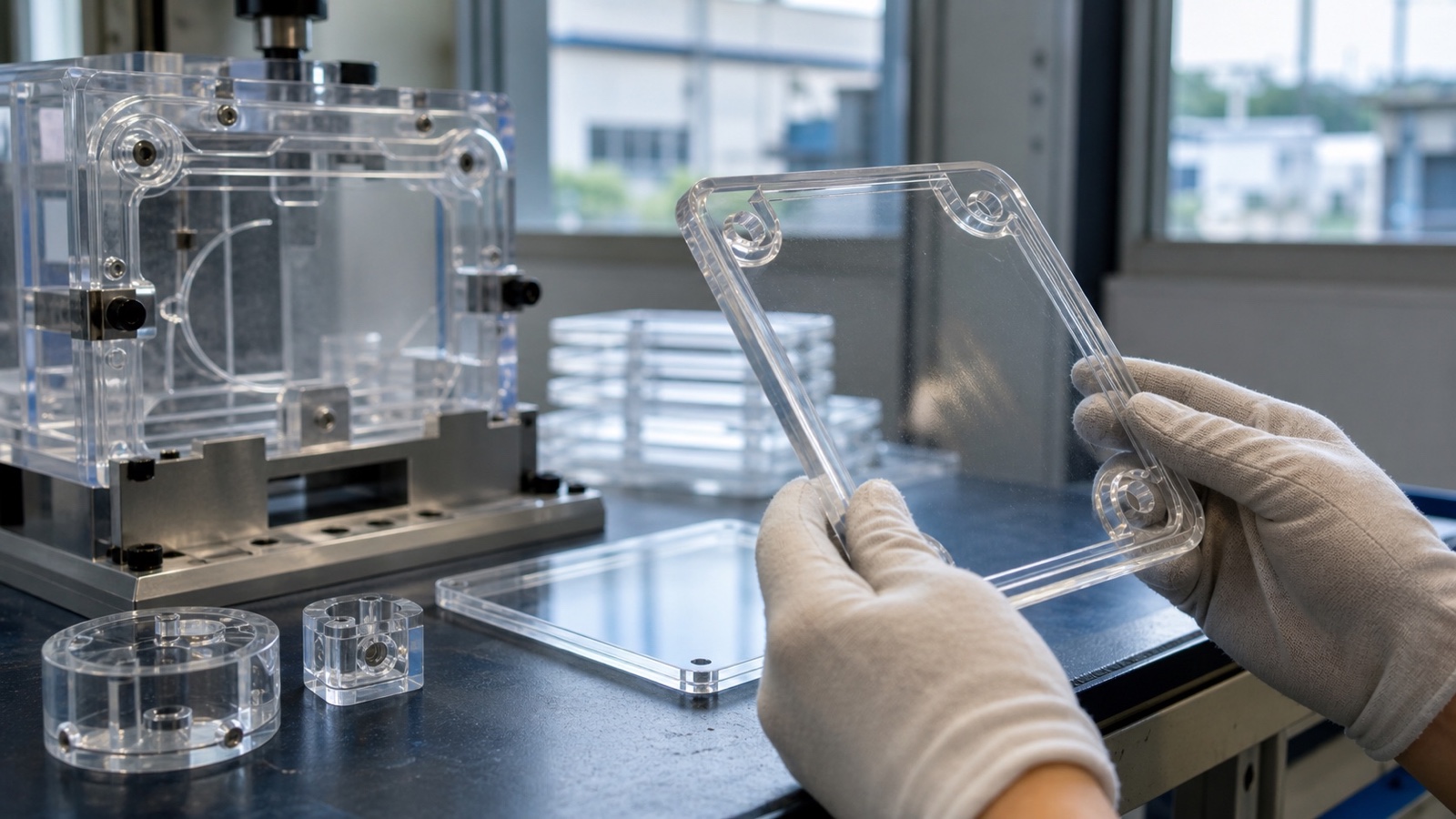
Here is how both plastics behave on 3-axis and 5-axis CNC routers and machining centers in our Dongguan shop:
PMMA Chip Formation & Edge Integrity
PMMA produces crisp, brittle chips. Because it does not gum easily when sharp, polished single-flute 'O-flute' carbide tools are deployed, it yields smooth, chatter-free edge finishes. However, aggressive tool entry, dull drill bits, or excessive clamping forces can cause sudden breakout chipping at through-holes or sharp internal corners.
PETG Ductility & Swarf Evacuation
PETG yields ductile, continuous ribbon chips rather than brittle flakes. If spindle speeds are too high or feed rates too conservative, the swarf wraps around the cutter body, creating friction heat that melts the plastic back onto the machined sidewall. Constant cold-air blast or deionized air streams are crucial during deep pocket milling.
Drilling, Threading, and Tapping
Tapping threads into PMMA carries high risk of stress concentration and subsequent crack propagation over time. We typically recommend brass or stainless steel threaded inserts or generous thread reliefs. PETG is far more forgiving for direct tapping; its ductile matrix resists the hoop stresses applied by metric and imperial fastener tightening.
Standard water-soluble petroleum cutting coolants and solvent-bearing fluids must never contact stressed PMMA, as they trigger immediate chemical craze cracking. At PlasticCNCPro, we use clean compressed air jets, vortex cold-air guns, or dedicated alcohol-free synthetic mists calibrated specifically for transparent optical polymers.
Is Acrylic Better Than PETG for Machined Parts?
Neither material is universally "better"; superiority is entirely governed by your mechanical load envelope, optical threshold, and environmental exposure.
When PMMA (Acrylic) Wins Optical Priority
- ✓ Superior Optical Finish: Can be diamond fly-cut and vapor-polished to 100% optical clarity.
- ✓ Surface Hardness: Much higher scratch and mar resistance than PETG (Rockwell M95 vs softer copolyesters).
- ✓ UV & Weathering: Naturally stable under outdoor sunlight without yellowing or degradation over 10+ years.
- × Vulnerability: Highly notch-sensitive; prone to catastrophic cracking under shock impact.
When PETG Wins Toughness Priority
- ✓ High Impact Toughness: 4x to 5x the impact resistance of PMMA; absorbs heavy physical vibration.
- ✓ Chemical Ductility: Resists sanitizing agents, weak acids, and sterilization washes better than acrylic.
- ✓ Fastener Integrity: Direct thread engagement and snap tabs can be machined without sudden brittle fracture.
- × Vulnerability: Scratches easily; lower service temperature limit (~65–70°C continuous).
Common Applications for Machined PMMA and PETG Parts
In our work supporting global OEMs in medical diagnostics, semiconductor assembly, and robotics, we manufacture custom clear plastic components tailored to distinct operational environments:
PMMA Applications
- • Microfluidic diagnostic chips & manifold blocks
- • Optical prisms, light guides, and collimator housings
- • Analytical instrumentation sight windows
- • High-end electronic display faceplates
- • Architectural and high-durability outdoor signage
PETG Applications
- • Industrial machinery viewing shields & safety baffles
- • Food-processing conveyor inspection guards (FDA-compliant)
- • Pharmaceutical packaging jigs and sample nests
- • Robotic end-effector covers subject to accidental drop
- • Chemical laboratory containment covers
Material Selection Framework
Before releasing your 2D engineering drawings and 3D CAD models to production, apply this practical engineering decision tree:
Does laser transmission, spectrophotometry, or distortion-free magnification pass through the component? If yes, specify PMMA.
Will assembly personnel bolt directly through the plastic without torque-limiting sleeves, or will the part undergo vibration? If yes, specify PETG to prevent crack propagation.
Are washdown cycles using isopropyl alcohol, strong detergents, or sterilizers frequent? PETG offers broader resistance to common solvents; PMMA will quickly stress-craze when exposed to alcohols and esters.
Continuous service above 70°C will warp PETG (Tg ~80°C). PMMA operates safely up to approximately 85–90°C (Tg ~105°C). For continuous service above 110°C, migrate to Polycarbonate or Polysulfone (PSU).
Frequently Asked Questions
Direct technical answers to common queries regarding clear plastic machining.
What is the best plastic for machining?
Across all engineering thermoplastics, POM (Acetal/Delrin) is widely considered the best plastic for precision CNC machining due to its excellent dimensional stability, low internal stress, and clean chip formation. However, when clear or optical transparency is required, PMMA is the best plastic for machining if surface polish and optical clarity are paramount, while Polycarbonate is the best for extreme impact resistance.
Is acrylic better than PETG?
Acrylic is better than PETG for applications demanding maximum light transmission (92%), surface scratch resistance, UV stability, and brilliant flame or diamond polishing. However, PETG is better than acrylic if the machined part requires impact toughness, snap-fit resilience, direct thread tapping, or resistance to aggressive washdown chemicals.
Is PETG stronger than polycarbonate?
No. Polycarbonate (PC) is substantially stronger and tougher than PETG. Polycarbonate offers notched Izod impact strength in the range of 600 to 850 J/m and a continuous heat deflection temperature above 130°C. In comparison, PETG provides roughly 80 to 115 J/m impact resistance and softens near 80°C. PETG is tougher than acrylic, but not polycarbonate.
Is acrylic and PMMA the same?
Yes, acrylic and PMMA refer to the exact same material. PMMA is the chemical abbreviation for polymethyl methacrylate, which is the polymer family widely known by the common name acrylic or registered trade names including Plexiglas, Lucite, and Perspex.
Precision Machining Support at PlasticCNCPro
Based in Dongguan, China, we specialize exclusively in precision CNC milling, turning, drilling, and tapping of engineering plastics. Whether you need rapid prototypes or production batches of optical PMMA manifolds, rugged PETG machine shrouds, or high-performance PEEK components, our engineering team reviews your drawings, tolerances, and mating assemblies to ensure consistent manufacturing execution.
Ready to Machine Your Clear Plastic Components?
Send us your 2D drawings, 3D CAD files (STEP/IGES), and material specifications. Our engineering team at PlasticCNCPro will review tolerances, evaluate optical and structural requirements, and deliver a detailed quotation and DFM assessment.