
Engineering materials guide · 2025
POM vs Nylon Density: Best Material for Precision Parts in 2025
We compare POM and nylon density, dimensional stability, strength, wear, chemical resistance, and CNC machinability so engineers can select the right polymer for high-precision components.
For most precision plastic parts, density is only the starting point. The practical decision is whether the part needs POM’s dimensional consistency and low friction or nylon’s toughness, flexibility, and broader load response.
Understanding POM and Nylon Densities
POM, commonly called acetal, has a typical specific gravity of approximately 1.41 g/cm³. Common unfilled nylon grades are lighter, generally around 1.14–1.15 g/cm³. In practical terms, an identically sized POM component weighs roughly 23% more than a comparable unfilled nylon component.
That difference affects more than shipping weight. It influences inertia in moving assemblies, the supporting structure around a component, the mass of rollers and gears, and the amount of material required to reach a target stiffness. Density is not a direct measure of strength, so we use it together with moisture behavior, modulus, friction, and operating temperature when reviewing a drawing.
| Material | Typical density | Design implication |
|---|---|---|
| POM / acetal | 1.41 g/cm³ | Higher mass and good stiffness-to-size consistency |
| Nylon / polyamide | 1.14–1.15 g/cm³ | Lower mass, with dimensions more sensitive to humidity |
POM vs Nylon: Key Material Properties Comparison
The following comparison is a material-selection guide rather than a substitute for a grade-specific datasheet. Filled, lubricated, heat-stabilized, and reinforced grades can behave differently from standard stock.
| Property | POM / acetal | Nylon / polyamide | Relevance to precision parts |
|---|---|---|---|
| Density | 1.41 g/cm³ | 1.14–1.15 g/cm³ | Controls weight and moving-part inertia |
| Tensile strength | Strong and consistent in standard dry conditions | Strong, tough, and grade-dependent | Nylon’s absorbed moisture can change measured performance |
| Moisture absorption | Very low relative to nylon | Meaningful absorption, varying by polyamide grade | Can alter fit, hole size, and preload |
| Thermal performance | Stable for many general engineering applications | Useful thermal performance, but moisture and grade affect behavior | Thermal expansion and temperature history must be considered |
How Density Affects Dimensional Stability
Density itself does not cause nylon to swell. The important relationship is that standard nylon’s lower density is accompanied by a more moisture-sensitive polymer structure. Nylon absorbs water from humid air, and that absorbed moisture acts as a plasticizer. The result can be dimensional growth, lower stiffness, and a change in fit after machining.
For a nylon bushing, guide, or precision spacer, the risk is not limited to a larger outside diameter. Internal bores, press fits, clearances, and preload can all shift. A part machined in a dry environment may not perform identically after storage or operation in a humid environment.
POM has much lower moisture sensitivity, so its dimensions are generally more predictable when ambient humidity changes. This is one reason we often recommend POM for close-fitting gears, bushings, sliding guides, and locating components where the part must retain its geometry over time.
Engineering note
If nylon is the preferred material for toughness or cost, specify the expected humidity range and conditioning state. We can review whether the tolerance should be adjusted for the intended environment rather than inspected only at the factory.
Strength and Mechanical Performance
When customers ask, “Which is stronger, nylon or Delrin?” I first ask what kind of strength they mean. Tensile strength, flexural stiffness, impact resistance, fatigue behavior, and resistance to permanent deformation are not interchangeable.
POM, including Delrin-branded grades, is stiff, dimensionally consistent, and effective for parts that must hold a profile or transmit motion. It is often a strong choice for load-bearing precision components because it resists deformation while maintaining a stable fit.
Nylon is tough and has good impact resistance. It can tolerate shock and flexing well, particularly where a component benefits from some compliance. However, absorbed moisture can reduce stiffness and alter mechanical performance, so the dry-as-machined condition should not be the only design reference.
Choose POM for controlled stiffness
POM is well suited to rigid gears, precision carriers, low-deflection guides, and parts where a stable interface matters more than maximum impact absorption.
Choose nylon for toughness
Nylon can be advantageous for shock-loaded brackets, rollers, wear elements, and components that need toughness or controlled flexibility, provided moisture effects are included in the design.
Wear Resistance and Friction Characteristics
POM is widely selected for low-friction sliding interfaces because it combines a naturally slick surface with good dimensional stability. In gears, bearings, rollers, guide blocks, and wear strips, that combination helps maintain engagement and clearance as the part operates.
Nylon also offers useful wear resistance and can perform well under impact and moderate sliding loads. Its friction and wear response, however, can vary with humidity, mating material, surface finish, pressure, speed, lubrication, and grade. A nylon part may become softer and behave differently after absorbing moisture.
Neither material should be selected from a coefficient-of-friction value alone. For a bearing or gear, we review load, speed, duty cycle, shaft material, lubrication, heat generation, and the required life. When the application prioritizes predictable low-friction motion, POM is usually the more straightforward starting point.
Machinability for Tight-Tolerance Parts
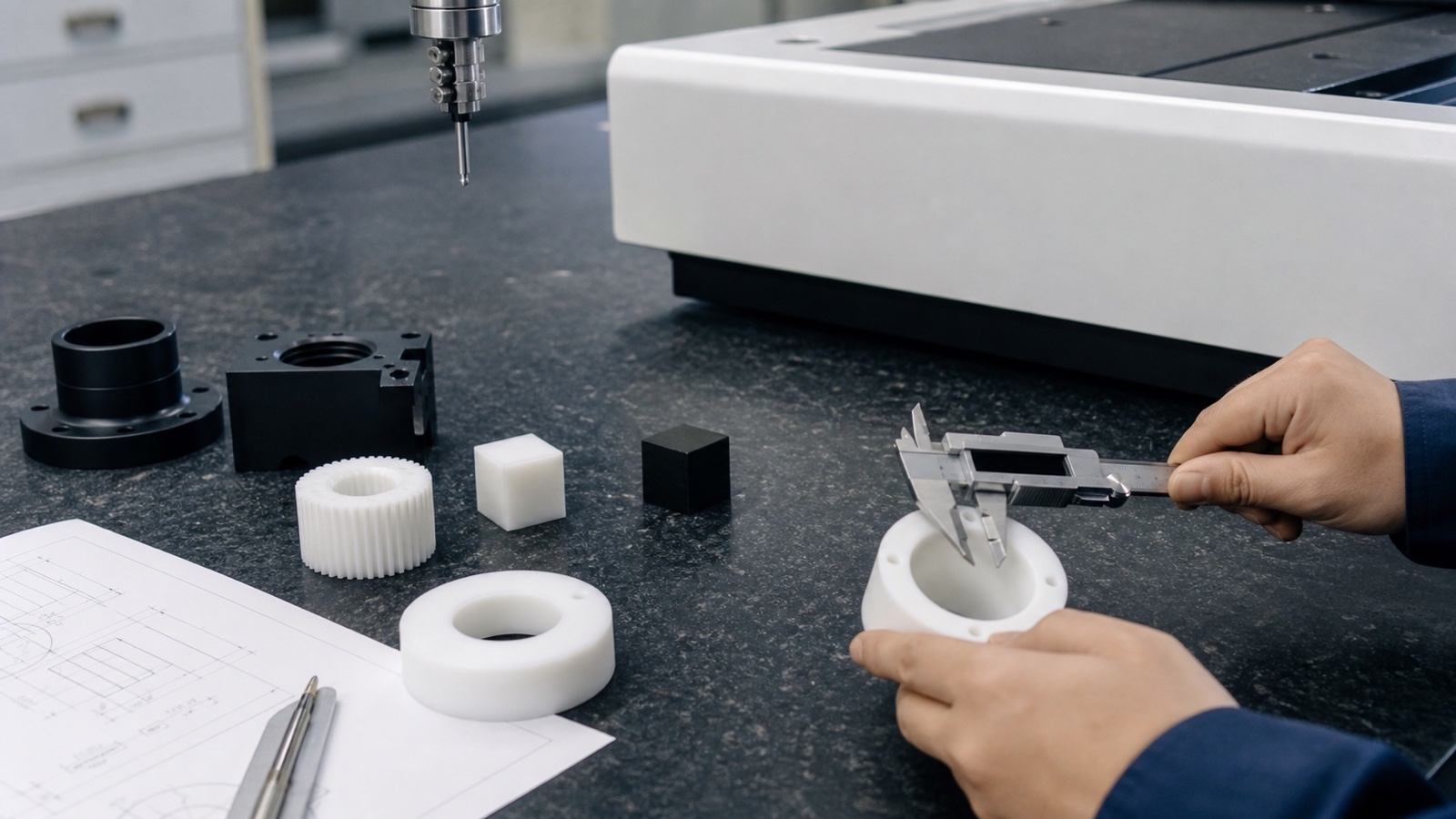
Both POM and nylon can be CNC milled, turned, drilled, tapped, threaded, and slotted. Their machining behavior is not identical, so tool condition, workholding, cutting strategy, stock preparation, and inspection timing all matter.
POM generally produces clean, controllable chips and supports crisp edges, accurate bores, and repeatable finishing operations. It is often easier to hold a close tolerance because the material absorbs little moisture and is less likely to change size between machining and inspection.
Nylon can produce stringy chips and may flex under cutting forces, especially in thin walls or unsupported sections. Heat and friction can also influence the finished surface. We manage this through suitable workholding, sharp tooling, controlled cutting conditions, and attention to the stock’s environmental history.
Confirm the material grade
Record whether the stock is standard, lubricated, reinforced, or otherwise modified.
Review geometry before quoting
Thin walls, deep bores, interrupted cuts, and long unsupported features can affect achievable precision.
Define inspection conditions
For nylon, include the expected service humidity and conditioning state when approving critical dimensions.
Chemical Resistance and Environmental Performance
POM offers good resistance to many oils, fuels, and common solvents, making it useful in mechanical equipment, fluid-handling assemblies, and industrial automation. Compatibility still depends on concentration, temperature, exposure duration, stress, and the specific grade.
Nylon has useful resistance to oils and many industrial environments, but moisture remains its defining environmental consideration. Water, humidity, cleaning processes, and storage conditions can affect both its dimensions and mechanical response. Some chemicals can also interact with polyamide grades more strongly than expected.
For humid equipment, exposed guides, or precision fluid-handling parts, we evaluate the full environment rather than relying on a generic material name. If chemical exposure is severe or the temperature is elevated, another engineering polymer may be more appropriate than either standard POM or nylon.
Cost Analysis and Value for Precision Applications
Nylon’s lower density can reduce material mass, and standard nylon may be attractive when the part is large, lightly loaded, or produced in a design that does not require exceptionally stable dimensions. POM can carry a higher material cost in some grades, but its machining predictability may reduce rework and fit-related problems.
The total cost should include raw stock, machining time, tool wear, inspection, conditioning, rejected parts, assembly adjustments, replacement frequency, and downtime. A lower unit price is not necessarily lower total cost if humidity-driven dimensional changes cause field failures.
Value check
For a precision bushing or gear, compare the cost of material against the cost of maintaining the intended fit over the part’s service life. For a non-critical cover, spacer, or bracket, nylon’s lower mass and toughness may deliver better value.
Best Applications for POM and Nylon in Precision Parts
We machine both materials for prototypes, low-volume production, replacement parts, fixtures, and repeat manufacturing. The application usually determines the better choice more reliably than the density number by itself.
POM is often ideal for
- Precision gears, rollers, bushings, and bearing components
- Sliding guides, wear strips, carriers, and locating parts
- Components requiring low moisture sensitivity and repeatable fit
Nylon is often ideal for
- Shock-loaded brackets, rollers, guards, and flexible supports
- Lightweight wear components where some compliance is helpful
- Parts where toughness and mass reduction outweigh humidity sensitivity
POM vs Nylon: Decision Guide for Engineers
Use this simple flowchart-style recommendation during early design review. For complex equipment, we recommend validating the selected grade against the complete load, temperature, humidity, and chemical environment.
- 1
Are close tolerances and stable fit the first priority?
Yes: start with POM. No: continue to the next question.
- 2
Will the part see high humidity or water exposure?
Yes: favor POM or review a moisture-stable alternative. If nylon is required, design and inspect for moisture conditioning.
- 3
Is impact toughness or controlled flexibility more important?
Yes: nylon may be the better starting point. Confirm its dimensional response in the service environment.
- 4
Will the part slide, rotate, or mesh repeatedly?
Start with POM for predictable low-friction motion, then validate wear against the actual mating material and duty cycle.
At PlasticCNCPro, we review drawings, CAD files, samples, quantity, tolerances, and application details before production. That engineering discussion helps us identify whether standard POM or nylon is sufficient, or whether another polymer grade should be considered.
Frequently Asked Questions
Is POM plastic the same as Delrin?
Delrin is a well-known brand name associated with acetal homopolymer. POM is the broader material family, which includes acetal homopolymer and copolymer grades from different suppliers. We confirm the required grade before machining because properties can vary.
Which material is better, nylon or POM?
POM is usually better for tight fits, low-friction movement, and humidity-stable precision. Nylon may be better for impact toughness, flexibility, lower mass, or applications where moisture can be controlled.
Which is stronger, nylon or Delrin?
Neither is universally stronger. Delrin-grade POM generally offers stable stiffness and dimensional control, while nylon offers toughness and impact resistance. The correct answer depends on load type, moisture, temperature, and grade.
Is POM plastic strong?
Yes. POM is a strong engineering plastic for many precision mechanical applications. It combines useful tensile and flexural performance with stiffness, wear resistance, low friction, and good dimensional stability.
Does nylon absorb water and affect precision?
Yes. Nylon absorbs moisture from the environment, which can cause dimensional growth and change stiffness. For precision nylon parts, the service humidity, conditioning state, tolerance scheme, and inspection timing should be considered together.
Need Help Selecting a Precision Polymer?
Send us your 2D drawing, 3D model, sample, material requirement, quantity, tolerance, and application details. We can review POM versus nylon for your specific load, environment, geometry, and production plan.
Request an engineering review