
Materials Engineering Guide
PPS vs PVDF for Chemical Equipment: Key Differences & Best Uses
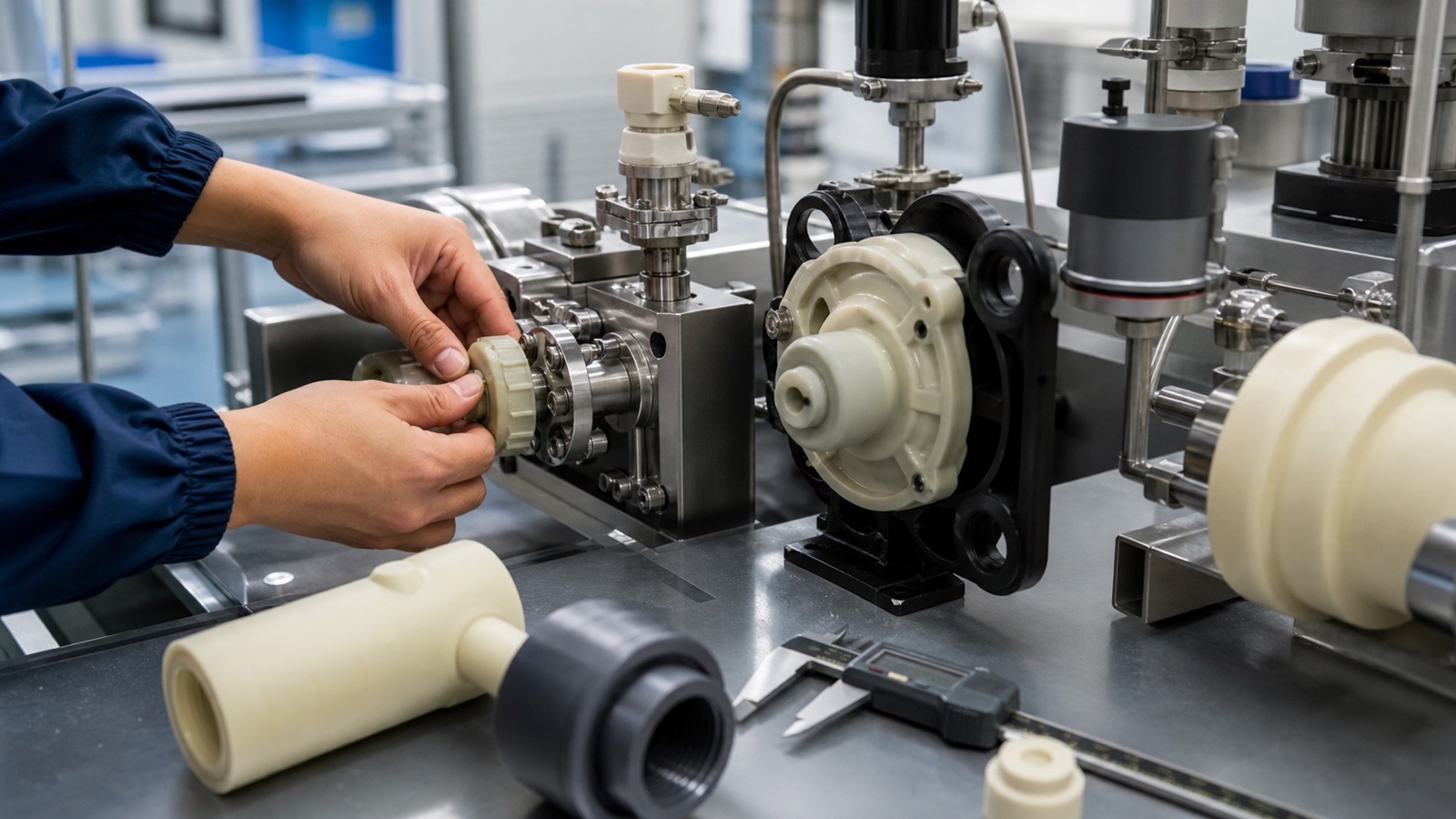
PPS and PVDF are both high-performance plastics for demanding chemical environments, but they solve different engineering problems. We compare chemical resistance, temperature capability, mechanical stability, safety, fabrication, and total value so your team can select the more reliable material for a custom component.
Introduction to PPS and PVDF in Chemical Processing
Chemical equipment has to withstand more than one stress at a time. A pump component may see corrosive fluid, elevated temperature, pressure cycling, abrasion, and tight dimensional requirements in the same operating cycle. High-performance plastics help engineers replace metal where corrosion, contamination, electrical insulation, or weight is a concern.
PPS, or polyphenylene sulfide, is a rigid, semi-crystalline engineering thermoplastic known for high temperature capability, low moisture absorption, chemical resistance, and excellent dimensional stability. PVDF, or polyvinylidene fluoride, is a fluoropolymer valued for broad chemical resistance, purity, and dependable performance in aggressive fluid-handling systems.
The practical decision is not simply “which plastic is stronger?” It is “which polymer keeps its critical properties in this chemical, at this temperature, with this load and cleanliness requirement?”
Key Differences Between PPS and PVDF
Their molecular structures explain much of the difference. PPS has an aromatic backbone linked by sulfur atoms, giving it a rigid structure with high thermal and mechanical stability. PVDF contains fluorinated carbon chains; the carbon-fluorine chemistry contributes to its strong resistance to many acids, bases, salts, and halogens.
PPS: rigid and dimensionally stable
PPS is often selected for precision parts that must hold geometry under heat, load, and chemical exposure. It is a strong candidate for valve components, pump parts, fixtures, insulators, and wear components where stiffness and predictable dimensions matter.
PVDF: fluoropolymer protection
PVDF is frequently preferred for pure or highly corrosive fluid paths. It is particularly useful in chemical distribution, semiconductor processing, laboratory systems, and piping components where chemical compatibility and low contamination are central priorities.
Chemical Resistance Head-to-Head
Neither material should be approved from a generic “chemical resistant” label alone. Concentration, temperature, exposure time, pressure, stress, and the specific grade can change the result. We recommend checking a compatibility chart and validating the actual operating condition before releasing a part for production.
| Exposure category | PPS tendency | PVDF tendency | Typical equipment implication |
|---|---|---|---|
| Acids | Strong resistance to many acids, especially at moderate temperatures; aggressive oxidizing acids require careful review. | Generally excellent resistance to many inorganic acids and corrosive fluid streams; temperature and concentration still matter. | PVDF is often favored for acid transfer and high-purity wetted parts. |
| Bases | Good resistance to many bases and alkaline process chemicals. | Good resistance to many bases, with strong alkaline conditions at elevated temperature requiring verification. | Either may work; thermal and mechanical requirements often decide. |
| Organic solvents | Broad resistance, but the exact solvent, temperature, and stress state must be checked. | Resistant to many chemicals, but some polar solvents, ketones, esters, and amines can be problematic. | Do not assume fluoropolymer chemistry makes every solvent safe. |
| Oxidizing agents | Can perform well, but strong oxidizers and hot exposure are important exceptions to investigate. | Often the safer starting point for aggressive oxidizing acid service, subject to grade and process validation. | PVDF commonly receives the first review for demanding oxidizing fluid paths. |
Engineering check
For a chemical pump, review the wetted impeller or liner separately from the shaft support or external mounting piece. One assembly may reasonably use PVDF in the fluid path and PPS for a dimensionally stable non-wetted support.
Thermal Performance and Temperature Limits
PPS generally has the higher temperature ceiling. Many PPS grades are used for continuous service around 200°C to 220°C, or approximately 392°F to 428°F, depending on reinforcement, load, geometry, and supplier data. Its heat deflection performance and low moisture uptake help precision parts retain their shape at elevated temperatures.
PVDF commonly serves in lower temperature ranges, often around 120°C to 150°C, or approximately 248°F to 302°F, depending on grade and load. Its advantage is not maximum heat capability; it is the combination of chemical resistance, purity, and reliable fluid contact performance.
What temperatures can PPS plastic withstand?
As a practical design answer, PPS can withstand continuous service near 200°C in many applications, with some grades supporting higher limits under controlled conditions. We would not approve a PPS part from temperature alone. Confirm the grade’s continuous-use rating, heat deflection data, applied stress, thermal cycling, and chemical exposure. A thin unsupported seal carrier and a heavily loaded pump component will not have the same safe operating limit.
Mechanical Properties and Dimensional Stability
PPS is usually the stronger choice when a machined plastic part must remain rigid and dimensionally consistent under load. Its low moisture absorption supports stable tolerances, while its resistance to creep makes it useful for bushings, valve seats, pump components, electrical supports, and fixtures that remain clamped for long periods.
PVDF has good mechanical performance for a fluoropolymer, but it is generally more flexible than PPS. That flexibility can help in some sealing and piping applications, yet it must be considered when designing thin walls, press fits, threaded features, or parts exposed to sustained pressure. Wear behavior also depends strongly on mating material, surface finish, load, speed, and lubrication.
What we review before machining a load-bearing part
-
1
Load and creep
We check sustained force, clamping pressure, and temperature rather than relying only on short-term strength.
-
2
Tolerance stack
We account for thermal expansion, fit type, wall thickness, and the relationship between machined features.
-
3
Chemical stress cracking
We identify notches, threads, sharp corners, and press fits that can amplify environmental stress.
Toxicity, Safety, and Regulatory Compliance
Is PPS plastic toxic?
Finished, properly selected PPS is generally considered a stable engineering plastic for industrial use. The safety question depends on the exact resin, additives, fillers, processing conditions, and intended contact. PPS should not be treated as automatically approved for food, pharmaceutical, or medical contact simply because the base polymer is chemically stable.
PVDF is also widely used in demanding fluid and high-purity systems, but its compliance status likewise depends on the grade and manufacturing controls. FDA or USP suitability must be confirmed from the material supplier’s documentation for the exact grade and application. A machined part may also require cleaning, traceability, packaging, or validation requirements beyond the raw material selection.
Flame-retardant and reinforced grades can change mechanical behavior, machinability, extractables, and regulatory suitability. We ask customers to specify whether the component is wetted, food-contact, pharmaceutical, cleanroom, electrical, or general industrial so the material recommendation matches the compliance target.
Fabrication, Machining, and Availability
Both PPS and PVDF can be CNC machined into prototypes, replacement parts, and low- or medium-volume production components. We machine features such as pockets, bores, threads, slots, channels, sealing faces, and complex profiles from customer drawings, CAD files, or samples.
PPS is rigid and machines predictably, although reinforced grades can be more abrasive to cutting tools. PVDF is softer and more flexible, so workholding, sharp tooling, chip control, and support of thin sections become especially important. Poor fixturing can produce distortion even when the CNC program is correct.
Machining versus welding and molded fabrication
PVDF is commonly associated with fabricated and welded fluid systems, while PPS is more often supplied as stock shapes or molded engineering components for precision machining. For custom geometry, CNC machining is valuable when quantities do not justify tooling, when a design is still being validated, or when an obsolete replacement part must be reproduced.
Sourcing guidance
Lead time depends on stock shape, grade, quantity, tolerance, inspection requirements, and whether the part needs special cleaning or packaging. Sending the drawing, 3D model, material requirement, quantity, tolerance, and application details together gives our team the clearest basis for a useful quotation.
Cost Analysis and Long-Term Value
PPS is often attractive when the application needs high temperature performance, stiffness, and dimensional stability without the full cost of a fluoropolymer fluid-path solution. PVDF can justify a higher material cost when chemical compatibility, purity, or resistance to aggressive oxidizing service prevents premature replacement or contamination.
The lowest unit price is rarely the lowest total cost in a chemical plant. Compare expected service life, cleaning cycles, downtime, replacement labor, rejected batches, inspection requirements, and the cost of a failed wetted component. A PVDF part that lasts through a corrosive process may be more economical than a lower-cost alternative that requires frequent maintenance.
A practical total-cost review
- Material risk: Confirm the polymer and grade against the complete chemical and temperature profile.
- Manufacturing risk: Include machining yield, tolerance control, inspection, and packaging in the comparison.
- Operating risk: Estimate the cost of leaks, contamination, downtime, and unplanned replacement.
When to Choose PPS for Chemical Equipment
Choose PPS when the part must remain rigid, dimensionally stable, and mechanically reliable under heat and chemical exposure. It is a strong candidate when the component is not directly exposed to the most aggressive oxidizing fluid, or when its structural performance is more important than fluoropolymer purity.
Typical applications include pump components, valve bodies or inserts, bushings, wear parts, sensor mounts, electrical insulators, machine fixtures, guides, and precision supports. PPS can also be useful in assemblies where low moisture absorption and repeatable machining are important.
PPS is usually the better starting point when
Dimensional stability, stiffness, creep resistance, elevated temperature capability, and cost control dominate the design, while the exact chemical exposure has been verified as compatible with the selected grade.
When to Choose PVDF for Chemical Equipment
Choose PVDF when the wetted surface must resist a broad range of corrosive chemicals and maintain a high-purity fluid path. It is especially relevant for semiconductor lines, chemical distribution systems, laboratory equipment, filtration assemblies, pump liners, valve components, and process piping parts.
PVDF deserves particular attention for oxidizing acid service above 150°F, provided the specific grade, concentration, pressure, and exposure time are validated. Its chemical resistance may provide a better margin than PPS in this situation, although the lower mechanical and temperature ceiling still need to be addressed in the design.
Purity matters
For semiconductor and laboratory equipment, material selection is only one part of contamination control. Machining cleanliness, handling, inspection, and packaging should be defined with the same care as the polymer grade.
Most Chemically Resistant Plastic: PPS or PVDF?
There is no universal winner. PVDF is generally the better first choice for broad chemical resistance, high-purity fluid handling, and many aggressive oxidizing acid applications. PPS is often the better choice when the component needs higher temperature capability, greater rigidity, lower moisture absorption, and excellent dimensional stability at a competitive overall cost.
Our decision framework is straightforward: identify the chemical and concentration, set the maximum and continuous temperature, calculate mechanical loads and pressure, determine whether the surface is wetted, then verify the exact grade. If fluid purity and corrosion resistance lead the requirements, begin with PVDF. If structural stability and high-temperature precision lead them, begin with PPS.
| Primary design priority | Likely first material to evaluate | Reason |
|---|---|---|
| High-purity corrosive fluid path | PVDF | Fluoropolymer chemistry and established fluid-handling use. |
| High temperature and rigid geometry | PPS | Higher temperature capability and dimensional stability. |
| Oxidizing acid above 150°F | PVDF | Often provides the stronger chemical-resistance starting point, subject to validation. |
| Loaded non-wetted support or fixture | PPS | Stiffness, creep resistance, and stable precision features. |
FAQ
Which plastic is the most chemically resistant?
The answer depends on the chemical, concentration, temperature, and stress. Between PPS and PVDF, PVDF is generally the stronger starting point for broad corrosive and high-purity fluid service, while PPS can be better for hot, rigid, dimensionally precise components.
What are the key differences between PPS and PVDF plastics?
PPS is a rigid, high-temperature engineering thermoplastic with strong dimensional stability and creep resistance. PVDF is a fluoropolymer with excellent resistance to many corrosive chemicals and strong suitability for pure fluid paths, but it is generally less rigid and has a lower temperature ceiling.
Is PPS plastic toxic?
Finished PPS is generally a stable engineering material, but safety and regulatory suitability depend on the precise grade, additives, processing, and intended contact. FDA, USP, food-contact, medical, and pharmaceutical requirements must be confirmed from the applicable grade documentation.
What temperatures can PPS plastic withstand?
Many PPS grades support continuous service around 200°C to 220°C, or approximately 392°F to 428°F, depending on grade, load, geometry, and environment. Always use the supplier’s data for the selected grade and evaluate chemical exposure and applied stress at the actual operating temperature.
Discuss your material decision
Send us your chemical equipment part requirements
At PlasticCNCPro, we help global B2B customers evaluate PPS, PVDF, and other engineering polymers for custom CNC-machined components. Share your 2D drawing, 3D model, sample, quantity, tolerance, chemical exposure, temperature, and application details so we can review manufacturability and recommend a practical production approach.