
Materials engineering guide
PVC vs PVDF for Corrosive Chemical Environments: Key Differences & Best Uses
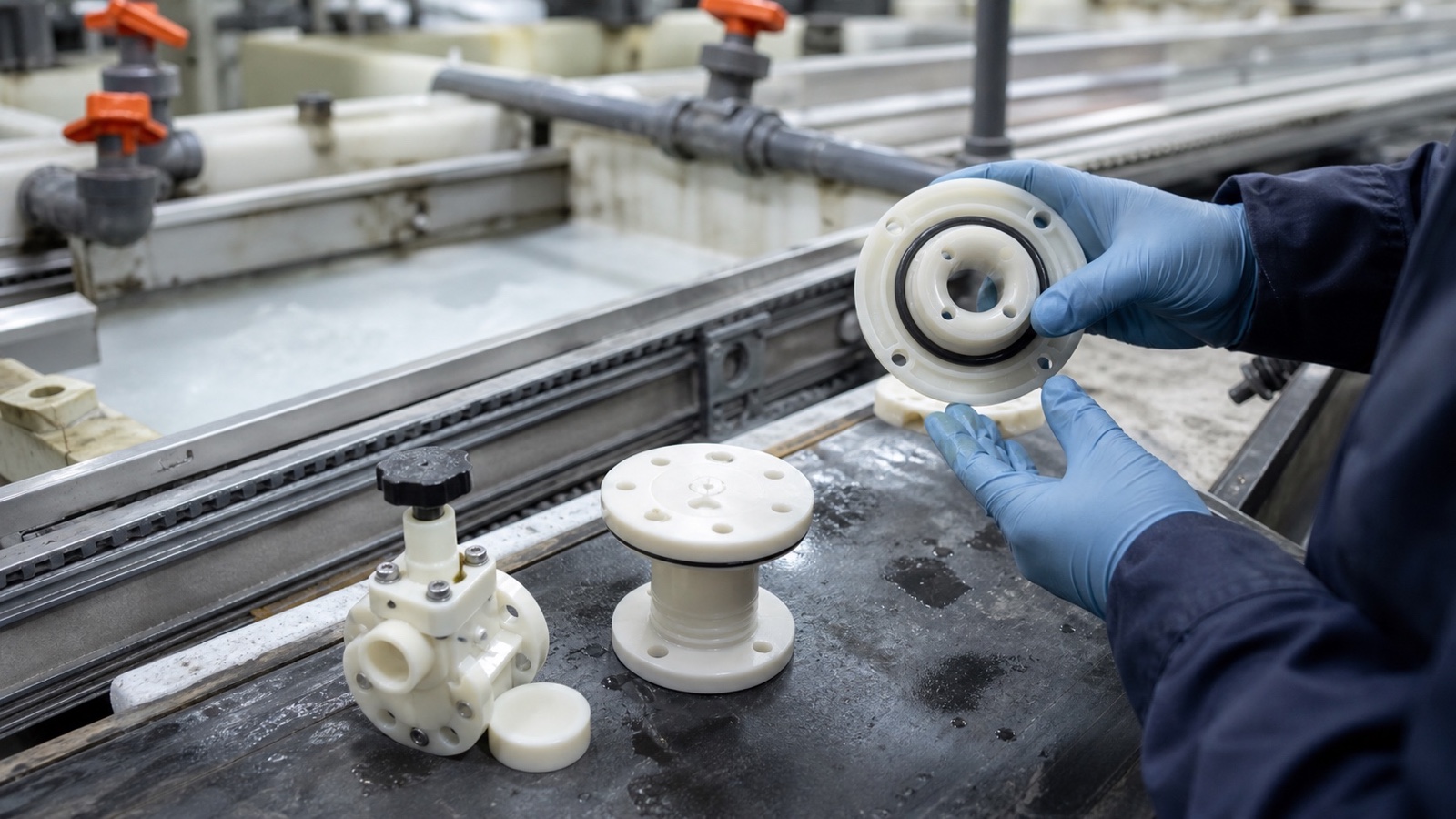
We compare PVC and PVDF for chemical resistance, temperature capability, mechanical service, cost, and manufacturability so engineering and purchasing teams can select a dependable material for corrosive fluid-handling equipment.
Introduction to PVC and PVDF in Harsh Chemical Settings
Chemical processors, laboratory equipment manufacturers, semiconductor suppliers, and fluid-handling OEMs increasingly use polymers where conventional metals can corrode, contaminate fluids, or create excessive maintenance. PVC and PVDF are two frequently considered options, but they occupy different performance and cost positions.
PVC is a practical, economical thermoplastic for many ambient-temperature acids, alkalis, salts, and aqueous chemicals. PVDF is a higher-performance fluoropolymer with broader chemical resistance, better temperature capability, and stronger long-term retention in demanding service. The correct choice depends on the actual chemical concentration, temperature, exposure time, mechanical load, and consequences of failure.
The best material is not simply the one with the strongest chemical reputation. It is the one that remains stable under your complete operating envelope while meeting budget, tolerance, and production requirements.
Material Composition and Core Properties
PVC, or polyvinyl chloride, is built from a carbon-chain polymer containing chlorine. Its molecular structure provides useful resistance to many water-based chemicals and allows economical extrusion, molding, and machining. Formulation matters: rigid PVC used for industrial components differs from flexible PVC, which contains plasticizers and should not automatically be treated as equivalent.
PVDF, or polyvinylidene fluoride, is a fluoropolymer whose carbon-fluorine bonds contribute to its high chemical stability. It combines chemical resistance with useful mechanical strength, low moisture absorption, electrical insulation, and good dimensional behavior. These advantages generally come with higher raw-material cost and more demanding processing.
PVC profile
A cost-conscious choice for rigid chemical piping, covers, tanks, guards, and machined parts operating within a moderate temperature range. It is widely available and comparatively easy to fabricate.
PVDF profile
A premium fluoropolymer for more severe chemical, thermal, purity, or long-life requirements. It is especially attractive when replacing a metal part would reduce corrosion risk or when contamination control is important.
Chemical Resistance Comparison
Both materials can perform well in corrosive service, but compatibility is never determined by the chemical name alone. Concentration, temperature, pressure, impurities, stress, and continuous versus intermittent exposure can change the result. We recommend checking a supplier compatibility chart and validating critical applications with representative testing.
| Chemical exposure | Rigid PVC | PVDF | Engineering note |
|---|---|---|---|
| Dilute hydrochloric acid | Generally suitable at moderate conditions | Generally excellent | Verify concentration, temperature, and mechanical stress. |
| Sulfuric acid | Useful in selected dilute or moderate conditions | Broad resistance, subject to conditions | Hot, concentrated acid requires detailed compatibility review. |
| Alkalis and salts | Generally good for many aqueous services | Generally excellent | Consider temperature and additives rather than pH alone. |
| Oxidizing chemicals | Compatibility can be limited | Often the stronger candidate | Confirm the exact oxidizer, concentration, and temperature. |
| Solvents and hydrocarbons | Highly chemical-specific | Usually broader, not universal | Check swelling, permeation, stress cracking, and seal compatibility. |
Design caution
A compatibility chart is a screening tool, not a guarantee. A machined fitting under thread stress may fail sooner than an unstressed sheet exposed to the same liquid. Review the complete assembly, including threads, seals, inserts, and surface finish.
Can PVC Withstand Acid?
Yes, rigid PVC can withstand many acids, including selected hydrochloric and sulfuric acid services, particularly when the concentration and temperature remain within the material supplier’s recommended range. This is why PVC is used in numerous chemical piping and process equipment applications.
However, “acid resistant” does not mean resistant to every acid condition. Hot or highly concentrated acid, oxidizing mixtures, prolonged exposure, and mechanically stressed parts can cause softening, embrittlement, discoloration, swelling, or loss of strength. For a critical component, we would review the exact concentration, temperature cycle, wall thickness, pressure, and expected service life before approving PVC.
Is PVC Corrosive?
PVC is not corrosive in the way a metal can rust or dissolve through an electrochemical corrosion process. The polymer itself is generally non-metallic and does not create conventional galvanic corrosion. The more accurate concern is chemical degradation: a specific chemical environment may attack, swell, embrittle, or weaken the material.
PVC components can also contribute to a system problem if they are incorrectly specified, exposed to excessive heat, over-tightened, or combined with incompatible seals and adhesives. We therefore distinguish between corrosion of the material and failure of the component under chemical, thermal, or mechanical stress.
Which Plastic Is the Most Chemically Resistant?
There is no single plastic that is best against every chemical and every operating condition. As a broad practical comparison, PVDF generally offers more extensive chemical resistance than rigid PVC, while PTFE and certain other fluoropolymers can provide even broader resistance in appropriate designs. CPVC commonly extends the temperature capability of PVC but does not automatically equal PVDF across all chemical exposures.
A useful screening order is PVDF for severe or high-purity service, CPVC for selected higher-temperature applications where its chemistry is suitable, and PVC for cost-effective moderate-temperature chemical handling. The final ranking must still come from the actual chemical compatibility data and mechanical design.
Temperature Tolerance and Mechanical Strength
Temperature is often the deciding factor between PVC and PVDF. Rigid PVC is effective for many ambient and moderately warm applications, but its pressure capacity and stiffness decrease as temperature rises. A design that works at room temperature may require reduced pressure, thicker walls, or a different material during hot chemical cycles.
PVDF generally retains useful mechanical performance at higher temperatures than PVC and offers better long-term stability in demanding chemical service. It is not immune to thermal expansion, creep, or design limitations, so engineers still need to account for support spacing, pressure, thread geometry, and thermal cycling.
Pressure and load
PVC can provide reliable pressure service when temperature, wall thickness, joint design, and support are controlled. PVDF is often selected when chemical exposure and elevated temperature make retention of strength more important than initial material cost.
Dimensional stability
Both materials require attention to thermal expansion and machining stress. PVDF’s low moisture absorption can be valuable for precision components, while PVC can be an efficient choice when the environment and tolerance requirements are less severe.
Engineering checkpoint
Do not select a material from a maximum temperature headline alone. Ask how the part behaves while carrying pressure, tightening a thread, supporting a seal, or cycling between hot chemical exposure and ambient conditions.
Cost Analysis and Long-Term Value
PVC normally has the lower raw-material and component cost, making it attractive for large piping systems, guards, tanks, and non-critical machined parts. It is also broadly available, which can simplify sourcing and replacement. For a stable, moderate-temperature process, choosing PVC can preserve budget without sacrificing practical chemical performance.
PVDF costs more at the material level and may require more careful machining, handling, and sourcing. Its value appears when the alternative is frequent replacement, unplanned downtime, contamination, leakage, or a safety-related shutdown. A higher initial cost can be justified when it reduces total ownership risk.
-
1
Define the exposure
Record chemical identity, concentration, temperature, pressure, duration, and cleaning cycles.
-
2
Estimate failure impact
Include replacement labor, production downtime, fluid loss, contamination, and safety exposure.
-
3
Compare total value
Choose PVC when its operating envelope is clear; consider PVDF when its extra margin protects uptime or product quality.
Industrial Applications and Use Cases
PVC is commonly considered for chemical drainage, water-treatment equipment, ventilation, tanks, pipe supports, pump guards, valve bodies, covers, and machined fixtures exposed to compatible aqueous chemicals. Its low cost and availability make it useful for prototypes and production parts where the chemical and thermal envelope is well understood.
PVDF is often preferred for aggressive chemical transfer, semiconductor and electronics equipment, laboratory systems, high-purity fluid paths, pump and valve components, sensor housings, and parts exposed to higher temperatures or more demanding cleaning regimes. It can also be valuable for custom CNC components that require a fluoropolymer’s chemical stability without using metal.
Where CNC machining fits
We machine both PVC and PVDF for custom low-volume and repeat-production components such as adapters, manifolds, valve parts, bushings, insulators, fixtures, and complex covers. For a drawing-based project, we review material selection together with tolerance, wall thickness, threads, sealing surfaces, and the expected chemical environment.
Downsides and Limitations of Each Material
PVC’s primary limitations are its narrower temperature envelope, reduced strength retention as temperature increases, and sensitivity to certain solvents, oxidizing chemicals, and concentrated or hot chemical mixtures. Rigid PVC can also become brittle under some conditions, and excessive thread tightening or impact can create failure points.
PVDF reduces many of those chemical and thermal concerns but introduces other trade-offs: higher material cost, more demanding machining and processing, possible supply constraints for particular grades or sizes, and design sensitivity at low temperatures or under impact. Neither material should be selected without considering the complete part geometry and assembly loads.
What Are the Downsides of PVDF?
Expense: PVDF usually has a higher raw-material cost than PVC, which matters in large-volume or non-critical applications.
Low-temperature impact: PVDF can be less forgiving of impact or sharp stress concentrations in cold conditions, so geometry and handling deserve attention.
Availability and processing: Certain forms may be less readily available, and machining requires controlled methods to protect tolerance, surface quality, and part integrity.
How PVDF and PVC Compare to Alternatives Like CPVC and Metal
CPVC is a modified PVC family with improved temperature capability compared with standard PVC. It can be a logical middle option when the process temperature is beyond a comfortable PVC range but the chemical compatibility, purity, and cost requirements do not justify PVDF. Compatibility remains chemical-specific, so CPVC should not be treated as a universal upgrade.
Metal piping and components can provide high structural strength and temperature capability, but corrosion, galvanic interaction, fluid contamination, coating failure, and maintenance can become important concerns. Plastics may reduce corrosion risk and provide electrical insulation, although they require careful attention to pressure, thermal expansion, permeation, and support.
| Material | Best fit | Main advantage | Main trade-off |
|---|---|---|---|
| PVC | Moderate-temperature aqueous chemical service | Low cost and broad availability | Narrower thermal and chemical envelope |
| PVDF | Aggressive, high-purity, or higher-temperature service | Broad chemical stability and premium performance | Higher cost and more demanding processing |
| CPVC | Selected warmer chemical applications | Higher temperature capability than PVC | Compatibility remains formulation- and chemical-specific |
| Metal | High-load, high-temperature structural systems | Structural strength and established infrastructure | Corrosion, contamination, weight, and maintenance risks |
FAQ: PVC vs PVDF Chemical Resistance Questions
Is PVDF better than PVC for sulfuric acid?
PVDF generally provides a broader margin, especially when temperature, concentration, purity, or service life is demanding. PVC may still be suitable for selected dilute or moderate conditions after compatibility review.
Is PVC suitable for hydrochloric acid?
Rigid PVC is commonly considered for many hydrochloric acid applications, but the exact concentration, temperature, pressure, and stress state must be checked before approval.
Can PVDF replace PVC in an existing component?
Sometimes, but not as a blind material substitution. Review dimensions, thermal expansion, thread engagement, seal behavior, stiffness, machining allowances, and the actual chemical environment.
Does PVDF resist every chemical better than PVC?
No. PVDF is broadly resistant, but compatibility remains chemical- and condition-specific. Some chemicals, mixtures, temperatures, or mechanical stresses require a different fluoropolymer or a separate design approach.
Which is easier to machine, PVC or PVDF?
PVC is generally the more economical and straightforward option for many machined parts. PVDF can also be CNC machined, but tool selection, heat control, workholding, and tolerance planning deserve more attention.
What information should we provide when requesting a material recommendation?
Send the drawing or 3D model, chemical identity and concentration, operating temperature, pressure, exposure duration, quantity, tolerances, sealing method, and any purity or electrical requirements. These details allow a more useful PVC-versus-PVDF review.
Conclusion and Material Selection Guidance
PVC is usually the sensible starting point when the chemical exposure is well characterized, the operating temperature is moderate, and cost and availability are important. It can provide dependable service in many acid, alkali, salt, drainage, and water-treatment applications when the design stays within its compatibility and mechanical limits.
PVDF is often the better choice when the chemical mixture is more aggressive, the temperature is higher, purity is critical, or failure would create substantial downtime or contamination risk. CPVC may be appropriate as an intermediate option, while metal remains relevant for high structural loads and specialized thermal requirements.
At PlasticCNCPro, we support global B2B customers with precision CNC-machined PVC, PVDF, and other engineering polymer parts for pumps, valves, laboratory systems, chemical-processing equipment, automation, and fluid-handling assemblies. We can review your drawing, sample, or concept with the operating conditions before production, then manufacture prototypes, low-volume parts, or repeat orders with attention to material suitability, tolerances, surface quality, and packaging.
A practical decision rule
Choose PVC when it clearly covers the chemical and thermal envelope. Choose PVDF when broader resistance, higher temperature capability, purity, or long-term risk reduction justifies the investment. When the conditions are uncertain, validate the material before releasing the design.
Discuss your material and part requirements