
Engineering guide · Wear-part material selection
UHMW-PE Density vs HDPE Density: Key Differences for Wear Parts
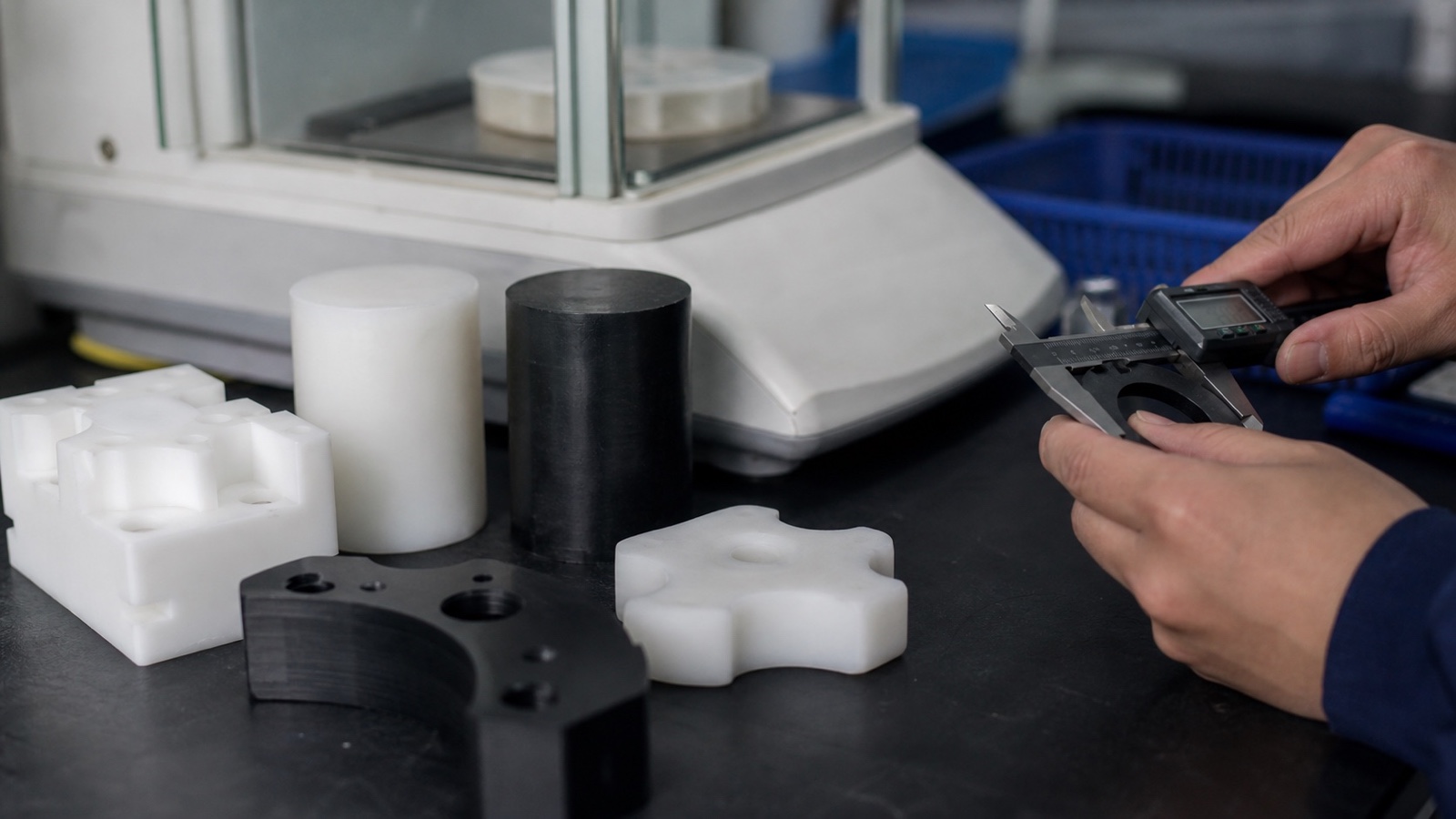
We compare UHMW-PE and HDPE density, wear resistance, friction, machinability, and total cost so you can select the right polymer for demanding sliding and abrasive applications.
Density is useful, but it is not the main reason UHMW-PE generally outlasts HDPE in abrasive wear applications. The decisive difference is molecular weight and the resulting resistance to chain separation, friction, and material removal.
Understanding UHMW-PE and HDPE Basics
UHMW-PE and HDPE are both polyethylene materials. Their chemical backbone is the same, but their molecular structures and processing grades are different. HDPE means high-density polyethylene, while UHMW-PE means ultra-high-molecular-weight polyethylene.
HDPE has a relatively high level of crystallinity and a lower average molecular weight than UHMW-PE. UHMW-PE contains exceptionally long polymer chains. Those long chains improve resistance to sliding wear, impact, and repeated contact, although they also make the material more difficult to melt-process and machine.
HDPE at a glance
Typical density is approximately 0.94–0.97 g/cm³. It is economical, readily available, chemically resistant, and comparatively straightforward to machine for general industrial parts.
UHMW-PE at a glance
Typical density is approximately 0.93–0.94 g/cm³. Its very long molecular chains provide exceptional abrasion resistance, low sliding friction, and high impact toughness in wear-part service.
For a wear part, density matters because it affects mass, buoyancy, material consumption, and sometimes crystallinity. However, density alone cannot predict service life. We also review load, counterface material, speed, temperature, contamination, alignment, and whether the part is continuously loaded.
UHMW-PE vs HDPE Density Comparison
The density gap between common UHMW-PE and HDPE grades is small. A design team should not assume that a heavier plastic will automatically resist wear better. In this comparison, UHMW-PE can actually be slightly less dense while delivering longer wear life.
| Property | UHMW-PE | HDPE | Design relevance |
|---|---|---|---|
| Typical density | About 0.93–0.94 g/cm³ | About 0.94–0.97 g/cm³ | Usually only a modest difference in part weight |
| Common measurement references | ASTM D792 or ISO 1183 | ASTM D792 or ISO 1183 | Use the supplier’s grade-specific data sheet |
| Molecular weight | Ultra-high | High, but much lower than UHMW-PE | A major driver of sliding and abrasive wear performance |
| Part weight effect | Slightly lower at equal volume in many grades | Slightly higher at equal volume in many grades | Important for moving guides, covers, and manually handled components |
Measurement note
Density values vary with grade, reinforcement, additives, crystallinity, and test method. For a controlled design, we use the exact material grade and the applicable ASTM or ISO test result rather than relying on a generic internet value.
Key Physical and Mechanical Property Differences
When we review a custom wear part, we compare the complete operating condition rather than selecting material from density alone. UHMW-PE normally leads in abrasion resistance, impact toughness, and low-friction sliding. HDPE remains attractive where loads and wear severity are moderate and cost or ease of machining is the priority.
Friction and Wear Behavior
Both polymers provide a relatively low-friction sliding surface, especially against compatible materials and under clean, well-aligned conditions. Typical unfilled values are often discussed in the broad range of roughly 0.10–0.20 for UHMW-PE and approximately 0.15–0.25 for HDPE, but coefficient of friction is highly dependent on pressure, speed, surface finish, lubrication, temperature, and the mating material.
In abrasive service, UHMW-PE generally wears more slowly because its long molecular chains are harder to pull away from the surface. This is valuable in conveyor liners, sliding strips, and chutes where loose particles repeatedly pass across the part. HDPE can perform well in light-duty guides and guards, but its wear rate usually becomes more noticeable as contact pressure, sliding distance, or contamination increases.
Hardness and Impact Resistance
Shore D hardness ranges overlap between many UHMW-PE and HDPE grades, so hardness by itself does not identify the better wear material. UHMW-PE is not selected because it is dramatically harder. It is selected because its molecular structure gives it a better combination of toughness, abrasion resistance, and low friction.
UHMW-PE also offers excellent impact resistance, including in applications where a part is struck, loaded suddenly, or exposed to dropped product. HDPE has useful impact strength and is adequate for many industrial components, but UHMW-PE is normally the safer choice when repeated impact is combined with sliding or abrasive contact.
Friction
UHMW-PE generally provides the lower-friction surface, helping reduce drive load, sticking, and surface damage.
Impact
UHMW-PE is usually better suited to repeated shock and impact, especially when the same surface must also resist abrasion.
Advantages of UHMW-PE for Wear Parts
UHMW-PE is our first material to evaluate when the main failure mode is surface wear. Its low density keeps parts relatively light, but the performance advantage comes primarily from ultra-high molecular weight rather than from density.
-
1
Longer service life in abrasive contact
The material resists surface removal from repeated contact with conveyed products, particles, and moving components.
-
2
Low friction and reduced sticking
Sliding components can move smoothly without relying on heavy lubrication in every design.
-
3
Quieter machine operation
Its toughness and damping behavior can reduce the noise associated with metal-to-metal impact and sliding.
Advantages of HDPE for Wear Parts
HDPE is a practical choice when the application has limited abrasion, moderate loads, and a clear cost target. It provides useful chemical resistance, low moisture absorption, low density, and a smooth surface for many non-critical guides, covers, spacers, and guards.
Compared with UHMW-PE, HDPE is often easier to source and machine consistently. That can simplify prototypes and lower the cost of low-volume custom parts. For an application that does not justify premium wear performance, HDPE may deliver the best balance of function and budget.
Drawbacks and Limitations of Each Material
Both materials have design limits. Selecting the correct polymer means understanding where the part will fail, how it will be manufactured, and whether the operating environment changes over time.
UHMW-PE limitations
- Higher material cost than standard HDPE in many purchasing situations.
- Long molecular chains make conventional melt processing more difficult.
- Can creep under sustained load, particularly in warm conditions.
HDPE limitations
- Usually has a shorter wear life in highly abrasive sliding service.
- May not tolerate repeated impact and abrasion as effectively as UHMW-PE.
- Can require more frequent replacement when wear is the dominant failure mode.
Common Applications for Wear Parts
The best material depends on the severity of contact, not simply on the part name. We commonly evaluate the following applications for custom CNC-machined components:
Conveyor liners and chute liners: choose UHMW-PE where bulk material, dust, or repeated sliding creates significant abrasion; HDPE can suit lighter-duty transfer surfaces.
Guides, wear strips, and rails: UHMW-PE is useful for continuous motion and low-friction contact, while HDPE works for slower or less heavily loaded guides.
Gears, sprocket components, and rollers: evaluate UHMW-PE for impact, noise, and sliding wear; confirm load, tooth geometry, and creep behavior before finalizing the design.
Bushings, spacers, and protective guards: HDPE may be an economical solution where contact is intermittent and dimensional movement is acceptable.
Cost Comparison: Is UHMW Cheaper Than HDPE?
UHMW-PE is not normally the cheaper material by purchase price. HDPE generally has the advantage when comparing raw material cost and straightforward machining. However, unit price is only one part of the cost of a wear component.
UHMW-PE can be the lower-cost option over the complete service period when it lasts substantially longer, reduces unplanned maintenance, protects a mating component, or avoids frequent shutdowns. We recommend comparing the installed cost, replacement labor, downtime, and expected wear life rather than comparing only the price per kilogram or per part.
Cost decision
Select HDPE when wear is minor and replacement is simple. Select UHMW-PE when abrasive wear, downtime, noise, or repeated service calls make part longevity more valuable than the initial material premium.
What Are the Downsides of UHMW-PE?
UHMW-PE is highly effective for wear, but it is not a universal replacement for HDPE or other engineering polymers.
- 1
Creep under sustained load
Like other thermoplastics, UHMW-PE can deform over time under continuous compression or tension. Support spacing, section thickness, temperature, and load duration must be considered.
- 2
UV sensitivity
Outdoor exposure can affect unprotected polyethylene over time. If a part will remain outdoors, we review the grade, stabilizer package, shielding, and expected exposure.
- 3
Machining considerations
UHMW-PE can flex, generate heat, and produce stringy chips during machining. Tool selection, workholding, cutting conditions, and inspection strategy matter for dimensional consistency.
What Is a Disadvantage of HDPE?
The primary disadvantage of HDPE in wear-part service is its lower wear life in demanding abrasive environments. It may initially perform well, then lose thickness or develop a worn profile as sliding distance and contamination accumulate.
HDPE also generally provides less impact and abrasion margin than UHMW-PE when both conditions occur together. That does not make HDPE unsuitable; it means the design team should be realistic about inspection intervals, replacement access, and the cost of eventual wear.
What Are the Key Differences Between HDPE and UHMW-PE?
The central difference is molecular weight, not density. UHMW-PE is typically slightly less dense than HDPE, yet its much longer molecular chains provide better resistance to abrasion, lower sliding friction, and stronger impact performance.
| Decision factor | Better fit in many cases | Reason |
|---|---|---|
| Lowest material cost | HDPE | Usually more economical for moderate-duty parts |
| Abrasive wear life | UHMW-PE | Long molecular chains resist surface removal |
| Impact and noise reduction | UHMW-PE | Higher toughness and damping in many wear applications |
| Simple machining and sourcing | HDPE | Practical for prototypes and lower-severity parts |
Choosing the Right Material for Your Wear Parts
We use a practical screening process before recommending HDPE or UHMW-PE for a custom part. The following sequence helps engineering and purchasing teams define the right starting point.
Define the contact
Identify the mating material, surface finish, load, contact area, sliding distance, and whether abrasive particles are present.
Check speed and temperature
Higher speed, heat, and continuous operation can change friction, creep, and expected wear life.
Review the environment
Consider moisture, chemicals, outdoor UV exposure, contamination, cleaning procedures, and any regulatory material requirements.
Balance service life and budget
Choose HDPE for adequate lower-wear performance and cost efficiency; choose UHMW-PE when wear life, impact resistance, low friction, or reduced downtime justify the premium.
At PlasticCNCPro, we manufacture custom plastic components from drawings, samples, and CAD files for prototypes, low-volume production, and repeat orders. We can review the material, tolerances, geometry, machining approach, and inspection requirements before production so your selected polymer matches the real application.
Material selection support
Need a machined UHMW-PE or HDPE wear part?
Send us your 2D drawing, 3D model, sample, quantity, tolerance, and application details. We will help review the material choice and manufacturability for your custom part.
Request a material and machining review