
Virgin PEEK vs. Carbon-Filled PEEK: Performance and Machining Differences
A practical comparison from the shop floor at PlasticCNCPro on mechanical behavior, thermal characteristics, cutting parameters, and tooling strategies for high-spec engineering plastics.
Table of Contents
Introduction
In ultra-demanding environments where conventional engineering thermoplastics soften, degrade, or deform under continuous load, polyetheretherketone (PEEK) represents an industry-standard baseline. As a semi-crystalline polyketone, PEEK delivers continuous service temperatures up to 260°C (500°F), excellent hydrolysis resistance, and broad chemical inertness.
However, virgin resin often reaches its physical limit when structural stiffness, load-bearing longevity, or tight dimensional stability under dynamic friction is mandated. That is where carbon fiber reinforcement changes the equation. By introducing short or chopped carbon fibers (typically 30% by weight), polymer compounders create a structural composite that significantly elevates rigidity, compressive strength, and thermal conductivity while reducing thermal expansion.
Engineering Takeaway
"Selecting between Virgin and Carbon-Filled PEEK is never just a trade-off in raw part strength. It completely alters cutter friction dynamics, heat build-up at the shear zone, residual stress relaxation, and the finishing parameters on your CNC machining center."
Here at PlasticCNCPro in Dongguan, our CNC turning and milling cells regularly run both unfilled and fiber-reinforced PEEK components for global semiconductor, aerospace, and medical valve builders. Below is our engineering guide to navigating their mechanical differences, cost drivers, and production practices.
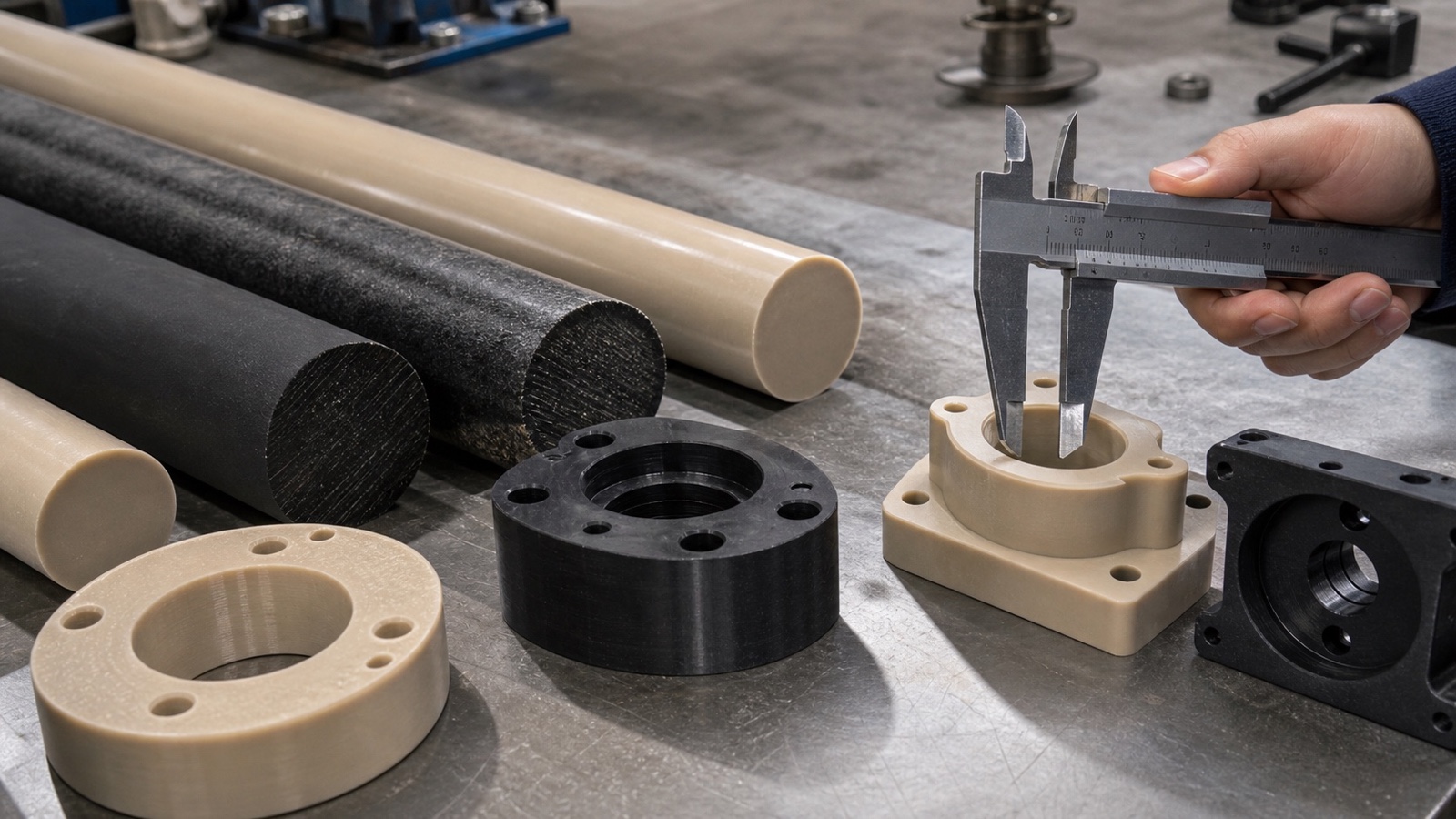
1. Understanding Material Composition: Virgin vs. Carbon-Filled
The fundamental distinction between these two grades lies in structural morphology. Unfilled PEEK relies solely on its pure semi-crystalline polymer backbone, whereas carbon-filled variants function as heterogeneous composite matrices.
Virgin PEEK (Unfilled / Natural)
Virgin PEEK (often supplied as light-tan or light-brown rod and plate) contains zero reinforcement fillers. It provides the highest elongation at break and superior impact toughness among the PEEK family. Because it is chemically pure, it complies directly with FDA, USP Class VI, and semiconductor outgassing standards, making it the default choice for cleanroom tooling, bio-inert instruments, and seals.
Carbon-Filled PEEK (Typically 30% CF)
Carbon-filled PEEK integrates pitch- or PAN-based chopped carbon fibers into the matrix. The resulting compound (solid matte black in appearance) exhibits substantially higher flexural and tensile moduli. The inclusion of carbon fibers restricts macromolecular movement under static load, mitigating long-term creep, and significantly improves thermal conductivity away from contact surfaces.
| Property Metric | Virgin PEEK (Unfilled) | Carbon-Filled PEEK (30% CF) | Impact on Function |
|---|---|---|---|
| Density (g/cm³) | ~1.30 – 1.32 | ~1.40 – 1.44 | CF grade is ~8% heavier due to fiber loading. |
| Tensile Strength (MPa) | 95 – 105 | 125 – 190 | Higher peak tensile threshold before yielding. |
| Tensile Modulus (GPa) | 3.8 – 4.2 | 7.5 – 13.0 | Carbon-filled is 2x to 3x stiffer under dynamic stress. |
| Elongation at Break (%) | 30% – 45% | 1.5% – 3.0% | Virgin bends/ductile; CF behaves in a brittle manner. |
| Heat Deflection Temp (0.45 MPa) | ~160°C | Up to 300°C | Substantially greater load resistance at elevated temperatures. |
| Electrical Resistivity | Insulative (>10¹⁴ Ω·cm) | Static Dissipative / Conductive (10² – 10⁶ Ω·cm) | CF bleeds static; Virgin acts as an electrical insulator. |
2. Performance Comparison: When to Choose Which
Selecting between unfilled PEEK and 30% CF PEEK requires analyzing real operating conditions: structural loads, thermal cycling, environmental media, and sliding velocity.
Mechanical Strength & Creep
Carbon fibers lock the polymer chains against lateral displacement. For continuous press-fits, high-pressure retaining rings, and structural brackets operating over 120°C, Carbon-Filled PEEK maintains its shape without continuous creep deformation where Virgin PEEK will cold-flow.
Thermal Management & CTE
Virgin PEEK exhibits a linear Coefficient of Thermal Expansion (CTE) of ~45–50 × 10⁻⁶/K. Adding 30% carbon fiber drops this to ~15–20 × 10⁻⁶/K along the fiber alignment plane, closely matching metallic alloys (like aluminum or brass) to minimize thermal interference.
Chemical & Environmental Limits
While both resist hydrocarbons, steam, acids, and aggressive solvents, Virgin PEEK is isotropic and non-porous. In highly aggressive acids or high-purity semiconductor fluids, Virgin avoids the risk of fluid wicking along exposed micro-fiber boundaries or carbon particulate shedding.
Friction, PV Value & Wear Rate
Carbon fibers naturally act as dry solid lubricants while increasing surface shear rigidity. Carbon-filled PEEK tolerates markedly higher Pressure-Velocity (PV) limits in sliding bushings and thrust washers, showing up to a 5x lower wear rate compared to unreinforced PEEK against steel shafts.
3. The Machinability Gap: Key Differences
From our perspective running high-speed 3-axis, 4-axis, and 5-axis CNC machines, cutting Virgin PEEK versus Carbon-Filled PEEK requires entirely different toolpaths, cutting edge preparations, and feeds.
Abrasiveness and Tool Wear
Virgin PEEK cuts cleanly with sharp micro-grain uncoated carbide end mills, yielding continuous, ductile ribbon chips. In contrast, carbon fibers are intensely abrasive. Running uncoated high-speed steel (HSS) or standard uncoated carbide on Carbon-Filled PEEK will round cutting edges within minutes. Once edge hone degrades, the cutter rubs rather than shears, triggering rapid thermal spikes and fiber pull-out.
Thermal Conductivity Dynamics
Unfilled PEEK acts as a thermal insulator. Virtually all cutting heat remains trapped inside the cut zone and transferred into the tool tip or the part skin, causing thermal expansion while clamped in the vise. Carbon-Filled PEEK has roughly double the thermal conductivity, allowing heat to evacuate more evenly through discontinuous, fractured chips, provided the feed rate maintains adequate chip thickness.
Surface Finish and Dimensional Accuracy
Achieving sub-micron surface finishes (Ra 0.4 µm) is straightforward on Virgin PEEK through polished flutes and high rake angles. With Carbon-Filled PEEK, achieving Ra below 0.8 µm requires meticulous tooling. If the tool pushes rather than cuts, micro-voids appear on the part face where fibers fractured beneath the theoretical plane.
PEEK is semi-crystalline (typically 30–35% crystallinity). Aggressive stock removal introduces uneven heat gradients, which disturbs the crystalline lattice and invites latent warping. For high-tolerance housings (under ±0.015 mm), we perform intermediate stress-relief annealing between roughing and semi-finishing cycles for both grades.
4. Best Practices for Machining Carbon-Filled PEEK
Machining carbon-reinforced polymers requires treating the material more like a non-ferrous composite than a generic plastic. Here are the core process parameters we enforce at PlasticCNCPro:
Tooling Strategy: PCD and Diamond Coatings
For prototype quantities, thick diamond-like carbon (DLC) or chemical vapor deposition (CVD) diamond-coated solid carbide tools are acceptable. For production batches exceeding 50 parts, Polycrystalline Diamond (PCD) tipped cutters are strictly required. PCD preserves razor-sharp cutting edge geometry, preventing fiber plucking and maintaining tolerance over hundreds of cycles.
Coolant Selection & Air Blast
Pressurized cold air blast (vortex tubes) is preferred for carbon-filled grades when parts must remain free of chemical residue. If wet machining is permissible, water-soluble flood coolants maintain consistent workpiece temperature and wash away microscopic carbon slurry, protecting machine ways and linear guides.
Feed and Speed Optimization
Reduce surface cutting speeds (Vc) by 25–40% compared to Virgin PEEK (typically 120–180 m/min for CF-PEEK vs. 200–300 m/min for Virgin). Maintain a steady, aggressive chip load (fz: 0.05–0.12 mm/tooth). Dwell or rubbing must be eliminated; if the cutter lingers, frictional heat will burn and soften the resin matrix.
Troubleshooting Burrs, Delamination, and Drift
Carbon-filled parts do not generate classic ductile plastic burrs; instead, brittle breakout occurs on tool exits. Use climb milling exclusively, program chamfering passes before deep pocket hogging, and design sacrificial backer stock when drilling through thin walls to eliminate edge breakout.
5. Industry Applications
Both Virgin and Carbon-Filled grades serve top-tier engineering sectors, but their specific mechanical attributes determine where they excel:
Aerospace & High-Stress Automotive
Carbon-Filled PEEK replaces titanium and aluminum for weight-sensitive brackets, intake manifold components, fuel-system back-up rings, and transmission sensor housings requiring structural stiffness under hot oil exposure.
Medical & Semiconductor Cleanrooms
Virgin PEEK dominates in surgical instrument handles, implantable trials, endoscope bodies, and wet-bench wafer carrier components. Its biological inertness, FDA compliance, non-porous structure, and zero particle shedding make it mandatory in contamination-free fluid paths.
Heavy Industrial, Pumps & Bushings
Carbon-filled and bearing-grade PEEK (often combined with graphite or PTFE) are the premier choice for rotary valve seats, subsea compressor slide pads, mechanical seals, and downhole drilling tools enduring continuous sliding friction under extreme pressures.
6. Frequently Asked Questions (FAQ)
Is PEEK difficult to machine compared to metals or other plastics?
PEEK is more challenging than commodity plastics like POM or Nylon because of high melting temperatures, residual manufacturing stresses, and sensitivity to thermal expansion. It requires strict heat dissipation and stress relief protocols, though it produces cleaner threads and holds tighter tolerances than softer polyolefins.
What are the primary downsides of PEEK material?
The main disadvantage is raw material cost; PEEK stock shapes are significantly more expensive than standard engineering resins. Additionally, it requires specialized PCD tooling when fiber-reinforced, and incorrect feed rates can cause cracking or internal stress distortion during deep cutting.
Is PEEK harder than Delrin (Acetal)?
Yes. Virgin PEEK exhibits a Rockwell M hardness around 88–93 compared to Delrin’s M80–M88. When reinforced with carbon fiber, PEEK’s surface stiffness and load resistance far exceed Delrin, alongside double the maximum continuous working temperature.
What are the other major types of reinforced PEEK?
Besides 30% Carbon-Filled PEEK, the most common variants are 30% Glass-Filled PEEK (GF30), which provides electrical insulation with heightened stiffness at a lower cost, and Bearing Grade PEEK (often containing 10% carbon, 10% graphite, and 10% PTFE) engineered specifically for low dynamic friction.
Conclusion
Choosing between Virgin PEEK and Carbon-Filled PEEK centers on matching mechanical stress with regulatory requirements. Virgin PEEK remains unmatched for high-purity fluidics, electrical insulation, and biomedical compliance. Meanwhile, Carbon-Filled PEEK stands as the material of choice when dimensional stiffness, low thermal expansion, and mechanical wear under continuous load dictate part survival.
Because PEEK stock shapes represent a sizable investment, piloting toolpaths and confirming proper annealing states prior to full production runs prevents costly scrap.
Need Precision CNC Machining for PEEK Components?
At PlasticCNCPro, we specialize in high-tolerance CNC milling and turning of pure and composite engineering plastics. Send us your CAD models, 2D drawings with GD&T callouts, and performance specs for a comprehensive DFM review and quotation.
Request a Technical QuoteStart Your Custom PEEK Machining Project
Submit your part drawings, material preference (Virgin, Carbon-Filled, or custom compound), target tolerances, and batch quantities. Our application engineering team will review manufacturability and provide an actionable quotation.