
Virgin PEEK vs. Glass-Filled PEEK: Which Grade Is Right for You?
A technical comparison from our CNC machining floor: balancing raw polymer purity, mechanical rigidity, thermal limits, and tooling wear to specify the ideal PEEK grade for mission-critical parts.
Introduction
Polyetheretherketone (PEEK) represents the apex of high-performance engineering thermoplastics. Renowned for its retention of mechanical properties at elevated temperatures, chemical inertness across extreme pH environments, and outstanding resistance to hydrolysis, PEEK has become a default metal-replacement candidate in semiconductor chambers, subsea downhole tools, and medical instruments.
When mechanical designers specify PEEK for precision CNC machining, the primary decision typically centers on two variants: Virgin PEEK (unfilled, natural polymer resin) and Glass-Filled PEEK (reinforced with micro-glass fibers, typically 30% by weight). While both share the core semicrystalline aromatic backbone, their behavioral profile under continuous stress, elevated heat, and friction diverges significantly.
"Virgin PEEK prioritizes absolute material purity, low coefficient of friction, and high elongation before break; Glass-Filled PEEK trades ductility and finish lubricity for maximum structural stiffness, reduced thermal expansion, and sustained creep resistance."
In this guide, we break down both materials based on real-world machining data from our facility in Dongguan, helping engineers and procurement managers evaluate structural loads, chemical exposure, operating temperatures, and overall manufacturing economics before ordering stock shapes.
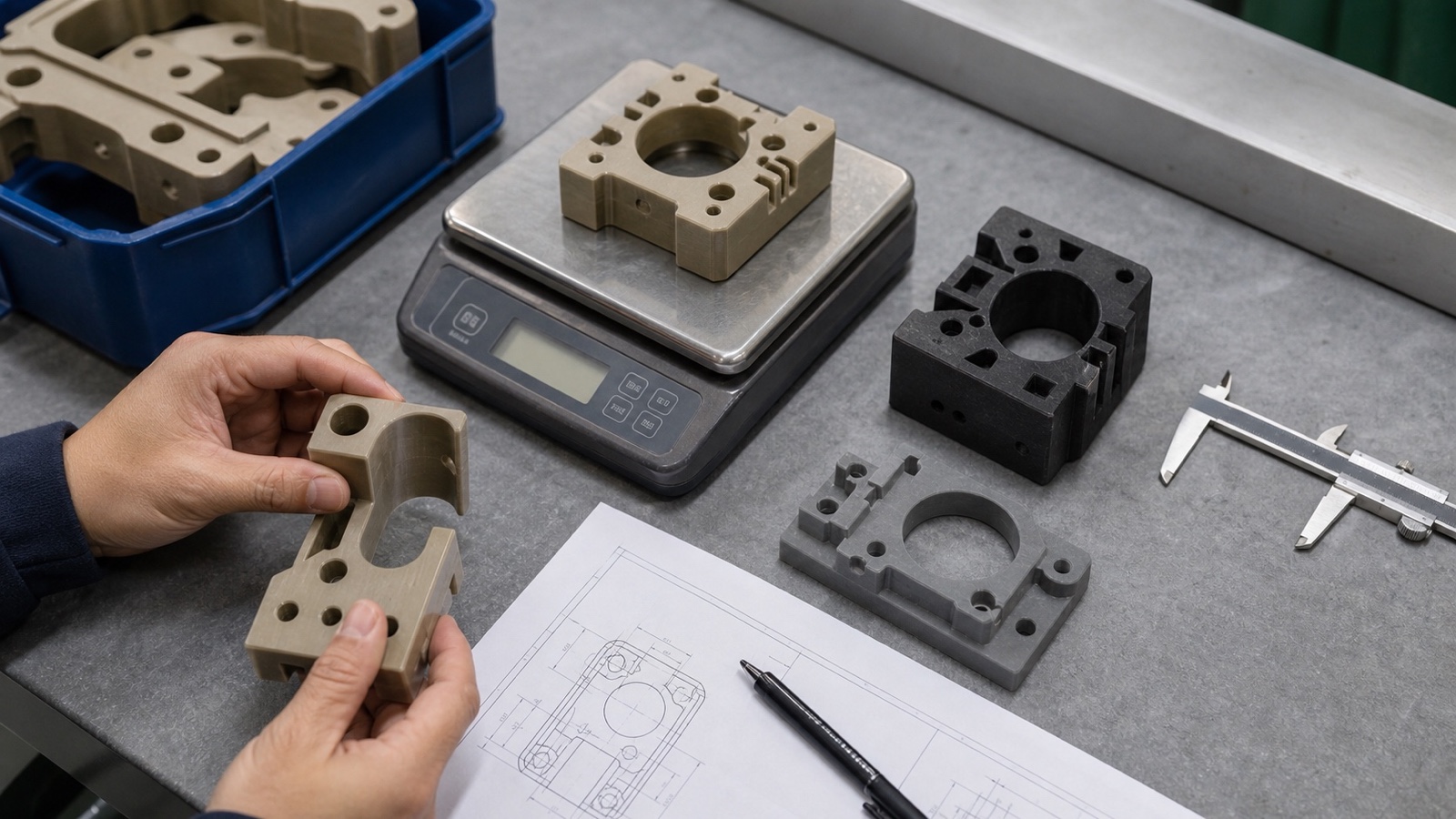
Understanding Virgin PEEK: The Pure Standard
Virgin PEEK is manufactured from 100% pure polyetheretherketone resin with zero fillers, glass strands, or internal lubricants. Often characterized by its natural light brownish-tan (or solid extruded black) aesthetic, it serves as the benchmark against which all compound grades are evaluated.
Key Properties of Pure Resin
Because it contains no inorganic reinforcements, unfilled PEEK retains the inherent chemical inertness of the pure polyaromatic matrix. It demonstrates near-zero moisture absorption (typically below 0.1% at equilibrium), exceptional dielectric strength, and minimal ionic contamination. Crucially, virgin resin satisfies rigorous regulatory standards including FDA compliance for direct food contact and USP Class VI biocompatibility for surgical tools and diagnostic apparatus.
Best Use Cases
We routinely machine virgin PEEK for components where purity, compliance, and ductile impact resistance are non-negotiable:
Medical & Life Sciences
Sterilizable surgical handles, dental healing caps, and fluidic manifolds requiring compatibility with repeated autoclave cycles, ethylene oxide (EtO), and gamma irradiation without leaching additives.
Semiconductor Processing
Wafer cassettes, end-effectors, and vacuum chamber isolators demanding ultra-low outgassing under high vacuum and complete absence of particle shed from reinforcing fibers.
Understanding Glass-Filled PEEK: The High-Stiffness Solution
Glass-Filled PEEK (most commonly PEEK GF30, reinforced with 30% electrical-grade E-glass fibers) is engineered specifically for mechanical and thermal stabilization. By compounding chopped glass filaments into the base polymer prior to extrusion, manufacturers alter the material's structural dynamics under stress.
Reinforced Mechanical Advantages
The mechanical improvement is substantial. The addition of 30% glass fibers elevates the flexural modulus from approximately 4.0 GPa in virgin material to over 10.0 GPa. This dramatic gain in flexural rigidity reduces deformation under heavy static and dynamic loads, while markedly raising the Heat Deflection Temperature (HDT) from roughly 152°C up to nearly 315°C under high flexural stress (1.8 MPa).
Engineering Trade-Offs
These structural gains introduce engineering trade-offs. The glass strands introduce micro-abrasiveness on exposed surfaces, which can rapidly erode soft mating metal shafts (such as untreated 316 stainless steel or aluminum). Additionally, the material loses elongation at break (dropping from ~30–40% in virgin PEEK down to ~2–4%), creating a stiffer but significantly more brittle failure mode under sudden impact shock.
Head-to-Head Comparison: Which Should You Choose?
To assist your team in selecting the correct grade during early design stages, we have compiled benchmark mechanical and thermal values based on standardized test procedures (ISO / ASTM) alongside our CNC machining observations:
| Property (Standard) | Virgin PEEK (Unfilled) | Glass-Filled PEEK (30% GF) | Machining & Design Impact |
|---|---|---|---|
| Tensile Strength (ISO 527) | ~95 – 100 MPa | ~150 – 165 MPa | GF30 supports ~60% higher tensile loading before yield. |
| Flexural Modulus (ISO 178) | ~3.8 – 4.2 GPa | ~9.5 – 11.0 GPa | GF30 prevents deflection in long, thin structural ribs. |
| Elongation at Break | 30% – 45% | 2.0% – 4.0% | Virgin absorbs sudden shock; GF30 behaves like a rigid ceramic. |
| HDT @ 1.8 MPa (ISO 75) | ~152°C (305°F) | ~315°C (599°F) | GF30 holds dimensional geometry under high mechanical heat. |
| CLTE (Flow Direction) | ~45 – 50 x 10⁻⁶ / K | ~15 – 22 x 10⁻⁶ / K | GF30 matches metal expansion rates much closer. |
| Relative Machining Tool Wear | Standard Carbide | Severe (Requires PCD) | GF30 causes accelerated flank wear on cutting edges. |
Mechanical Strength & Creep Resistance
If your component is subjected to sustained cantilever bending, high torque, or continuous hydrostatic bolt preloads, virgin PEEK will gradually experience viscoelastic creep over time. Glass-Filled PEEK effectively pins the crystalline polymer matrix, resisting deformation under high mechanical load for thousands of operational hours.
Thermal Performance & Expansion Matching
While both polymers melt at approximately 343°C (649°F), their dimensional stability across fluctuating operating cycles differs completely. Virgin PEEK expands at roughly double the rate of glass-filled grades. When designing tight-clearance housings that interface with stainless steel or aluminum shafts, 30% glass reinforcement dampens the coefficient of linear thermal expansion (CLTE), preserving your engineered tolerances from -40°C up to 200°C.
Wear, Dynamic Friction, and Bearing Loads
A frequent misconception among design teams is that adding glass to PEEK automatically improves its wear life. In sliding friction contacts, the opposite is true. As the thin outer resin layer experiences dynamic contact, glass fiber ends become exposed. These glass needle tips cut into unhardened mating metals and accelerate self-wear.
For high-speed bushings, thrust washers, and rotary seals, neither Virgin nor GF30 is optimal. Instead, consider Bearing-Grade PEEK (internally lubricated with 10% PTFE, 10% carbon fiber, and 10% graphite), which delivers superior PV limits and ultra-low friction coefficients.
Cost Efficiency and Total Part Economics
Raw stock shape pricing between virgin and 30% glass-filled extruded rods is often within a 5% to 15% range. However, the total cost equation must incorporate CNC cycle times and tooling consumption. Glass fibers generate severe abrasive wear on tooling flutes. When we machine high-volume GF PEEK runs, we implement polycrystalline diamond (PCD) tooling to hold ±0.01 mm tolerances, whereas virgin PEEK cuts cleanly with sharp micro-grain carbide end mills.
Addressing the Downsides of PEEK
While PEEK solves engineering hurdles that melt standard acetal or nylon, it introduces specific manufacturing constraints that must be handled during processing and machining:
High Material Procurement Cost
PEEK resin remains significantly costlier than standard engineering polymers like POM, PA66, or PET. Designing parts with excessive wall thicknesses or ordering oversized billet blocks without proper nesting drives up project costs unnecessarily.
Internal Stress and Annealing Requirements
Both virgin and filled PEEK exhibit high crystallization energy. Extruded stock shapes harbor internal stresses. In our CNC process, we mandate multi-stage intermediate heat annealing cycles between roughing and finish passes to avoid dimensional warping over time.
The Mating Surface Abrasiveness Factor
Glass-filled PEEK behaves like ultra-fine sandpaper when placed against softer counter-faces. If an assembly pairs a GF PEEK guide rail with an anodized aluminum slide, the glass reinforcement will score and groove the aluminum track under vibration or reciprocation.
Frequently Asked Questions
Is PEEK harder than Delrin (POM)?
Yes. Both Virgin and Glass-Filled PEEK offer higher Rockwell hardness, superior tensile strength, and far greater continuous operating temperature thresholds (250°C for PEEK vs. 90–105°C for POM). While Delrin is an outstanding, cost-effective engineering plastic for ambient industrial mechanics, it yields quickly under high thermal or aggressive chemical loads where PEEK excels.
What are the common industrial applications for Glass-Filled PEEK?
Common machined parts include aerospace structural clips, high-pressure pump impellers, back-up rings in petrochemical valves, semiconductor test sockets, thermal isolator blocks, and downhole logging tool housings that experience combined thermal and structural loads.
Can Virgin PEEK be used for high-load applications?
Virgin PEEK can withstand substantial short-term mechanical stress (tensile strength ~100 MPa). However, if your application involves high static compressive stress or continuous flexural load at elevated temperatures (above 100°C), virgin resin will exhibit mechanical creep. For sustained high-load assemblies, Glass-Filled or Carbon-Filled grades are strongly recommended.
Is glass-filled nylon a cheaper alternative to glass-filled PEEK?
Glass-filled nylon (PA66-GF30) is significantly less expensive, but it has distinct limitations. Nylon absorbs up to 6–8% atmospheric moisture, resulting in dimensional swelling and a drop in electrical insulation. Nylon also decomposes at lower operational temperatures and cannot survive aggressive acids, steam autoclaves, or harsh cleaning solvents that PEEK resists effortlessly.
How to Select the Right Grade for Your Application
When reviewing customer prints at PlasticCNCPro, we use the following step-by-step checklist to help engineers confirm their material selection before CNC production begins:
Does the component require high stiffness under continuous mechanical load?
Will operating temperatures exceed 150°C while simultaneously sustaining flexural stress?
Is direct food contact (FDA) or medical implantable/surgical contact (USP Class VI) required?
Does the part run as a dynamic bearing, bushing, or seal against an unhardened counter-face?
Conclusion
Both Virgin PEEK and Glass-Filled PEEK are exceptional engineering thermoplastics capable of handling extreme operating conditions where ordinary plastics fail. Virgin PEEK remains the gold standard when you need chemical purity, low outgassing, high electrical resistance, and ductile toughness. Glass-Filled PEEK is the premier problem solver when your application demands maximum structural rigidity, minimal thermal expansion, and stability under sustained heat.
If your project involves severe sliding wear, tight dimensional tolerances, or critical safety thresholds, consulting early with an experienced CNC machining partner ensures you avoid expensive material scrap and tool wear issues.
Need Machined PEEK Components with Tight Tolerances?
PlasticCNCPro turns technical drawings into precision components from our facility in Dongguan. Send us your CAD models, required tolerances, and application specifics for engineering feedback and a formal quotation.