
ABS vs PC-ABS: Which Material Is Better for Housings and Enclosures?
Selecting the ideal thermoplastic resin dictates not just your upfront prototyping or tooling budget, but your product’s real-world structural reliability, drop survivability, and thermal operating limits. Here is how we evaluate ABS against PC-ABS for custom enclosures at PlasticCNCPro.
Engineering Takeaway
ABS remains the industry benchmark for standard commercial enclosures prioritizing low cost, easy machining, and effortless paintability. PC-ABS introduces polycarbonate's superior impact resistance, low-temperature toughness, and higher heat deflection, making it the superior polymer when housings face drop impacts, snap-fit strain, or elevated operating temperatures.
What Are ABS and PC-ABS Plastics?
When mechanical designers consult us in Dongguan regarding prototype housings or low-volume CNC production runs, ABS and PC-ABS are consistently the two most requested amorphous thermoplastics. Understanding their chemical backbone explains their distinct mechanical limits.
Acrylonitrile Butadiene Styrene (ABS) is an amorphous terpolymer. Acrylonitrile imparts thermal stability and mild chemical resistance; butadiene contributes elastomeric toughness and impact absorption; styrene grants surface gloss, rigidity, and exceptional machinability. ABS is universally prized because it balances strength and affordability while holding strict dimensional tolerances.
Polycarbonate / Acrylonitrile Butadiene Styrene (PC-ABS) is an engineering thermoplastic blend that marries the processability and ductility of ABS with the immense mechanical strength, rigidity, and high heat deflection temperature of Polycarbonate (PC). By compounding PC with ABS, resin formulators resolve the typical notch sensitivity and high melt viscosity of pure PC while substantially raising the thermal and structural baseline of unmodified ABS.
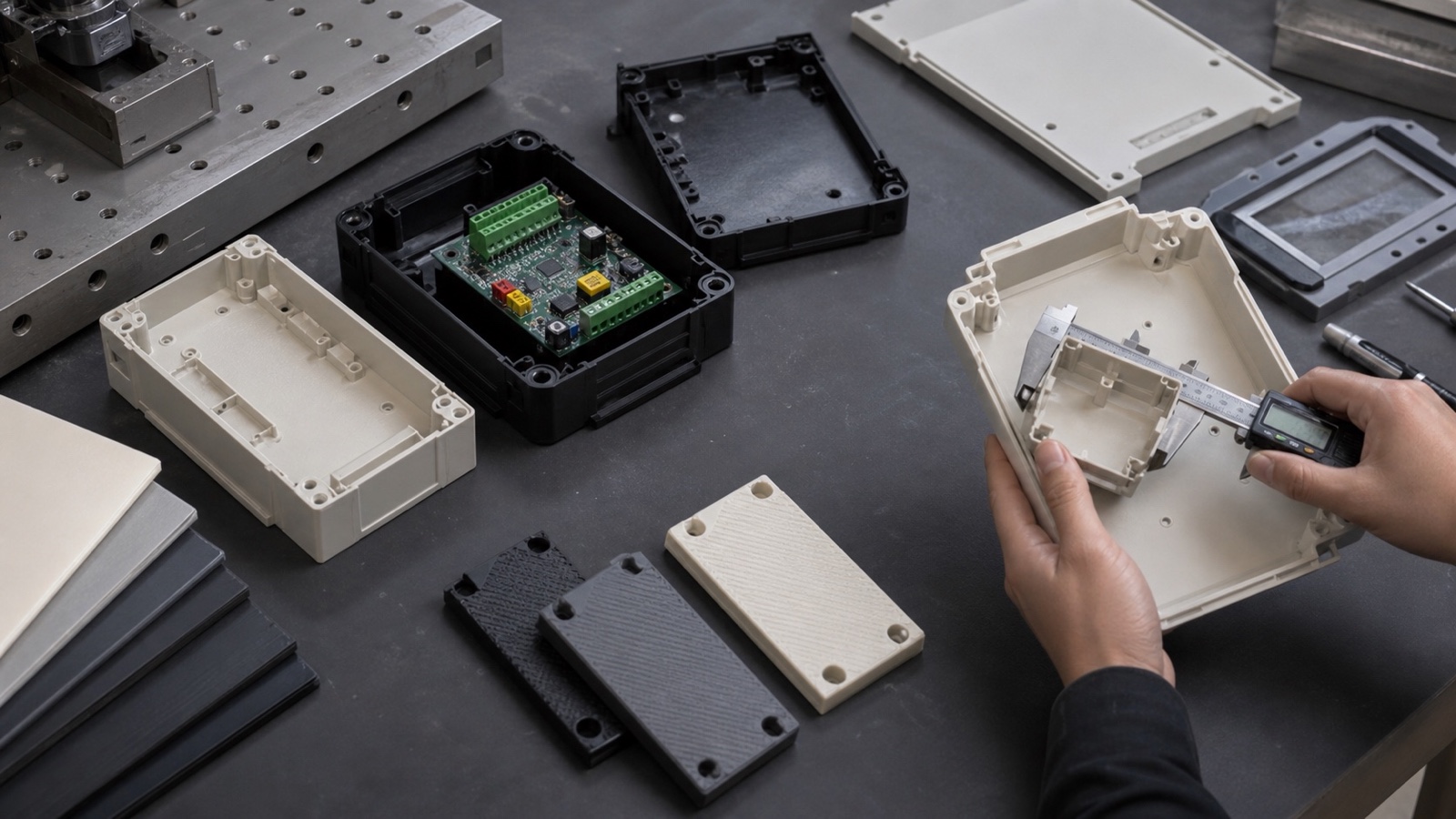
Rigid housings machined from engineering polymers require precise balancing of impact absorption and wall rigidity.
Which Plastic Is Better, ABS or PC-ABS?
The short answer: neither material is universally superior. Instead, PC-ABS is the mechanically and thermally superior plastic, whereas ABS is the economically and operationally superior plastic.
Your decision hinges on the mechanical duty cycle of the enclosure:
The enclosure must survive repeat drop-testing, protect delicate electronics in harsh industrial or automotive settings, house internal heat-generating components (>80°C), or rely on flexible snap-fits that cannot fatigue or snap during field assembly.
The enclosure operates indoors under controlled room temperatures, requires complex secondary cosmetic electroplating or adhesive solvent bonding, is produced under aggressive unit-cost constraints, or requires rapid multi-axis CNC prototype machining with minimal residual stress.
Key Property Comparison: Impact Resistance, Heat, and Strength
To provide our OEM and engineering clients with predictable mechanical behavior, we reference standardized test values. The table below outlines how unreinforced general-purpose injection and machining grades stack up:
| Mechanical Property | Standard ABS | PC-ABS Blend | Enclosure Design Impact |
|---|---|---|---|
| Tensile Strength (Yield) | 40 – 48 MPa | 52 – 62 MPa | PC-ABS handles ~25% higher tensile strain without yielding. |
| Flexural Modulus | 2.1 – 2.4 GPa | 2.4 – 2.8 GPa | Allows thinner nominal wall sections in PC-ABS without panel flex. |
| Notched Izod Impact (23°C) | 150 – 250 J/m | 400 – 600 J/m | PC-ABS exhibits more than double the fracture resistance against sudden impacts. |
| Impact Resistance at -30°C | Poor (Brittle transition) | High (Ductile retention) | Critical for handheld scanners, outdoor monitoring, and automotive parts. |
| Heat Deflection Temp (0.45 MPa) | 85 – 95 °C | 110 – 130 °C | PC-ABS resists sagging near high-draw power supplies or automotive cowls. |
| Mold Shrinkage Rate | 0.4 – 0.7 % | 0.5 – 0.8 % | Both exhibit predictable, isotropic volumetric shrinkage. |
Structural and Thermal Implications in Enclosures
In practical enclosure engineering, internal ribs, screw bosses, and interlocking perimeters experience localized stress concentrations. When a field device drops onto concrete, standard ABS often fails along the base of thread bosses or at sharp chassis corners due to notch sensitivity. PC-ABS dissipates this kinetic shock effectively.
Furthermore, heat deflection is a safety gate. If your electronics enclose power converters, motor drives, or microprocessors generating continuous heat, ambient chassis air temperatures can hit 70°C. Under continuous internal heat and external preload, pure ABS risks creep and localized warping, whereas PC-ABS maintains its geometric integrity up to ~110°C or higher depending on the PC ratio.
Cost vs Performance: When Does PC-ABS Justify the Premium?
Raw PC-ABS resin typically carries a 20% to 35% cost premium over standard injection-grade ABS pellets. When CNC machining prototype blocks or slab stock, the material surcharge can be slightly higher because stress-relieved PC-ABS extruded stock requires tighter annealing controls during plate manufacturing.
When the PC-ABS Investment Saves Capital:
Handheld field terminals, diagnostic kits, and survey tools face frequent drops. Using PC-ABS avoids cracked housings, internal PCB damage, and high return rates.
Because PC-ABS possesses higher flexural modulus and yield strength, engineers can design housings with 2.0 mm wall thicknesses instead of 2.8 mm ABS walls, offsetting resin cost via reduced part volume.
Moldability, Surface Finish, and Production Considerations
From the viewpoint of precision manufacturing—whether cutting injection tooling or machining complex enclosures directly on our 5-axis CNC machining centers—processing behavior differs sharply between the two:
High Flow, Effortless Post-Processing
ABS melts with low viscosity, enabling effortless filling of intricate ribs and thin louvers at modest injection pressures. For CNC milling, ABS cuts cleanly with razor-sharp single-flute or two-flute router bits. It responds cleanly to vapor polishing, chemical solvent welding with MEK/acetone, and accepts direct plating or pad printing without aggressive surface priming.
High Viscosity, Strict Thermal Control
The polycarbonate component elevates melt viscosity. Injection requires higher barrel temperatures (240–280°C) and higher clamping force to avoid knit line flaws. In CNC turning and milling, tool speeds and chip loads must be tuned carefully to mitigate frictional heat, as localized re-melting can cause internal stress cracks. Pre-drying resin pellets or plate stock is mandatory to prevent moisture streaking.
Machining Expert Note
When we CNC machine prototype enclosures from extruded stock at PlasticCNCPro, internal residual stress can cause deep pocket housings to bow. For tight-tolerance PC-ABS enclosures (±0.05 mm), we perform intermediate stress-relief annealing cycles between roughing and finishing passes to guarantee planarity across mating sealing faces.
Best Applications for ABS Housings and Enclosures
ABS is the reigning workhorse for stationary and non-critical enclosure hardware. When impact shocks are negligible and operating temperatures remain moderate, it provides an unbeatable combination of cost and finish:
Consumer Electronics & Smart Home Hubs
Desktop modems, Wi-Fi routers, wall thermostats, smart speaker chassis, and remote control shells that sit indoors under benign environmental conditions.
Small Domestic Appliances
Coffee machine exterior panels, vacuum cleaner decorative handles, air purifiers, and peripheral monitor frames requiring molded-in textures or painted gloss finishes.
Rapid Prototyping & Proof-of-Concept Mocks
Initial functional models and fit-check chassis where mechanical verification is needed fast before locking injection tooling investments.
Best Applications for PC-ABS Housings and Enclosures
When mechanical failure results in field recalls, electrical hazards, or system downtime, engineers specify PC-ABS. Its primary deployment arenas include:
Automotive Interior and Lighting Consoles
Instrument cluster housings, glove box mechanisms, center console frames, and overhead light bezels that must meet strict FMVSS flammability regulations and endure summer cabin heat exceeding 85°C.
Rugged Handhelds & Industrial Equipment
Barcode scanners, ruggedized tablet perimeter frames, vibration-resistant robotics controller cases, and automated factory sensor pods subjected to shop-floor impacts.
Medical Diagnostic & Laboratory Hardware
Point-of-care analytical consoles, portable infusion pump chassis, and monitoring enclosures requiring flame retardancy (UL 94 V-0 ratings) and structural integrity against accidental drops.
Outdoor and UV Performance: ABS vs PC-ABS
Neither unmodified ABS nor unmodified PC-ABS is intrinsically weather-proof. In natural or standard color formulations, ultraviolet (UV) radiation triggers photo-oxidative degradation:
ABS Under Solar Exposure
The polybutadiene rubber phase contains carbon-carbon double bonds that break down rapidly under UV wavelength exposure. The plastic yellows, chalks, and experiences severe embrittlement within months, losing up to 70% of its drop resistance.
PC-ABS Under Solar Exposure
PC-ABS performs somewhat better due to polycarbonate’s greater UV tolerance, but without UV stabilizers (such as benzotriazole-based UV absorbers or HALS), yellowing and surface micro-crazing will eventually manifest.
Engineering Recommendation for Outdoor Service
If an enclosure is destined for direct outdoor installation without secondary paint coatings, specify ASA (Acrylonitrile Styrene Acrylate) instead, or formulate PC-ABS with specialized carbon black compounding and outdoor UV inhibitors. Alternatively, applying a 2K polyurethane exterior clear or color coat shields the substrate completely.
Chemical Resistance and Environmental Limitations
A critical enclosure design hazard is Environmental Stress Cracking (ESC). When molded-in or machined residual stresses meet harsh solvents, premature catastrophic cracking occurs.
Ketones, Esters, and Aromatics: Both polymers are vulnerable. Acetone, ethyl acetate, benzene, and toluene quickly dissolve or swell ABS and craze PC-ABS.
Alcohols & Sanitizers: Isopropyl alcohol (IPA) wipe-downs are common in medical devices. While ABS resists short IPA wipes, PC-ABS can exhibit micro-cracking around press-fit inserts if exposed to prolonged industrial cleaning solutions under stress.
Oils and Greases: Hydrocarbon lubricants are generally tolerated well by both resins, though synthetic ester-based automotive lubricants require validation with test coupons.
How to Choose Between ABS and PC-ABS for Your Project
When reviewing RFQs and customer CAD models, our engineering team uses this structured decision sequence to validate material suitability:
Quantify Operating Temperatures
If the enclosure housing internal transformers, lithium cells, or lamps experiences sustained internal temperatures above 75°C, select PC-ABS to guard against long-term creep and warping.
Evaluate Mechanical Drop and Snap-Fit Criteria
Will this enclosure be dropped repeatedly onto hard surfaces (e.g., standard 1.2m or 1.8m MIL-STD drop tests)? If yes, PC-ABS notched impact performance is non-negotiable. For static desktop housings, standard ABS is more than adequate.
Verify Flammability Classifications (UL 94)
Standard ABS is naturally combustible (HB rated). While flame-retardant (FR) ABS exists, FR-PC-ABS offers far superior mechanical retention under UL 94 V-0 and 5VA requirements for electrical and transportation enclosures.
Review Production Method and Batch Volume
For low-volume CNC machining of enclosure prototypes or replacement batches, ABS delivers slightly faster machining cycle times, lower tooling wear, and easier burr-free finishing. For high-volume production with demanding stress tolerances, PC-ABS delivers consistent reliability.
Frequently Asked Questions
Which plastic is better, ABS or PC?
Neither is better in isolation; they serve different design priorities. Pure Polycarbonate (PC) is drastically stronger, highly transparent, and possesses significantly higher heat resistance (HDT up to 135°C), but it is harder to mold and machine, prone to stress cracking, and more expensive. ABS is opaque, far easier to machine and mold, cheaper, and accepts decorative plating and painting effortlessly.
Is polycarbonate better than ABS?
Polycarbonate is mechanically superior in terms of tensile strength, flexural resistance, and impact toughness. However, it is not "better" when your application requires low-stress CNC milling of thin walls, optical opacity at low cost, chemical solvent bonding, or minimal internal molded stresses.
Is polycarbonate plastic stronger than ABS?
Yes, substantially. Pure polycarbonate provides a tensile yield strength of roughly 60 to 70 MPa and an Izod impact strength between 600 and 850 J/m, compared to ABS which typically yields at 40 to 48 MPa with an impact rating of 150 to 250 J/m. PC is nearly bullet-resistant in thick sheets, whereas ABS will crack under severe point-load impacts.
What are the downsides of ABS plastic?
The primary disadvantages of ABS plastic are poor weatherability and fast UV degradation, moderate heat resistance (it softens around 85–95°C), low resistance to aromatic hydrocarbons and acetone, and vulnerability to brittle failure in sub-zero working temperatures.
Need Custom Machined ABS or PC-ABS Housings?
Send us your 2D drawings, 3D CAD models, material requirements, and target quantities. Our Dongguan engineering team will review tolerances, evaluate manufacturability, and supply a detailed quotation within 24 hours.