
Density of Filled Plastics: Glass-Filled vs. Carbon-Filled Materials Compared
An engineering analysis of how glass and carbon fiber reinforcement alter polymer mass, rigidity, thermal stability, and machinability across high-spec structural components.
Table of Contents
Introduction: Why Density Matters in Reinforced Thermoplastics
In precision engineering, selecting the right composite is rarely just about picking the highest tensile modulus on a raw data sheet. Reinforced thermoplastics—formulated by compounding base matrices such as Polyamide (Nylon), PEEK, Polycarbonate, or PPS with chopped or continuous fibers—exist to close the performance gap between unfilled polymers and structural metals. Yet, one foundational parameter directly controls the physics and economics of the finished assembly: density.
When our engineering team at PlasticCNCPro reviews CAD drawings for high-cycle robotics, aviation valve bodies, or automated end-effectors, component weight directly dictates motor sizing, kinetic inertia, and vibration response. Beyond dynamic performance, density drives raw material mass costs, global shipping overhead for serial production, and thermal dissipation rates. The choice between Glass Fiber (GF) and Carbon Fiber (CF) is fundamentally a balance of grams, rigidity, abrasion, and budget.
Key Takeaway
"Glass fibers bolster structural stability and electrical insulation at minimal cost, but add substantial mass. Carbon fibers drive density down while dramatically boosting specific stiffness, creating unrivaled strength-to-weight performance at a premium material investment."
Understanding Material Density: How Fillers Change the Baseline
To grasp the resultant density of a reinforced compound, we begin with the virgin base resin. Common industrial matrices sit in predictable specific gravity ranges:
Nylon (PA66)
1.13 – 1.15
g/cm³ typicalPETG / PBT
1.27 – 1.31
g/cm³ typicalPEEK (Virgin)
1.30 – 1.32
g/cm³ typicalWhen reinforcement strands are compounded into the matrix, the composite density follows the rule of mixtures based on the specific gravities of the filler and polymer. Standard E-glass fiber has a nominal density of approximately 2.54 to 2.60 g/cm³. In sharp contrast, standard PAN-based high-strength carbon fiber possesses a density of only 1.75 to 1.82 g/cm³.
The Fiber Density Differential
Because carbon fiber is roughly 30% less dense than glass fiber, a polymer loaded with 30% carbon fiber by weight will yield a significantly lighter part than the identical matrix loaded with 30% glass fiber. Crucially, because carbon fiber has a higher intrinsic tensile modulus (230+ GPa vs. 72 GPa for E-glass), you achieve greater structural rigidity while cutting overall mass.
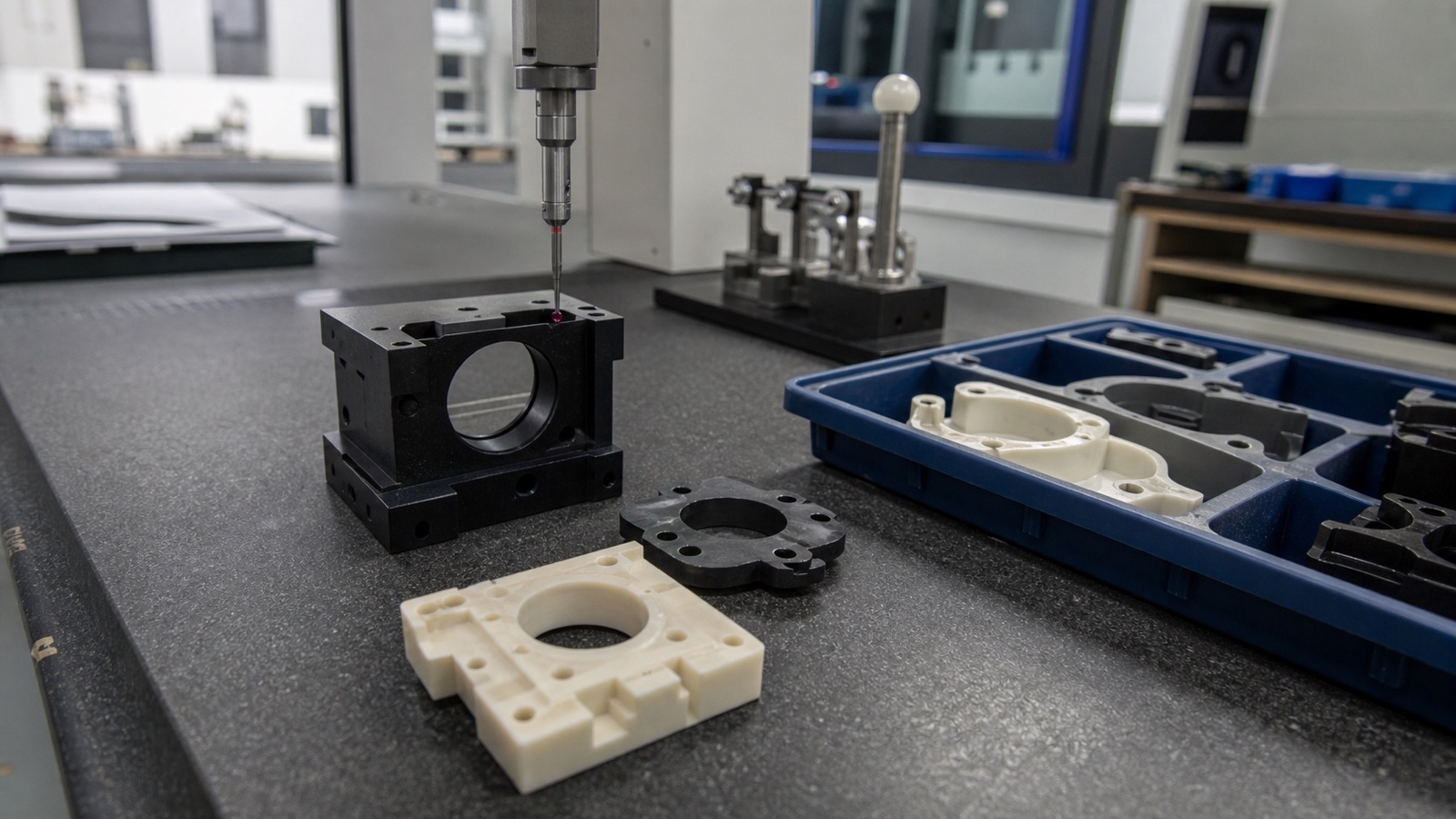
Precision CNC machining of fiber-reinforced thermoplastic stocks requires distinct tooling geometries depending on whether glass or carbon fillers are utilized.
Glass-Filled Plastics: Properties and Applications
Glass-filled (GF) polymers represent the industrial workhorse of reinforced plastics. Whether specifying PA66-GF30, PBT-GF30, or PEEK-GF30, engineering designers leverage these formulations for robust mechanical strength without introducing conductive pathways.
Characteristics
Glass fibers provide balanced reinforcement. They enhance compressive and tensile strength, suppress creep under continuous load, and notably improve the Heat Deflection Temperature (HDT). Because silica-based glass is an inert dielectric, glass-filled plastics maintain high surface resistivity and dielectric breakdown strength, making them indispensable in high-voltage environments.
Density Impact
Because glass fiber is substantially denser than the host matrix, adding 30% glass fiber to PA66 increases the composite density from 1.14 g/cm³ to roughly 1.36 – 1.40 g/cm³—an increase of over 20%. In high-density base polymers like PPS or PTFE, glass compounding pushes the specific gravity well past 1.65 to 2.25 g/cm³. For stationary machinery, this added mass is negligible, but for dynamic components, it requires careful inertia calculations.
Best Use Cases
Industrial & Electrical Housings
High-voltage terminal blocks, breaker enclosures, and sensor bodies where electrical non-conductivity and dimensional stability are non-negotiable.
Pump & Fluid-Handling Components
Impellers, valve bodies, and chemical manifolds that experience continuous hydrostatic pressure and chemical exposure without justifying carbon costs.
Carbon-Filled Plastics: The Lightweight High-Performer
When structural stiffness cannot come at the expense of mass, carbon-filled (CF) polymers step forward. Used extensively in aerospace, advanced automation, and racecraft, these composites deliver mechanical resilience comparable to cast metals.
Characteristics
Carbon fibers contribute incredible axial stiffness, vastly superior fatigue resistance, and an exceptionally low Coefficient of Thermal Expansion (CTE). Unlike glass, carbon fibers are electrically and thermally conductive. This gives carbon-filled plastics natural antistatic (ESD) or conductive dissipation properties and superior heat spreading across continuous operating cycles.
Density Impact
At roughly 1.80 g/cm³, carbon fiber raises the baseline density far less than glass. For instance, PA66-CF30 has a specific gravity of roughly 1.24 to 1.28 g/cm³, compared to 1.37 g/cm³ for PA66-GF30. You achieve roughly 40% higher tensile modulus than glass-reinforced equivalents while securing an immediate 8% to 12% weight reduction in the finished component.
Best Use Cases
Aerospace & Defense Components
Brackets, avionics trays, and drone structural arms where every gram removed translates to extended range or payload capacity.
High-Speed Pick-and-Place Arms
Robotic end-effectors and automated tooling that undergo rapid start-stop cycles where low inertia prevents overshoot and motor strain.
Side-by-Side Comparison: Density, Strength, and Performance
Below is an engineering comparison using standard Polyamide 66 (PA66) and Polyetheretherketone (PEEK) matrix benchmarks compounded with standard 30% by weight chopped fibers.
| Material Grade | Density (g/cm³) | Tensile Strength (MPa) | Tensile Modulus (GPa) | Electrical Property | Relative Cost |
|---|---|---|---|---|---|
| Unfilled PA66 | 1.14 | 80 | 3.0 | Insulative | Baseline ($) |
| PA66-GF30 | 1.37 | 175 | 8.5 | Insulative | Low-Moderate ($$) |
| PA66-CF30 | 1.26 | 220 | 14.5 | Conductive / ESD | Moderate-High ($$$$) |
| Virgin PEEK | 1.30 | 100 | 4.0 | Insulative | Premium ($$$$) |
| PEEK-GF30 | 1.51 | 160 | 10.0 | Insulative | High ($$$$$) |
| PEEK-CF30 | 1.41 | 215 | 13.5 | Static Dissipative | Ultra-High ($$$$$$) |
Evaluating the Cost-vs-Weight Equation
Glass fiber is approximately 5 to 10 times cheaper per kilogram than PAN carbon fiber strands. Unless weight minimization or electrical conductivity is a core requirement, glass-filled plastics remain the standard choice for general mechanical brackets and structural machinery components.
Critical Design Considerations for Filled Materials
Machining or forming reinforced polymers introduces physics challenges distinct from unfilled stock. At PlasticCNCPro, we evaluate three major variables when processing customer files:
Anisotropy & Fiber Orientation
During extrusion of extruded plate/rod stocks, chopped fibers align predominantly along the flow path. This makes strength, stiffness, and thermal expansion anisotropic. Strength parallel to fiber grain can be up to 40% higher than perpendicular. When we machine tight-tolerance components, we account for stock grain alignment relative to primary operational stresses.
Tooling & Equipment Wear
Both glass and carbon fibers are highly abrasive. In CNC milling and turning, standard high-speed steel (HSS) tools will lose edge geometry in minutes. We utilize solid micrograin carbide, diamond-like carbon (DLC), or PCD (polycrystalline diamond) tooling to prevent edge rounding, which would otherwise induce dimensional drift, material push-out, and poor surface roughness.
Viscosity, Internal Stress, and Warpage
Fiber additions sharply drop the Melt Flow Index (MFI) and alter shrinkage rates. Molded or extruded thick-section blanks contain substantial frozen-in internal stresses. In precision CNC operations, asymmetrical stock removal can release these stresses, inducing warp. We routinely apply multi-stage stress-relief thermal annealing cycles before final finishing passes.
Frequently Asked Questions (FAQ)
Does plastic weigh less than carbon fiber?
Unfilled engineering plastics generally weigh less than pure continuous carbon fiber composites. Unfilled polymers like Polypropylene (0.90 g/cm³) or Nylon (1.14 g/cm³) have lower densities than pure carbon fiber sheets (typically 1.55 – 1.60 g/cm³). However, carbon fiber is significantly stiffer and stronger per unit of volume, meaning a much thinner carbon fiber section can bear loads that would deform thick plastic parts.
Is PLA-CF as strong as PETG?
PLA-CF (carbon-fiber-reinforced PLA) exhibits substantially higher tensile stiffness and modulus than standard unfilled PETG, meaning it resists bending under load far better. However, PETG possesses superior chemical resistance, higher ductile elongation at break, and greater layer adhesion in additive manufacturing, making it less brittle during sudden impact.
What are the core pros and cons of glass fiber vs. carbon fiber?
Glass Fiber Pros: Highly cost-effective, excellent electrical insulator, high impact resistance. Cons: Higher composite density (heavier parts), lower specific stiffness.
Carbon Fiber Pros: Maximum stiffness-to-weight ratio, lower overall density, static dissipative/conductive, minimal thermal expansion. Cons: High raw material cost, conductive nature unsuitable for electrical insulation.
Is it illegal to print or machine certain parts with these materials?
The materials themselves (glass-filled or carbon-filled polymers) are completely legal industrial engineering commodities used across robotics, medical devices, and manufacturing. However, fabricating regulated items such as firearms, unregistered weapons components, or ITAR/EAR-restricted military articles is subject to strict national laws, licensing, and trade compliance regardless of manufacturing method.
Conclusion: Making the Right Choice for Your Application
Choosing between glass-filled and carbon-filled plastics centers on three engineering parameters: density-driven inertia targets, modulus requirements, and electrical insulation constraints.
If your application involves electrical isolators, structural housings where minor weight differences are non-critical, or cost-driven production, glass-filled composites (like PA66-GF30 or PEEK-GF30) offer the most reliable return on investment. If you are developing dynamic robotic linkages, aircraft interior brackets, or high-speed automation tools where reducing mass by even 10% lowers motor wear and increases cycle speeds, carbon-filled plastics are worth the higher upfront cost.
We always advise cross-checking the specific lot datasheets from raw polymer compounders before initiating series production, as fiber aspect ratios and processing orientations influence final yield strength.
Request a Machining Review for Reinforced Polymer Parts
At PlasticCNCPro, our engineering team in Dongguan assists global buyers in selecting, prototyping, and precision-machining glass-filled and carbon-filled engineering plastics. Send your 2D/3D CAD drawings for tolerance validation, material consultation, and competitive quotation.