
Materials engineering guide
High-Density Plastics for Radiation Shielding: Industrial & Space Applications
Explore how high-density plastics such as HDPE and borated polyethylene provide effective, lightweight radiation shielding for industrial, medical, nuclear, and aerospace applications.
Introduction
Radiation protection is no longer limited to dense metallic barriers. In many industrial and aerospace designs, hydrocarbon polymers—especially high-density polyethylene (HDPE)—provide a practical way to manage radiation exposure while reducing mass, corrosion risk, and fabrication complexity.
The value of HDPE comes from its hydrogen-rich molecular structure. Hydrogen is particularly effective at slowing fast neutrons, making polyethylene an important moderator in neutron-shielding systems. For gamma radiation, plastics generally require a different design approach because their lower atomic number and density do not provide the same attenuation as lead or other dense metals.
In this guide, we examine the material science behind high-density plastics for radiation shielding and industrial applications, the role of borated polyethylene, performance indicators such as half-value layer and mean free path, and the manufacturing considerations that matter when shielding components must be custom-machined.
The most effective shielding solution is usually a system design: match the material to the radiation type, then engineer the geometry, thickness, joints, and supporting structure around the actual operating environment.
Why polymers are gaining ground
Compared with traditional lead assemblies, polymer shielding can reduce weight and simplify handling. HDPE also resists many corrosive environments and can be produced in forms that integrate with equipment housings, liners, barriers, and modular enclosures.
Where engineering matters
Radiation shielding is not simply a material-selection exercise. Temperature, dimensional stability, structural loading, source intensity, access requirements, and inspection criteria all influence the final design.
The Science of Plastic Radiation Shielding
Different radiation types interact with matter in different ways. The design principle that makes HDPE useful for neutron protection is not identical to the principle used for gamma shielding. A reliable design begins by identifying the radiation spectrum and the required reduction in dose or particle flux.
| Radiation concern | How high-density plastics contribute | Typical design note |
|---|---|---|
| Fast neutrons | Hydrogen atoms scatter and slow neutrons through repeated collisions. | Polyethylene is often used as a moderator, with boron added to capture thermalized neutrons. |
| Gamma radiation | HDPE alone is generally less effective per unit thickness than dense metals. | A layered or hybrid system may be required when gamma attenuation is the primary objective. |
| Mixed fields | A polymer layer can moderate neutrons while other materials address secondary or photon radiation. | The complete assembly must be evaluated rather than judging one material in isolation. |
Hydrogen-rich materials and neutron moderation
Fast neutrons lose energy efficiently when they collide with nuclei of similar mass. Hydrogen is present at a high concentration in polyethylene, so each collision can transfer meaningful energy from the neutron to the hydrogen nucleus. Multiple interactions progressively slow the neutron, after which an absorber such as boron can help capture it.
Why plastic shielding is attractive in industry
For equipment builders, the benefits extend beyond radiation physics. HDPE and related engineering polymers are corrosion-resistant, electrically insulating, comparatively easy to handle, and suitable for CNC machining. Their lower mass can simplify installation and maintenance, especially when shielding panels or liners must be removed regularly.
Engineering caution
Lower weight does not automatically mean lower risk. Shielding gaps, penetrations, fastener locations, seams, and equipment access points can determine the performance of the entire assembly.
Borated Polyethylene: The Gold Standard for Neutron Shielding
When neutron shielding requires both moderation and absorption, borated polyethylene is a widely used solution. It combines the hydrogen-rich behavior of polyethylene with a boron additive that helps capture neutrons after they have been slowed.
What Is Borated Polyethylene?
Borated polyethylene is a composite material based on HDPE or a related polyethylene matrix with boron distributed through the polymer. The polyethylene moderates fast neutrons, while the boron contributes neutron absorption. This combination is why the material is frequently selected for nuclear facilities, research environments, and specialized imaging spaces.
The correct grade depends on the radiation field, required attenuation, available space, processing requirements, and environmental conditions. The boron percentage should therefore be treated as a design variable—not as a universal ranking in which the highest loading is always best.
Performance Metrics: Understanding 5%, 10%, and 30% Boron Loading
Boron loading levels are commonly discussed as approximate material formulations. In practical selection, 5%, 10%, and 30% grades may serve different design priorities. Increasing the loading can affect neutron absorption potential, material density, machinability, mechanical behavior, and cost.
Lower boron loading
A lower loading may support applications where moderate absorption is needed while preserving easier processing or a broader mechanical design margin.
Intermediate boron loading
Intermediate grades can provide a balance between neutron absorption, manufacturability, thickness, and project economics.
Higher boron loading
Higher loading may be considered where stronger absorption is required, but the design team must also review processing, structural properties, and dimensional behavior.
Primary Applications
Borated polyethylene is used in nuclear facilities and research laboratories for shielding barriers, access structures, localized protection, and equipment enclosures. In medical imaging environments, it can be incorporated into duct shielding and wall liners where penetrations and service routes must be addressed without relying exclusively on heavy metal construction.
For each application, we recommend reviewing the complete assembly with the project’s radiation-safety specialists. Material thickness, joints, support frames, and interfaces with other shielding materials should be evaluated together.
Advanced Applications: From Deep Space to Industrial Plants
The value of high-density plastics becomes especially clear when shielding must conform to complex geometry, move with an operator, or integrate into a larger machine. Aerospace and industrial designers use polymers not only as passive barriers but also as engineered components within a complete system.
Aerospace Defense and Astronaut Protection
In spaceflight, every kilogram and every restriction on movement matters. Hydrogen-rich polymers such as HDPE can be used in wearable or localized shielding concepts because they offer radiation-moderation potential without the bulk and weight associated with traditional dense-metal systems.
AstroRad is an example of a specialized astronaut vest concept developed to provide localized protection against cosmic radiation while preserving mobility. The broader engineering lesson is that shielding can be distributed around the body or equipment rather than treated only as a fixed wall.
Industrial Fabrication and Custom Machining
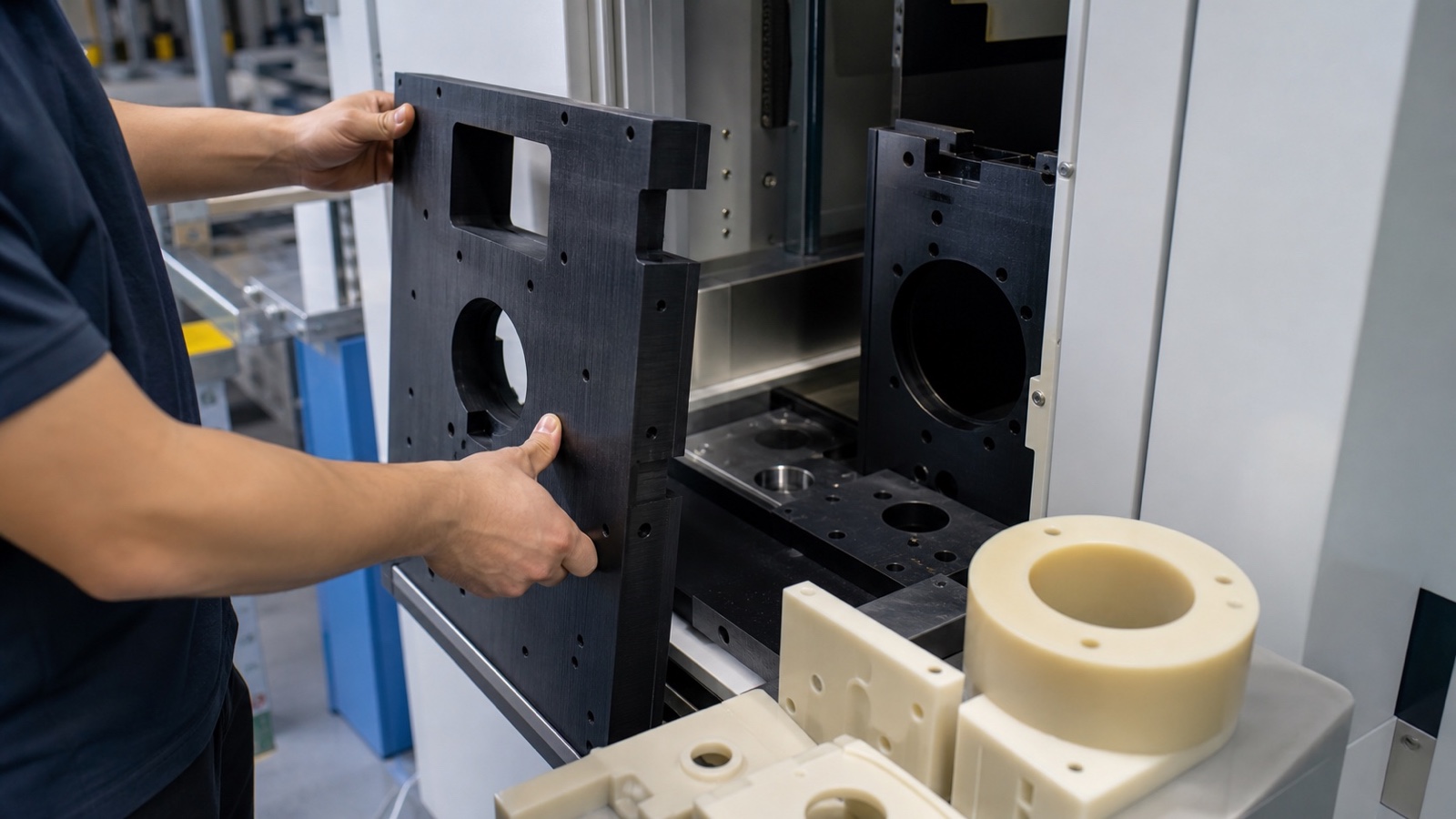
Industrial shielding rarely arrives as a simple rectangular block. Components may need bolt patterns, pockets, stepped profiles, access openings, cable routes, rounded transitions, or interfaces with metal frames. CNC machining makes these custom features practical for prototypes, low-volume production, replacement parts, and repeat manufacturing.
At PlasticCNCPro, we review the drawing, material grade, tolerances, and intended environment before production. Our work includes CNC milling, turning, drilling, tapping, threading, slotting, and complex custom machining for thermoplastics and engineering polymers. That design-for-manufacturing review is particularly important for filled or borated materials because their behavior may differ from unfilled HDPE during cutting and inspection.
Structural Versatility in Complex Equipment
High-density plastics can be integrated into equipment housings, removable liners, partitions, duct interfaces, fixtures, protective covers, and localized shielding inserts. Their electrical insulation and corrosion resistance can also be useful in equipment that combines radiation management with fluid handling, laboratory processes, automation, or sensitive electronics.
Manufacturing perspective
A shielding component should be designed for installation, cleaning, inspection, replacement, and safe handling—not only for its nominal attenuation performance.
Key Performance Indicators: Understanding Shielding Efficiency
Shielding performance is expressed through more than material name or nominal density. Engineers use measurement and modeling terms to compare how radiation intensity changes as it passes through a material.
Half-Value Layer
The Half-Value Layer, or HVL, is the thickness of a material required to reduce a specified radiation intensity to one-half under defined conditions. HVL depends on the radiation energy, material composition, density, and measurement geometry.
Mean Free Path
The Mean Free Path, or MFP, describes the average distance a particle travels before a specified interaction. In polymer shielding analysis, it helps researchers understand scattering and interaction behavior rather than acting as a universal thickness recommendation.
Effective atomic number and material comparison
Effective atomic number, often written as Zeff, is a way to represent the combined radiation-interaction behavior of a composite or mixture as an equivalent atomic-number value. It can be useful when comparing formulations, but it should not replace application-specific testing or radiation transport analysis.
Mechanical and thermal validation
A shielding part must remain physically reliable throughout its service life. Tensile testing can help characterize mechanical behavior, while thermal stability analysis helps identify changes that may occur at the intended operating temperature. Dimensional inspection, surface review, and evaluation of interfaces are also important when a machined component must fit tightly inside a larger assembly.
Define the radiation field
Identify whether the primary concern is neutron, gamma, or mixed radiation and document the relevant operating conditions.
Match material and geometry
Select the polymer formulation, thickness, joints, and surrounding materials as one shielding system.
Validate performance and manufacturability
Review radiation calculations alongside mechanical, thermal, dimensional, and production requirements.
FAQ: Common Questions About Plastic Radiation Shielding
What is the best material to shield against radiation?
There is no single best material for every radiation type. Lead and other dense materials are commonly considered for gamma shielding, while HDPE and borated polyethylene are often more suitable for neutron moderation and absorption. Mixed radiation fields may require layered or hybrid designs.
What is the disadvantage of HDPE?
HDPE has temperature limitations compared with some high-performance engineering polymers, and its lower density means it is not as efficient as dense metals for every gamma-shielding requirement. It can also require careful support and dimensional design when exposed to heat, load, or long service cycles.
Which plastic has the highest density?
HDPE is a standard choice for hydrogen-rich neutron shielding, but it is not automatically the highest-density plastic in every comparison. Specialized additives and filled formulations can increase effective density and alter shielding behavior. The correct choice depends on the desired balance of radiation response, strength, temperature resistance, machinability, and cost.
Can polyethylene be used for radiation shielding?
Yes. Polyethylene is widely used as a neutron moderator because its hydrogen-rich structure slows fast neutrons. When neutron capture is also required, borated polyethylene can combine moderation with absorption. For gamma-dominant applications, polyethylene may need to be combined with other shielding materials.
Selecting the Right Material for Your Project
For global B2B buyers developing equipment, prototypes, or low-volume production parts, the material decision should connect radiation requirements with manufacturing realities. A drawing that specifies only “plastic shielding” leaves several important questions unanswered.
Radiation source intensity and type
Document the source, energy range, exposure conditions, and whether the field is neutron, gamma, or mixed.
Environmental temperature
Confirm the normal and peak temperatures so the selected polymer can maintain its required shape and performance.
Structural and installation loads
Consider whether the component is self-supporting, clamped, bolted, removable, or integrated into a metal structure.
Budget and production volume
Prototype and low-volume CNC production can be practical when molding is not yet economical, while repeat programs benefit from stable drawings and defined inspection requirements.
Professional consultation is especially important for mission-critical shielding. Radiation calculations and safety validation should be handled by qualified specialists, while the manufacturing partner should confirm material availability, machining approach, tolerances, surface requirements, and inspection documentation.
At PlasticCNCPro, customers can send a 2D drawing, 3D model, sample, or project requirement. We help review material suitability and manufacturability for precision plastic components used in industrial equipment, laboratory systems, aerospace-related equipment, chemical processing, automation, and other demanding applications.
Conclusion
High-density plastics are helping engineers rethink radiation protection. HDPE provides a hydrogen-rich base for neutron moderation, while borated polyethylene adds neutron absorption potential in applications ranging from nuclear facilities and research laboratories to medical imaging and aerospace systems.
The shift toward polymer-based shielding is driven by more than weight reduction. Corrosion resistance, custom geometry, electrical insulation, ease of machining, and integration into complex equipment can all improve the practicality of a final design. At the same time, temperature limits, lower density for gamma attenuation, structural loads, and shielding gaps must be addressed carefully.
We encourage engineering and sourcing teams to evaluate their specific radiation environment, operating conditions, production volume, and dimensional requirements before selecting a polymer composite. With the right material and a manufacturing plan aligned to the application, high-density plastics can become a dependable part of an advanced shielding system.
Discuss your component
Need a custom-machined polymer shielding part?
Send us your drawing, CAD model, material requirement, quantity, tolerance, and application details. Our team can review the design and recommend a practical CNC machining approach for prototypes, low-volume parts, or repeat production.