
PAI vs. PI: Comparing Ultra-High-Temperature Engineering Plastics
A practical engineering comparison of Polyamide-imide (PAI) and Polyimide (PI) covering thermal endurance, mechanical loads, wear life, and CNC machinability for extreme environments.
Jump to Section
Introduction
When mechanical systems operate in extreme physical environments—such as rocket turbopump housings, plasma etching chambers in semiconductor foundries, or high-bypass jet engines—standard engineering plastics like POM or nylon quickly yield to thermal creep, outgassing, or chemical breakdown. Even familiar high-performance thermoplastics like PEEK encounter operational boundaries when sustained working temperatures surpass 250°C (482°F).
At this tier of severe operating requirements, design engineers inevitably face a choice between two premier polymer families: Polyamide-imide (PAI) and Polyimide (PI). While the acronyms sound similar, their underlying molecular architectures produce distinctly different balances of tensile strength, thermal ceilings, creep resistance, and machinability. In this guide, we break down their performance profiles to help you select and specify the exact grade required for your mission-critical components.
Choose PAI when you need exceptional tensile strength, rigidity, and dimensional stability under continuous mechanical loads up to 260°C. Choose PI when operating conditions exceed 300°C, require vacuum compatibility with zero outgassing, or demand unlubricated friction reliability under extreme PV factors.
Understanding the Materials: PAI vs. PI
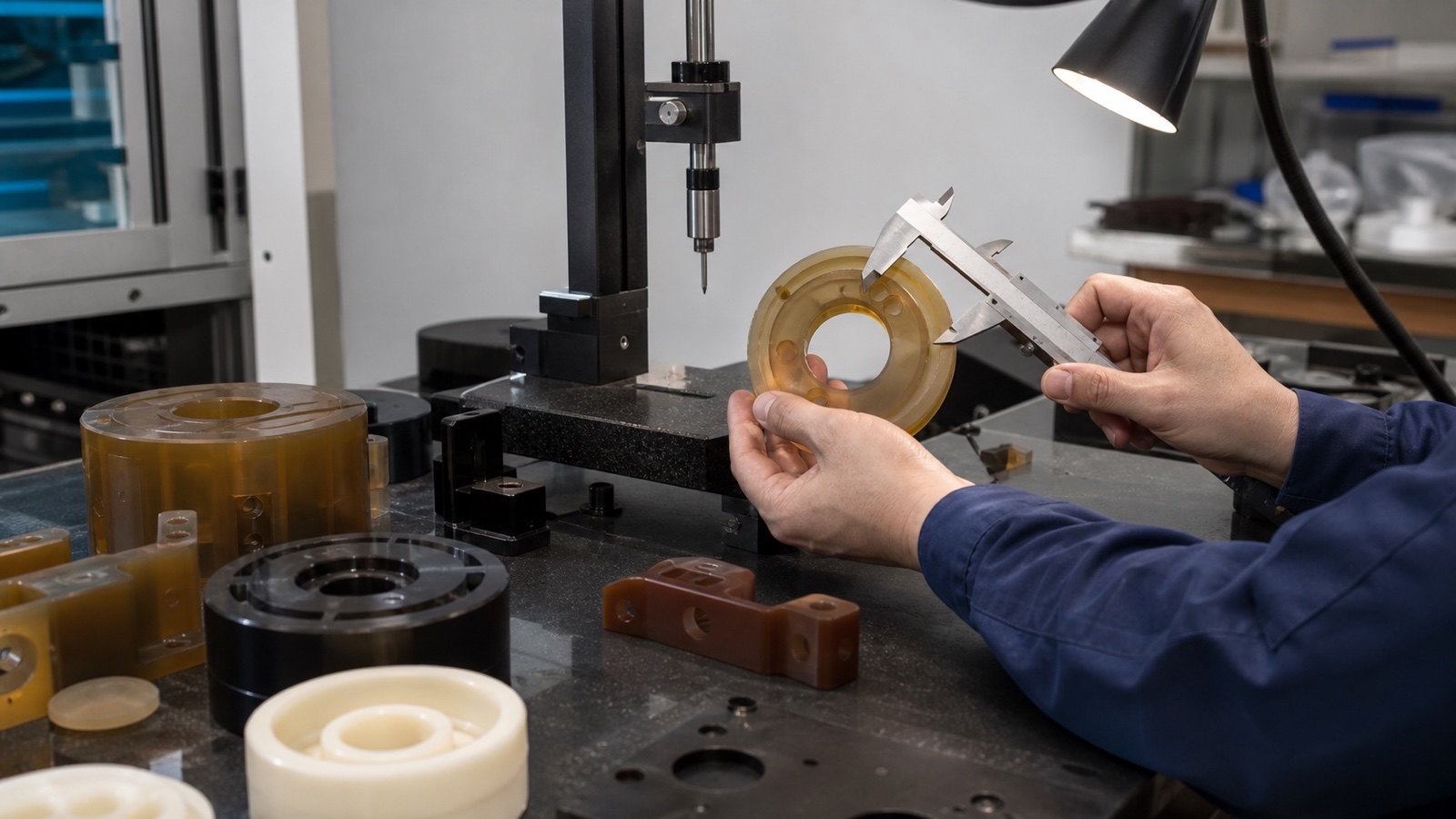
What is PAI (Polyamide-imide)?
Polyamide-imide (PAI), widely recognized under trade names such as Torlon®, is an amorphous thermoplastic characterized by repeating alternating aromatic amide and imide linkages. This hybrid structure gives PAI a distinct duality: the aromatic imide ring delivers exceptional heat resistance and stiffness, while the amide link contributes toughness, elongation, and melt-processability.
PAI can be melt-processed via injection molding and extrusion, though parts require a multi-day post-curing schedule to cross-link the polymer backbone, maximizing molecular weight and building ultimate mechanical tenacity. Once cured, it boasts the highest room-temperature and elevated-temperature tensile strength of any commercially available melt-processable thermoplastic.
What is PI (Polyimide)?
Polyimide (PI), famously known under brand names like Vespel® (SP series) and Meldin®, represents an ultra-high-temperature polymer class containing purely imide groups in the main chain. Many high-end PI materials used for precision components are thermosetting or non-melting polymers produced using powder metallurgy techniques such as hot isostatic pressing or direct-forming followed by sintering.
Because it does not melt in the traditional sense, pure polyimide exhibits no true glass transition point or melting temperature below thermal decomposition (often past 500°C / 932°F). It behaves like an engineered organic ceramic, maintaining structural cohesion, mechanical integrity, and electrical insulation across temperatures where standard engineering polymers soften or burn.
Thermal Performance and Heat Resistance
Thermal behavior is often the initial gating factor when deciding between PAI and PI. While both polymers reside in the top echelon of polymer thermal capabilities, their thresholds diverge noticeably under continuous severe exposure.
| Thermal Characteristic | PAI (Torlon® 4203 / 4301) | PI (Vespel® SP-1 / Meldin®) |
|---|---|---|
| Glass Transition Temp (Tg) | ~275°C (527°F) | None detected / >360°C (680°F) |
| Continuous Use Temp (Air) | 260°C (500°F) | 288°C – 300°C (550°F – 572°F) |
| Short-Term Excursion Limit | ~280°C – 300°C (572°F) | 480°C – 500°C (896°F – 932°F) |
| Coefficient of Thermal Expansion (CTE) | 31 × 10⁻⁶ / K (unfilled) | 45 × 10⁻⁶ / K (isotropic) |
| Flammability (UL 94) | V-0 | V-0 / 5VA |
A common query we hear from machine designers is: What is the highest temperature-rated plastic? Polyimide (PI) is almost universally the answer for solid, machinable structural shapes. Because it has no melting point, standard thermoset polyimide parts survive brief flash exposures exceeding 480°C without liquefying, blistering, or flowing.
Conversely, PAI has a well-defined glass transition temperature at 275°C. Once operating conditions push past 260°C, PAI begins to lose elastic modulus, which can lead to rapid dimensional relaxation under sustained mechanical clamping.
Mechanical Strength and Stiffness Comparison
While PI wins on raw thermal endurance, PAI commands a distinct advantage in structural load capacity. Polyamide-imide was intentionally formulated to offer high room-temperature strength that persists deep into elevated thermal bands.
PAI: Structural Workhorse
Unfilled PAI (Torlon 4203) features a tensile strength near 190 MPa (27,500 psi) at 23°C. Even at 200°C (392°F), its tensile strength remains above 100 MPa—higher than many commodity plastics at room temperature. It delivers remarkable flexural rigidity and shear strength for bolted assemblies and threaded housings.
PI: Thermal Ductility
Direct-formed, unfilled PI (Vespel SP-1) exhibits an ambient tensile strength of roughly 85–100 MPa (12,000–14,500 psi). While lower than PAI, PI maintains its mechanical profile with virtually zero softening slope as temperatures climb toward 300°C, offering continuous, ductile compliance without brittle fracture.
Creep Resistance: For components loaded under static compression or tension—such as high-pressure hydraulic piston rings, aerospace thrust washers, or valve seats—creep resistance determines part longevity. PAI's cured cross-linked structure gives it high resistance to cyclic loading and static deformation below 250°C.
However, when mechanical loads must be sustained at temperatures between 260°C and 340°C, PAI yields, making polyimide the required material choice.
Tribological Properties and Wear Resistance
Both materials are extensively formulated into specialized bearing grades, usually compounded with graphite, PTFE, or carbon fiber. Yet their friction mechanisms differ substantially under high pressure-velocity (PV) thresholds.
Unlubricated "Dry" Performance
Polyimide (e.g., SP-21 graphite-filled or SP-211 graphite/PTFE) is widely recognized as the industry benchmark for dry friction surfaces. PI does not gall, melt, or melt-smear onto mating shafts during momentary lubrication starvation, running smoothly in deep vacuum and cleanroom environments.
High-PV Load Carrying
Bearing-grade PAI (such as Torlon 4301 or 4275) excels in lubricated or semi-lubricated regimes with severe unit loads. Because PAI has higher baseline compressive strength, it resists extrusion and pounding wear in reciprocating equipment better than polyimide.
Both graphite-filled PAI and PI generate fine, abrasive airborne dust during CNC turning and milling. Tool wear accelerates dramatically, making micro-grain carbide or polycrystalline diamond (PCD) tooling standard practice in our machining processes to keep bores within ±0.01 mm.
Chemical Resistance and Environmental Stability
Chemical compatibility under high heat is an intricate evaluation. Both materials show broad resistance to aliphatic and aromatic hydrocarbons, transmission fluids, aviation fuels, chlorinated solvents, and fluorinated refrigerants.
However, engineers must evaluate two critical environmental hazards: strong bases and moisture absorption.
Hydrolytic Stability & Steam Exposure
Both PAI and PI contain chemical bonds that are vulnerable to hydrolysis under sustained high-pressure steam. Unfilled PAI absorbs up to 0.3% – 0.4% moisture within 24 hours (and over 1.5% at saturation). Moisture absorption causes measurable volumetric swelling. For tight-tolerance parts, this dimensional shift must be factored into drawing tolerances or managed through pre-assembly drying cycles.
Resistance to Strong Bases & Amines
Both polymers are vulnerable to high concentrations of strong alkalis (such as sodium hydroxide) and short-chain organic amines at elevated temperatures. Strong bases cleave the imide rings, degrading surface toughness and structural integrity.
Machinability and Fabrication Considerations
When sourcing precision components, material processability directly impacts raw stock price, lead times, and cycle times. From a manufacturing perspective in our CNC shop, PAI and PI require distinct operational handling.
Stock Shape Availability: PAI shapes are extruded in rods, plates, and tubes. Stock shapes undergo factory annealing to balance residual stresses. PI is commonly sold as compression-molded or isostatically pressed rods and plates, carrying a raw material cost 3 to 6 times higher per kilogram than PAI.
Internal Stress and Annealing: Extruded PAI rods can retain internal casting stresses. Aggressive hogging or drilling large diameters can trigger warping. At PlasticCNCPro, we use intermediate thermal stress-relief cycles between roughing and finishing passes on complex PAI parts.
Burr Formation & Surface Finish: PAI's high tensile toughness causes it to form tenaciously attached burrs during milling and cross-hole drilling. PI, behaving more like a dense ceramic, cuts crisply with fine powdery swarf, yielding mirror-like finishes and burr-free edges, but requiring sharp tools to avoid micro-chipping.
Selecting the Right Material for Your Application
To simplify the selection process between PAI and PI, evaluate your core engineering priorities against the primary requirements below.
| Operational Requirement | Recommended Polymer | Engineering Rationale |
|---|---|---|
| Continuous Heat 200°C – 250°C with High Load | PAI (Torlon®) | Significantly higher tensile strength and lower raw material procurement cost. |
| Continuous Exposure > 280°C | PI (Vespel®) | PAI loses modulus above its 275°C Tg; PI maintains integrity beyond 300°C. |
| Semiconductor Wafer Clamps / Vacuum | PI (Vespel®) | Minimal outgassing in high-vacuum plasma chambers, high purity, zero ionic contamination. |
| Heavy-Duty Hydraulic Check Valve Balls | PAI (Torlon®) | Superior fatigue life, high impact resistance, and resilience against high-pressure cyclical seating. |
| Non-Lubricated High-Speed Bushings | PI (Vespel® SP-21) | Low dry friction coefficient with no risk of melt-adhesion on precision shafts. |
Frequently Asked Questions
What are three types of thermoplastics?
Thermoplastics are typically grouped by performance and thermal capability into three tiers: (1) Commodity plastics (like Polyethylene and Polypropylene), (2) Engineering plastics (such as POM/Acetal, Nylon, and Polycarbonate), and (3) High-performance polymers (including PEEK, PEI, and PAI) designed for severe mechanical and thermal environments.
What is the difference between PEEK and PAI?
While both are high-performance polymers, PEEK is a semi-crystalline thermoplastic with a continuous temperature limit of 240°C to 250°C and broad chemical resistance, but it softens near its 143°C glass transition temperature. PAI is an amorphous polymer with a Tg of 275°C, offering higher tensile strength, greater stiffness, and lower creep at temperatures above 150°C.
Does PAI or PI provide better thermal conductivity?
Both unfilled PAI and PI are natural thermal insulators, displaying low thermal conductivity around 0.25 to 0.35 W/(m·K). However, both materials are routinely compounded with conductive fillers—most notably graphite, carbon powder, or pitch-based carbon fibers—which elevate thermal conductivity to facilitate heat dissipation in high-speed rotating bushings.
Conclusion
Navigating the choice between PAI (Polyamide-imide) and PI (Polyimide) comes down to balancing mechanical loading against thermal extremes. When peak tensile strength, high stiffness, and fatigue resistance up to 260°C are your primary design criteria, PAI offers industry-leading performance at a more accessible production cost. When your application pushes temperatures past 280°C, operates in vacuum environments, or demands unlubricated wear resistance, Polyimide stands in a class of its own.
Because high-performance stock shapes represent a major material investment, machining them accurately without scrap, tool deflection, or post-machining distortion requires specialized experience with high-temperature polymer dynamics.
Need Guidance on Your High-Temp Component?
Our engineering team at PlasticCNCPro regularly works with design and procurement teams around the world, manufacturing tight-tolerance parts from PAI, PI, PEEK, and other engineering polymers. We are ready to review your tolerances, evaluate thermal trade-offs, and recommend the most cost-effective production strategy.
Request an Engineering QuotationRequest a Quote for PAI or PI Machined Parts
Send us your 2D drawings, 3D CAD files, and material requirements. Our application engineering team will review your tolerances and provide an actionable manufacturing quote with international shipping support.