
Engineering material guide
PET vs PA12 for Dimensionally Stable Parts: Key Differences & Best Uses
We compare PET, especially carbon-fiber-reinforced PET, with PA12 for precision parts that must hold their dimensions through printing, service, humidity changes, and repeated use.
The short answer: PET-CF is often the better choice when low moisture sensitivity and high stiffness are the priority. PA12 is often better when toughness, impact resistance, complex geometry, and forgiving functional performance matter more than absolute dimensional stability.
Neither material wins every application. In our engineering reviews at PlasticCNCPro, we look at the part’s tolerance, load direction, temperature, humidity, print orientation, post-processing plan, and expected service life before recommending a polymer.
For a dry indoor fixture, PET-CF can provide a highly rigid and repeatable result. For a snap-fit, protective housing, or part exposed to impact, PA12 may remain the more reliable engineering choice even though it absorbs more moisture.
Material Properties Comparison
The values below are practical comparison ranges rather than universal specifications. Reinforcement level, printer settings, test direction, conditioning, and supplier formulation can change the result, so we always verify the selected grade’s technical data sheet before production.
| Property | PET-CF | PA12 | Engineering meaning |
|---|---|---|---|
| Tensile strength | Often approximately 60–90 MPa for CF grades | Often approximately 45–70 MPa unfilled; higher for reinforced grades | PET-CF generally carries load with less elastic movement; PA12 trades some rigidity for toughness. |
| Tensile modulus | Commonly about 5–10 GPa for CF grades | Commonly about 1.5–3 GPa unfilled; reinforced grades can be higher | Higher modulus usually means less deflection under the same load. |
| Moisture absorption | Low, commonly below 0.5% depending on grade and test method | Higher; commonly around 1–2.5% at conditioning equilibrium | PA12 can change size and stiffness as it absorbs or loses moisture. |
| Heat deflection | Often roughly 100–150°C for reinforced formulations | Often roughly 90–140°C unfilled; reinforced formulations may be higher | The grade and test load matter; continuous-use temperature is not the same as HDT. |
| Dimensional behavior | Low moisture movement; may be more sensitive to print stress and fiber orientation | Good toughness and process tolerance; moisture-related movement must be allowed for | Final accuracy depends on the complete process, not one property number. |
PET-CF: rigidity with low moisture movement
Carbon fiber raises stiffness and can reduce the sensitivity of the finished part to ambient humidity. The trade-off is a more anisotropic material, with performance influenced by fiber alignment and the bonding between printed layers.
PA12: toughness with environmental sensitivity
PA12 is valued for impact resistance, ductility, and functional parts that must survive handling or vibration. Its moisture absorption can alter dimensions and mechanical properties, so conditioning and inspection timing are important.
Key Differences Between PET-CF and PA 612 CF
PET-CF and PA 612 CF are not interchangeable labels. PET-CF uses a PET-based matrix, while PA 612 CF uses a nylon matrix with a different moisture response, crystallization behavior, and toughness profile. PA 612 CF may be a useful comparison when a project specifies a reinforced long-chain nylon, but its behavior should not be assumed to represent unfilled PA12.
| Dimension-related factor | PET-CF | PA 612 CF |
|---|---|---|
| Moisture-related movement | Usually lower because the PET matrix is less hygroscopic. | Lower than many nylon grades, but still sensitive to conditioning and humidity. |
| Print warpage tendency | Often moderate to low with a controlled thermal environment; fiber alignment can create local distortion. | Can be moderate; crystallization, cooling gradients, and part geometry affect the result. |
| Shrinkage consistency | Generally predictable after the process is tuned, with orientation-dependent shrinkage. | Requires attention to moisture state, cooling history, and shrinkage across axes. |
| Long-term stability | Strong candidate for dry, rigid fixtures and dimension-critical brackets. | Strong candidate where toughness and fatigue resistance offset moderate environmental movement. |
Engineering note
There is no universal “best” shrinkage percentage. We recommend printing a representative test coupon or first article in the actual orientation, then measuring it after the same drying, conditioning, and finishing cycle planned for production.
What the Stiffness Numbers Do Not Show
A high modulus does not automatically produce a dimensionally accurate assembly. A rigid part can still be inaccurate if the print is warped, if the material changes moisture state, or if the part creeps under a constant load.
Creep: PA12 can gradually deform under sustained stress, especially at elevated temperature. PET-CF resists deflection better, but the polymer matrix can still creep.
Humidity: Nylon dimensions and flexibility can shift as moisture content changes. Measure PA12 parts in a controlled and documented condition.
Post-processing: Drilling, reaming, sanding, annealing, or machining can release internal stress or change a critical feature. The inspection plan should cover the finished condition.
Dimensional Accuracy in 3D Printing
The printer, slicer, build chamber, nozzle, layer height, orientation, and cooling profile can matter as much as the polymer. PET-CF generally benefits from controlled cooling and a stable build surface. PA12 requires careful moisture control and may need more attention to chamber temperature and thermal gradients.
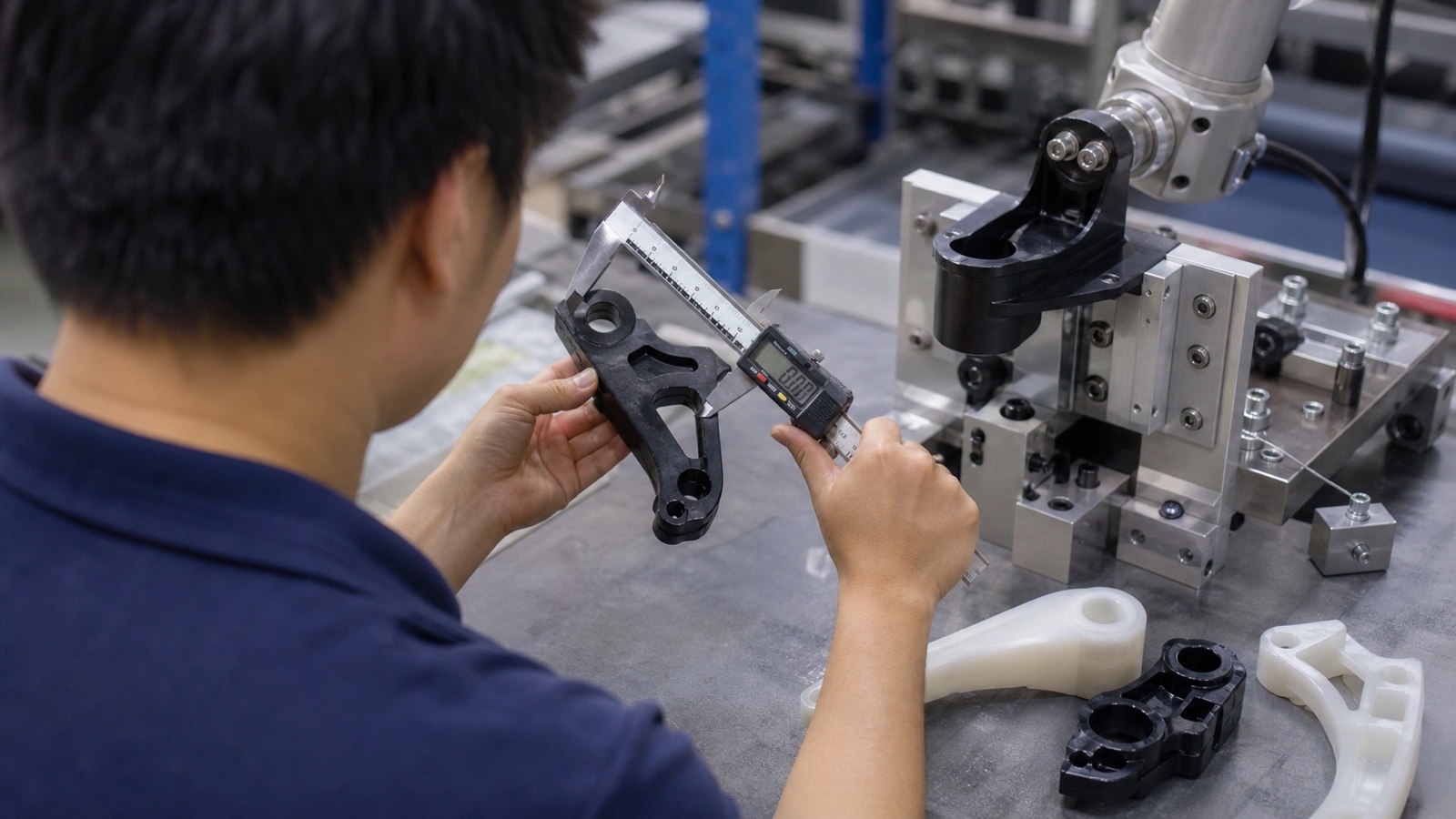
For both materials, large flat sections, sharp corners, thin walls, and abrupt changes in cross-section are common sources of distortion. We reduce risk by designing generous corner radii, balancing wall thickness, orienting critical features deliberately, and separating cosmetic surfaces from datum surfaces.
Accuracy principle
A printed part can be dimensionally consistent without being dimensionally correct. We distinguish repeatability from absolute accuracy, then use calibration, process compensation, and—when needed—CNC machining of critical interfaces.
Is PLA or PETG More Dimensionally Accurate?
PLA is usually easier to print accurately because it has relatively low shrinkage and strong shape retention during cooling. PETG can also produce accurate parts, but its stringing, surface adhesion, and thermal behavior may require more tuning. Neither is automatically a replacement for PET-CF or PA12 when the application demands engineering-level heat, impact, or wear performance.
For a simple visual prototype, PLA may be the most dimensionally convenient. For a general functional prototype, PETG is often a practical middle ground. For a load-bearing fixture or production-intent component, PET-CF or PA12 should be selected based on the service environment rather than dimensional accuracy alone.
Printing Requirements and Challenges
Reliable results begin before the first layer. We treat drying, nozzle selection, bed preparation, enclosure control, and inspection as one process rather than isolated settings.
Dry the material correctly
PA12 is particularly sensitive to humidity and should be dried and stored in a controlled condition. PET-based materials also benefit from drying when the spool has been exposed to ambient moisture.
Use a wear-resistant nozzle for CF grades
Carbon fiber is abrasive. A hardened or otherwise wear-resistant nozzle is generally required, and nozzle wear should be considered when tolerances are tight.
Control the build environment
A stable bed, consistent first layer, and controlled airflow help limit warpage. An enclosure is especially useful for larger PA12 parts and geometries with substantial thermal gradients.
Plan supports and datums
Support removal can mark or distort a critical surface. Place supports away from datum faces and consider machining those faces after printing when the tolerance is important.
Can PETG Withstand 100 Degrees?
PETG may tolerate short-term exposure near 100°C in some grades, but that does not mean every PETG part will retain its shape under load at that temperature. Softening, creep, wall thickness, print orientation, and exposure duration all matter. For a dimension-critical component operating continuously near 100°C, we would not select generic PETG without a grade-specific validation plan.
PET-CF typically offers a stronger heat and stiffness margin than standard PETG, while PA12 can perform well in warm functional applications when its moisture state and load are controlled. For higher-temperature service, we review alternatives such as the engineering polymers available through our CNC machining work rather than relying on a generic filament label.
Do not confuse
Heat-deflection temperature is measured under a defined load and test method. It is not a blanket continuous-use rating, and it does not account for creep, chemical exposure, or the dimensional tolerance of your assembly.
Applications Where Each Material Shines
The right choice depends on whether the part needs to remain rigid and dimensionally quiet, or whether it must absorb impact and tolerate mechanical abuse.
Best uses for PET-CF
PET-CF is well suited to rigid inspection fixtures, robot end-of-arm tooling, dimensional gauges, brackets, machine covers, and functional prototypes where low moisture sensitivity is valuable. It is also a strong option when a part must maintain stiffness without adding much bulk.
Best uses for PA12
PA12 is well suited to housings, protective components, clips, ducting, guides, low-volume automotive parts, and functional prototypes exposed to impact or vibration. Its toughness can be more valuable than maximum stiffness in assemblies that are repeatedly handled.
Production perspective
For a low-volume part, 3D printing can be a fast route to validation. If a critical interface needs tighter dimensional control, we can also review a hybrid approach: print the near-net shape, then CNC machine mounting faces, bores, slots, or datums from a suitable engineering polymer.
What Is PETG Not Good For?
PETG is not ideal for every precision application. It is generally a poor choice when the part must resist sustained high temperature, hold a tight fit while heavily loaded, remain rigid over a long period, or operate in an environment where chemical, wear, or creep resistance is critical.
It can also be less convenient than PET-CF or PA12 for demanding geometries because stringing, surface adhesion, and cooling behavior may complicate finishing. PETG remains useful for many prototypes, guards, and general-purpose parts, but we would move to PET-CF, PA12, or a machined engineering plastic when the application has a defined load and service-life requirement.
Cost vs Value and Final Selection Path
Material price is only one part of the total cost. A less expensive spool can become expensive if parts warp, require repeated printing, need extensive finishing, or fail after absorbing moisture in service.
PET-CF may justify its higher material and nozzle requirements when stiffness, low moisture response, and repeatable dimensions reduce rework. PA12 may provide better value when impact resistance prevents breakage, when the geometry is complex, or when a tougher part avoids frequent replacement.
Define the critical dimension
Identify the bore, mounting face, slot, mating edge, or datum that controls assembly function.
Document the service environment
Record temperature, humidity, chemical contact, impact, vibration, sustained load, and expected service duration.
Choose the process, not only the polymer
Decide whether printed PET-CF or PA12 meets the tolerance, or whether critical surfaces should be CNC machined from PET, nylon, POM, PEEK, or another suitable polymer.
Validate the conditioned part
Inspect the part after the same drying, cooling, humidity exposure, and finishing sequence expected in production.
Our practical rule is simple: select PET-CF when rigid, low-moisture dimensional behavior is the dominant requirement; select PA12 when toughness and impact tolerance are more important; and consider CNC machining when the part has demanding interfaces or needs predictable repeat production.
Discuss your part
Need help choosing PET, PA12, or a machined engineering polymer?
Send us your 2D drawing, 3D model, material requirement, quantity, tolerance, and application details. At PlasticCNCPro, we review the design and recommend a practical route for prototypes, low-volume production, or repeat manufacturing.