
PTFE Density Explained: Why PTFE Weighs More Than Most Plastics
When machine shops and design engineers pick up a raw PTFE billet for the first time, its sheer heft comes as a surprise. As application engineers at PlasticCNCPro machining fluoropolymers daily, here is our breakdown of PTFE density, atomic mechanics, and design trade-offs.
"With a standard density between 2.14 and 2.20 g/cm³, virgin PTFE is more than twice as dense as Polypropylene and polyethylene, behaving dynamically closer to light structural metals than traditional lightweight commodity plastics on our CNC mills."
What Density Actually Means for Plastics
In engineering terms, density represents mass per unit volume (ρ = m / V), routinely measured in grams per cubic centimeter (g/cm³) or kilograms per cubic meter (kg/m³). In custom plastic CNC machining, density is not just a nominal catalog specification; it directly dictates raw stock shipping weight, inertia in dynamic machinery, vibration damping, and tool chip-loading physics.
When our machining teams calculate raw stock requirements for custom seals, manifolds, or laboratory fluid housings, the material's density establishes the baseline cost and structural feasibility. A cubic foot of low-density polyethylene weighs roughly 59 lbs (27 kg), while the exact same volumetric block of pure PTFE exceeds 134 lbs (61 kg). Choosing a dense fluoropolymer when low-mass inertia is needed can overburden rotary actuators, whereas overlooking its density in chemical environments can result in unwanted component buoyancy.
High mass increases momentum in high-speed reciprocating valves, guides, and slide bushings.
PTFE has a specific gravity well above water (1.0 g/cm³), preventing parts from floating in process tanks.
High density combined with low yield stress requires precise clamping pressure to eliminate deformation.
Exact Density of PTFE and Teflon
Polytetrafluoroethylene (commercially branded by Chemours as Teflon™) has an exceptionally tight density specification. For virgin, unpigmented, unfilled grade PTFE, the standard bulk density ranges from 2.14 g/cm³ to 2.20 g/cm³ (2,140 to 2,200 kg/m³) at 23°C, per ASTM D792 or ISO 1183 test standards.
Chemically, PTFE and virgin Teflon share the exact same chemical formulation: -[CF₂-CF₂]n-. The exact final density of a machined blank depends heavily on the compression sintering process used to form the raw billet before it arrives on our CNC beds:
Sintering Cooling Rate
Slow cooling increases polymer chain crystallization, producing finished densities near 2.18–2.20 g/cm³, whereas rapid quenching limits crystal growth, yielding densities around 2.14–2.16 g/cm³.
Micro-Porosity and Compaction
Unlike standard melt-processible resins, PTFE resin powder is cold-compacted and then sintered. Inadequate compression pressure can trap minute voids, artificially decreasing measurable density.
Reinforcing Fillers
When we machine filled grades for industrial wear pads, the density shifts: 25% glass-filled PTFE measures ~2.25 g/cm³, while bronze-filled PTFE (60% bronze) reaches roughly 3.90 g/cm³.
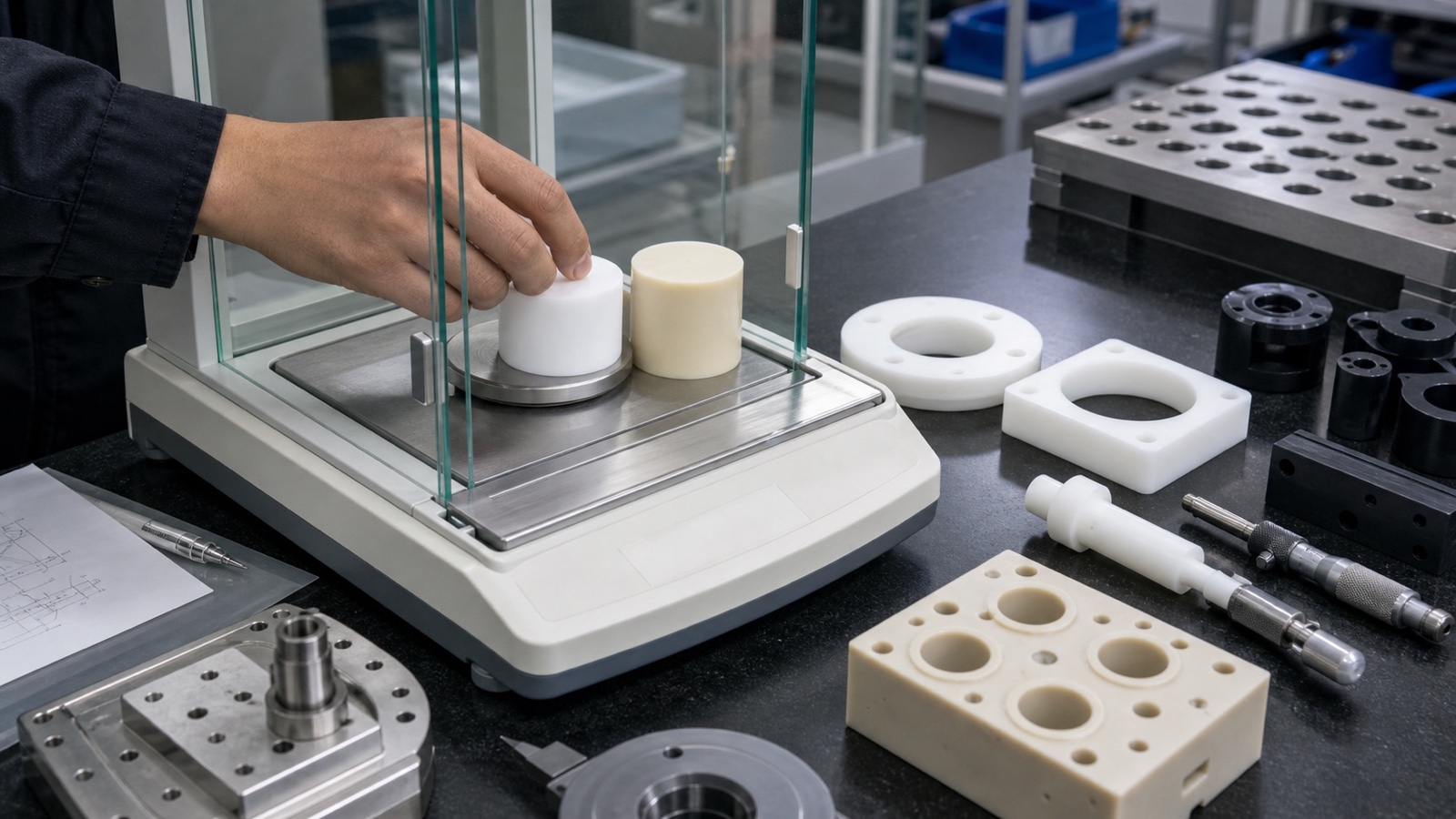
Density Comparison: PTFE vs Other Plastics
To appreciate where PTFE sits in the polymer hierarchy, we have compiled the density and typical application profiles for the most common engineering plastics we machine in our Dongguan facility:
| Polymer Material | Specific Gravity / Density (g/cm³) | Relative Weight vs PTFE | Common CNC Machined Applications |
|---|---|---|---|
| Polypropylene (PP) | 0.90 – 0.91 | ~58% Lighter | Chemical storage tanks, plating barrels, battery cases |
| UHMW-PE / HDPE | 0.93 – 0.96 | ~56% Lighter | Wear strips, conveyor star wheels, chute liners |
| Nylon 6 / PA6 | 1.13 – 1.15 | ~47% Lighter | Industrial gears, sheaves, high-load bushings |
| Polycarbonate (PC) | 1.20 | ~45% Lighter | Optical sight glasses, machine safety covers, housings |
| PEEK (Virgin) | 1.30 – 1.32 | ~40% Lighter | Aerospace valve seats, medical manifolds, semiconductor rings |
| Acetal / POM-C | 1.41 – 1.42 | ~35% Lighter | Precision structural gears, dimensional fixtures, fluid fittings |
| Rigid PVC | 1.38 – 1.45 | ~34% Lighter | Acid headers, ducting components, wet bench manifolds |
| PVDF (Kynar®) | 1.76 – 1.78 | ~18% Lighter | Semiconductor high-purity piping, chemical valve bodies |
| Virgin PTFE | 2.14 – 2.20 | Baseline (100%) | Cryogenic seals, semiconductor fluid seats, non-stick guides |
Why PTFE Has Higher Density Than Many Plastics
The extraordinary mass of PTFE is not a manufacturing anomaly; it stems directly from atomic architecture and quantum mechanical forces governing the fluoropolymer backbone.
1. Atomic Weight of Fluorine
Hydrocarbon plastics like Polyethylene (PE) or Polypropylene (PP) consist of carbon and hydrogen. Hydrogen has an atomic mass of ~1.008 amu. In PTFE, every single hydrogen atom is replaced by Fluorine, which possesses an atomic mass of ~18.998 amu—nearly 19 times heavier. That substitution alone loads tremendous mass along the molecular spine.
2. Tight Helical Packing
Fluorine atoms are relatively large and carry high electronegativity, mutually repelling each other along the chain. This electrostatic repulsion forces the carbon backbone into a rigid, uniform, twisted helical sheath. The straight, rod-like chains pack together cleanly in parallel bundles without excessive free spatial volume.
3. High Degree of Crystallinity
As-polymerized PTFE can reach 90% to 95% crystallinity, and even sintered and machined industrial billets retain 50% to 70% crystalline phase content. The dense crystalline lattice structure eliminates molecular voids, packing the massive fluorocarbon chains into tight cubic volume.
4. Extreme Molecular Weight
PTFE exhibits one of the highest molecular weights in polymer science, typically ranging between 10^6 and 10^7 g/mol. These ultra-long chains interlock tightly during the heat-sintering cycle, ensuring a solid, dense bulk mass with zero need for liquid plasticizers.
How PTFE Density Affects Performance
The high molecular density of PTFE directly underpins its exceptional real-world capabilities across industrial chemical, medical, and semiconductor processing equipment:
The dense outer electron envelope of fluorine atoms shields the inner carbon-carbon bond from aggressive chemical attack, oxidative breakdown, and permeation by pressurized industrial gases.
Total Chemical Inertness & Impermeability
Because molecules are bundled so closely together, corrosive reagents, concentrated acids (such as hydrofluoric or nitric acid), and harsh organic solvents cannot penetrate the polymer matrix. PTFE survives continuous immersion where lighter plastics swell or dissolve.
Thermal Stability Across Extreme Windows
PTFE's high mass and strong atomic bonds maintain structural cohesion from cryogenic liquid nitrogen temperatures (-200°C) up to continuous operating limits of +260°C (+500°F), resisting thermal degradation far beyond hydrocarbon polymers.
Lowest Coefficient of Friction
The tightly wrapped, electronegative fluorine sheath presents an ultra-smooth molecular surface with practically zero surface energy (~18 mN/m). Dynamic friction coefficients (0.04 to 0.10) make it the benchmark for unlubricated sliding contact.
PTFE vs HDPE: Density and Extreme Performance Trade-offs
Mechanical engineers frequently compare PTFE against High-Density Polyethylene (HDPE) or UHMW-PE when designing custom wear shoes, guide rails, and slide pads. Despite both polymers sharing a carbon chain with low surface friction, their density disparity creates very distinct operating envelopes:
| Performance Metric | Virgin PTFE | HDPE / UHMW-PE | Design Selection Verdict |
|---|---|---|---|
| Density | 2.14 – 2.20 g/cm³ | 0.94 – 0.96 g/cm³ | HDPE is >55% lighter; floats on water |
| Max Operating Temp | Up to +260°C (+500°F) | Up to +80°C (+176°F) | PTFE survives harsh ovens and exhaust lines |
| Creep / Cold Flow | Moderate to High under load | Low to Moderate | HDPE holds continuous compressive loads better |
| Abrasive Slurry Wear | Fair (soft matrix) | Exceptional (UHMW-PE) | UHMW-PE outperforms PTFE for particulate chutes |
| Raw Material Cost | High (fluoropolymer) | Low to Medium (commodity) | HDPE is far more economical for large structures |
Our recommendation for clients: If your component operates below 80°C without aggressive solvent exposure, HDPE or UHMW-PE provides a lighter, more economical, and impact-resistant solution. However, when thermal cycling, aggressive chemistries, high-purity non-leaching standards, or broad cryogenic capabilities are needed, PTFE is non-negotiable.
Physical and Mechanical Properties Tied to Density
In our machining inspection cell, density measurements serve as a primary verification of billet quality. Deviations in density directly correlate with shifts in mechanical performance:
Virgin PTFE exhibits tensile strength between 20 to 35 MPa with elongation at break reaching 250% to 400%. Under-sintered low-density billets (density < 2.13 g/cm³) experience premature tensile tearing during micro-machining of thin diaphragm walls.
Although high in molecular density, PTFE has a relatively low modulus of elasticity (~0.5 GPa) and low Shore D hardness (50–65). When we clamp dense PTFE bars in CNC lathe collets or mill vises, the high mass can yield under localized point pressure. We utilize custom pie jaws and engineered torque parameters to prevent cold-flow distortion during machining.
PTFE's high thermal expansion coefficient (100–160 x 10⁻⁶/K) combined with its dense structure requires sharp polished tooling and flood air or coolant. Dense continuous stringer chips must be cleared quickly to prevent heat buildup, which can alter critical final part dimensions.
Common Questions About PTFE Density
What is the density of PTFE plastic in different engineering units?
Standard virgin PTFE has a density of 2.14 to 2.20 g/cm³. In metric system units, this equals 2,140 to 2,200 kg/m³. In imperial units used across US manufacturing, it equals 0.0773 to 0.0795 lbs/in³ or approximately 133.6 to 137.3 lbs/ft³.
Which plastic has the highest density?
Among unfilled engineering thermoplastics, PTFE ranks at the very top alongside fellow fluoropolymers like PCTFE (~2.12–2.18 g/cm³). When looking at filled formulations, metal-loaded plastics such as Bronze-Filled PTFE (up to 3.9 g/cm³) or Tungsten-filled PEEK/polymers (reaching 10+ g/cm³ for x-ray shielding) hold the absolute highest densities in manufacturing.
Does machining or milling alter PTFE density?
No. CNC machining is a subtractive mechanical cutting process that does not change the crystalline morphology or atomic structure of the polymer bulk. However, localized tool friction that generates excessive heat (>327°C) could trigger localized melting and thermal degradation, altering porosity. At PlasticCNCPro, we control cutting feeds, speeds, and cooling to preserve 100% material integrity.
FAQ: PTFE Regulations, Recycling, and Misconceptions
Is PTFE banned in Europe?
No, PTFE is not banned in Europe. There is ongoing regulatory review under the EU ECHA PFAS restriction proposal concerning per- and polyfluoroalkyl substances. Major fluoropolymer trade groups are advocating for the clear distinction of high-molecular-weight "fluoropolymers of low concern" like PTFE, which are stable, non-bioaccumulative, non-toxic solids. Machined PTFE parts remain in widespread, compliant use across medical, industrial, and semiconductor applications globally.
Can PTFE be melted and recycled like standard polypropylene or ABS?
No. Virgin PTFE does not exhibit a conventional fluid melt flow; at its gel transition temperature (~327°C), it transforms into a high-viscosity rubbery state rather than a liquid. Scrap chips and turnings cannot simply be fed into an injection molding machine. PTFE recycling requires specialized irradiation or mechanical micronization into reprocessing powders used as lubricant additives or blended fill stock.
Why is it impossible to bond PTFE with standard adhesives?
PTFE's high fluorine density and chemical inertness produce an exceptionally low surface free energy (~18 dynes/cm). Adhesives simply bead up without wetting out. To glue or bond PTFE parts to mating steel or aluminum frames, the surface must undergo a specialized chemical sodium-naphthalene or plasma etching treatment that strips surface fluorine atoms and introduces bondable polar groups.
Is virgin machined PTFE safe for food and pharmaceutical contact?
Yes. High-purity virgin PTFE is physiologically inert, odorless, tasteless, and inherently free of plasticizers or heavy metal stabilizers. It is universally specified for food-contact filling valves, pharmaceutical fluid manifolds, and surgical components.
Need Tight-Tolerance PTFE or Engineering Plastic Components?
At PlasticCNCPro, we specialize in custom CNC milling, turning, and micro-machining of virgin PTFE, filled grades, PEEK, POM, UHMW-PE, and other performance polymers. Share your CAD drawings and technical specifications for rapid feedback and dependable manufacturing from Dongguan, China.