
PVDF vs PP Density Comparison for Chemical Equipment Selection
Comparing raw density metrics, thermal endurance, chemical compatibility, and CNC precision machining characteristics between polyvinylidene fluoride and polypropylene for high-reliability fluid-handling hardware.
"When sizing components for aggressive chemical scrubbers, manifolds, or pump bodies, engineers often zero in on corrosion charts first. However, the 97% density difference between PVDF and Polypropylene fundamentally dictates structural load, vibration dampening, fastener stress, and raw stock procurement economics."
— Senior Application Engineering Team, PlasticCNCProPVDF and PP Density at a Glance
Polypropylene (PP) and Polyvinylidene Fluoride (PVDF, frequently specified under trade names like Kynar®) represent two opposite ends of the polymer weight spectrum. Polypropylene ranks among the lightest industrial thermoplastics commercially machined, featuring a typical specific gravity of 0.90 to 0.91 g/cm³. In contrast, PVDF is a high-density, semi-crystalline fluoropolymer possessing a specific gravity ranging from 1.76 to 1.79 g/cm³.
| Physical Property | Polypropylene (PP-H) | PVDF (Homopolymer) | Design Impact |
|---|---|---|---|
| Nominal Density (g/cm³) | 0.905 | 1.78 | PVDF parts are ~97% heavier than identical PP geometries. |
| Density (lbs/in³) | 0.033 | 0.064 | Direct volumetric raw material weight impact. |
| Buoyancy in Water (1.0 g/cm³) | Floats | Sinks | Crucial for level switches, valve balls, and submerged fixtures. |
| Tensile Modulus (MPa) | 1,300 – 1,600 | 2,000 – 2,400 | Higher structural rigidity per cross-section with PVDF. |
Why does density matter so much in process engineering? When designing overhead process piping headers, wet-bench structural columns, or CNC-machined distribution manifolds, a PVDF component places nearly double the deadweight load on mounting brackets and pipe hangers compared to PP. Conversely, in submersed chemical tanks or fluid control check valves, PP components naturally float, while PVDF check valve balls and retaining rings maintain positive seat sealing and steady submergence without secondary ballast.
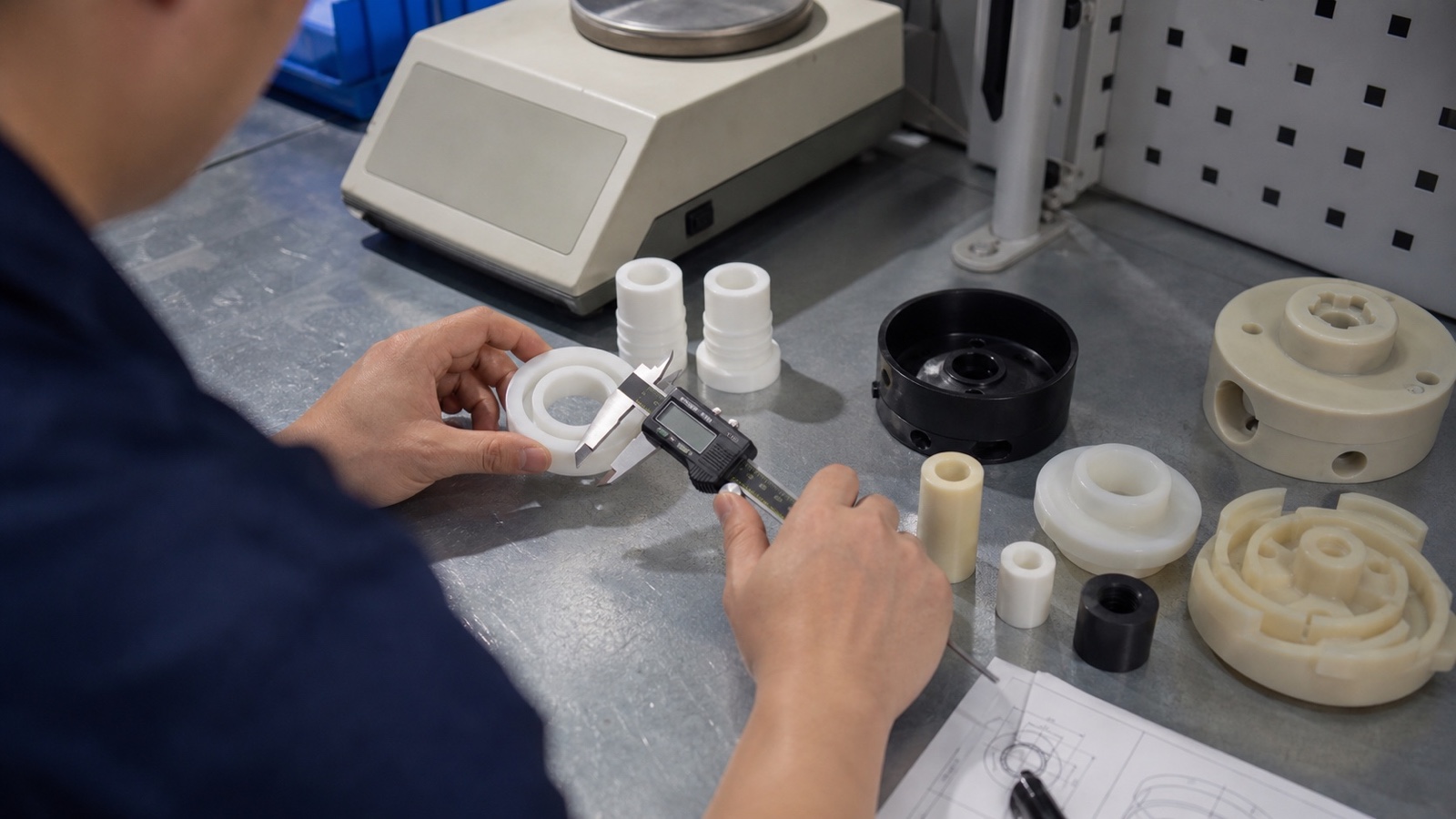
Key Differences Between PP and PVDF Plastics
While density differences are stark, the mechanical and material divergence between these two thermoplastics determines their practical survival in production plants. Below are the primary structural trade-offs we weigh in our machining consultations:
Rigidity and Mechanical Strength
PVDF offers superior tensile strength (~50–55 MPa vs. PP’s ~30–35 MPa) and a significantly higher flexural modulus. Thin-walled PVDF bodies withstand internal line pressure surges with less radial deformation than homopolymer PP.
Dimensional Stability & Thermal Expansion
Polypropylene displays a relatively high coefficient of linear thermal expansion (CLTE ~100–150 × 10⁻⁶/K), making tight tolerance maintenance difficult over wide operational temperature swings. PVDF is distinctly more stable (CLTE ~80–120 × 10⁻⁶/K), allowing CNC-turned seal grooves and threads to stay in spec.
UV & Gamma Weathering Resistance
Standard natural PP degrades when exposed to continuous outdoor ultraviolet radiation or sanitizing gamma radiation, requiring UV-stabilizing carbon black additives. PVDF contains an inherent fluorinated chemical bond matrix that remains impervious to UV degradation and retains clarity over decades outdoors.
Chemical Resistance Head-to-Head
Chemical compatibility dictates whether a valve body runs for five years or micro-fractures in five weeks. The presence of electronegative fluorine atoms gives PVDF superior barrier properties, but polypropylene exhibits notable resilience in specific alkaline environments.
Strong Acids & Oxidizers
PVDF provides near-universal resistance to concentrated mineral acids including hydrochloric (HCl), hydrofluoric (HF), and nitric acid (HNO₃), as well as aggressive halogens (wet and dry chlorine, bromine). Polypropylene safely handles dilute mineral acids, but oxidizing acids like hot nitric or concentrated sulfuric acid cause severe environmental stress cracking and chain scission in PP.
Caustics & Strong Bases
An essential nuance: Polypropylene delivers outstanding resistance to caustic soda (sodium hydroxide, NaOH) and potassium hydroxide (KOH), even at elevated concentrations and warm temperatures. PVDF, however, is susceptible to dehydrofluorination and embrittlement when exposed to hot, high-pH (pH > 12) caustic solutions or primary amines.
Solvents and Hydrocarbons
PP swells appreciably in aromatic and chlorinated hydrocarbons (such as benzene, toluene, and trichloroethylene). PVDF resists fuels, oils, halogenated solvents, and alcohols, though polar solvents such as acetone, MEK, and DMAc will attack and soften PVDF.
Engineering Tip: Operating pressure and stress concentrations directly magnify chemical attack. A threaded port under mechanical torque will fail via stress-cracking in borderline chemical exposure long before an unstressed test coupon exhibits any visual degradation.
Heat Resistance and Creep Behavior
Elevated fluid temperatures accelerate creep, stress-relaxation around bolted flanged connections, and pressure rating derating. Understanding continuous upper temperature limits is mandatory for safety-critical hardware:
Polypropylene Limits
- Continuous rating: 80°C to 90°C (176°F – 194°F)
- Heat Deflection Temp (0.45 MPa): ~85°C – 100°C
- Significant cold-flow under bolt pre-load above 60°C
PVDF Limits
- Continuous rating: 140°C to 150°C (284°F – 302°F)
- Heat Deflection Temp (0.45 MPa): ~135°C – 145°C
- Substantially lower creep; maintains gasket seal integrity
In high-temperature cycling scenarios, polypropylene experiences pronounced stress relaxation around CNC-machined flat face flanges and tapped pipe connections. When hot corrosive media exceeds 65°C (150°F), we generally advise our clients against unreinforced PP in favor of PVDF or reinforced engineering alternatives to mitigate joint seepage.
When to Choose Polypropylene
Polypropylene is widely considered the workhorse of industrial chemistry for good reason. Its lightweight density and favorable pricing make it ideal in the following scenarios:
Cost-Sensitive Bulk Systems
Large rinse vessels, atmospheric drainage sumps, exhaust ventilation ductwork, and non-critical distribution manifolds where stock volume is substantial.
High-pH Caustic Scrubbing
Bleach makeup tanks, sodium hypochlorite blending fixtures, and alkaline cleaning baths where PVDF would risk embrittlement.
Moderate-Temperature Plumbing
Industrial cooling water circuits, agricultural fertilizer injector manifolds, and deionized water transfer lines operating below 60°C.
Buoyancy-Dependent Mechanisms
Float level sensors, light liquid skimming devices, and buoyant check plates requiring a specific gravity below 1.0.
When to Choose PVDF (Kynar)
When downtime, trace contamination, or safety risks prevent compromises, PVDF is the default engineering fluoropolymer:
Ultra-High-Purity (UHP) Semiconductor Loops
Natural PVDF is manufactured without stabilizers, plasticizers, lubricants, or flame retardants. It resists bacterial biofilm formation and exhibits near-zero TOC (Total Organic Carbon) and trace ionic leachables in 18.2 MΩ-cm ultra-pure water.
Concentrated Halogens and Aggressive Acids > 65°C
Piping manifolds handling 98% sulfuric acid, hot hydrochloric dosing systems, chlor-alkali wet chlorine lines, and hot mixed acid etching lines where PP life is measured in weeks.
Rigid Fire and Cleanroom Code Compliance
PVDF possesses inherent flame retardancy meeting UL 94 V-0, with low smoke generation (LOI ~44%). Standard polypropylene is readily combustible (UL 94 HB) and prohibited in plenum spaces or cleanroom enclosures without fire suppression modifications.
Fabrication, Machining, and Welding Considerations
At PlasticCNCPro, we routinely machine both PP and PVDF on our CNC turning and 3/4/5-axis milling centers. The manufacturing nuances differ sharply:
CNC Machining Dynamics
Polypropylene: PP is ductile with a relatively low melting point. It tends to generate continuous stringy swarf that can bird-nest around tooling spindles. Extremely sharp, single-flute or double-flute polished carbide cutters, aggressive feeds, and high air-blast cooling are needed to prevent re-welding on the cutting edge.
PVDF: PVDF cuts cleanly, producing crisp, well-fragmented chips and smooth sidewalls. Its rigidity allows tighter dimensional tolerances (±0.05 mm or better) compared to PP. However, its higher density and abrasiveness cause faster tool edge wear, requiring micro-grain carbide tooling.
Welding and Thermal Joining
Both materials weld effectively via butt fusion, socket fusion, hot-gas welding, and infrared (IR) fusion. PVDF requires strictly monitored, higher heater temperatures (~240°C) and cleanroom-grade handling to prevent weld bead contamination. Polypropylene welds at lower temperatures (~210°C) and is more forgiving of slight thermal fluctuations.
Cost, Availability, and Grade Selection
The financial contrast between PP and PVDF involves both raw resin cost per kilogram and volumetric part density:
Common Applications in Chemical Equipment
To provide real-world context, here is how our industrial clients systematically segment their Bill of Materials between both materials:
| Industry Sector | Polypropylene (PP) | PVDF (Kynar) |
|---|---|---|
| Semiconductor & Solar | Chemical drain lines, cleanroom tool skins, DI water storage reservoirs. | Wafer etching cassettes, chemical injection manifolds, UHP piping systems. |
| Water Treatment | Flocculant mixing tanks, filter press plates, caustic dosing assemblies. | Ozone contact headers, chlorine gas injectors, UV sensor housings. |
| Industrial Chemistry | Electroplating rinse tanks, fume hood scrubbers, secondary containment basins. | Centrifugal pump impellers, acid metering valves, flanged line spools. |
| Pharma & Biotech | Non-critical transport carts, media holding tanks, wastewater sumps. | Clean-in-place (CIP) distribution blocks, sanitary sampling valves. |
Frequently Asked Questions
What is the density of PVDF material?
Virgin PVDF homopolymer typically exhibits a density of 1.76 to 1.79 g/cm³ (0.064 lbs/in³). This high density reflects its heavily fluorinated chemical backbone, making it nearly twice as dense as commodity polyolefins like polypropylene and polyethylene.
Does polypropylene have good chemical resistance?
Yes, polypropylene demonstrates exceptional resistance to non-oxidizing mineral acids, inorganic salts, and strong caustic bases (such as 50% sodium hydroxide). However, it performs poorly against strong oxidizers (hot nitric acid, halogens) and aromatic solvents, which trigger swelling and stress cracking.
Is PVDF plastic chemically compatible?
PVDF is among the most chemically inert engineering thermoplastics in existence, delivering virtually complete resistance to aggressive acids, halogens, hydrocarbons, and ozone up to 140°C. Its primary compatibility weaknesses are concentrated hot caustic alkalies (pH > 12), liquid fluorine, and strong polar solvents such as acetone or DMF.
What are the key differences between PP and PVDF plastics?
The primary differences lie in density (PVDF is ~1.78 g/cm³ vs. PP’s ~0.91 g/cm³), operating temperature ceiling (PVDF reaches 150°C vs. PP’s 90°C), flame rating (PVDF is UL 94 V-0 vs. PP’s UL 94 HB), mechanical stiffness, and price point. PVDF provides premium purity and chemical-thermal performance, whereas PP delivers an economical, ultra-lightweight structural solution.
Custom Machined PVDF and PP Components from China
At PlasticCNCPro in Dongguan, our entire shop floor is engineered around precision plastic cutting. Whether your project calls for prototype validation in virgin Kynar® PVDF or repeat production runs of custom-turned Polypropylene fluid manifolds, we ensure strict geometric tolerances, burr-free fluid passages, and verified lot-to-lot consistency.
DFM & Material Review
We verify wall thickness, thread pitches, and chemical service conditions against material suitability.
Precision CNC Machining
Multi-axis milling and turning using dedicated plastic-cutting tools to prevent surface micro-crazing.
Inspection & Export
Dimensional CMM reports, optical surface checks, and protective export packaging delivered globally.
Ready to Machine Your Custom Chemical Parts?
Send us your 2D drawings (PDF / DWG) and 3D CAD files (STEP / IGES). Our senior application engineers will evaluate tolerances, advise on PVDF vs. PP resin performance, and return a competitive production quote.