
HDPE vs POM: Which Plastic Performs Better for Wear and Sliding Parts?
An engineering evaluation of high-density polyethylene and polyoxymethylene across friction coefficients, dimensional retention, machineability, and dynamic cycle life.
In sliding mechanisms, choosing between high-density polyethylene (HDPE) and polyoxymethylene (POM/Acetal) is rarely a question of which plastic is objectively superior. Rather, it centers on how load profile, surface speed, and machining tolerances interact with each polymer's viscoelastic nature.
At our CNC facility in Dongguan, we frequently receive customer prints requesting bushings, linear guides, wear shoes, or drive gears specified simply as "wear-resistant polymer." Selecting the incorrect material can result in premature bore galling, frictional thermal runaway, or unrecoverable part creep under clamping bolts.
Both HDPE and POM are workhorse engineering thermoplastics known for low surface friction and chemical stability. However, their internal crystalline structures behave differently under continuous contact stress, elevated heat, and aggressive machining cycles. This guide evaluates where each material thrives and where failure modes emerge.
Quick Material Overview
Understanding the basic molecular traits of each resin clarifies why they react differently to mechanical shear, frictional heating, and tool pressure.
HDPE (PE-HD)
A semi-crystalline polyolefin known for its paraffin-like surface, exceptional low-temperature toughness, zero moisture absorption, and near-universal resistance to acids and cleaning alkalis.
- Density: ~0.95 to 0.96 g/cm³ (floats in water)
- Shore Hardness: ~60 to 70 Shore D
- Continuous Service Temp: Up to 80°C (176°F)
- Primary Trait: Impact absorption & non-stick sliding
POM (Acetal / Delrin®)
A high-modulus engineering plastic characterized by exceptional mechanical rigidity, fatigue resistance, dimensional stability, and crisp chip formation during CNC milling and turning.
- Density: ~1.41 to 1.42 g/cm³
- Rockwell Hardness: ~M80 to M88
- Continuous Service Temp: Up to 90°C–105°C (194°F–221°F)
- Primary Trait: High stiffness & tight-tolerance retention
Head-to-Head Property Comparison
When our engineers calculate part longevity for robotic guides or conveyor track components, we evaluate these standard ASTM mechanical data points side by side:
| Property (Nominal Values) | HDPE (Extruded Sheet/Rod) | POM-C (Acetal Copolymer) | Sliding Impact Factor |
|---|---|---|---|
| Tensile Strength (Yield) | 22 – 32 MPa | 65 – 70 MPa | POM carries 2.5x higher normal loads |
| Flexural Modulus | 1.0 – 1.4 GPa | 2.6 – 3.0 GPa | POM resists structural cantilever flex |
| Dynamic CoF (Dry vs Steel) | 0.15 – 0.22 | 0.25 – 0.35 | HDPE exhibits lower initial breakout drag |
| Heat Deflection Temp (0.45 MPa) | 60 – 75 °C | 140 – 160 °C | POM survives higher dynamic PV heating |
| Moisture Absorption (24 hr Sat.) | < 0.01% | 0.20 – 0.25% | Both are suitable for submerged components |
| Linear Thermal Expansion (CLTE) | 120 – 180 × 10⁻⁶ / K | 80 – 110 × 10⁻⁶ / K | POM retains tighter precision clearances |
Mechanical Strength and Rigidity
When a sliding mechanism operates under continuous compressive or bending loads, POM dominates the comparison. With tensile yield values hovering around 68 MPa and a flexural modulus exceeding 2.8 GPa, POM sustains high unit contact pressures without structural spreading.
HDPE, by contrast, is a ductile, relatively soft polyolefin. Under high point contact—such as a steel roller resting on a narrow rail—HDPE experiences localized cold creep and plastic displacement. Where load-bearing capacity is mandatory, POM prevents bore deformation and maintains running clearances.
Coefficient of Friction and Self-Lubrication
Both materials operate effectively without external grease or oil lubricants, making them staples in hygienic food packaging and cleanroom automation. However, their sliding kinematics differ noticeably:
HDPE: Waxy, Low-Breakout Characteristic
Its lower dynamic coefficient of friction (0.15–0.20 against polished steel) creates virtually zero stick-slip jerk at initial startup, making it ideal for unguided, gravity-fed product chutes.
POM: Hard, Consistent High-Velocity Interface
Though dynamic friction is slightly higher (0.28–0.32), POM's hard surface prevents the microscopic tearing and surface heating common to softer materials when rubbing at surface speeds above 1.5 m/s.
Wear Resistance and Abrasion Performance
Wear resistance is directly tied to the abrasion mechanism. POM delivers exceptional resistance to mechanical wear between mating precision surfaces—such as an acetal spur gear driving an acetal or metal mate. Its hardness resists adhesive transfer and localized surface pitting under moderate dynamic cycles.
Conversely, in the presence of particulate contaminants, loose grit, glass dust, or slurry, HDPE outlasts POM. Because HDPE is softer and ductile, sharp particulate embeds harmlessly into the matrix or slides past without scouring micro-trenches into the substrate. For rough handling environments, HDPE (and its ultra-high-molecular cousin, UHMW-PE) provides superior sliding abrasion performance.
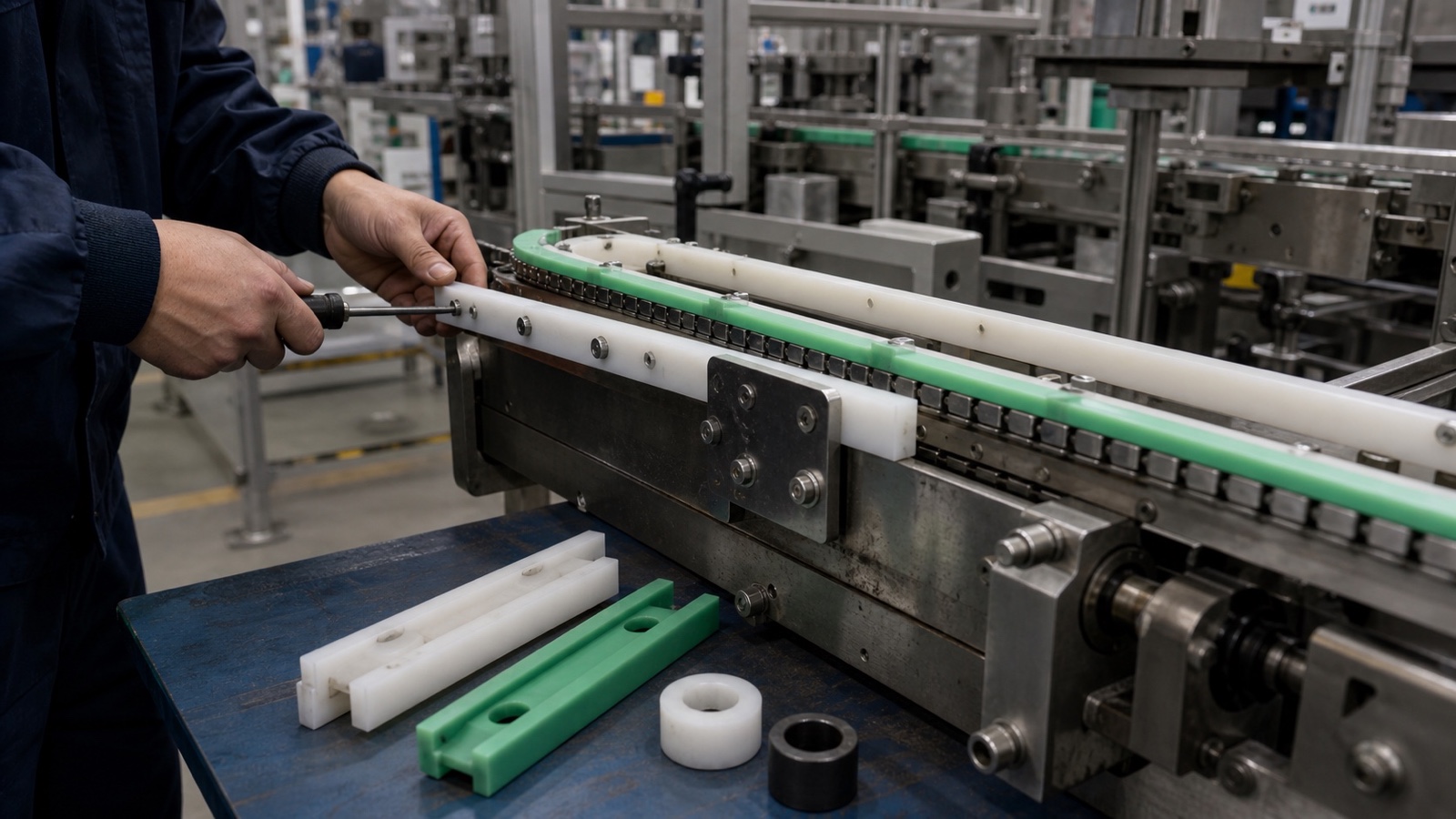
Temperature Resistance and Stability
Operating temperature represents a primary dividing line between these two resins:
Sliding friction generates interface heat. When Pressure (P) multiplied by Velocity (V) exceeds an engineering threshold, HDPE quickly approaches its 65°C softening plateau. POM maintains structural modulus and thermal deflection stability past 100°C, offering a significantly wider operating envelope.
If an application involves cryogenic environments (down to -50°C), HDPE retains notable flexibility and refuses to shatter, whereas standard POM grades become increasingly notch-sensitive and brittle.
Chemical and Moisture Resistance
Both materials handle water without swelling issues, especially compared to hygroscopic polymers like Polyamide (Nylon 6/66). However, their chemical compatibility diverges significantly when aggressive cleaning solutions are introduced:
HDPE Chemical Scope
Near-universal chemical resistance. Impervious to concentrated acids, bases, hypochlorite washdowns, and salt solutions. Weak only against aggressive aromatic hydrocarbons and chlorinated solvents.
POM Chemical Scope
Excellent resistance to fuels, lubricants, neutral solvents, and alcohols. However, POM degrades rapidly in contact with mineral acids (hydrochloric, sulfuric) and aggressive oxidizers such as chlorine sanitizers.
Impact Toughness and Dimensional Stability
Impact resilience favors HDPE. If heavy steel parcels, shipping tote boxes, or luggage repeatedly slam into a guide shoe, HDPE absorbs the kinetic strike without fracturing. POM is more notch-sensitive under sharp, repetitive mechanical impacts.
Conversely, POM excels in creep resistance. If a component must be held in place with torque-tensioned fasteners or sustain a non-stop deadweight cantilever load for months, POM retains its initial geometry. HDPE subjected to long-term bolted clamping will experience localized creep relaxation, causing mounting hardware to loosen over time.
Cost, Machinability, and Availability
Material and Processing Costs
From a raw material perspective, HDPE raw extruded slab or rod is substantially more economical per kilogram than POM-C or Delrin® homopolymer. Furthermore, with HDPE's lower density (0.95 g/cm³ vs POM's 1.41 g/cm³), you require approximately 32% less material by weight to produce the exact same physical volume.
However, the final part piece price depends on cycle time and deburring operations. When machining complex components with threaded bores, deep pockets, or critical fit tolerances, POM often achieves lower overall manufacturing costs because it cuts cleanly and requires minimal post-processing.
Machinability and Fabrication
In our Dongguan CNC machining center, the operational differences between these two materials on milling beds and lathes are distinct:
Machining POM / Delrin
POM produces brittle, discontinuous chips that evacuate smoothly from flute channels. It maintains exceptional flatness and allows holding tolerances of ±0.02 mm to ±0.05 mm on standard multi-axis equipment without excessive tool rubbing or burring.
Machining HDPE
HDPE generates continuous, ductile chips that can wrap around spindle tooling if feeds are improperly tuned. It has high internal stress and a large thermal expansion coefficient, necessitating razor-sharp polished cutters, balanced clamping pressure, and realistic design tolerances (typically ±0.10 mm to ±0.15 mm).
Application Recommendations for Wear and Sliding Parts
Drawing from hundreds of industrial automation and mechanical assemblies processed annually, here is our targeted selection criteria:
When to Choose POM
Specify POM when components require exact geometric tolerances, high cantilever stiffness, and low rotational or linear wear under continuous load:
- Precision spur, helical, and bevel gears
- High-speed sliding sleeve bushings and sleeve bearings
- Linear guide blocks and machine dovetails
- Valve discs, metering pistons, and internal pump wear plates
- Precision spring-clip and latching mechanisms
When to Choose HDPE
Specify HDPE when surface contact areas are large, point impact is frequent, or aggressive chemicals/cost reduction dictate the material envelope:
- Conveyor bed liners, chute wear plates, and slider beds
- Bottling line star wheels and container guide strips
- Marine dock rub rails and fender facing panels
- Bulk solids hopper funnels and transfer chutes
- Acidic chemical bath sliding rails and roller tracks
Current Trends in Wear-Resistant Plastics
The engineering plastics sector is evolving rapidly to address strict regulatory compliance and efficiency demands across automated assembly environments:
Internally Lubricated POM Formulations
Manufacturers are adopting POM-H and POM-C compounds filled with PTFE micro-particles, silicone oil, or specialized solid lubricants. These hybrid formulations drop dry friction values below 0.18 while preserving the stiff, machinable matrix of standard acetal.
Metal and X-Ray Detectable Grades
In food processing machinery, both POM and PE materials are now widely supplied with metal-oxide additives. If a wear strip or scraper blade chips under mechanical failure, downstream metal detectors or optical sensors immediately reject the contaminated package.
Bio-Attributed Feedstocks and Direct Scrap Recycling
European and North American buyers are increasingly asking for recycled-content verification. While regrind HDPE has long served in rough agricultural parts, closed-loop recycled POM grades are gaining traction for non-critical structural brackets, lowering the embodied carbon footprint of machinery builds.
Frequently Asked Questions
What is the disadvantage of HDPE?
The primary disadvantages of HDPE are low mechanical stiffness, poor resistance to compressive creep under continuous load, and a low melting threshold (softening begins around 65°C–80°C). It is also challenging to glue or bond with standard industrial adhesives without intensive surface flame- or corona-treatment, and it exhibits high thermal shrinkage during precision CNC machining.
What plastic is better than HDPE?
"Better" depends on failure modes. If your design suffers from wear and abrasive gouging, UHMW-PE (Ultra-High-Molecular-Weight Polyethylene) offers vastly superior abrasion resistance while maintaining polyethylene's low friction. If your design fails from structural deflection, bore distortion, or poor dimensional accuracy, POM (Acetal), Cast Nylon 6, or PEEK provide substantially higher strength, stiffness, and heat stability.
Is HDPE stronger than Delrin?
No. Delrin (POM homopolymer) has more than double the tensile strength (roughly 70 MPa vs 25 MPa) and nearly triple the flexural modulus of standard HDPE. Delrin is far stronger in load-carrying capability, torque transmission, and thread pull-out force. HDPE is only "stronger" in terms of unnotched impact toughness and its ability to absorb direct hammer strikes without brittle cracking.
Will HDPE warp in the sun?
Yes, unless specifically stabilized with carbon black or UV chemical inhibitors. Natural or standard colored HDPE sheets expand significantly when heated by solar radiation (CLTE around 150 × 10⁻⁶ / K). When mounted rigidly without oversized slotted clearance holes, this thermal expansion causes the sheet to buckle, ripple, and warp outward.
Conclusion & Decision Matrix
When sizing components for dynamic machinery, keep this simple rule of thumb on your drafting board:
The part functions as a gear, bearing, valve component, or precision mechanism with tight drawing tolerances (< ±0.05 mm), continuous bearing loads, or operation up to 90°C.
The part acts as a surface wear plate, guide strip, or liner handling high-impact goods, harsh acid/caustic washdowns, or large-area contact where low material cost is paramount.
At PlasticCNCPro, our engineering team in Dongguan assists designers, machinery OEMs, and sourcing directors worldwide in selecting and machining the right grade. Whether you need rapid POM prototypes or recurring batches of complex HDPE wear components, we review your 3D models and 2D drawings for optimal machinability, tolerance fit, and cost efficiency.
Need Custom Machined Plastic Wear Parts?
Send us your 2D drawings (PDF/DWG) and 3D CAD files (STEP/IGES). Our team will evaluate your material requirements, check tolerances, and provide a competitive manufacturing quotation.