
Thermal Engineering & Polymer Machining
Heat Deflection Temperature vs Melting Point: Which One Matters More?
When sizing engineering plastics for structural machinery components, relying strictly on a polymer's datasheet melting point is one of the costliest mistakes an engineer can make. Here is our machining-floor breakdown of what Heat Deflection Temperature (HDT) and melting point actually signify, how they diverge across crystalline and amorphous resins, and which metric must dictate your design decisions.
Key Takeaway for Machinists & Designers
Melting point tells you when a polymer transitions into an isotropic liquid state during melt processing. Heat Deflection Temperature (HDT) reveals the exact threshold where your finished, load-bearing plastic component deforms irreversibly under real mechanical stress. For operational reliability, HDT is almost always the defining specification.
What Is the Melting Point of Plastic?
In physical chemistry, the melting point (Tm) marks the thermodynamic phase change where a solid substance transitions into a molten fluid. At this threshold, thermal energy overcomes the intermolecular bonding holding molecular chains into an ordered crystal lattice. However, when working with synthetic polymers on the shop floor, the term "melting point" comes with significant caveats.
Thermoplastics can be melted, cooled, reshaped, and resolidified repeatedly through thermal cycling. In contrast, thermosets (such as cross-linked epoxies, phenolics, or vulcanized rubbers) do not possess a true melting point. Subjecting a thermoset to extreme thermal input leads directly to covalent chain breakdown—thermal degradation and charring—rather than flowable liquefaction.
The Amorphous Plastic Exception
Strictly speaking, amorphous thermoplastics—such as Polycarbonate (PC), Polymethyl Methacrylate (PMMA), and Acrylonitrile Butadiene Styrene (ABS)—do not have a distinct, thermodynamic melting point. Because their molecular structure resembles an unaligned "spaghetti bowl" with no crystal lattice, they exhibit only a Glass Transition Temperature (Tg). Above Tg, they soften gradually across an extended processing spectrum without an endothermic crystalline phase change.
What Does Heat Deflection Temperature Mean?
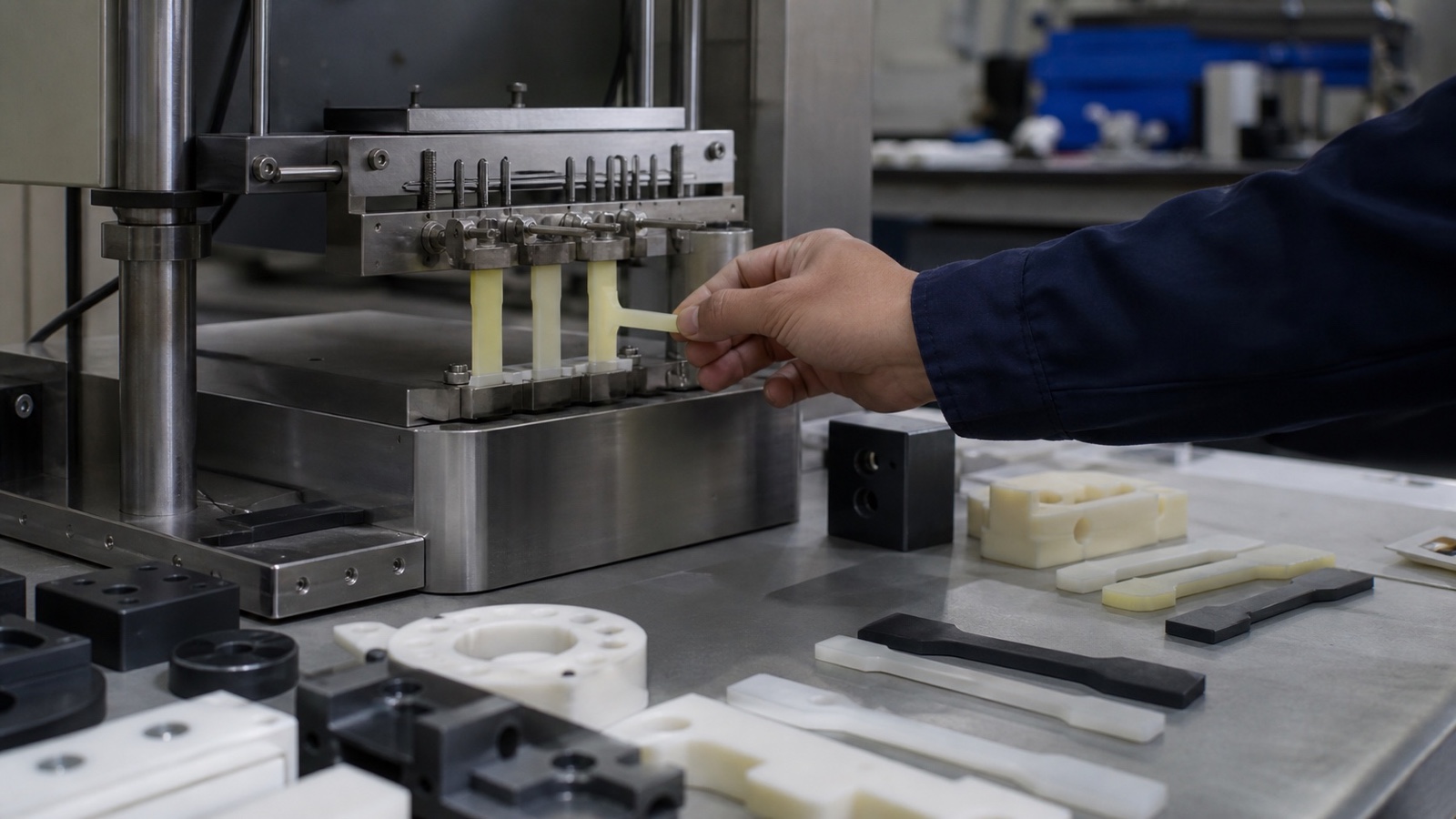
Heat Deflection Temperature (HDT), standardized under ASTM D648 and ISO 75, measures the precise temperature at which a standard polymer test bar deflects by an arbitrary distance (typically 0.25 mm / 0.010 in) while subjected to a defined flexural bending load in a heated silicone oil bath.
Unlike theoretical molecular transition points, HDT accounts directly for how mechanical stress affects a polymer's modulus of elasticity under elevated thermal energy. It reflects practical engineering limits: long before a polymer melts into liquid, its Young's modulus drops sharply, leading to bending, binding, or complete structural creep.
HDT @ 0.455 MPa (66 psi)
Applies minimal mechanical load. Simulates lightly stressed components, internal enclosures, electronic housings, or parts supporting only their own deadweight under elevated internal ambient heat.
HDT @ 1.82 MPa (264 psi)
Represents realistic industrial operating conditions. Ideal for dimensioning load-bearing gears, linear guide blocks, robotic actuator brackets, and manifold assemblies where mechanical forces coexist with continuous heat.
Melting Point vs Heat Deflection Temperature: Core Differences
The operational gulf between a polymer's melting point and its HDT can range from 30°C to upwards of 180°C depending on molecular crystallinity and reinforcement fillers. Confusing these two numbers regularly leads to out-of-spec field failures, seized pump rotors, and collapsed structural bushings.
| Comparison Vector | Melting Point (Tm) | Heat Deflection Temp (HDT) |
|---|---|---|
| Primary Definition | Thermodynamic liquid phase transition | Temperature of specific flexural sag under load |
| Mechanical Stress Applied | Zero (Stress-free molecular test) | 0.455 MPa or 1.82 MPa standardized load |
| Applicable Polymer Classes | Semi-crystalline thermoplastics only | All solid thermoplastics & reinforced composites |
| Primary Industrial Relevance | Injection molding, extrusion, hot runner sizing | Structural component engineering, CNC end-use |
| Safety Margin Required | Not applicable for structural boundaries | Must operate 15°C–30°C below rated HDT |
Crystalline vs Amorphous Plastics
Understanding polymer morphology is essential when interpreting thermal datasheets. Thermoplastics fall broadly into two structural camps: semi-crystalline and amorphous. Each responds entirely differently when subjected to thermal energy and mechanical loads.
Semi-Crystalline Resins (POM, PA66, PEEK, PET, PP, UHMW-PE)
These materials feature tightly packed crystalline domains interwoven with amorphous matrix pockets. They exhibit sharp, distinct melting points. Below Tm, the crystalline structure maintains high stiffness, wear resistance, and chemical shielding.
Engineering Catch: In unfilled semi-crystalline polymers like standard unfilled POM or Nylon 6/6, unreinforced HDT @ 1.82 MPa is often dramatically lower than its melting point. Nylon 6/6 melts at 260°C, but unreinforced it deflects under a 1.82 MPa load at only 75°C to 85°C!
Amorphous Resins (ABS, PC, PMMA, PEI, PSU, PVC)
Amorphous chains are tangled uniformly without crystalline periodicity. They soften progressively as temperature passes through their glass transition threshold (Tg).
Engineering Catch: Because amorphous plastics do not exhibit a sudden crystalline melt collapse, their HDT typically tracks quite close to their Tg. For example, Polycarbonate (PC) maintains reliable dimensional stiffness right up to 130°C–140°C, mere degrees below its glass transition (~145°C).
Plastic Melting Point and HDT Charts for Common Materials
The table below compiles physical lab values across commodity, engineering, and high-performance polymers routinely machined in our Dongguan facility. Notice the critical difference between unfilled and fiber-reinforced grades.
| Polymer Grade | Morphology | Melting Point (Tm) | HDT @ 0.455 MPa | HDT @ 1.82 MPa |
|---|---|---|---|---|
| Polypropylene (PP) | Semi-Crystalline | 160°C – 165°C | 100°C – 105°C | 52°C – 60°C |
| HDPE (High Density Polyethylene) | Semi-Crystalline | 130°C – 135°C | 70°C – 80°C | 43°C – 48°C |
| ABS (General Purpose) | Amorphous | None (Softens >105°C) | 92°C – 98°C | 82°C – 88°C |
| Polycarbonate (PC Unfilled) | Amorphous | None (Softens >150°C) | 138°C – 142°C | 128°C – 132°C |
| POM-C (Acetal Copolymer) | Semi-Crystalline | 165°C – 168°C | 158°C – 162°C | 95°C – 110°C |
| Nylon 6/6 (PA66 Unfilled) | Semi-Crystalline | 255°C – 265°C | 170°C – 185°C | 75°C – 90°C |
| Nylon 6/6 (PA66 + 30% Glass Fiber) | Semi-Crystalline Composite | 255°C – 265°C | 250°C – 255°C | 235°C – 245°C |
| PEEK (Virgin Unfilled) | Semi-Crystalline | 340°C – 343°C | 240°C – 250°C | 152°C – 160°C |
| PEEK (30% Glass / Carbon Fiber) | Semi-Crystalline Composite | 340°C – 343°C | 320°C – 330°C | 300°C – 315°C |
| PEI (Ultem 1000 Unfilled) | Amorphous | None (Softens >217°C) | 210°C – 215°C | 198°C – 202°C |
Why Melting Point Matters in Injection Molding and Manufacturing
While structural engineers prioritize HDT for mechanical reliability, manufacturing engineers and toolmakers rely heavily on melting point to govern conversion processes. In injection molding, extrusion, and secondary heat sealing, the melting point establishes the foundation for:
Barrel Temperature Zones & Melt Rheology
Setting screw cylinder heaters properly above Tm ensures homogenous resin plasticization without unmelted shear pellets scoring barrels or clogging nozzles.
Mold Design & Thermal Gate Sizing
Polymers with sharp melting points (like Nylon or POM) exhibit rapid freeze-off upon entering cooler mold tooling. Gates must be sized adequately to pack out cavities before gate freeze causes cavitation voids.
Thermal Degradation Prevention
Exceeding safe melt processing windows induces chain scission, gas venting streaks (splay), discoloration, and radical loss of impact toughness in finished stock shapes.
Machinist Note: Friction Heat in CNC Milling
In CNC milling and turning, melting point also plays a direct role. Polymers with low melting points (like PE and PP) reweld instantly across chip channels or build a built-up edge on cutter flutes if feeds, speeds, and air chillers are miscalculated. We use polished flutes and high chip-load geometries to extract heat via the chip before local temperatures cross the melting zone.
Why Heat Deflection Temperature Matters in End-Use Applications
In operating industrial machinery, structural plastic parts rarely reach their melting point. Instead, they fail because the operating temperature crosses their HDT under working stress. The consequence is not a puddle of liquid, but elastic and plastic deformation that causes operational downtime.
Loss of Critical Tolerances & Bearing Seizure
Consider an unreinforced PA66 bushing inside a conveyor idler. If the friction and enclosure air reach 95°C, the bushing remains 165°C below its melting point. However, because its HDT under 1.82 MPa is around 80°C, the bushing creeps under radial belt tension, collapses its shaft clearance, and seizes the bearing assembly.
Fluid Manifold Warpage & Gasket Bleed
In medical or semiconductor fluid blocks machined from Polypropylene or POM, hydraulic pressure exerts sustained bending force on external fastener bosses. If warm cleaning fluids push localized temperatures past HDT, bolt pretension relaxes, faces warp, and fluid seals blow out.
Electrical & Electronics Safety Non-Compliance
Standards like UL 746C, IEC 60950, and automotive tier-1 specifications require plastic terminal strips, relay brackets, and busbar insulators to maintain rigid mechanical separation under elevated operating conditions to prevent arcing and short-circuits.
Factors That Influence Melting Point and HDT
Neither melting point nor HDT are completely rigid constants; both respond to polymer chemistry, reinforcement fibers, and external operating variables.
Glass and Carbon Fiber Reinforcement
Adding 30% glass fibers barely alters the thermodynamic melting point (Tm remains governed by the matrix), but it dramatically raises HDT under 1.82 MPa—shifting PA66 from ~80°C to ~240°C and PEEK from ~155°C to ~315°C.
Applied Mechanical Load Magnitude
HDT drops significantly as load increases. Comparing datasheets tested at 0.455 MPa vs 1.82 MPa often shows a 50°C to 80°C discrepancy on identical resin grades.
Moisture Absorption & Plasticization
Hygroscopic materials like Polyamides (Nylon 6 and 66) absorb ambient humidity. Absorbed water acts as an internal plasticizer, depressing both glass transition temperature and HDT by as much as 20°C–35°C.
Internal Residual Stress & Annealing State
Machining heavy plastic billets releases internal molding stresses. Unannealed parts deflect at lower temperatures. At PlasticCNCPro, we use intermediate thermal annealing cycles on PEEK, Ultem, and Acetal to normalize stress and preserve maximum thermal performance.
How to Choose the Right Plastic: Melting Point or HDT First?
Follow this practical 4-step decision sequence when filtering through polymer datasheets for your design project:
Determine Continuous Load vs Static Presence
If the component supports mechanical torque, clamp force, or hydraulic pressure, discard the melting point entirely. Your primary thermal ceiling is the HDT @ 1.82 MPa.
Apply Practical Safety Margins
Because HDT is a standardized short-term flexure test, continuous mechanical service temperatures should generally remain at least 15°C to 30°C below the rated HDT value to account for creep over prolonged operational cycles.
Assess Reinforcement Needs
If chemical resistance mandates a semi-crystalline polymer (like PEEK, PPS, or Nylon) but structural loads exceed its unreinforced HDT, upgrade to a 30% glass-fiber or carbon-fiber reinforced grade.
Check Secondary Thermal Exposure
If parts undergo momentary autoclave sterilization, ultrasonic welding, or downstream reflow soldering without sustained load, verify that peak temperature excursions remain below both the HDT @ 0.455 MPa and the melting onset.
Critical Comparisons: HDT vs Vicat, Tg, and Continuous Use Temperature
Data sheets also publish other thermal metrics. Here is how HDT correlates with Vicat Softening Temperature, Glass Transition (Tg), and Continuous Use Temperature (CUT):
| Thermal Metric | Test Setup / Mechanism | When It Governs Your Part |
|---|---|---|
| Vicat Softening (ASTM D1525) | Flat needle point penetrates 1 mm under 10 N or 50 N load | Surface hardness, localized indentation, pin-contact resistance |
| Glass Transition (Tg) | DSC measurement where chains shift from rigid glassy to rubbery | Clear ceiling for amorphous plastics; impact baseline |
| Continuous Use Temp (CUT / RTI) | Thermal aging (e.g., UL 746B) retaining 50% properties over 100k hrs | Long-term oxidative endurance and multi-year durability |
At What Temperature Will PLA Start to Melt?
Standard Poly-Lactic Acid (PLA) exhibits a melting point between 150°C and 180°C (depending on its D-lactide enantiomer ratio). In 3D printing and melt extrusion, hotend temperatures are maintained higher, between 190°C and 220°C, to lower melt viscosity for fluid extrusion.
Practical Warning for Functional Prototypes
While PLA melts around 160°C, its glass transition temperature (Tg) is only 55°C to 60°C, and its HDT under modest loads is equally poor (~55°C). A PLA component left on an automobile dashboard in direct summer sunlight will sag and warp completely, even though ambient temperature never approaches its melting point.
Which Plastic Has the Highest Melting Point?
Among commercially viable melt-processable engineering polymers, PEEK (Polyetheretherketone) ranks near the very top with a melting point of 343°C (649°F). High-end polyaryletherketone variants like PEKK can hit up to 360°C.
Polytetrafluoroethylene (PTFE/Teflon) exhibits a gel melting transition at 327°C, but because of its extreme melt viscosity, it cannot be injection molded and must instead be sintered and CNC machined from billets.
HDT Standout: For ultra-high thermal load rigidity, melt-processable materials are led by reinforced PEEK 30% CF (HDT @ 1.82 MPa = 315°C) and non-melting melt-sintered Polyimides such as Vespel (SP-1), which deliver structural retention past 350°C.
Is Melting or Boiling Point Higher?
In standard thermodynamics, boiling point is always higher than melting point. However, plastics do not have a boiling point.
Because synthetic polymer chains possess enormous molecular weights (tens to hundreds of thousands of grams per mole), the covalent bonds holding individual atoms together within the backbone rupture well before sufficient thermal energy can vaporize whole macromolecules into a gas. Heating plastic far past its melting point leads to thermal pyrolysis, chemical cracking, smoke, and combustible volatile organic outgassing—never a clean vapor boil.
Frequently Asked Questions
What is the melting point of plastic?
The melting point of plastic is the temperature range where crystalline domains in semi-crystalline thermoplastics break down, converting the material from a solid state to a flowable molten fluid. It typically ranges from 110°C for low-density commodity polyethylenes to over 340°C for high-performance polymers like PEEK.
What temperature will plastic melt?
Most commodity household plastics melt between 110°C and 165°C (e.g., LDPE at ~115°C, Polypropylene at ~160°C). Engineering plastics like Acetal (POM) melt near 168°C, Nylon 6/6 at ~260°C, and PEEK at ~343°C. Amorphous plastics like ABS and PC do not melt cleanly, but soften into formable liquids above 105°C and 150°C respectively.
Why do plastics have relatively low melting points?
Plastics have much lower melting points than metals or ceramics because polymer chains are held together by secondary intermolecular forces (such as van der Waals bonds and hydrogen bonds) rather than metallic or ionic crystal bonding. These weak intermolecular bonds require far less kinetic energy to dissociate.
Will plastic melt at 95 degrees?
At 95°C (203°F), standard thermoplastics will not fully melt into liquid, but low-temperature plastics (such as LDPE, PLA, or thin films) will soften significantly, lose structural rigidity, and sag under their own weight. Boiling water (100°C) is sufficient to severely deform 3D-printed PLA, unreinforced PVC, and hot-wire polyethylenes.
What is the melting point of common plastics?
Common ranges include: HDPE (130°C–135°C), Polypropylene (160°C–165°C), POM / Delrin (165°C–175°C), PET (245°C–255°C), Nylon 6/6 (255°C–265°C), PTFE (327°C transition), and PEEK (343°C).
Precision Machining for High-Temperature Polymers
At PlasticCNCPro, we specialize exclusively in precision CNC milling, turning, and tight-tolerance custom machining of engineering polymers. Whether your project demands high HDT performance under continuous load (such as PEEK-CF30, PEI Ultem, or PA66-GF30) or clean optical clarity with amorphous polymers, our engineering team in Dongguan, China delivers predictable dimensional stability from initial prototype runs to repeat series manufacturing.
Start Your Project
Request a Precision Plastic CNC Quotation
Send your 2D drawings, 3D CAD models (STEP/IGES), thermal operating conditions, and tolerance specifications. Our application engineering team will provide a comprehensive DFM manufacturability review and competitive quotation.