
Materials Engineering Guide
How Carbon Fiber Filling Changes Plastic Density and Machinability
Carbon fiber-reinforced plastics give engineers a remarkable strength-to-weight ratio, but they also rewrite the rules of density, stiffness, and cutting behavior. Here is what we see on the shop floor when fiber loading goes up.
Introduction
Carbon fiber-reinforced plastics, usually shortened to CFRP, are composite materials built from a polymer matrix reinforced with carbon fibers. The base resin — think PEEK, Nylon, PPS, or PEI — carries the load in compression and holds the fibers in place, while the carbon fibers carry tensile and bending loads. The reason our customers keep asking for these grades is simple: they deliver an outstanding strength-to-weight ratio compared to unfilled polymers, and often compared to metals as well.
Filler loading is normally expressed as a percentage by weight, and most machinable grades we handle sit between 10% and 30% carbon fiber. That number is not cosmetic. It shifts density, stiffness, thermal expansion, electrical behavior, and — critically for anyone running a spindle — the way the material behaves under a cutting edge.
This post is written for the engineers and machinists who have to live with both sides of that trade-off. We want to help you understand where carbon filling genuinely earns its cost, and where it quietly makes manufacturing harder.
Every percentage point of carbon fiber you add buys stiffness and dimensional stability — and charges you back in tool wear, dust control, and process discipline.
The Impact of Carbon Fiber on Material Density
Unfilled engineering polymers are relatively light. PEEK typically sits around 1.30 g/cm³, and unfilled Nylon grades are closer to 1.13–1.15 g/cm³. Carbon fiber itself is denser than the resin it reinforces, generally in the 1.75–1.80 g/cm³ range for the fiber used in compounding. When you blend the two, the composite density lands somewhere between them, weighted by the fiber volume fraction.
In practice, a 30% carbon fiber PEEK grade commonly lands near 1.40–1.44 g/cm³, while a 30% carbon fiber Nylon can climb to roughly 1.35 g/cm³ depending on the exact grade and any additional fillers such as PTFE or graphite. Fiber volume fraction, not just weight percentage, is what ultimately drives the final specific gravity — and it also determines how much of the load path is actually carried by the fibers.
Why it matters
A density increase of 8–10% sounds like a penalty, and on a weight-sensitive assembly it is. But the same fiber loading can raise tensile modulus by two to three times. When we quote a carbon-filled part, we always ask the customer whether they are optimizing for mass or for stiffness — the answer changes the grade recommendation.
So yes, the part gets heavier. In most industrial applications — wear strips, bushings, structural brackets, semiconductor handling components — the mechanical performance gain comfortably outweighs the modest weight penalty. The exception is genuinely mass-critical work, where an unfilled or glass-filled grade with a different geometry may be the smarter answer.
Mechanical and Thermal Advantages of Carbon-Filled Plastics
Density is only one variable in the equation. The reasons customers accept the added weight are the mechanical and thermal gains that come with it.
Enhanced Stiffness and Strength
Adding carbon fiber raises the modulus of elasticity dramatically. An unfilled Nylon might sit near 2.5–3 GPa in tensile modulus, while a 30% carbon-filled grade can reach 15–20 GPa. Tensile strength and creep resistance improve as well, which is why carbon-filled grades hold their shape under sustained load far better than unfilled ones.
Thermal Stability
Carbon fibers constrain the resin's natural expansion, so the coefficient of thermal expansion (CTE) drops noticeably compared to the unfilled polymer. For tight-tolerance parts that see temperature swings — semiconductor fixtures, metrology components — that dimensional stability is often the deciding factor.
Conductivity
Base plastics are electrical insulators. Once carbon fiber is introduced above a certain loading, the composite becomes semi-conductive or anti-static. That is a benefit in electronics handling and ESD-sensitive environments, but it is a design constraint anywhere electrical isolation is required.
Challenges in Machining Carbon-Filled Plastics
This is where the conversation gets practical. Carbon-filled polymers machine differently from their unfilled counterparts, and the differences show up fast.
Abrasive Wear
Carbon fibers act like micro-files against the cutting edge. Standard high-speed steel tooling dulls within minutes, and even general-purpose carbide shows accelerated flank wear. Once the edge rounds over, cutting pressure rises, heat climbs, and surface finish collapses.
Delamination Risks
Fibers can pull out of the resin matrix instead of shearing cleanly. This shows up as fuzzing, fiber breakout at exit edges, and — in severe cases — subsurface delamination that only appears after the part is in service.
Thermal Management
Heat generated at the cutting zone has nowhere to go quickly in a polymer. If speeds and feeds are pushed without adequate cooling or air blast, localized resin melting or degradation can occur, leaving smeared surfaces and burned edges.
Warning
Do not run carbon-filled grades on the same setup you use for unfilled Nylon or POM. The tool life assumptions, chip evacuation strategy, and dust handling all change.
Best Practices for Machining Carbon-Filled Composites
None of the challenges above are deal-breakers. They are process requirements. Here is how we approach them.
Tooling Selection
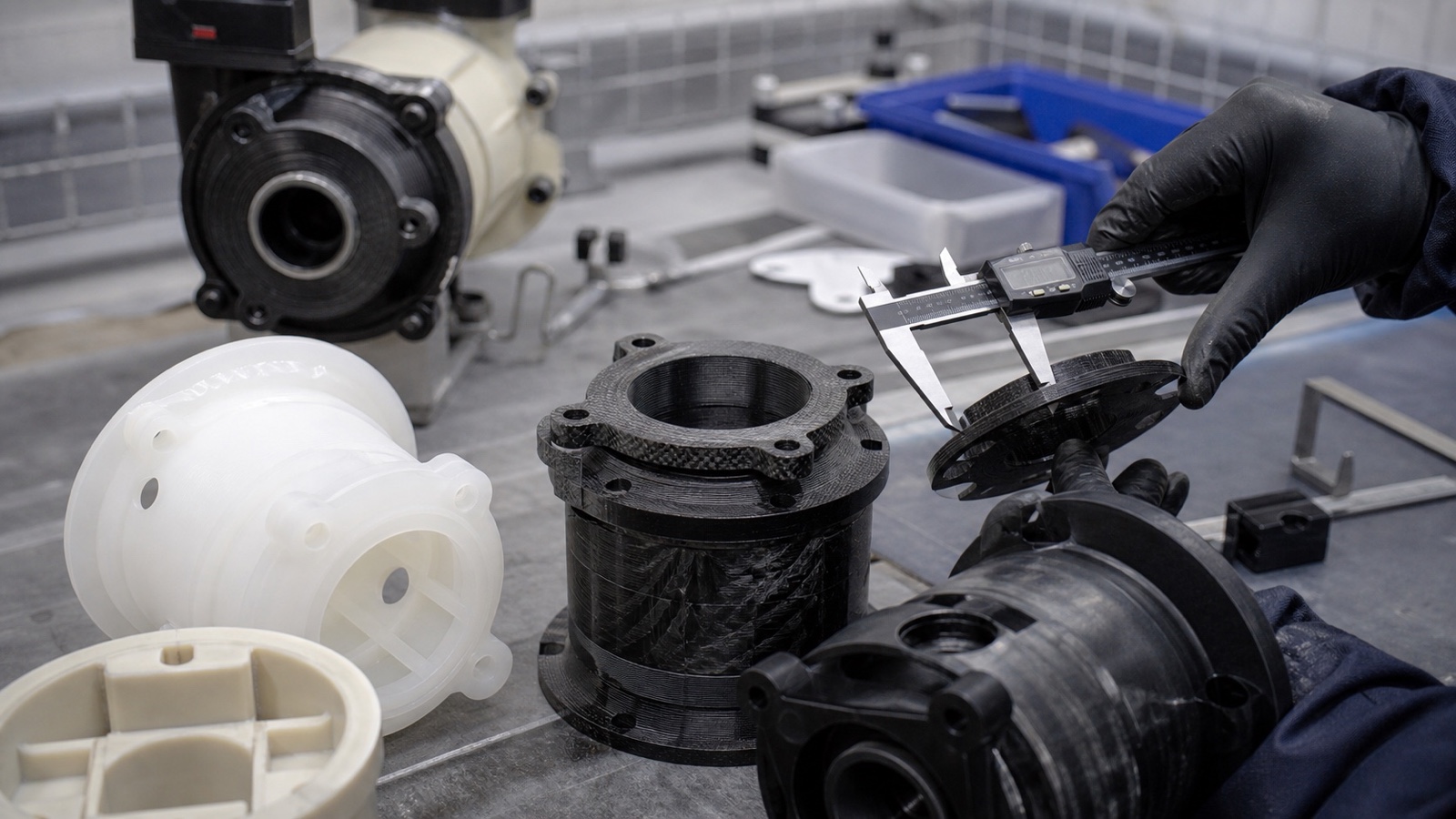
For production runs in carbon-filled material, we recommend polycrystalline diamond (PCD) tooling. PCD holds a sharp edge far longer than carbide against abrasive fibers, which translates into consistent dimensions across the batch rather than a slow drift as the tool wears. Carbide-tipped tooling is a reasonable middle ground for prototypes and short runs, provided the grade is selected for abrasive non-ferrous and composite work and the edges are kept fresh.
Speed and Feed Optimization
The goal is to cut cleanly rather than rub. Too light a chip load lets the edge burnish the resin and generate heat; too aggressive a feed on a flexible setup invites fiber pull-out. We typically favor a moderate surface speed with a positive, maintained chip load, sharp climb-cutting passes, and generous clearance for chip evacuation. On finishing passes, reducing the radial engagement and keeping the tool moving avoids dwelling in one spot.
Dust Mitigation
Carbon fiber dust is a genuine health and equipment concern. Fine conductive particles can irritate skin and airways and can also find their way into electronics. We enclose cutting zones and use HEPA-filtered vacuum extraction at the point of cut, and we never rely on dry sweeping or compressed air blow-off to clear a machine.
Shop-floor checklist
- Tool condition: inspect edges between parts, not between shifts.
- Entry and exit: support the edge with backing or a sacrificial layer to control breakout.
- Cooling: use air blast or a suitable coolant strategy to keep the cutting zone stable.
- Extraction: confirm HEPA vacuum is running before the first cut, not after.
- First-article check: verify dimensions and edge quality before the run continues.
FAQ: Common Questions About Carbon-Filled Polymers
What is the weakness of carbon fiber?
Carbon fiber is strong in tension but brittle. It does not yield gracefully — it fractures. Impact damage can create internal cracks that are difficult to see from the surface, and the material has limited elongation compared to many unfilled polymers. Design for stiffness and fatigue, not for energy absorption.
What ruins carbon fiber?
Three things show up most often: chemical degradation from incompatible solvents or aggressive media, prolonged UV exposure that degrades the resin matrix, and poor machining practice — dull tools, excessive heat, and unsupported edges that cause delamination. The fiber itself is robust; the matrix and the interface are what fail.
What is the density of carbon fiber reinforced plastic?
It varies with the base resin and the fiber loading. As a general range, carbon-filled engineering polymers land roughly between 1.30 and 1.45 g/cm³ at typical 20–30% loadings. A PEEK-based grade will sit higher than a Nylon-based one because the base resin is already denser.
Why choose carbon fiber over glass fiber?
Carbon gives higher stiffness per unit weight and is generally less abrasive to tooling than glass fiber, which is notably harsh on cutting edges. Glass fiber is typically less expensive and offers good impact resistance. If stiffness and weight matter most, carbon wins; if cost and toughness dominate, glass is often the better call.
Choosing the Right Material: A Quick Comparison
When a customer asks us whether to go carbon-filled, glass-filled, or unfilled, the answer usually comes down to stiffness, wear, and cost.
| Property | Unfilled | Carbon-Filled | Glass-Filled |
|---|---|---|---|
| Stiffness | Baseline | Highest | High |
| Density | Lowest | Moderate | Moderate to high |
| Tool wear | Low | Moderate | High |
| Thermal expansion | Highest | Lowest | Low |
| Relative cost | Lowest | Highest | Moderate |
Carbon-Filled vs. Unfilled
The cost of the filler is justified when the application demands stiffness, creep resistance, dimensional stability under heat, or anti-static behavior. If the part is a simple cover or a low-load spacer, an unfilled grade will usually machine faster and cost less.
Carbon-Filled vs. Glass-Filled
Glass-filled grades are generally more abrasive to tooling than carbon-filled ones, which surprises some customers who assume carbon is the harder material to cut. Carbon delivers better stiffness per unit weight; glass offers toughness and lower material cost.
Key Considerations for Selection
Filler loading also affects flowability and viscosity during compounding, which matters if the same grade will later be molded. Beyond that, we always ask about the service environment — temperature, chemicals, moisture, and electrical requirements — because those constraints often eliminate one option before machining is even discussed.
Conclusion
Carbon fiber filling is a deliberate trade. You accept a modest density increase and a more demanding machining process in exchange for stiffness, thermal stability, and dimensional control that unfilled polymers simply cannot match. The engineering question is never "is carbon better?" — it is "does this application need what carbon provides?"
Our advice to design teams: bring your material supplier and an experienced CNC shop into the conversation early, before the drawing is frozen. Tooling choices, edge conditions, dust extraction, and tolerance strategy are much easier to design in than to retrofit. That early conversation is usually what separates a part that lasts from a part that gets redesigned twice.
At PlasticCNCPro, we machine carbon-filled, glass-filled, and unfilled engineering polymers every day from our facility in Dongguan. If you are evaluating a carbon-filled grade for a prototype or a production run, send us the drawing, the material requirement, and the application details — we will tell you honestly what the material will do on the machine and in service.
Start Your Project
Request a Quotation for Carbon-Filled Plastic Parts
Send us your 2D drawing, 3D model, material requirement, quantity, tolerance, and application details. We review the design, material, and manufacturability, then come back to you with a quotation and a production recommendation — whether you need a single prototype or repeat production.