
How to Select High-Temperature Plastics for Precision Machined Parts
A practical engineering roadmap for mechanical designers, manufacturing engineers, and procurement teams evaluating high-performance polymers under severe thermal, mechanical, and chemical loads.
Application Engineering Takeaway
"High-temperature plastics do not fail because the polymer melts in service; they fail because thermal expansion shifts critical dimensions or unrelieved residual stress causes parts to creep out of tolerance long before reaching bulk degradation limits."
Introduction
In modern engineering, the boundary between metal and polymer functionality continues to narrow. In our machine shop at PlasticCNCPro, we frequently manufacture precision components for semiconductor etch chambers, downhole energy exploration assemblies, surgical autoclave tools, and aerospace propulsion manifolds. In these demanding operating conditions, standard engineering plastics like POM (Delrin®) or Nylon soften, creep, or hydrolyze rapidly.
Transitioning to high-performance polymers provides critical advantages: significant weight reduction, chemical inertness, electrical insulation, and superior tribological properties. However, selecting a high-temperature thermoplastic is not merely about finding a material with the highest melting point on a raw resin datasheet.
Maintaining tight geometric tolerances (often within ±0.012 mm / ±0.0005 in) through aggressive temperature cycling requires a holistic understanding of thermal transition points, thermal expansion coefficients, internal molecular stress, and raw stock machinability. When a component operates under thermal stress, improper material selection inevitably leads to binding, leakage, catastrophic structural fracture, or sudden electrical breakdown.
Understanding Thermal Performance: Key Metrics
When reviewing manufacturer datasheets, engineers often encounter conflicting temperature ratings. To ensure precision parts retain geometric accuracy under working stress, we focus on three foundational metrics and the underlying polymer morphology.
Glass Transition Temperature (Tg) vs. Continuous Service Temperature (CST)
The Glass Transition Temperature (Tg) defines the point at which an amorphous polymer (or the amorphous phase of a semicrystalline resin) changes from a hard, glassy state to a flexible, rubbery matrix. Above Tg, physical stiffness drops dramatically, while the Coefficient of Linear Thermal Expansion (CLTE) accelerates, causing sudden volumetric swelling.
In contrast, Continuous Service Temperature (CST)—often determined via UL 746B Relative Temperature Index (RTI)—indicates the maximum operating temperature at which a polymer retains 50% of its critical mechanical and electrical properties after 100,000 hours of continuous exposure. A part may survive short-term spikes above CST, but long-term exposure will trigger thermo-oxidative degradation and embrittlement.
Heat Deflection Temperature (HDT) in Precision Machining
Heat Deflection Temperature (HDT, measured per ASTM D648 or ISO 75) measures the temperature at which a standard test bar deflects by 0.25 mm under an applied flexural stress of either 0.45 MPa (66 psi) or 1.8 MPa (264 psi).
For precision-machined structural parts, we always evaluate HDT at the higher 1.8 MPa load. A plastic with an impressive melting point but low HDT will deform under clamp forces, bolt torques, or working hydraulic pressures when elevated operating temperatures are applied.
Amorphous vs. Semicrystalline Plastics Under Thermal Load
The molecular structure dictates both how the material behaves under heat and how easily we can hold tight tolerances on a 5-axis CNC mill:
Amorphous Polymers (e.g., PEI, PSU, PAI)
Feature randomly entangled polymer chains without a sharp melting point. They exhibit uniform, predictable thermal expansion in all spatial axes, making them exceptionally stable for tight-tolerance optical housings and vacuum fittings. However, they are sensitive to environmental stress cracking under aggressive solvent exposure.
Semicrystalline Polymers (e.g., PEEK, PPS, PTFE)
Feature tightly ordered, crystalline domains embedded within an amorphous matrix. They maintain mechanical stiffness above Tg up toward their crystalline melting point, offering unmatched wear resistance, chemical inertness, and fatigue life. However, they carry higher anisotropic shrinkage and cutting stresses.
| Polymer Grade | Morphology | Glass Transition (Tg) | HDT @ 1.8 MPa | Continuous Service Temp | CLTE (10⁻⁵ / °C) |
|---|---|---|---|---|---|
| PEEK (Unfilled 450G) | Semicrystalline | 143°C (289°F) | 152°C (306°F) | 250°C (482°F) | 4.7 |
| Ultem® 1000 (PEI) | Amorphous | 217°C (423°F) | 200°C (392°F) | 170°C (338°F) | 5.6 |
| Torlon® 4203 (PAI) | Amorphous | 275°C (527°F) | 278°C (532°F) | 260°C (500°F) | 3.1 |
| PPS (Techtron®) | Semicrystalline | 90°C (194°F) | 110°C (230°F) | 220°C (428°F) | 5.0 |
| PTFE (Virgin) | Semicrystalline | 130°C (266°F) | 55°C (131°F) | 260°C (500°F) | 12.0 – 16.0 |
Top High-Performance Thermoplastics for CNC Machining
In our daily precision machining operations at PlasticCNCPro, five core engineering polymers dominate high-heat applications. Each represents distinct trade-offs between mechanical strength, chemical resistance, electrical behavior, and ease of cutting.
PEEK (Polyetheretherketone)
PEEK is universally recognized as the benchmark high-temperature polymer. It combines exceptional mechanical strength, stiffness, and creep resistance with almost universal chemical resistance—unaffected by steam, superheated water, hydrocarbons, and aggressive organic solvents up to 250°C.
We machine virgin PEEK (Victrex® 450G, Ketron® 1000) for medical devices, food-contact manifolds, and valve bodies. When high mechanical loading or dynamic wear is present, reinforced grades like 30% glass-filled (PEEK-GF30) and 30% carbon-fiber-filled (PEEK-CF30) dramatically raise the HDT past 300°C and lower the CLTE to approximate metallic aluminum.
Ultem® (Polyetherimide / PEI)
Ultem 1000 and 2300 (glass-reinforced) are amber, translucent amorphous thermoplastics known for outstanding dielectric strength, inherent flame retardancy (UL 94 V-0 without additives), and negligible smoke generation. Ultem maintains high rigidity up to its 200°C HDT.
Because of its isotropic thermal behavior, Ultem is our preferred candidate for high-frequency electrical isolators, semiconductor test sockets, medical manifold blocks undergoing repeated ethylene oxide (EtO) sterilization, and avionics sensor enclosures. Note that Ultem is susceptible to stress cracking when exposed to aromatic hydrocarbons and methylene chloride.
Torlon® (Polyamide-imide / PAI)
Torlon PAI sits at the pinnacle of melt-processable thermoplastics. With a glass transition of 275°C (527°F), Torlon retains higher tensile strength and flexural modulus at 200°C than most engineering plastics possess at ambient room temperature.
We machine electrical grade Torlon 4203 and wear-grade Torlon 4301 (bearing grade with graphite and PTFE) for turbomachinery seals, extreme-environment bushings, aerospace actuator pins, and semiconductor wafer-handling end effectors. Torlon requires precise post-cure thermal cycling to reach full cross-linking density and mechanical performance.
PTFE (Polytetrafluoroethylene / Teflon®)
PTFE offers an unrivaled continuous operating window (-200°C to +260°C) paired with virtually complete chemical inertness and an ultra-low dynamic coefficient of friction (down to 0.04). It does not absorb moisture, making it ideal for aggressive chemical diaphragm valves and fluid seals.
However, pure PTFE exhibits significant cold flow (creep under mechanical load) and a high coefficient of linear thermal expansion. For precision structural applications, we frequently recommend modified fluoropolymers or glass-filled/carbon-filled PTFE grades to resist deflection under compression.
PPS (Polyphenylene Sulfide / Techtron®)
PPS is a high-rigidity semicrystalline polymer that resists chemical attack below 200°C second only to fluoropolymers. It exhibits practically zero moisture absorption (<0.02% at 24 hours), which eliminates dimensional drift caused by atmospheric humidity changes.
Unfilled PPS is inherently brittle, so we predominantly machine 40% glass-reinforced PPS (Ryton® / Techtron® PPS). It offers an exceptional cost-to-performance ratio for pump impellers, automotive fuel rails, downhole electrical connectors, and chemical valve seats where PEEK is over-budgeted.
Factors Influencing Material Selection
Selecting the ideal high-temp resin requires evaluating the entire operational lifecycle of your part. When reviewing drawings with clients at PlasticCNCPro, our engineering team systematically cross-examines four critical vectors:
Application Environment & Media Exposure
Evaluate simultaneous stresses: Is the part submerged in harsh acids or solvent vapor at 150°C? (PEEK or PTFE excels; PEI risks micro-cracking). Will it undergo high-dose gamma sterilization or X-ray radiation? (PEEK and PEI retain tensile elongation; PTFE degrades rapidly under ionizing radiation).
Dimensional Accuracy & Thermal Expansion (CLTE)
Unfilled thermoplastics expand at 4 to 10 times the rate of carbon steel or aluminum. If a tight-tolerance bushing (±0.015 mm) is machined at 20°C ambient room temperature, it will seize on a rotating metal shaft when the operational environment hits 160°C unless thermal clearances and CLTE differentials are engineered into the CAD model.
Machinability & Tool Engagement
High-temperature polymers possess low thermal conductivity (~0.25 W/m·K compared to ~160 W/m·K for aluminum). Frictional heat generated at the cutting edge stays trapped in the part surface and tool interface. In glass-filled or carbon-filled polymers, fibers cause extreme micro-chipping on cutting edges, demanding diamond-like coatings and tuned feeds to prevent delamination.
Cost-to-Performance Ratio
Torlon stock can cost 5 to 8 times more than virgin PEEK, which is already substantially pricier than POM or Nylon. If an assembly only reaches 140°C in air without aggressive fluids, selecting a glass-filled PPS or unfilled PEI delivers equivalent reliability at a fraction of the raw bill-of-materials cost.
Precision Machining Best Practices for High-Temp Plastics
Machining high-temperature polymers to tight aerospace and semiconductor specs demands distinct strategies compared to cutting metal or commodity plastics. Here is how we ensure dimensional consistency and flawless surface finish in our shop:
Tooling Selection: Polished Carbide & PCD
Standard positive-rake metalworking end mills tend to push and rub polymers rather than slicing clean chips, inducing immediate heat and localized melting. For unfilled PEEK, Ultem, and PPS, we utilize ultra-fine micrograin solid carbide end mills with polished flutes, zero or high positive rake angles, and sharp cutting edges.
When cutting abrasive glass-fiber or carbon-fiber reinforced grades (such as PEEK-GF30 or Torlon 5030), standard carbide tools dull within minutes, triggering heavy burring and dimensional drift. We deploy Polycrystalline Diamond (PCD) tipped tooling or diamond-coated (CVD) mills to maintain sharp cutting geometries across large production batches.
Managing Cutting Heat & Coolant Strategies
Because plastics do not conduct heat, the cutter must continuously extract thermal energy within the chip itself. Maintaining an adequate chipload per tooth is critical; rubbing with light skim cuts creates friction that warps thin-walled features.
We prefer clean, filtered air blasts or chilled cold-air guns (Vortex tubes) when machining amorphous resins like Ultem to prevent chemical stress-cracking caused by emulsifiers in water-soluble cutting fluids. For medical implant PEEK and semiconductor parts, we either run dry under pressurized ionized air or utilize certified non-aromatic, residue-free coolant formulations followed by ultrasonic degreasing.
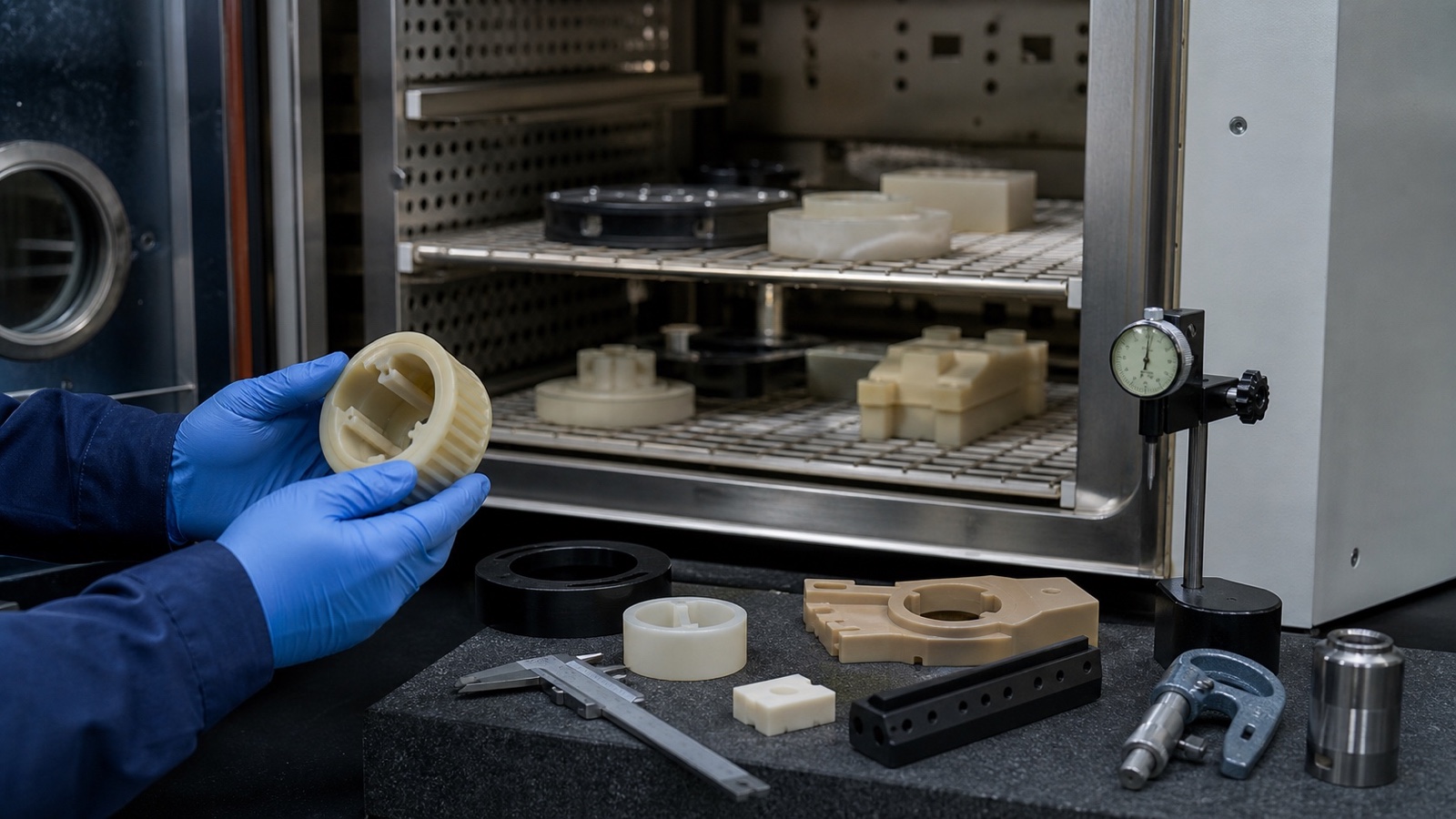
Stress Relieving & Post-Cure Annealing Processes
Extruded and compression-molded polymer shapes harbor severe internal stresses from solidification cooling. When we remove large volumes of stock during roughing (e.g., deep pocketing or turning long bore steps), these internal forces rebalance, causing un-annealed components to twist, bow, or crack over time.
Our standardized stress-relieving sequence for tight-tolerance high-temp parts:
- 1 Pre-machining Annealing: Cycle raw stock through a programmable convection oven to eliminate extrusion skin stresses.
- 2 Rough Machining: Cut within 0.5 mm to 1.0 mm of final dimensions to liberate macro-stresses.
- 3 Intermediate Annealing: Slow thermal ramp-up (typically 10°C/hr), soak just below Tg, followed by an extremely controlled cool-down to room temperature.
- 4 Final Finishing Passes: Light depth-of-cut finish machining to achieve final blueprint dimensions and Ra 0.4–0.8 µm surface finishes.
Frequently Asked Questions (FAQ)
Which plastics can withstand the highest temperatures?
Among machinable thermoplastics, Torlon® PAI (Polyamide-imide) and Polyimides (PI, such as Vespel®) withstand the highest operating temperatures, functioning continuously at 260°C to 300°C (500°F–572°F) with short-term excursions up to 480°C. For melt-processable polymers, PEEK operates continuously up to 250°C (482°F) and retains high structural integrity.
What plastic can withstand 400°F (200°C) and above?
Multiple high-performance polymers easily operate above 200°C (392°F). The most common selections in our facility include virgin and reinforced PEEK (CST 250°C), Torlon PAI (CST 260°C), virgin and filled PTFE (CST 260°C), and PPS (CST 220°C). For mechanical rigidity under continuous mechanical load at 200°C, PEEK-GF30 or Torlon 4203 are our primary recommendations.
What is the biggest challenge when machining high-temp plastics?
The primary challenge is managing internal stress and excessive thermal expansion during cutting. Because high-temp polymers exhibit low thermal conductivity, heat concentrates in the workpiece, causing geometric distortion after unclamping. Without proper annealing cycles, precise chip loads, and specialized tooling, parts will distort beyond blueprint tolerances within 24 hours of machining.
Is it better to use 3D printing or CNC machining for high-heat parts?
While FDM/FFF 3D printing of PEEK and PEI has improved, CNC machining from certified extruded stock remains superior for high-load applications. CNC machining produces 100% dense isotropic parts without interlayer weakness, achieves true hermetic sealing, delivers Ra 0.4–0.8 µm surface finishes, and easily holds ±0.015 mm tolerances that additive processes cannot reliably achieve.
Conclusion & Selection Framework
Selecting high-temperature plastics for precision CNC machined parts is an exercise in balancing operating environment requirements, mechanical stiffness, thermal expansion coefficients, and machining process controls. PEEK remains the all-around champion for combined strength and chemical resistance; Torlon PAI handles extreme thermal and mechanical loads; Ultem PEI provides dielectric performance and flame resistance; PPS offers cost-effective chemical stability; and PTFE provides unmatched low friction and inertness.
Engaging your manufacturing partner early in the design stage eliminates costly iterations. At PlasticCNCPro, we review your CAD models, GD&T callouts, and operating parameters to recommend the most cost-effective resin grade and custom machining strategy before cutting begins.
Ready to Machine Your High-Temperature Plastic Parts?
Send us your 2D drawings (PDF/DWG) and 3D CAD files (STEP/IGES). Our senior application engineers in Dongguan will perform a detailed Design for Manufacturability (DFM) review and provide material optimization feedback along with a transparent quote within 24 hours.