
How Does Density Affect the Weight of CNC-Machined Plastic Parts?
A practical breakdown of mass, volume, and polymer density dynamics in precision CNC milling and turning—and how smart resin selection prevents unexpected weight and machining costs.
In mechanical design, mass, volume, and material density are strictly bound by fundamental physics. When machining metals like aluminum or stainless steel, engineers rarely expect substantial density shifts within an alloy family. In the world of engineering polymers, however, the playing field is drastically different. Two identical CAD models can yield finished components where one weighs more than double the other, simply due to the polymer selected.
At PlasticCNCPro, we frequently work with aerospace, medical device, robotics, and automotive manufacturers who operate under stringent payload envelopes. In these sectors, weight optimization is not a secondary aesthetic choice—it dictates battery runtime, motor inertia, dynamic payload balance, and regulatory compliance. Understanding how resin density translates to real-world mass on the machining bed is critical to hitting target performance metrics without compromising structural integrity.
Because machining removes material from a solid extruded or cast billet, density directly governs not only the finished component's final mass, but also raw billet procurement costs, heat build-up at the cutting edge, and clamping dynamics under high-feed milling.
1. Understanding Plastic Density and Specific Gravity
In raw technical terms, density is the measure of mass per unit volume, typically represented in engineering datasheets as grams per cubic centimeter (g/cm³) or kilograms per cubic meter (kg/m³). When calculating machine tool paths and blank stock requirements, we convert these values to match component volume extracted from your STEP or IGES files.
Designers often see density and specific gravity used interchangeably on supplier spec sheets. Specific gravity is a dimensionless ratio comparing the polymer's density to the density of pure water at 4°C (1.00 g/cm³). For quick practical machining estimates in the metric system, a polymer with a specific gravity of 1.41 (such as Delrin/POM-C) directly equals a density of 1.41 g/cm³. If a polymer has a specific gravity below 1.0, it will float in water; if above 1.0, it will sink.
What is the weight density of plastic?
Unlike metals which usually sit between 2.7 g/cm³ (aluminum) and 8.0 g/cm³ (stainless steel), the practical weight density of unreinforced engineering thermoplastics spans from approximately 0.90 g/cm³ to 2.20 g/cm³. Ultra-light polyolefins like polypropylene hover around 0.905 g/cm³, standard industrial plastics like nylon and acetal sit in the 1.14 to 1.42 g/cm³ corridor, while heavy fluoropolymers such as PTFE reach up to 2.18 g/cm³.
2. The Direct Impact of Density on Part Weight
The mathematical relationship governing CNC plastic weight is linear:
Because volume is frozen once your CAD geometry is finalized, switching your bill of materials (BOM) from one polymer to another shifts the part's weight proportionally. For instance, consider a precision fluid-manifold block with a net solid volume of 250 cm³ machined for a chemical-processing rig:
-
1
Polypropylene (PP, ~0.91 g/cm³):
Final component weight equals approximately 227.5 grams.
-
2
POM-C / Delrin (∼1.41 g/cm³):
Final component weight rises to 352.5 grams (+55% increase over PP).
-
3
PTFE / Teflon (∼2.18 g/cm³):
Final component weight reaches 545.0 grams (+139% increase over PP).
The mechanical trade-off is clear: higher density in pure polymers often correlates with tighter molecular packaging, bringing higher tensile modulus, creep resistance, and chemical shielding. Conversely, lower-density options provide immediate payload relief for high-speed robotics arms or airborne drone mounts, but often introduce trade-offs in rigidity and dimensional stability under thermal stress.
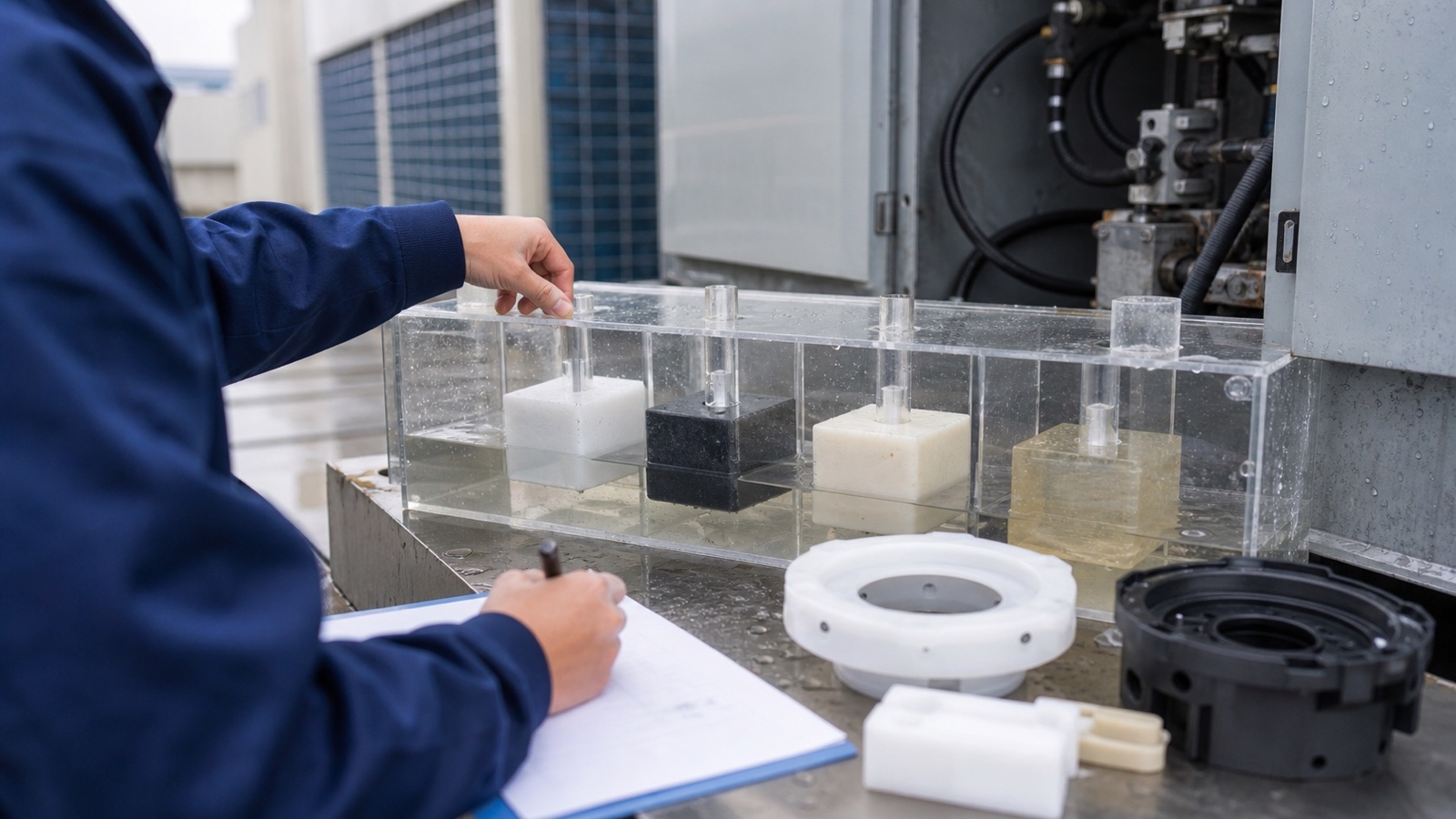
Precision CNC milling of engineering plastics where billet density directly dictates chip morphology and finished component weight.
3. Factors Influencing Plastic Density
A polymer’s nominal density is not arbitrary; it is the physical result of how atoms and macromolecular chains are structured, packed, or reinforced.
Molecular Structure
At a microscopic level, linear polymer chains with minimal branching can align closely together, forming a compact matrix that exhibits elevated density. Highly branched structures, by contrast, create steric hindrance—leaving empty spaces between disordered chains, resulting in reduced specific gravity. This explains why High-Density Polyethylene (HDPE, 0.95–0.96 g/cm³) is distinctly denser and stiffer than Low-Density Polyethylene (LDPE, ~0.92 g/cm³).
Crystallinity: Semi-Crystalline vs. Amorphous
Polymers generally fall into two structural camps. Amorphous plastics (like Polycarbonate, Acrylic, and PEI) possess a disorganized, tangled structure resembling dry spaghetti; their density remains relatively uniform across thermal cycles. Semi-crystalline plastics (such as PEEK, Acetal, and Nylon) form tightly organized lamellar crystal regions. These crystalline domains increase localized density and structural hardness, but also cause semi-crystalline stock shapes to shrink more during cooling and exhibit directional grain characteristics during milling.
Fillers and Reinforcement Additives
Base resins are regularly compounded with additives to enhance flexural modulus or wear life. Glass fibers (density ~2.54 g/cm³) and mineral/ceramic powders dramatically increase base polymer weight. For example, neat unfilled PEEK has a density of 1.30 g/cm³, whereas PEEK GF30 (30% glass fiber reinforced) climbs to roughly 1.51 g/cm³. Carbon fiber reinforcement (density ~1.80 g/cm³) increases density to a lesser extent while providing superior specific stiffness.
Foamed Structures & Micro-Voids
While structural CNC machining predominantly uses extruded or compression-molded solid billets to maintain pin-point tolerances, specialized micro-cellular or chemical foamed boards (such as expanded PVC or polyurethane tooling boards) purposefully incorporate gas bubbles. These voids lower density for non-structural mockups, architectural prototypes, or lightweight thermal baffles, though they sacrifice screw-retention strength and surface micro-finish.
4. Comparing Common Plastics for CNC Machining
To assist your mechanical engineering team during CAD configuration and bill-of-materials compilation, the table below categorizes common CNC-machined engineering thermoplastics by density tier, typical specific gravity, and structural characteristics.
| Polymer / Grade | Density (g/cm³) | Weight Class | Primary Machining Application |
|---|---|---|---|
| PP (Polypropylene) | 0.90 – 0.92 | Low | Chemical tanks, plating barrels, laboratory fluidics |
| UHMW-PE | 0.93 – 0.94 | Low | Wear strips, conveyor guide rails, chute liners |
| HDPE | 0.95 – 0.96 | Low | Food contact tooling, scrub tanks, marine fixtures |
| ABS | 1.04 – 1.07 | Medium | Electronic enclosures, visual prototypes, automotive trim |
| Nylon 6 / PA66 | 1.13 – 1.15 | Medium | Gears, high-load bushings, structural brackets |
| Polycarbonate (PC) | 1.20 – 1.22 | Medium | Sight glasses, machine guards, optical housings |
| PEEK (Unfilled) | 1.30 – 1.32 | High | Aerospace manifolds, semiconductor rings, spine implants |
| POM / Delrin / Acetal | 1.41 – 1.42 | High | Precision valves, tight-tolerance shafts, sliding components |
| PVC (Rigid Industrial) | 1.38 – 1.45 | High | Acid headers, electrical ducting, plating tanks |
| PTFE (Teflon) | 2.15 – 2.20 | Ultra-High | High-temp gaskets, cryogenic seals, non-stick insulators |
Which plastic has the highest density?
Among commonly machined engineering polymers, PTFE (Polytetrafluoroethylene) has the highest density, clocking in at approximately 2.15 to 2.20 g/cm³. This is due to its heavy fluorine atoms forming a dense helical sheath around the carbon backbone. If your design requires PTFE's extreme chemical inertness and low friction coefficient, your BOM must accommodate parts that weigh more than double their polypropylene or UHMW counterparts.
5. Why Weight and Density Matter in CNC Manufacturing
In custom plastic CNC machining, density is not just a line item on a spec sheet. It has direct operational and commercial ramifications for both the buyer and our shop floor in Dongguan.
Raw Stock Procurement Costs
Extruded and cast polymer billets (sheet, rod, and tubular stock) are usually priced and sold by raw weight (kilograms or pounds), not volume. When machining a part with significant pocketing where 70% of the billet is milled into scrap chips, a high-density resin like PTFE or Delrin demands considerably higher raw material spend per cubic centimeter than lower-density polymers like HDPE.
High-Dynamic Lightweighting
In robotics, drone gimbals, and automated picking arms, inertial mass governs motor sizing and cycle acceleration. Utilizing a low-density polymer with a superior strength-to-weight ratio (such as UHMW or carbon-reinforced PA) lowers dynamic loading, reducing motor wear, heat dissipation, and cycle time across millions of operations.
From a machining performance perspective, density heavily dictates chip load, heat retention, and tool wear. Denser polymers with crystalline configurations, such as Delrin, shear cleanly, leaving crisp edges and powdery or small broken chips. Conversely, low-density soft materials like UHMW or low-grade PP have low thermal conductivity; they tend to deflect under tool pressure and form stringy, continuous swarf that can wrap around spindles if cutting speeds, feed rates, and single-flute tool geometries are not precisely calibrated.
6. Best Practices for Selecting Plastic for Your Project
To prevent design revisions or cost overruns during prototyping and production runs, our engineering team recommends evaluating candidate polymers using this four-point checklist:
Evaluate Specific Strength (Strength-to-Weight Ratio)
Do not select solely on tensile strength. If your assembly is payload-limited, calculate the specific modulus (tensile modulus divided by density). A low-density polymer with slightly lower yield strength often outperforms a dense resin under dynamic conditions.
Assess Environmental and Operating Temperatures
Low-density polyolefins (PP, PE) experience rapid mechanical drop-off above 80°C. If your application involves elevated temperatures, autoclaving, or exposure to harsh industrial solvents, denser polymers like PEEK, PVDF, or PPS become mandatory regardless of part weight.
Account for Machinability & Tolerance Stability
Ultra-low density plastics often have higher coefficients of linear thermal expansion (CLTE) and lower modulus, making tight tolerances (±0.025 mm) difficult to hold during aggressive milling. Medium-to-high density resins like Delrin or PEEK yield superior dimensional repeatability.
Factor Total Freight & Landed Costs
For large production batches exported internationally, billet density directly influences air and ocean shipping weights. Shifting from PTFE to a high-performance, lower-density alternative like unfilled PEEK or POM can yield compounding shipping savings over annual production cycles.
What is the best plastic for CNC machining?
There is no universal "best" plastic—only the best plastic for your application's operating environment. For general mechanical components requiring tight tolerances, rigid threads, and balanced weight, POM-C (Acetal/Delrin) remains the industry workhorse. For ultra-demanding environments requiring high heat and chemical resistance alongside minimal weight, PEEK is unmatched. When chemical resistance and lowest possible weight on a budget are prioritized, Polypropylene or UHMW-PE lead the field.
7. Frequently Asked Questions
How do I calculate the weight of a machined part before production?
Export your finalized solid body from your CAD software (SolidWorks, Inventor, Fusion 360) and navigate to the "Mass Properties" or "Measure" panel. Extract the net volume in cubic centimeters (cm³), then multiply that figure by the manufacturer's nominal density value (g/cm³). When quoting, we verify these volumes against our CNC cam blank dimensions to account for stock billet size.
Do fillers always make plastic heavier?
In almost all standard industrial cases, yes. Reinforcements such as glass beads, chopped glass fibers, barium sulfate (for radiopacity), and bronze or mineral dust have densities substantially higher than the host polymer matrix. The rare exceptions are hollow glass microspheres or syntactic fillers, which purposefully embed microscopic air pockets into the resin to reduce bulk density for marine flotation or buoyancy tooling.
What are the common mistakes made regarding material density?
The most frequent mistake is assuming low-density plastics machine with lower cutting forces. While low-density plastics like UHMW and HDPE are soft, their low thermal conductivity and elasticity cause them to deform away from the cutter and re-expand behind it, causing binding, chip melting, and out-of-spec dimensions. Machinists must adjust spindle speeds, cutter rake angles, and fixture clamping pressures when moving from dense, rigid polymers to elastic, low-density grades.
Is there a universal "lightweight" plastic for all CNC projects?
No. While polypropylene and UHMW have the lowest density (~0.91–0.94 g/cm³), they exhibit high thermal expansion, low flexural modulus, and poor creep performance under heavy loads. If a design requires sub-millimeter precision under mechanical load at elevated temperatures, an engineer might be forced to choose carbon-reinforced PEEK or Torlon (PAI)—accepting a slightly higher density to ensure the part does not warp, creep, or fail in service.
Conclusion
Polymer density is far more than a textbook metric. It is an active engineering variable that governs physical part weight, billet consumption costs, cutting tool performance, and export shipping budgets. Factoring density into your calculations early during CAD modeling eliminates costly redesigns and ensures your components survive real-world operational stresses.
At PlasticCNCPro, we help product designers, manufacturing engineers, and sourcing teams navigate the nuances of engineering plastics. Whether you are validating a new drone mount in low-density UHMW, machining high-precision Delrin manifolds, or milling high-performance PEEK bushings, our application engineers review your drawings, tolerances, and operating requirements to deliver consistent, tight-tolerance parts.
Request a Machining Review & Quotation
Upload your 2D drawings (PDF/DWG) and 3D CAD files (STEP/IGES). Our engineering team in Dongguan will review your geometry, tolerance requirements, and plastic material selection to provide a manufacturing recommendation and quotation.