
PEEK vs PAI: Which Plastic Offers Better Mechanical Performance?
A practical, shop-floor evaluation of polyetheretherketone (PEEK) and polyamide-imide (PAI / Torlon) for structural stiffness, creep resistance, friction, thermal limits, and real-world precision CNC machining.
"When design engineers ask us at PlasticCNCPro whether PEEK or PAI will perform better, the immediate follow-up is simple: Are you fighting aggressive broad-spectrum chemicals, or are you demanding raw structural rigidity and creep resistance under extreme temperatures? PEEK wins the chemical marathon; PAI takes the crown for sheer mechanical muscle."
Introduction to PEEK and PAI Materials
In our daily precision CNC machining operations in Dongguan, we routinely handle high-performance polymers for mission-critical assemblies in aerospace, semiconductor handling, energy exploration, and precision instrumentation. Among the ultra-polymers sitting at the pinnacle of the plastics pyramid, Polyetheretherketone (PEEK) and Polyamide-imide (PAI, widely recognized under the Solvay brand name Torlon®) stand out as the top candidates when standard engineering plastics like Acetal, Nylon, or even Ultem (PEI) fail under mechanical or thermal stress.
While both materials excel under high stresses and elevated operating temperatures, they stem from fundamentally distinct polymer chemistries:
PEEK (Polyetheretherketone)
A semi-crystalline thermoplastic with aromatic backbone rings linked by ether and ketone groups. The semi-crystalline matrix delivers exceptional chemical inertness, high fatigue endurance, excellent resistance to hydrolysis (superheated steam), and self-lubricating characteristics in tribological grades.
PAI (Polyamide-imide / Torlon)
An amorphous thermoplastic combining the aromatic rigidity of imide rings with the chemical toughness of amide links. Because it is amorphous and post-cured via specialized thermal cycles, PAI exhibits higher tensile strength, compressive strength, and flexural modulus than almost any other commercial melt-processable thermoplastic.
Key Mechanical Properties Head-to-Head
From a purely structural perspective, unfilled PAI outperforms unfilled PEEK in absolute tensile yield, flexural modulus, and resistance to creep. Below is a direct comparison based on standard ISO/ASTM laboratory benchmarks for virgin extruded stock shapes.
| Property | Standard PEEK (Virgin) | PAI / Torlon 4203 (Virgin) | Performance Winner |
|---|---|---|---|
| Tensile Strength (23°C) | 100 – 115 MPa | 150 – 190 MPa | PAI (+35% to +65%) |
| Tensile Modulus (23°C) | 3.6 – 4.0 GPa | 4.5 – 5.0 GPa | PAI (Stiffer) |
| Compressive Strength (10% strain) | 110 – 130 MPa | 170 – 220 MPa | PAI (Heavy loads) |
| Izod Impact Strength (Notched) | 50 – 80 J/m | 80 – 110 J/m | PAI |
| Tensile Strength at 200°C | ~25 – 35 MPa | ~75 – 95 MPa | PAI (Retention) |
| Elongation at Break | 20 – 40% | 10 – 15% | PEEK (Ductility) |
The data demonstrates why PAI is the standard choice when engineers demand metal-like load-bearing capability. It resists deformation under constant sustained mechanical stress (creep) far better than virgin PEEK. However, PEEK’s higher elongation at break gives it superior ductility, meaning it will deform before snapping abruptly under sudden shock loads.
Wear, Friction, and Load-Bearing Performance
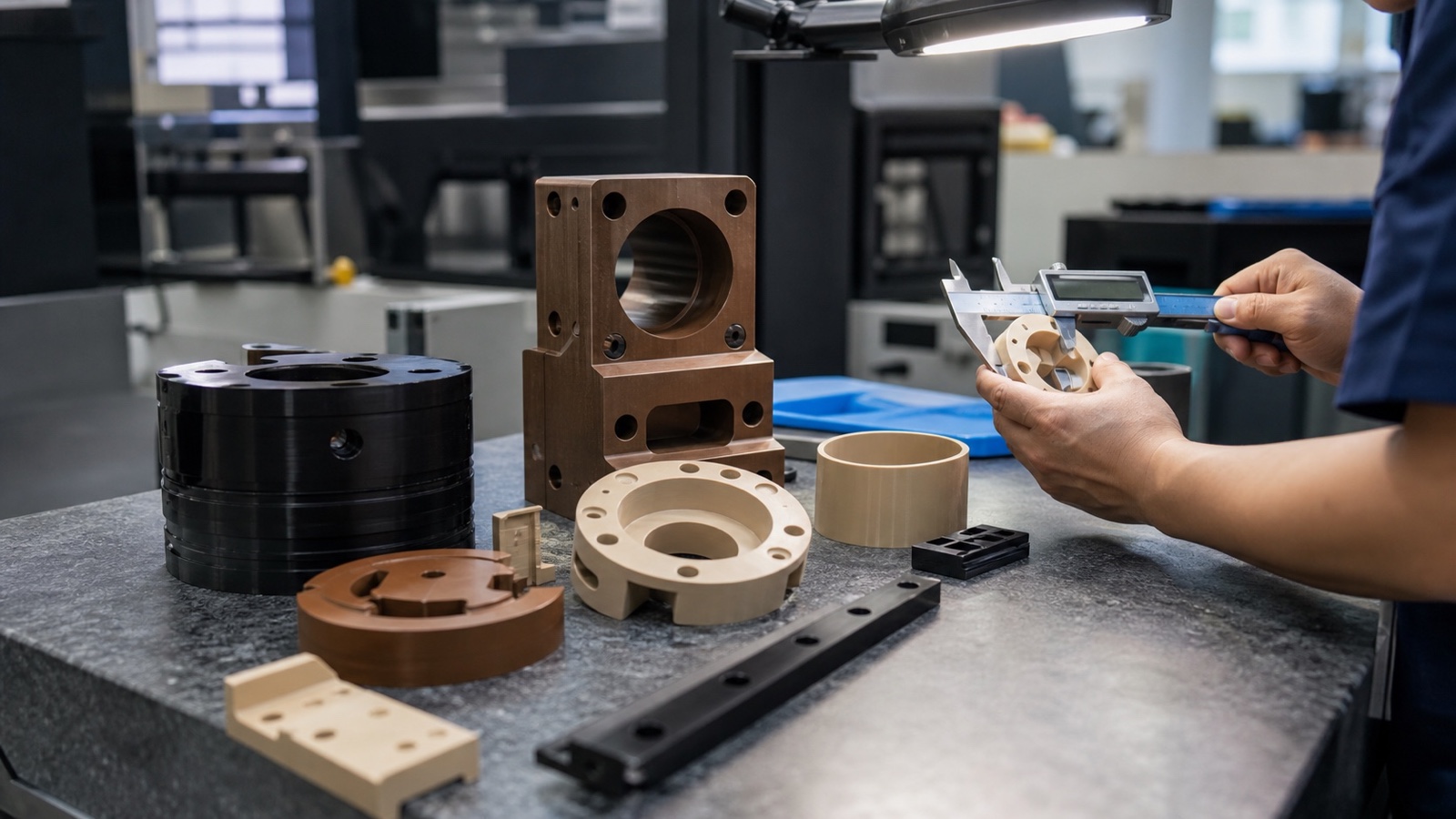
In dynamic motion systems—such as high-speed rotating bushings, split seal rings, thrust washers, and non-lubricated gears—mechanical performance depends on the pressure-velocity (PV) limit and surface tribology.
Unfilled Bearing Grades
Virgin PEEK has an inherently lower coefficient of dynamic friction against polished steel (approx. 0.30–0.38) compared to virgin PAI (approx. 0.40–0.45). For light-load, medium-speed slide components, virgin PEEK runs cooler and smoother out of the box.
Specialized Tribological Formulations
Comparing bearing-grade modifications changes the equation. PEEK-FC30 (containing 10% carbon fiber, 10% graphite, and 10% PTFE) versus Torlon 4301 or Torlon 4275 (PAI with graphite and fluoropolymer additives) show critical distinctions. While PEEK-FC30 handles wet, steam-rinsed, or chemical environments effortlessly, Torlon 4301 delivers unmatched PV ratings under heavy compressive contact pressures exceeding 50 MPa.
Galling & Micro-Welding Resistance
Under severe dry boundary conditions where temperatures rise locally at contact asperities, Torlon maintains its modulus without softening, preventing the galling and catastrophic roll-over extrusion that semi-crystalline PEEK can experience near its 143°C glass transition threshold.
Thermal Stability and Elevated-Temperature Strength
A common misconception in polymer specification is looking only at Continuous Service Temperature (CST). Both PEEK and PAI boast impressive continuous thermal ratings—250°C to 260°C. But the way they retain mechanical stiffness above 140°C is vastly different.
The Glass Transition Divergence (Tg)
PEEK has a glass transition temperature (Tg) of approximately 143°C (289°F). Although its melting point is 343°C, unfilled PEEK loses substantial modulus once operating temperatures cross 140°C. Its tensile modulus drops by more than 50%, transitioning from a stiff structural polymer into a tough, pliable solid supported only by its crystalline phases.
PAI has an extremely high Tg of 275°C (527°F). As a result, PAI retains essentially its full room-temperature stiffness up to 200°C and maintains substantial structural integrity all the way to 260°C. For load-bearing valve plates or test sockets operating at 180°C–220°C, PAI remains rigid where unfilled PEEK would deflect and creep under bolt preload.
Because PAI stock shapes require post-extrusion multi-day oven curing cycles to achieve full imidization and strength, they are susceptible to moisture pick-up (up to 0.3–0.4% in humid shop air). When we machine tight-tolerance PAI parts (±0.01mm), we actively manage raw material pre-drying and post-machining stabilization. PEEK, by contrast, has near-zero moisture absorption (0.1% max) and remains dimensionally stable through coolant exposure.
Chemical and Environmental Resistance Factors
Chemical compatibility is the deciding boundary where PEEK frequently overtakes PAI. Even if PAI has superior mechanical stiffness, chemical exposure can dictate the material choice.
PEEK Chemical Profile
- Superheated Steam & Hydrolysis: Outstanding; withstands thousands of autoclave cycles without embrittlement.
- Acids & Bases: Resists dilute and concentrated organic acids and alkalis; attacked only by concentrated sulfuric/nitric acid.
- Hydrocarbons & Solvents: Exceptional resistance to jet fuels, brake fluids, crude oils, and chlorinated solvents.
PAI Chemical Profile
- Hydrocarbons & Oils: Excellent resistance to automotive fuels, synthetic hydraulic oils, and fluorocarbon refrigerants.
- Steam & Moisture at High Temp: Prone to hydrolytic degradation; continuous exposure to steam above 130°C causes molecular chain scission.
- Strong Alkalis & Amines: Strong bases will hydrolyze the imide linkages, causing stress cracking and surface degradation.
Cost-Effectiveness and Material Selection Trade-offs
Both materials belong to the highest cost tier among machinable engineering thermoplastics. Raw shape stock for PAI is generally 15% to 35% more expensive than standard virgin PEEK shapes, primarily due to the complex, multi-stage solid-state polymerization and extended post-curing schedules required to manufacture void-free Torlon billets.
Machining machinability also influences part economics:
Machining Behavior: PEEK
PEEK is relatively forgiving on tooling. It generates continuous ribbons or manageable curls when cut with polished carbide or PCD tooling. Coolant management is straightforward, and internal stress relief can be performed through standard thermal annealing.
Machining Behavior: PAI
PAI is brittle during rapid shear and highly abrasive, requiring high-positive rake geometry and razor-sharp cutting edges to prevent chip pack and edge chipping on breakout walls. Deep-hole drilling requires frequent peck clearing and dry compressed air blast to avoid localized thermal shock.
If an assembly operates strictly below 100°C without aggressive solvents or steam, using PEEK or PAI is frequently an over-specification. In our quotation reviews, when customers do not require extreme temperature or chemical thresholds, we often evaluate whether PPS, PEI (Ultem 1000), or POM-C can achieve the exact print tolerances at 30% to 60% lower total project cost.
Common Industry Applications
Real-world performance drives engineers to specify these polymers across targeted critical sectors:
Semiconductor Test Sockets (PAI Domain)
IC test sockets and burn-in fixtures require microscopic holes drilled at 0.2mm to 0.5mm diameters on tight pitch grids. Torlon 4203 and 5030 glass-filled provide exceptional burr-free micro-machinability, high electrical insulation, and virtually zero deflection under contact pin spring pressures up to 150°C.
Oil & Gas Downhole Seals (PEEK Domain)
Downhole completions expose components to methane, sour gas (H2S), brine, and drilling muds under high pressures. PEEK’s resistance to chemical attack and rapid gas decompression (RGD) makes it the standard choice for backup rings, chevron packing, and electrical penetrators.
Aerospace Fasteners & Bushings (Both)
Titanium replacement brackets and jet engine actuator bushings rely on carbon-fiber PAI (Torlon 4435 / 7130) for high stiffness-to-weight ratios up to 260°C. PEEK is preferred on external airframe manifolds and hydraulic return couplings where skydrol fluid resistance is required.
Medical & Surgical Devices (PEEK Domain)
Surgical guides, endoscope tips, and implantable trials require ISO 10993 or USP Class VI biocompatibility alongside resilience against repeated steam autoclave sterilization. PEEK holds this field almost exclusively, as PAI degrades under repetitive hot autoclave conditions.
Downsides of PEEK and When PAI Performs Better
While PEEK is often treated as the default high-performance polymer, engineers encounter real limitations when testing parts under extreme mechanical stress:
1. Modulus Drop Above 143°C
Because of its 143°C glass transition, virgin PEEK softens significantly when subjected to heat. When a hydraulic valve seal or compressor piston ring sees sustained 180°C operation under 15 MPa pressure, PEEK can deform, extrude into clearance gaps, and cause system failure. PAI maintains structural form up to 275°C without plastic creep.
2. Lower Ultimate Tensile & Compressive Strength
Virgin PEEK yields around 100–115 MPa. Virgin Torlon PAI reaches 150–190 MPa. For structural cages, transmission thrust washers, and precision gears that must transmit torque without tooth deflection, PAI delivers higher mechanical load headroom.
3. Higher Thermal Expansion Rate (CLTE)
PEEK’s coefficient of linear thermal expansion is roughly 45–50 × 10⁻⁶/K below Tg and increases substantially above Tg. Unfilled PAI has an exceptionally low CLTE of approximately 30 × 10⁻⁶/K, closely mimicking metal expansion rates and preserving tight running clearances across wide operating envelopes.
FAQ: Answering Engineer Questions
What are the downsides of PEEK material?
The primary mechanical downside of PEEK is its relatively low glass transition temperature (143°C), above which unfilled grades experience a significant loss in structural modulus and creep resistance. It is also attacked by concentrated sulfuric, nitric, and hydrofluoric acids, is sensitive to notch-concentrated fatigue under high-frequency cycling, and carries a high raw material cost compared to polyimides or engineering plastics like PPS and POM.
Is Ultem a better material than PEEK?
Ultem (PEI) is not universally better, but it offers advantages in specific engineering contexts. PEI has a higher glass transition temperature (approx. 217°C) than PEEK (143°C), meaning unfilled Ultem maintains structural rigidity at temperatures between 150°C and 200°C better than unfilled PEEK. Ultem is also significantly more affordable and inherently flame retardant with low smoke generation. However, PEEK offers far superior chemical resistance, higher fatigue endurance, and better sliding wear characteristics.
Is PEEK harder than Delrin?
Yes. Virgin PEEK typically exhibits a Rockwell M hardness of M99 to M105 (Rockwell R 126), whereas Delrin (Acetal / POM-H) measures around Rockwell M88 to M94 (Rockwell R 120). PEEK has higher surface hardness, greater scratch resistance, and approximately 50% higher tensile strength than Delrin, along with double the continuous service temperature capability.
Why is PEEK plastic so expensive?
PEEK synthesis is an energy-intensive, multi-step step-growth polymerization requiring expensive specialty monomers (hydroquinone and 4,4'-difluorobenzophenone) dissolved in high-boiling diphenyl sulfone solvents at temperatures exceeding 300°C. The equipment required to handle this process is built from exotic nickel alloys. Additionally, extrusion of PEEK stock shapes requires specialized high-temperature melting dies and tight thermal annealing controls to ensure uniform crystallinity without internal voids.
Machining Precision PEEK and PAI Components with PlasticCNCPro
At PlasticCNCPro, we focus specifically on custom CNC machining of high-performance engineering plastics. Whether you are validating a prototype for semiconductor burn-in testing or need repeat production batches of critical hydraulic seals, our Dongguan facility manages the process from CAD review through precision milling, turning, de-burring, and dimensional inspection.
Request a Machining Review & Quotation
Upload your 2D drawings, 3D CAD files (STEP, IGES, DXF), and project requirements. Our engineering team will review tolerances, evaluate PEEK vs PAI suitability, and provide manufacturing feedback with a clear quotation.