
Guide des matériaux techniques
PPSU ou PEEK : quel plastique est le plus adapté aux pièces de dispositifs médicaux ?
Une comparaison pratique et orientée ingénierie destinée aux concepteurs, responsables des achats et ingénieurs de fabrication qui doivent sélectionner le polymère haute performance adapté aux dispositifs réutilisables, instruments chirurgicaux, composants de gestion des fluides et applications médicales exigeantes.
Réponse rapide : faut-il choisir le PPSU ou le PEEK ?
Chez PlasticCNCPro, les équipes de dispositifs médicaux nous posent souvent cette question lors des premières revues de conception. La réponse honnête est qu’aucun matériau n’est universellement supérieur. Le PEEK est généralement préférable pour la résistance, la résistance à l’usure et aux produits chimiques, ainsi que pour les pièces implantables ou porteuses exigeantes. Le PPSU est souvent mieux adapté à la stérilisation répétée à la vapeur, à la résistance aux chocs, à la transparence et aux dispositifs réutilisables sensibles aux coûts.
Le meilleur matériau dépend de la méthode de stérilisation, de la charge mécanique, de la température, des exigences de biocompatibilité, de la visibilité, du procédé de fabrication et du coût total du cycle de vie. Choisir la bonne famille de polymères n’est que la première étape. La nuance, le procédé de fabrication et la géométrie de la pièce déterminent les performances réelles du matériau sur le terrain.
| Propriété | PEEK | PPSU |
|---|---|---|
| Résistance à la température | Excellente ; point de fusion élevé et aptitude à l’utilisation continue | Très bonne pour un polymère amorphe |
| Résistance et rigidité | Performances supérieures en traction, flexion et fatigue | Bonne, mais inférieure à celle du PEEK |
| Résistance aux chocs | Bonne pour de nombreuses nuances, mais plus rigide et moins tolérante | Ténacité et résistance à la fissuration exceptionnelles |
| Résistance chimique | Large résistance aux nettoyants, fluides et solvants | Excellente stabilité hydrolytique et résistance aux agents nettoyants |
| Stérilisation à la vapeur | Adaptée lorsque la nuance et la conception sont validées | Excellente pour les cycles d’autoclave répétés |
| Transparence | Généralement brun ou noir opaque | Naturellement transparent ou ambré translucide |
| Usinabilité | Bonne avec un contrôle thermique et un recuit appropriés | Bonne, mais la relaxation des contraintes est importante |
| Coût relatif | Coût des matériaux et du traitement plus élevé | Coût inférieur à celui du PEEK |
Que sont le PEEK et le PPSU ?
PEEK : polyétheréthercétone
PEEK is a high-performance engineering thermoplastic with a semi-crystalline structure. We see it used across medical, aerospace, automotive, and industrial applications where strength, fatigue resistance, wear performance, and dimensional stability matter. Standard PEEK is not the same as medical-grade or implantable-grade PEEK. The latter includes stricter raw-material controls and documented testing.
Modified PEEK grades include carbon-fiber-reinforced, glass-fiber-reinforced, and tribological formulations. These filled grades change stiffness, creep resistance, thermal conductivity, and friction behavior. When we machine PEEK at PlasticCNCPro, we always confirm whether the customer needs unfilled medical PEEK or a filled grade for structural or wear-intensive service.
PPSU : polyphénylsulfone
PPSU is an amorphous, high-temperature polysulfone thermoplastic designed for demanding medical and life-science applications. Its natural amber or transparent appearance makes it useful for fluid paths, reservoirs, and components that benefit from visual inspection. PPSU is often confused with PSU or PES, but it generally offers higher impact strength, better hydrolytic stability, and stronger performance after repeated sterilization.
In our machining work, PPSU is commonly selected for reusable devices that must survive drops, handling, cleaning chemicals, and hundreds of autoclave cycles. It is not usually the first choice for continuous sliding contact or high-load structural parts, but it is an excellent engineering material for housings, handles, trays, and fluid-management components.
PEEK ou PPSU : comparaison des propriétés essentielles
Résistance mécanique et rigidité
PEEK typically offers higher tensile strength, flexural strength, modulus, fatigue resistance, and creep resistance than PPSU. That is why we recommend PEEK for structural, wear-bearing, and precision components that must hold tight tolerances under load. PPSU is still a strong polymer, but its strength is usually sufficient for housings, trays, handles, and reusable instrument parts rather than high-load mechanisms.
Résistance aux chocs et ténacité
PPSU is exceptional in impact resistance and resistance to cracking during handling, drops, and repeated sterilization. PEEK is stronger and stiffer, but it can be less forgiving in thin sections or sharp corners. Real-world impact performance depends on wall thickness, geometry, reinforcement, and processing. We advise testing the actual part design rather than relying only on datasheet values.
Résistance à la température et déformation sous chaleur
PEEK is a semi-crystalline polymer with a high melting point and strong continuous-use temperature capability. PPSU is an amorphous polymer with very good high-temperature performance for its class. Short-term temperature ratings should not be treated as continuous-use recommendations. In medical devices, the realistic operating envelope includes sterilization temperature, dwell time, pressure, and cleaning chemistry.
Résistance chimique
Both materials resist water, steam, many cleaning agents, disinfectants, solvents, lipids, and bodily fluids. PEEK generally offers superior chemical and wear resistance in aggressive service. However, concentrated acids, strong bases, oxidizers, and certain solvents can affect either material depending on exposure conditions. We always ask customers about the full chemical environment, including cleaning agents and residual disinfectants.
Usure, friction et pouvoir lubrifiant
PEEK is generally better suited to bushings, gears, seals, bearings, and sliding components. Filled PEEK grades, including carbon fiber, glass fiber, and PTFE-modified formulations, can improve wear behavior and reduce friction. PPSU may be adequate for low-wear applications, but it is not the first choice for continuous sliding contact under load.
Stabilité dimensionnelle et fluage
PEEK performs well in precision components because of its low creep, low moisture absorption, and predictable thermal expansion when processed correctly. PPSU offers stability in reusable medical assemblies, but amorphous materials can still develop residual stress if machined or molded improperly. Annealing, mold design, machining practices, and operating temperature all affect long-term dimensional retention.
Transparence, couleur et inspection visuelle
PPSU’s natural transparency or translucency is a major advantage for fluid paths, reservoirs, and visual inspection. PEEK is typically opaque brown or black, although some medical-grade color options exist. Transparence supports contamination checks, fluid-level monitoring, and device usability. If visibility is a requirement, PPSU often becomes the preferred choice unless the mechanical loads demand PEEK.
Stérilisation : comparaison du PEEK et du PPSU
Stérilisation à la vapeur et autoclavage
Both materials can perform at common steam sterilization conditions such as 121°C and 134°C. PPSU has a strong reputation for repeated autoclave cycles, hydrolytic stability, and retained mechanical properties. PEEK can also be suitable for reusable devices when the selected grade and design are properly validated. Cycle count claims must be supported by application-specific testing rather than assumed from datasheet ratings.
Rayonnement gamma
Gamma exposure can affect color, molecular weight, toughness, and long-term performance. Radiation resistance varies by polymer grade, dose, packaging, atmosphere, and cumulative exposure. PEEK and PPSU should both be tested before use in gamma-sterilized single-use devices. A cosmetic color shift does not automatically mean the part has failed, but it must be evaluated alongside mechanical and chemical performance.
Stérilisation à l’oxyde d’éthylène et au peroxyde d’hydrogène
EtO and vaporized hydrogen peroxide sterilization are generally compatible with both materials, but residual chemicals, repeated cycles, surface finish, and component geometry can influence performance. We recommend validating the complete sterilization process, including packaging and assembly materials, not just the polymer resin.
Décoloration due à la stérilisation et perte de performance
It is important to distinguish cosmetic color shift from meaningful changes in strength, toughness, chemical resistance, or dimensional accuracy. Testing should measure both visual appearance and functional performance. For reusable medical parts, inspection criteria should define acceptable color, surface condition, and dimensional limits after repeated cycles.
Biocompatibilité et conformité aux exigences médicales
ISO 10993 et USP Class VI
Resin manufacturers may offer grades tested to ISO 10993 and/or USP Class VI, but compliance is grade- and application-specific. Finished-part biocompatibility depends on additives, pigments, processing residues, surface treatments, cleaning agents, and sterilization. Reviewing technical files, certificates, test reports, and change-control documentation is essential before final material approval.
Applications implantables et non implantables
Short-term contact, prolonged contact, external devices, surgical instruments, and implantable components have different requirements. Implantable PEEK requires stricter material traceability and validation than general medical-grade PEEK. PPSU is commonly selected for reusable and external medical components rather than permanent implants.
Considérations réglementaires et qualité
Material traceability, lot consistency, supplier qualification, process validation, and documentation requirements all influence material selection. Medical-grade resin availability, regulatory change notifications, and controlled manufacturing environments matter. Material selection cannot replace full device-level risk assessment and validation.
Quel matériau convient le mieux aux pièces de dispositifs médicaux ?
Choisir le PEEK lorsque vous avez besoin de
- Une résistance et une rigidité mécaniques élevées dans un composant léger.
- Une excellente résistance à l’usure, à la fatigue, au fluage et aux produits chimiques.
- Des pièces de précision exposées à des charges élevées, à la friction ou à des fluides agressifs.
- Des composants implantables ou des pièces structurelles radiotransparentes fabriquées dans une formulation médicale appropriée.
- Des performances modifiées par des fibres de carbone, des fibres de verre ou une formulation tribologique.
Choisir le PPSU lorsque vous avez besoin de
- Une ténacité aux chocs et une résistance à la fissuration exceptionnelles.
- Une stérilisation répétée à la vapeur et une stabilité hydrolytique.
- Des pièces transparentes ou translucides pour l’inspection visuelle.
- Des composants durables et réutilisables soumis à des charges mécaniques modérées.
- Une alternative moins coûteuse au PEEK lorsque des performances extrêmes en matière d’usure ou de charge ne sont pas nécessaires.
Envisager le PEI, le PSU ou d’autres solutions lorsque
- PEI is needed for high-temperature dimensional stability or an alternative to PPSU.
- PSU provides adequate performance for less demanding reusable components.
- Polycarbonate is preferred for clarity and lower-cost medical housings, provided sterilization requirements are acceptable.
- POM, PTFE, or medical-grade nylon is better suited to specific low-friction, sealing, or economical applications.
- UHMW-PE or other polymers are more appropriate for specialized wear or implant-related requirements.
Applications courantes dans les dispositifs médicaux
Applications du PEEK
- Orthopedic and spinal implants, dental components, and radiolucent implantable parts.
- Surgical instrument components, endoscopic parts, and high-wear mechanisms.
- Pump components, seals, bushings, gears, and precision medical machine parts.
- Components requiring chemical resistance, fatigue strength, or long-term dimensional stability.
Applications du PPSU
- Sterilization trays, surgical instrument handles, and reusable device housings.
- Anesthesia and respiratory components, fluid-management parts, and manifolds.
- Connectors, reservoirs, inspection windows, and parts exposed to repeated autoclaving.
- Components where toughness, transparency, and repeated disinfection matter more than extreme wear resistance.
Facteurs de conception des pièces qui influencent le choix du matériau
Thin walls, snap-fits, threads, living hinges, undercuts, and molded-in features all affect material behavior. Load direction, stress concentration, impact risk, and required service life must be evaluated. Fluid exposure, cleaning chemistry, sterilization cycle, and temperature profile matter. The need for radiolucency, transparency, color coding, or embedded components can also shift the decision toward one material or the other.
Considérations relatives au traitement et à la fabrication
Moulage par injection du PPSU
PPSU requires high processing temperatures, controlled mold temperature, proper drying, venting, and careful attention to shrinkage and residual stress. Its amorphous behavior supports transparency and dimensional consistency, but mold design must account for weld lines, sink marks, warpage, bubbles, and stress cracking.
Moulage par injection du PEEK
PEEK requires higher melt and mold temperature requirements compared with PPSU. Crystallinity, cooling rate, annealing, shrinkage variation, and processing conditions directly affect final properties. Consistent crystallization is important for dimensional accuracy and mechanical performance.
Usinage CNC du PEEK et du PPSU
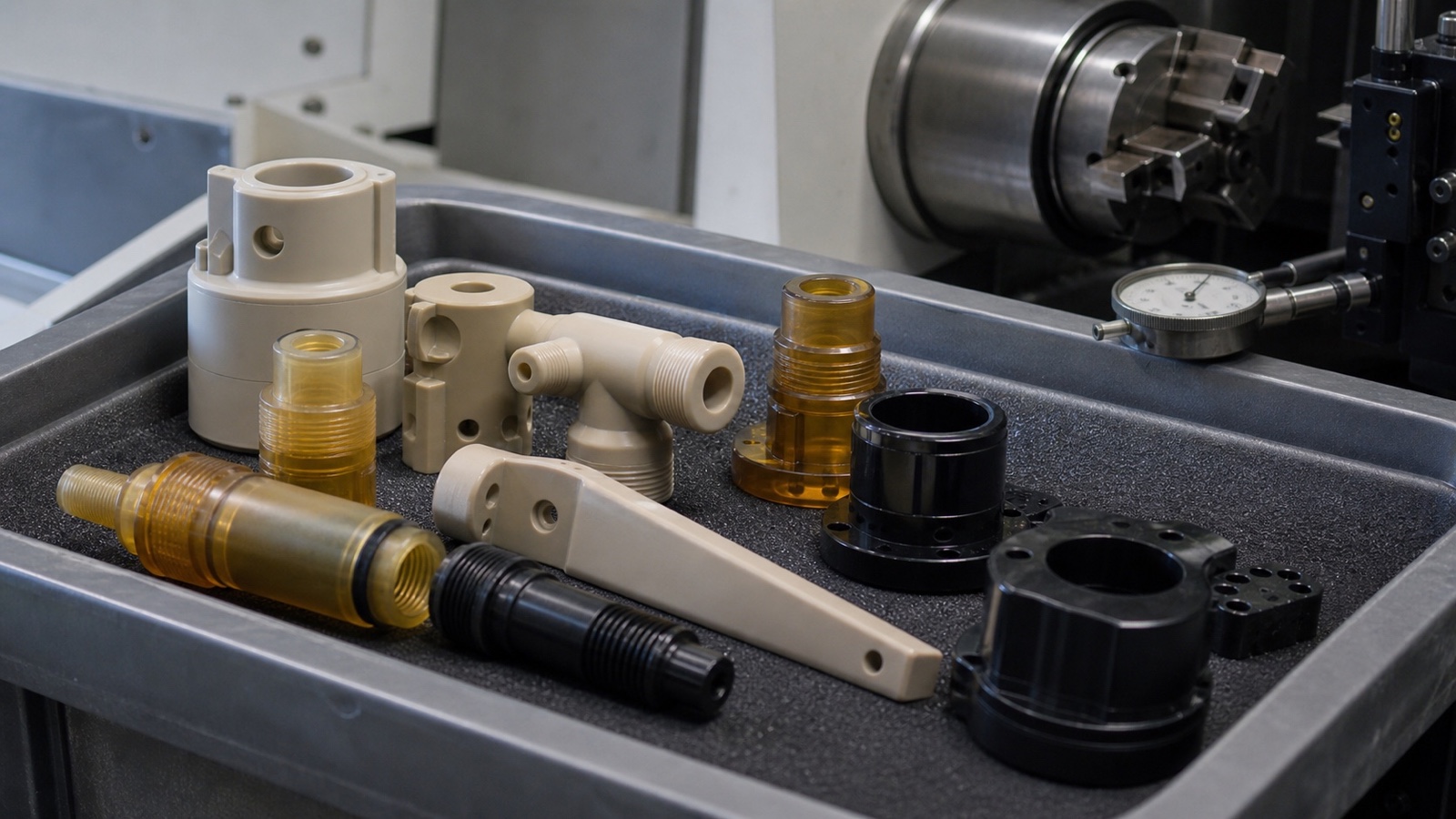
At PlasticCNCPro, we machine both materials regularly. PEEK requires careful thermal management, sharp tooling, controlled chip evacuation, and stress relief for precision parts. PPSU is also machinable, but internal stress can cause movement after material removal. Machining tolerances may differ from molded-part tolerances, which is why prototype testing is important before committing to production.
Fabrication additive et prototypage rapide
High-temperature 3D printing for PEEK and related materials is growing, but printed parts differ from molded parts in anisotropy, porosity, surface finish, sterilization response, and validation requirements. We recommend using printed components for prototyping only until production-process equivalence is demonstrated.
Assemblage, étanchéité et jonction
Ultrasonic welding, laser welding, thermal welding, adhesive bonding, press fits, and mechanical fastening all behave differently with PEEK and PPSU. Sterilization can affect joint strength, seals, dimensional fits, and plastic-to-plastic interfaces. The complete assembled device should be tested after sterilization and aging.
Arbitrages liés aux coûts, à l’approvisionnement et au cycle de vie
Coûts des matériaux et de la fabrication
PEEK typically carries a higher material cost than PPSU, but resin price is only one part of total cost. Tooling, machining, cycle time, scrap, validation, sterilization life, and replacement costs all matter. PPSU can reduce cost without compromising required performance when extreme wear or load performance is not needed.
Économie des dispositifs réutilisables
Initial material cost should be compared with service life, number of autoclave cycles, maintenance, repair, and replacement frequency. Better impact resistance or wear resistance can lower total cost of ownership. A lifecycle cost model is more useful than price per kilogram or part.
Chaîne d’approvisionnement et disponibilité des matériaux
Medical-grade availability, approved supplier lists, lead times, lot traceability, and resin substitutions all affect sourcing. Unapproved grade changes can affect regulatory documentation and device validation. Maintaining qualified backup suppliers and monitoring material changes is important for long-term production.
Considérations de durabilité
Durability, reuse, sterilization energy, material waste, and end-of-life limitations all contribute to sustainability. Longer service life can reduce environmental impact compared with lower material cost. Medical-device sustainability decisions must remain compatible with infection control and regulatory requirements.
Matrice de décision : PPSU ou PEEK ?
Définir les conditions d’exposition
Identify sterilization type, number of cycles, temperature, pressure, chemicals, radiation dose, and service duration. Record contact with bodily fluids, drugs, cleaning agents, solvents, and lubricants.
Définir les exigences mécaniques et dimensionnelles
Set requirements for tensile strength, stiffness, impact resistance, fatigue life, wear, creep, tolerance, and surface finish. Determine whether the part is structural, load-bearing, sliding, sealing, cosmetic, or fluid-handling.
Confirmer les exigences réglementaires et matérielles
Verify medical-grade documentation, ISO 10993 or USP Class VI data, implantability status, and traceability. Confirm that pigments, fillers, lubricants, coatings, and processing aids are approved for the intended use.
Sélectionner et valider la nuance finale
Compare specific resin grades rather than generic polymer families. Test molded or machined production-representative parts through sterilization, aging, mechanical loading, and chemical exposure. Document acceptance criteria for dimensions, color, surface condition, and functional performance.
FAQ sur le PEEK, le PPSU et les plastiques pour dispositifs médicaux
Quel est le meilleur plastique pour les dispositifs médicaux ?
Aucun plastique unique ne convient à tous les dispositifs médicaux. Les choix courants comprennent le PEEK, le PPSU, le PEI, le PSU, le polycarbonate, le polypropylène, le POM, le PTFE et le nylon de qualité médicale. La stérilisation, la biocompatibilité, les exigences mécaniques et le coût du cycle de vie sont les facteurs déterminants.
Le PEEK est-il plus résistant que le nylon ?
PEEK generally offers higher strength, stiffness, temperature resistance, chemical resistance, fatigue performance, and dimensional stability than standard nylon. Reinforced or specialty nylons may be competitive for specific applications at a lower cost. Nylon also has higher moisture absorption, which affects dimensions and mechanical properties.
Le PEEK est-il meilleur que le PTFE ?
PEEK is typically stronger, stiffer, more wear-resistant under load, and more dimensionally stable than PTFE. PTFE generally provides lower friction and broader chemical resistance. PEEK is often selected for structural or load-bearing parts, while PTFE is favored for low-friction seals, liners, and chemically aggressive environments.
Quels types de plastiques sont couramment utilisés dans les dispositifs médicaux ?
PEEK, PPSU, PSU, PEI, polycarbonate, polypropylene, polyethylene, POM, PTFE, PVC, silicone, and medical-grade nylon are common. Each polymer matches different uses such as housings, tubing, fluid paths, surgical tools, seals, implants, and disposable components. The exact grade and manufacturing process determine suitability.
Le PPSU et le PEEK peuvent-ils être autoclavés ?
Properly selected medical grades of both materials can withstand many steam sterilization cycles. PPSU has a strong reputation for repeated autoclaving, while PEEK offers higher mechanical and wear performance. Application-specific cycle testing is recommended because geometry, stress, additives, and cleaning chemistry affect results.
Le PPSU résiste-t-il mieux aux chocs que le PEEK ?
PPSU is often preferred for high-impact reusable parts and applications where cracking is a concern. PEEK may outperform PPSU in strength, stiffness, fatigue, and wear depending on the grade. Performance should be evaluated using the actual part design and loading conditions.
Recommandation finale : PPSU ou PEEK
The final choice depends on sterilization, mechanical load, wear, transparency, impact risk, regulatory needs, processing method, and budget. PEEK is usually the better choice for high-load, high-wear, precision, or implantable components. PPSU is usually the better choice for transparent, impact-resistant, repeatedly autoclaved reusable components.
At PlasticCNCPro, we recommend that the device designer, material supplier, molding or machining partner, sterilization expert, and regulatory team collaborate before final material approval. Selecting the right polymer family is important, but validating the exact grade, process, and part geometry is what ultimately determines device performance and reliability.
Besoin d’aide pour sélectionner ou usiner du PPSU ou du PEEK ?
Send us your drawing, 3D model, material requirement, quantity, tolerance, and application details. Our team will review the design, material, tolerances, and manufacturability, then provide a quotation and production recommendation for CNC-machined medical device components.