
Leitfaden für technische Werkstoffe
PPSU vs. PEEK: Welcher Kunststoff ist besser für medizinische Geräteteile?
Ein praxisnaher, ingenieurorientierter Vergleich für Konstrukteure, Einkaufsmanager und Fertigungsingenieure, die das richtige Hochleistungspolymer für wiederverwendbare Geräte, chirurgische Instrumente, fluidführende Komponenten und anspruchsvolle medizinische Anwendungen auswählen müssen.
Kurzantwort: PPSU oder PEEK wählen?
Bei PlasticCNCPro hören wir diese Frage häufig von Teams aus der Medizintechnik in frühen Konstruktionsprüfungen. Die ehrliche Antwort lautet, dass kein Werkstoff grundsätzlich besser ist. PEEK bietet im Allgemeinen Vorteile bei Festigkeit, Verschleiß- und Chemikalienbeständigkeit sowie bei anspruchsvollen implantierbaren oder tragenden Teilen. PPSU ist häufig besser für wiederholte Dampfsterilisation, Schlagfestigkeit, Transparenz und kostenbewusste wiederverwendbare Geräte geeignet.
Der beste Werkstoff hängt von Sterilisationsmethode, mechanischer Belastung, Temperatur, Biokompatibilitätsanforderungen, Sichtbarkeit, Fertigungsverfahren und den gesamten Lebenszykluskosten ab. Die Auswahl der richtigen Polymerfamilie ist nur der erste Schritt. Die konkrete Type, das Verarbeitungsverfahren und die Bauteilgeometrie bestimmen, wie sich der Werkstoff im Einsatz tatsächlich verhält.
| Eigenschaft | PEEK | PPSU |
|---|---|---|
| Temperaturbeständigkeit | Ausgezeichnet; hoher Schmelzpunkt und Eignung für den Dauerbetrieb | Für ein amorphes Polymer sehr gut |
| Festigkeit und Steifigkeit | Überlegene Zug-, Biege- und Ermüdungsfestigkeit | Gut, jedoch niedriger als bei PEEK |
| Schlagfestigkeit | Bei vielen Typen gut, jedoch steifer und weniger fehlertolerant | Außergewöhnliche Zähigkeit und Rissbeständigkeit |
| Chemikalienbeständigkeit | Breite Beständigkeit gegenüber Reinigern, Flüssigkeiten und Lösungsmitteln | Hohe Hydrolysestabilität und Beständigkeit gegenüber Reinigungsmitteln |
| Dampfsterilisation | Geeignet, wenn Type und Konstruktion validiert sind | Ausgezeichnet für wiederholte Autoklavenzyklen |
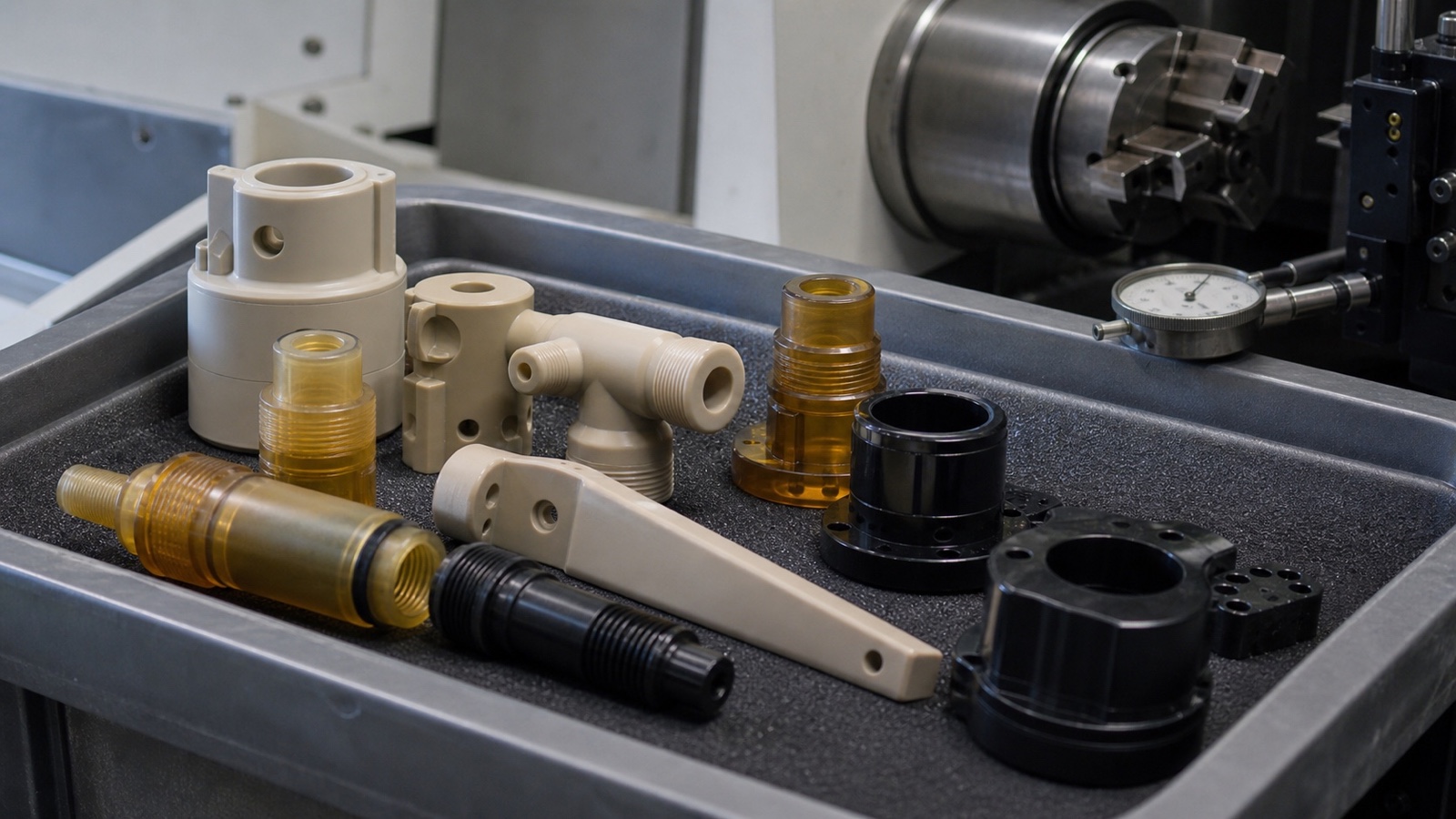
| Transparenz | Typischerweise opak braun oder schwarz | Natürlich transparent oder transluzent bernsteinfarben |
| Zerspanbarkeit | Gut bei geeigneter Temperaturführung und Tempern | Gut, jedoch ist Spannungsabbau wichtig |
| Relative Kosten | Höhere Material- und Verarbeitungskosten | Geringere Kosten als PEEK |
Was sind PEEK und PPSU?
PEEK: Polyetheretherketon
PEEK is a high-performance engineering thermoplastic with a semi-crystalline structure. We see it used across medical, aerospace, automotive, and industrial applications where strength, fatigue resistance, wear performance, and dimensional stability matter. Standard PEEK is not the same as medical-grade or implantable-grade PEEK. The latter includes stricter raw-material controls and documented testing.
Modified PEEK grades include carbon-fiber-reinforced, glass-fiber-reinforced, and tribological formulations. These filled grades change stiffness, creep resistance, thermal conductivity, and friction behavior. When we machine PEEK at PlasticCNCPro, we always confirm whether the customer needs unfilled medical PEEK or a filled grade for structural or wear-intensive service.
PPSU: Polyphenylsulfon
PPSU is an amorphous, high-temperature polysulfone thermoplastic designed for demanding medical and life-science applications. Its natural amber or transparent appearance makes it useful for fluid paths, reservoirs, and components that benefit from visual inspection. PPSU is often confused with PSU or PES, but it generally offers higher impact strength, better hydrolytic stability, and stronger performance after repeated sterilization.
In our machining work, PPSU is commonly selected for reusable devices that must survive drops, handling, cleaning chemicals, and hundreds of autoclave cycles. It is not usually the first choice for continuous sliding contact or high-load structural parts, but it is an excellent engineering material for housings, handles, trays, and fluid-management components.
PEEK vs. PPSU: Vergleich der Kerneigenschaften
Mechanische Festigkeit und Steifigkeit
PEEK typically offers higher tensile strength, flexural strength, modulus, fatigue resistance, and creep resistance than PPSU. That is why we recommend PEEK for structural, wear-bearing, and precision components that must hold tight tolerances under load. PPSU is still a strong polymer, but its strength is usually sufficient for housings, trays, handles, and reusable instrument parts rather than high-load mechanisms.
Schlagfestigkeit und Zähigkeit
PPSU is exceptional in impact resistance and resistance to cracking during handling, drops, and repeated sterilization. PEEK is stronger and stiffer, but it can be less forgiving in thin sections or sharp corners. Real-world impact performance depends on wall thickness, geometry, reinforcement, and processing. We advise testing the actual part design rather than relying only on datasheet values.
Temperaturbeständigkeit und Wärmeformbeständigkeit
PEEK is a semi-crystalline polymer with a high melting point and strong continuous-use temperature capability. PPSU is an amorphous polymer with very good high-temperature performance for its class. Short-term temperature ratings should not be treated as continuous-use recommendations. In medical devices, the realistic operating envelope includes sterilization temperature, dwell time, pressure, and cleaning chemistry.
Chemikalienbeständigkeit
Both materials resist water, steam, many cleaning agents, disinfectants, solvents, lipids, and bodily fluids. PEEK generally offers superior chemical and wear resistance in aggressive service. However, concentrated acids, strong bases, oxidizers, and certain solvents can affect either material depending on exposure conditions. We always ask customers about the full chemical environment, including cleaning agents and residual disinfectants.
Verschleiß, Reibung und Gleitfähigkeit
PEEK is generally better suited to bushings, gears, seals, bearings, and sliding components. Filled PEEK grades, including carbon fiber, glass fiber, and PTFE-modified formulations, can improve wear behavior and reduce friction. PPSU may be adequate for low-wear applications, but it is not the first choice for continuous sliding contact under load.
Maßhaltigkeit und Kriechverhalten
PEEK performs well in precision components because of its low creep, low moisture absorption, and predictable thermal expansion when processed correctly. PPSU offers stability in reusable medical assemblies, but amorphous materials can still develop residual stress if machined or molded improperly. Annealing, mold design, machining practices, and operating temperature all affect long-term dimensional retention.
Transparenz, Farbe und Sichtprüfung
PPSU’s natural transparency or translucency is a major advantage for fluid paths, reservoirs, and visual inspection. PEEK is typically opaque brown or black, although some medical-grade color options exist. Transparenz supports contamination checks, fluid-level monitoring, and device usability. If visibility is a requirement, PPSU often becomes the preferred choice unless the mechanical loads demand PEEK.
Sterilisation: Wie vergleichen sich PEEK und PPSU?
Dampfsterilisation und Autoklavieren
Both materials can perform at common steam sterilization conditions such as 121°C and 134°C. PPSU has a strong reputation for repeated autoclave cycles, hydrolytic stability, and retained mechanical properties. PEEK can also be suitable for reusable devices when the selected grade and design are properly validated. Cycle count claims must be supported by application-specific testing rather than assumed from datasheet ratings.
Gammastrahlung
Gamma exposure can affect color, molecular weight, toughness, and long-term performance. Radiation resistance varies by polymer grade, dose, packaging, atmosphere, and cumulative exposure. PEEK and PPSU should both be tested before use in gamma-sterilized single-use devices. A cosmetic color shift does not automatically mean the part has failed, but it must be evaluated alongside mechanical and chemical performance.
Sterilisation mit Ethylenoxid und Wasserstoffperoxid
EtO and vaporized hydrogen peroxide sterilization are generally compatible with both materials, but residual chemicals, repeated cycles, surface finish, and component geometry can influence performance. We recommend validating the complete sterilization process, including packaging and assembly materials, not just the polymer resin.
Sterilisationsbedingte Verfärbung vs. Leistungsverlust
It is important to distinguish cosmetic color shift from meaningful changes in strength, toughness, chemical resistance, or dimensional accuracy. Testing should measure both visual appearance and functional performance. For reusable medical parts, inspection criteria should define acceptable color, surface condition, and dimensional limits after repeated cycles.
Biokompatibilität und Konformität für medizinische Anwendungen
ISO 10993 und USP Class VI
Resin manufacturers may offer grades tested to ISO 10993 and/or USP Class VI, but compliance is grade- and application-specific. Finished-part biocompatibility depends on additives, pigments, processing residues, surface treatments, cleaning agents, and sterilization. Reviewing technical files, certificates, test reports, and change-control documentation is essential before final material approval.
Implantierbare vs. nicht implantierbare Anwendungen
Short-term contact, prolonged contact, external devices, surgical instruments, and implantable components have different requirements. Implantable PEEK requires stricter material traceability and validation than general medical-grade PEEK. PPSU is commonly selected for reusable and external medical components rather than permanent implants.
Regulatorische und qualitative Aspekte
Material traceability, lot consistency, supplier qualification, process validation, and documentation requirements all influence material selection. Medical-grade resin availability, regulatory change notifications, and controlled manufacturing environments matter. Material selection cannot replace full device-level risk assessment and validation.
Welcher Werkstoff ist besser für medizinische Geräteteile?
PEEK wählen, wenn Sie Folgendes benötigen
- Hohe mechanische Festigkeit und Steifigkeit bei einem leichten Bauteil.
- Ausgezeichnete Verschleiß-, Ermüdungs-, Kriech- und Chemikalienbeständigkeit.
- Präzisionsteile, die hohen Belastungen, Reibung oder anspruchsvollen Flüssigkeiten ausgesetzt sind.
- Implantierbare Komponenten oder röntgentransparente Strukturteile aus einer geeigneten medizinischen Type.
- Leistungssteigerung durch Kohlenfaser-, Glasfaser- oder tribologische Modifizierung.
PPSU wählen, wenn Sie Folgendes benötigen
- Außergewöhnliche Schlagzähigkeit und Rissbeständigkeit.
- Wiederholte Dampfsterilisation und Hydrolysestabilität.
- Transparente oder transluzente Teile zur Sichtprüfung.
- Robuste, wiederverwendbare Gerätekomponenten mit moderaten mechanischen Belastungen.
- Eine kostengünstigere Alternative zu PEEK, wenn extreme Verschleiß- oder Belastungsperformance nicht erforderlich ist.
PEI, PSU oder andere Alternativen in Betracht ziehen, wenn
- PEI is needed for high-temperature dimensional stability or an alternative to PPSU.
- PSU provides adequate performance for less demanding reusable components.
- Polycarbonate is preferred for clarity and lower-cost medical housings, provided sterilization requirements are acceptable.
- POM, PTFE, or medical-grade nylon is better suited to specific low-friction, sealing, or economical applications.
- UHMW-PE or other polymers are more appropriate for specialized wear or implant-related requirements.
Häufige Anwendungen in der Medizintechnik
PEEK-Anwendungen
- Orthopedic and spinal implants, dental components, and radiolucent implantable parts.
- Surgical instrument components, endoscopic parts, and high-wear mechanisms.
- Pump components, seals, bushings, gears, and precision medical machine parts.
- Components requiring chemical resistance, fatigue strength, or long-term dimensional stability.
PPSU-Anwendungen
- Sterilization trays, surgical instrument handles, and reusable device housings.
- Anesthesia and respiratory components, fluid-management parts, and manifolds.
- Connectors, reservoirs, inspection windows, and parts exposed to repeated autoclaving.
- Components where toughness, transparency, and repeated disinfection matter more than extreme wear resistance.
Konstruktionsfaktoren, die die Werkstoffwahl beeinflussen
Thin walls, snap-fits, threads, living hinges, undercuts, and molded-in features all affect material behavior. Load direction, stress concentration, impact risk, and required service life must be evaluated. Fluid exposure, cleaning chemistry, sterilization cycle, and temperature profile matter. The need for radiolucency, transparency, color coding, or embedded components can also shift the decision toward one material or the other.
Überlegungen zu Verarbeitung und Fertigung
PPSU-Spritzguss
PPSU requires high processing temperatures, controlled mold temperature, proper drying, venting, and careful attention to shrinkage and residual stress. Its amorphous behavior supports transparency and dimensional consistency, but mold design must account for weld lines, sink marks, warpage, bubbles, and stress cracking.
PEEK-Spritzguss
PEEK requires higher melt and mold temperature requirements compared with PPSU. Crystallinity, cooling rate, annealing, shrinkage variation, and processing conditions directly affect final properties. Consistent crystallization is important for dimensional accuracy and mechanical performance.
CNC-Bearbeitung von PEEK und PPSU
At PlasticCNCPro, we machine both materials regularly. PEEK requires careful thermal management, sharp tooling, controlled chip evacuation, and stress relief for precision parts. PPSU is also machinable, but internal stress can cause movement after material removal. Machining tolerances may differ from molded-part tolerances, which is why prototype testing is important before committing to production.
Additive Fertigung und Rapid Prototyping
High-temperature 3D printing for PEEK and related materials is growing, but printed parts differ from molded parts in anisotropy, porosity, surface finish, sterilization response, and validation requirements. We recommend using printed components for prototyping only until production-process equivalence is demonstrated.
Fügen, Abdichten und Montage
Ultrasonic welding, laser welding, thermal welding, adhesive bonding, press fits, and mechanical fastening all behave differently with PEEK and PPSU. Sterilization can affect joint strength, seals, dimensional fits, and plastic-to-plastic interfaces. The complete assembled device should be tested after sterilization and aging.
Kosten-, Versorgungs- und Lebenszyklusabwägungen
Material- und Fertigungskosten
PEEK typically carries a higher material cost than PPSU, but resin price is only one part of total cost. Tooling, machining, cycle time, scrap, validation, sterilization life, and replacement costs all matter. PPSU can reduce cost without compromising required performance when extreme wear or load performance is not needed.
Wirtschaftlichkeit wiederverwendbarer Geräte
Initial material cost should be compared with service life, number of autoclave cycles, maintenance, repair, and replacement frequency. Better impact resistance or wear resistance can lower total cost of ownership. A lifecycle cost model is more useful than price per kilogram or part.
Lieferkette und Materialverfügbarkeit
Medical-grade availability, approved supplier lists, lead times, lot traceability, and resin substitutions all affect sourcing. Unapproved grade changes can affect regulatory documentation and device validation. Maintaining qualified backup suppliers and monitoring material changes is important for long-term production.
Nachhaltigkeitsaspekte
Durability, reuse, sterilization energy, material waste, and end-of-life limitations all contribute to sustainability. Longer service life can reduce environmental impact compared with lower material cost. Medical-device sustainability decisions must remain compatible with infection control and regulatory requirements.
Entscheidungsmatrix: PPSU oder PEEK?
Einsatzbedingungen definieren
Identify sterilization type, number of cycles, temperature, pressure, chemicals, radiation dose, and service duration. Record contact with bodily fluids, drugs, cleaning agents, solvents, and lubricants.
Mechanische und maßliche Anforderungen definieren
Set requirements for tensile strength, stiffness, impact resistance, fatigue life, wear, creep, tolerance, and surface finish. Determine whether the part is structural, load-bearing, sliding, sealing, cosmetic, or fluid-handling.
Regulatorische und werkstoffbezogene Anforderungen bestätigen
Verify medical-grade documentation, ISO 10993 or USP Class VI data, implantability status, and traceability. Confirm that pigments, fillers, lubricants, coatings, and processing aids are approved for the intended use.
Endgültige Type auswählen und validieren
Compare specific resin grades rather than generic polymer families. Test molded or machined production-representative parts through sterilization, aging, mechanical loading, and chemical exposure. Document acceptance criteria for dimensions, color, surface condition, and functional performance.
Häufige Fragen zu PEEK, PPSU und Kunststoffen für medizinische Geräte
Welcher Kunststoff ist der beste für medizinische Geräte?
Kein einzelner Kunststoff ist für jedes medizinische Gerät optimal. Häufige Werkstoffe sind PEEK, PPSU, PEI, PSU, Polycarbonat, Polypropylen, POM, PTFE und medizinischer Kunststoff. Sterilisation, Biokompatibilität, mechanische Anforderungen und Lebenszykluskosten sind die entscheidenden Faktoren.
Ist PEEK stärker als Nylon?
PEEK generally offers higher strength, stiffness, temperature resistance, chemical resistance, fatigue performance, and dimensional stability than standard nylon. Reinforced or specialty nylons may be competitive for specific applications at a lower cost. Nylon also has higher moisture absorption, which affects dimensions and mechanical properties.
Ist PEEK besser als PTFE?
PEEK is typically stronger, stiffer, more wear-resistant under load, and more dimensionally stable than PTFE. PTFE generally provides lower friction and broader chemical resistance. PEEK is often selected for structural or load-bearing parts, while PTFE is favored for low-friction seals, liners, and chemically aggressive environments.
Welche Kunststoffarten werden häufig in medizinischen Geräten eingesetzt?
PEEK, PPSU, PSU, PEI, polycarbonate, polypropylene, polyethylene, POM, PTFE, PVC, silicone, and medical-grade nylon are common. Each polymer matches different uses such as housings, tubing, fluid paths, surgical tools, seals, implants, and disposable components. The exact grade and manufacturing process determine suitability.
Können PPSU und PEEK autoklaviert werden?
Properly selected medical grades of both materials can withstand many steam sterilization cycles. PPSU has a strong reputation for repeated autoclaving, while PEEK offers higher mechanical and wear performance. Application-specific cycle testing is recommended because geometry, stress, additives, and cleaning chemistry affect results.
Ist PPSU schlagfester als PEEK?
PPSU is often preferred for high-impact reusable parts and applications where cracking is a concern. PEEK may outperform PPSU in strength, stiffness, fatigue, and wear depending on the grade. Performance should be evaluated using the actual part design and loading conditions.
Abschließende Empfehlung: PPSU vs. PEEK
The final choice depends on sterilization, mechanical load, wear, transparency, impact risk, regulatory needs, processing method, and budget. PEEK is usually the better choice for high-load, high-wear, precision, or implantable components. PPSU is usually the better choice for transparent, impact-resistant, repeatedly autoclaved reusable components.
At PlasticCNCPro, we recommend that the device designer, material supplier, molding or machining partner, sterilization expert, and regulatory team collaborate before final material approval. Selecting the right polymer family is important, but validating the exact grade, process, and part geometry is what ultimately determines device performance and reliability.
Benötigen Sie Hilfe bei der Auswahl oder Bearbeitung von PPSU oder PEEK?
Send us your drawing, 3D model, material requirement, quantity, tolerance, and application details. Our team will review the design, material, tolerances, and manufacturability, then provide a quotation and production recommendation for CNC-machined medical device components.