
工程材料指南
PPSU 與 PEEK:哪種塑膠更適合醫療器材零件?
為設計師、採購經理與製造工程師提供以實務與工程為核心的比較,協助為可重複使用裝置、手術器械、流體處理元件及高要求醫療應用選擇合適的高性能聚合物。
快速回答:應選擇 PPSU 還是 PEEK?
在 PlasticCNCPro,我們經常在醫療器材團隊的早期設計審查中聽到這個問題。坦白說,沒有任何一種材料在所有情況下都更好。PEEK 通常在強度、耐磨性、耐化學性,以及高要求的植入式或承載零件方面更具優勢。PPSU 則通常更適合反覆蒸汽滅菌、抗衝擊、透明度及成本敏感型的可重複使用裝置。
最佳材料取決於滅菌方式、機械負載、溫度、生物相容性要求、可視性、製造流程及整體生命週期成本。選擇正確的聚合物家族只是第一步。具體牌號、加工方式與零件幾何形狀,才決定材料在實際使用中的性能。
| 性能 | PEEK | PPSU |
|---|---|---|
| 耐溫性 | 優異;具有高熔點與連續使用能力 | 對非晶型聚合物而言非常良好 |
| 強度與剛性 | 拉伸、彎曲與疲勞性能優異 | 良好,但低於 PEEK |
| 抗衝擊性 | 許多牌號表現良好,但剛性較高、容錯性較低 | 卓越的韌性與抗裂性 |
| 耐化學性 | 廣泛抵抗清潔劑、流體與溶劑 | 優異的水解穩定性與清潔劑耐受性 |
| 蒸汽滅菌 | 在牌號與設計經過驗證時適用 | 非常適合反覆高壓蒸汽滅菌循環 |
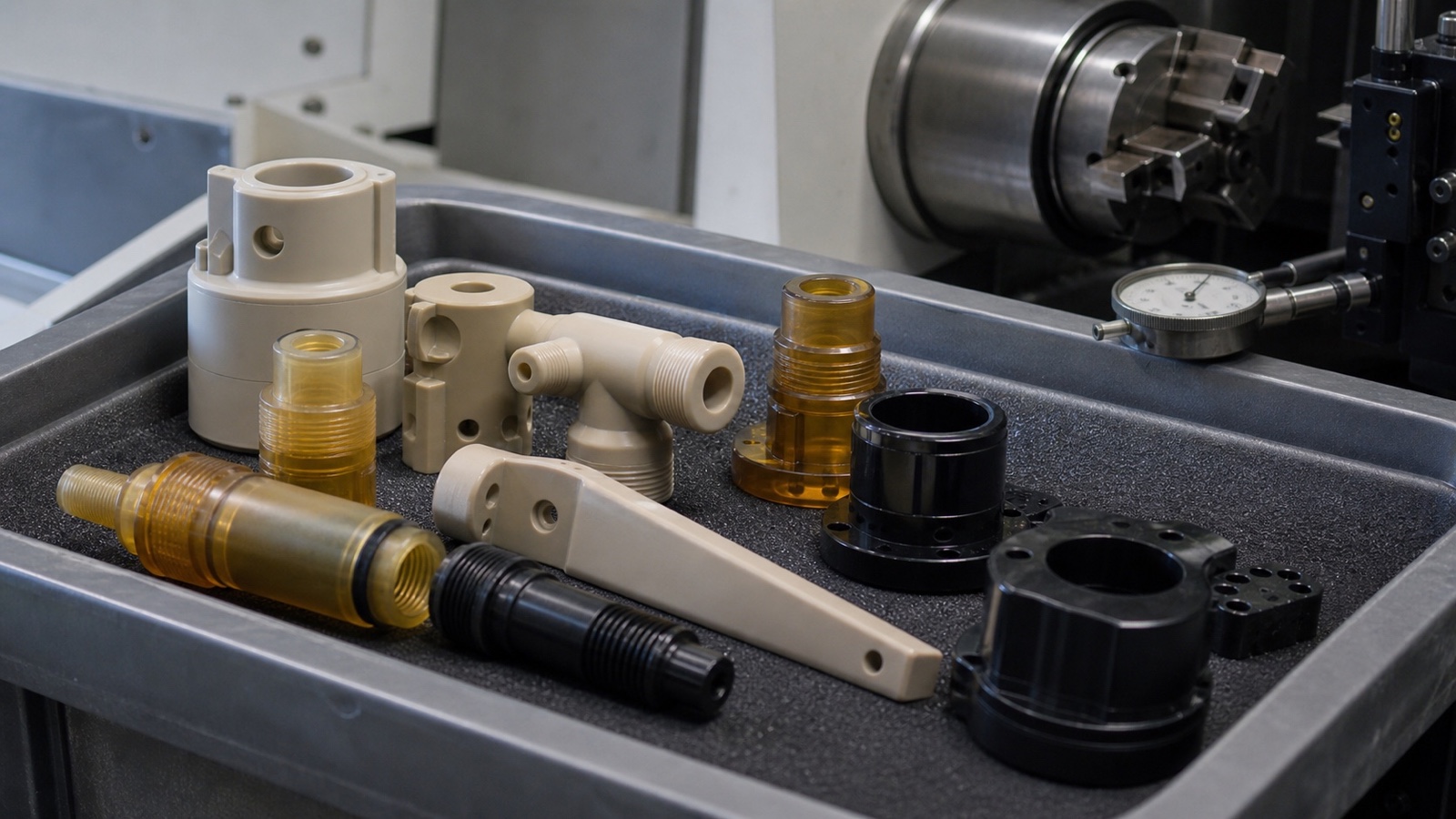
| 透明度 | 通常為不透明棕色或黑色 | 天然透明或半透明琥珀色 |
| 可加工性 | 配合適當的熱控制與退火時表現良好 | 良好,但消除應力很重要 |
| 相對成本 | 材料與加工成本較高 | 成本低於 PEEK |
PEEK 與 PPSU 是什麼?
PEEK:聚醚醚酮
PEEK is a high-performance engineering thermoplastic with a semi-crystalline structure. We see it used across medical, aerospace, automotive, and industrial applications where strength, fatigue resistance, wear performance, and dimensional stability matter. Standard PEEK is not the same as medical-grade or implantable-grade PEEK. The latter includes stricter raw-material controls and documented testing.
Modified PEEK grades include carbon-fiber-reinforced, glass-fiber-reinforced, and tribological formulations. These filled grades change stiffness, creep resistance, thermal conductivity, and friction behavior. When we machine PEEK at PlasticCNCPro, we always confirm whether the customer needs unfilled medical PEEK or a filled grade for structural or wear-intensive service.
PPSU:聚苯碸
PPSU is an amorphous, high-temperature polysulfone thermoplastic designed for demanding medical and life-science applications. Its natural amber or transparent appearance makes it useful for fluid paths, reservoirs, and components that benefit from visual inspection. PPSU is often confused with PSU or PES, but it generally offers higher impact strength, better hydrolytic stability, and stronger performance after repeated sterilization.
In our machining work, PPSU is commonly selected for reusable devices that must survive drops, handling, cleaning chemicals, and hundreds of autoclave cycles. It is not usually the first choice for continuous sliding contact or high-load structural parts, but it is an excellent engineering material for housings, handles, trays, and fluid-management components.
PEEK 與 PPSU:核心性能比較
機械強度與剛性
PEEK typically offers higher tensile strength, flexural strength, modulus, fatigue resistance, and creep resistance than PPSU. That is why we recommend PEEK for structural, wear-bearing, and precision components that must hold tight tolerances under load. PPSU is still a strong polymer, but its strength is usually sufficient for housings, trays, handles, and reusable instrument parts rather than high-load mechanisms.
抗衝擊性與韌性
PPSU is exceptional in impact resistance and resistance to cracking during handling, drops, and repeated sterilization. PEEK is stronger and stiffer, but it can be less forgiving in thin sections or sharp corners. Real-world impact performance depends on wall thickness, geometry, reinforcement, and processing. We advise testing the actual part design rather than relying only on datasheet values.
耐溫性與熱變形
PEEK is a semi-crystalline polymer with a high melting point and strong continuous-use temperature capability. PPSU is an amorphous polymer with very good high-temperature performance for its class. Short-term temperature ratings should not be treated as continuous-use recommendations. In medical devices, the realistic operating envelope includes sterilization temperature, dwell time, pressure, and cleaning chemistry.
耐化學性
Both materials resist water, steam, many cleaning agents, disinfectants, solvents, lipids, and bodily fluids. PEEK generally offers superior chemical and wear resistance in aggressive service. However, concentrated acids, strong bases, oxidizers, and certain solvents can affect either material depending on exposure conditions. We always ask customers about the full chemical environment, including cleaning agents and residual disinfectants.
耐磨性、摩擦與潤滑性
PEEK is generally better suited to bushings, gears, seals, bearings, and sliding components. Filled PEEK grades, including carbon fiber, glass fiber, and PTFE-modified formulations, can improve wear behavior and reduce friction. PPSU may be adequate for low-wear applications, but it is not the first choice for continuous sliding contact under load.
尺寸穩定性與蠕變
PEEK performs well in precision components because of its low creep, low moisture absorption, and predictable thermal expansion when processed correctly. PPSU offers stability in reusable medical assemblies, but amorphous materials can still develop residual stress if machined or molded improperly. Annealing, mold design, machining practices, and operating temperature all affect long-term dimensional retention.
透明度、顏色與目視檢查
PPSU’s natural transparency or translucency is a major advantage for fluid paths, reservoirs, and visual inspection. PEEK is typically opaque brown or black, although some medical-grade color options exist. 透明度 supports contamination checks, fluid-level monitoring, and device usability. If visibility is a requirement, PPSU often becomes the preferred choice unless the mechanical loads demand PEEK.
滅菌:PEEK 與 PPSU 如何比較?
蒸汽滅菌與高壓蒸汽滅菌
Both materials can perform at common steam sterilization conditions such as 121°C and 134°C. PPSU has a strong reputation for repeated autoclave cycles, hydrolytic stability, and retained mechanical properties. PEEK can also be suitable for reusable devices when the selected grade and design are properly validated. Cycle count claims must be supported by application-specific testing rather than assumed from datasheet ratings.
伽馬射線
Gamma exposure can affect color, molecular weight, toughness, and long-term performance. Radiation resistance varies by polymer grade, dose, packaging, atmosphere, and cumulative exposure. PEEK and PPSU should both be tested before use in gamma-sterilized single-use devices. A cosmetic color shift does not automatically mean the part has failed, but it must be evaluated alongside mechanical and chemical performance.
環氧乙烷與過氧化氫滅菌
EtO and vaporized hydrogen peroxide sterilization are generally compatible with both materials, but residual chemicals, repeated cycles, surface finish, and component geometry can influence performance. We recommend validating the complete sterilization process, including packaging and assembly materials, not just the polymer resin.
滅菌引起的變色與性能損失
It is important to distinguish cosmetic color shift from meaningful changes in strength, toughness, chemical resistance, or dimensional accuracy. Testing should measure both visual appearance and functional performance. For reusable medical parts, inspection criteria should define acceptable color, surface condition, and dimensional limits after repeated cycles.
生物相容性與醫療級合規性
ISO 10993 與 USP Class VI
Resin manufacturers may offer grades tested to ISO 10993 and/or USP Class VI, but compliance is grade- and application-specific. Finished-part biocompatibility depends on additives, pigments, processing residues, surface treatments, cleaning agents, and sterilization. Reviewing technical files, certificates, test reports, and change-control documentation is essential before final material approval.
植入式與非植入式應用
Short-term contact, prolonged contact, external devices, surgical instruments, and implantable components have different requirements. Implantable PEEK requires stricter material traceability and validation than general medical-grade PEEK. PPSU is commonly selected for reusable and external medical components rather than permanent implants.
法規與品質考量
Material traceability, lot consistency, supplier qualification, process validation, and documentation requirements all influence material selection. Medical-grade resin availability, regulatory change notifications, and controlled manufacturing environments matter. Material selection cannot replace full device-level risk assessment and validation.
哪種材料更適合醫療器材零件?
需要以下性能時選擇 PEEK
- 輕量零件仍需具備高機械強度與剛性。
- 優異的耐磨、耐疲勞、抗蠕變與耐化學性。
- 暴露於高負載、摩擦或嚴苛流體中的精密零件。
- 由適當醫療級配方製成的植入式元件或可透 X 射線的結構零件。
- 碳纖維、玻璃纖維或摩擦學改質性能。
需要以下性能時選擇 PPSU
- 卓越的抗衝擊韌性與抗裂性。
- 反覆蒸汽滅菌與水解穩定性。
- 用於目視檢查的透明或半透明零件。
- 承受中等機械負載的耐用可重複使用裝置元件。
- 在不需要極端耐磨或承載性能時,作為 PEEK 的低成本替代材料。
以下情況可考慮 PEI、PSU 或其他替代材料
- PEI is needed for high-temperature dimensional stability or an alternative to PPSU.
- PSU provides adequate performance for less demanding reusable components.
- Polycarbonate is preferred for clarity and lower-cost medical housings, provided sterilization requirements are acceptable.
- POM, PTFE, or medical-grade nylon is better suited to specific low-friction, sealing, or economical applications.
- UHMW-PE or other polymers are more appropriate for specialized wear or implant-related requirements.
常見醫療器材應用
PEEK 應用
- Orthopedic and spinal implants, dental components, and radiolucent implantable parts.
- Surgical instrument components, endoscopic parts, and high-wear mechanisms.
- Pump components, seals, bushings, gears, and precision medical machine parts.
- Components requiring chemical resistance, fatigue strength, or long-term dimensional stability.
PPSU 應用
- Sterilization trays, surgical instrument handles, and reusable device housings.
- Anesthesia and respiratory components, fluid-management parts, and manifolds.
- Connectors, reservoirs, inspection windows, and parts exposed to repeated autoclaving.
- Components where toughness, transparency, and repeated disinfection matter more than extreme wear resistance.
會改變材料選擇的零件設計因素
Thin walls, snap-fits, threads, living hinges, undercuts, and molded-in features all affect material behavior. Load direction, stress concentration, impact risk, and required service life must be evaluated. Fluid exposure, cleaning chemistry, sterilization cycle, and temperature profile matter. The need for radiolucency, transparency, color coding, or embedded components can also shift the decision toward one material or the other.
加工與製造考量
PPSU 射出成型
PPSU requires high processing temperatures, controlled mold temperature, proper drying, venting, and careful attention to shrinkage and residual stress. Its amorphous behavior supports transparency and dimensional consistency, but mold design must account for weld lines, sink marks, warpage, bubbles, and stress cracking.
PEEK 射出成型
PEEK requires higher melt and mold temperature requirements compared with PPSU. Crystallinity, cooling rate, annealing, shrinkage variation, and processing conditions directly affect final properties. Consistent crystallization is important for dimensional accuracy and mechanical performance.
PEEK 與 PPSU CNC 加工
At PlasticCNCPro, we machine both materials regularly. PEEK requires careful thermal management, sharp tooling, controlled chip evacuation, and stress relief for precision parts. PPSU is also machinable, but internal stress can cause movement after material removal. Machining tolerances may differ from molded-part tolerances, which is why prototype testing is important before committing to production.
積層製造與快速原型
High-temperature 3D printing for PEEK and related materials is growing, but printed parts differ from molded parts in anisotropy, porosity, surface finish, sterilization response, and validation requirements. We recommend using printed components for prototyping only until production-process equivalence is demonstrated.
接合、密封與組裝
Ultrasonic welding, laser welding, thermal welding, adhesive bonding, press fits, and mechanical fastening all behave differently with PEEK and PPSU. Sterilization can affect joint strength, seals, dimensional fits, and plastic-to-plastic interfaces. The complete assembled device should be tested after sterilization and aging.
成本、供應與生命週期取捨
材料與製造成本
PEEK typically carries a higher material cost than PPSU, but resin price is only one part of total cost. Tooling, machining, cycle time, scrap, validation, sterilization life, and replacement costs all matter. PPSU can reduce cost without compromising required performance when extreme wear or load performance is not needed.
可重複使用裝置的經濟性
Initial material cost should be compared with service life, number of autoclave cycles, maintenance, repair, and replacement frequency. Better impact resistance or wear resistance can lower total cost of ownership. A lifecycle cost model is more useful than price per kilogram or part.
供應鏈與材料可得性
Medical-grade availability, approved supplier lists, lead times, lot traceability, and resin substitutions all affect sourcing. Unapproved grade changes can affect regulatory documentation and device validation. Maintaining qualified backup suppliers and monitoring material changes is important for long-term production.
永續性考量
Durability, reuse, sterilization energy, material waste, and end-of-life limitations all contribute to sustainability. Longer service life can reduce environmental impact compared with lower material cost. Medical-device sustainability decisions must remain compatible with infection control and regulatory requirements.
決策矩陣:PPSU 還是 PEEK?
定義暴露條件
Identify sterilization type, number of cycles, temperature, pressure, chemicals, radiation dose, and service duration. Record contact with bodily fluids, drugs, cleaning agents, solvents, and lubricants.
定義機械與尺寸要求
Set requirements for tensile strength, stiffness, impact resistance, fatigue life, wear, creep, tolerance, and surface finish. Determine whether the part is structural, load-bearing, sliding, sealing, cosmetic, or fluid-handling.
確認法規與材料要求
Verify medical-grade documentation, ISO 10993 or USP Class VI data, implantability status, and traceability. Confirm that pigments, fillers, lubricants, coatings, and processing aids are approved for the intended use.
選擇並驗證最終牌號
Compare specific resin grades rather than generic polymer families. Test molded or machined production-representative parts through sterilization, aging, mechanical loading, and chemical exposure. Document acceptance criteria for dimensions, color, surface condition, and functional performance.
PEEK、PPSU 與醫療器材塑膠常見問題
醫療器材最好的塑膠是什麼?
沒有任何單一塑膠適合所有醫療器材。常見選擇包括 PEEK、PPSU、PEI、PSU、聚碳酸酯、聚丙烯、POM、PTFE 與醫療級尼龍。滅菌、生物相容性、機械要求與生命週期成本是決定因素。
PEEK 比尼龍更強嗎?
PEEK generally offers higher strength, stiffness, temperature resistance, chemical resistance, fatigue performance, and dimensional stability than standard nylon. Reinforced or specialty nylons may be competitive for specific applications at a lower cost. Nylon also has higher moisture absorption, which affects dimensions and mechanical properties.
PEEK 比 PTFE 更好嗎?
PEEK is typically stronger, stiffer, more wear-resistant under load, and more dimensionally stable than PTFE. PTFE generally provides lower friction and broader chemical resistance. PEEK is often selected for structural or load-bearing parts, while PTFE is favored for low-friction seals, liners, and chemically aggressive environments.
醫療器材通常使用哪些塑膠?
PEEK, PPSU, PSU, PEI, polycarbonate, polypropylene, polyethylene, POM, PTFE, PVC, silicone, and medical-grade nylon are common. Each polymer matches different uses such as housings, tubing, fluid paths, surgical tools, seals, implants, and disposable components. The exact grade and manufacturing process determine suitability.
PPSU 與 PEEK 可以進行高壓蒸汽滅菌嗎?
Properly selected medical grades of both materials can withstand many steam sterilization cycles. PPSU has a strong reputation for repeated autoclaving, while PEEK offers higher mechanical and wear performance. Application-specific cycle testing is recommended because geometry, stress, additives, and cleaning chemistry affect results.
PPSU 的抗衝擊性比 PEEK 更好嗎?
PPSU is often preferred for high-impact reusable parts and applications where cracking is a concern. PEEK may outperform PPSU in strength, stiffness, fatigue, and wear depending on the grade. Performance should be evaluated using the actual part design and loading conditions.
最終建議:PPSU 與 PEEK
The final choice depends on sterilization, mechanical load, wear, transparency, impact risk, regulatory needs, processing method, and budget. PEEK is usually the better choice for high-load, high-wear, precision, or implantable components. PPSU is usually the better choice for transparent, impact-resistant, repeatedly autoclaved reusable components.
At PlasticCNCPro, we recommend that the device designer, material supplier, molding or machining partner, sterilization expert, and regulatory team collaborate before final material approval. Selecting the right polymer family is important, but validating the exact grade, process, and part geometry is what ultimately determines device performance and reliability.
需要協助選擇或加工 PPSU 與 PEEK?
Send us your drawing, 3D model, material requirement, quantity, tolerance, and application details. Our team will review the design, material, tolerances, and manufacturability, then provide a quotation and production recommendation for CNC-machined medical device components.