
Leitfaden für technische Werkstoffe
POM vs. Nylon: Vergleich von Schmelzpunkt und thermischer Stabilität
POM und Nylon sind beides teilkristalline technische Thermoplaste, verhalten sich jedoch sehr unterschiedlich, wenn Temperatur, Feuchtigkeit, mechanische Belastung und Maßtoleranzen kritisch werden. Wir vergleichen ihr Schmelzverhalten, ihre thermische Stabilität, Verarbeitungsanforderungen und praktische Anwendungsfälle für Präzisionskunststoffteile.
Unsere technische Zusammenfassung: Nylon, insbesondere PA66 sowie wärmebeständige oder glasfaserverstärkte Typen, bietet normalerweise die höhere Temperaturbeständigkeit. POM ist häufig die bessere Wahl für Präzisionskomponenten bei mittleren Temperaturen, die geringe Reibung, geringe Feuchtigkeitsaufnahme und stabile Abmessungen erfordern.
Kurze Antwort: Ist POM oder Nylon bei hohen Temperaturen besser?
Für einen dauerhaften Einsatz bei hohen Temperaturen ist Nylon im Allgemeinen der stärkere Kandidat. PA66 besitzt einen deutlich höheren Schmelzpunkt als POM, und wärmebeständiges oder glasfaserverstärktes Nylon kann unter anspruchsvollen thermischen Bedingungen brauchbare Festigkeit und Steifigkeit behalten. PA6 übertrifft POM ebenfalls beim Schmelzpunkt, wobei seine Feuchtigkeitsreaktion in die Konstruktion einbezogen werden muss.
POM, auch Acetal genannt, bleibt bei mittleren Temperaturen äußerst wertvoll. Es weist eine sehr geringe Feuchtigkeitsaufnahme, ausgezeichnete Maßstabilität, geringe Reibung und ein vorhersehbares Zerspanungsverhalten auf. Diese Eigenschaften können POM für Präzisionszahnräder, Buchsen, Ventilteile und Mechanismen mit Feuchtigkeits- oder Reinigungsbelastung zuverlässiger als Nylon machen.
Nylon wählen, wenn
Wärmebelastung, Schlagbeanspruchung, strukturelle Belastung oder Kriechbeständigkeit bei erhöhter Temperatur im Vordergrund stehen.
POM wählen, wenn
Geringe Reibung, enge Toleranzen, Feuchtigkeitsbeständigkeit und reproduzierbare Abmessungen wichtiger sind als die maximale Temperaturbeständigkeit.
Das Wort „besser“ ist daher anwendungsabhängig. Vor der Freigabe eines Werkstoffs bewerten wir Dauergebrauchstemperatur, kurzzeitige Temperaturspitzen, mechanische Belastung, Feuchtekonditionierung, Verstärkung, Chemikalieneinwirkung und den genauen Lieferantentyp.
POM und Nylon im Überblick
POM ist Polyoxymethylen und wird üblicherweise Acetal genannt. Nylon ist die gebräuchliche technische Bezeichnung für Polyamid bzw. PA. Beide sind teilkristalline Thermoplaste und enthalten somit geordnete kristalline Bereiche für Festigkeit, Verschleißbeständigkeit und chemische Leistung sowie weniger geordnete Bereiche, die Zähigkeit und Verarbeitung beeinflussen.
The thermal comparison is not between two single materials. Relevant grades include POM-Homopolymer, POM-Copolymer, PA6, PA66, PA12, impact-modified nylon, heat-stabilized nylon, and glass-fiber-reinforced nylon. Resin grade, additives, fillers, pigments, molding history, and conditioning state can all change the values published on a technical data sheet.
POM family
POM-Homopolymer and POM-Copolymer are used for low-friction, dimensionally stable mechanisms.
Nylon family
PA6, PA66, and PA12 offer different balances of heat resistance, toughness, flexibility, and moisture uptake.
Modified grades
Glass fiber, heat stabilizers, lubricants, flame retardants, and impact modifiers change design behavior.
Was ist POM (Polyoxymethylen/Acetal)?
POM ist ein teilkristalliner technischer Thermoplast, der für geringe Reibung, gute Verschleißbeständigkeit, geringe Feuchtigkeitsaufnahme und Präzisionsformbarkeit bekannt ist. Es wird häufig für Zahnräder, Buchsen, Rollen, Ventilkomponenten, Clips, Riegel, Förderkomponenten und Gleitstücke eingesetzt.
Its low water uptake is a major practical advantage. A machined or molded POM component usually changes less after exposure to humidity or water than a comparable nylon component. This helps us maintain fits and clearances in mechanisms where backlash, shaft alignment, or sealing geometry matters.
Was ist Nylon (Polyamid)?
Nylon ist eine breite Familie teilkristalliner Polyamide mit hoher Zähigkeit, Verschleißbeständigkeit und nützlicher struktureller Leistungsfähigkeit. PA6, PA66 und PA12 sind gängige Typen; glasfasergefüllte, wärmebeständige, schlagzähmodifizierte, flammhemmende und hydrolysebeständige Typen erweitern die Familie für anspruchsvollere Anwendungen.
Nylon is used in automotive under-hood parts, bearings, gears, cable ties, electrical housings, brackets, structural components, and industrial wear parts. Its principal design complication is moisture absorption: absorbed water can significantly change stiffness, strength, dimensions, impact performance, and electrical behavior.
Vergleich der Schmelzpunkte von POM und Nylon
Die folgenden Bereiche sind für einen ersten Vergleich nützlich, ersetzen jedoch nicht das technische Datenblatt des ausgewählten Typs. Der Schmelzpunkt entspricht weder der empfohlenen Einsatztemperatur noch der Wärmeformbeständigkeit oder Spritzgießtemperatur.
| Werkstoff | Typischer Schmelzpunktbereich | Allgemeine thermische Bewertung |
|---|---|---|
| POM-Copolymer | Etwa 160–175°C | Guter technischer Kunststoff für mittlere Temperaturen; typischerweise niedriger als PA6 und PA66. |
| POM-Homopolymer | Etwa 175–180°C | Etwas höhere Kristallinität, Steifigkeit und höherer Schmelzpunkt als POM-Copolymer. |
| Nylon 6 (PA6) | Etwa 215–225°C | Höherer Schmelzpunkt als POM; Eigenschaften werden stark von Feuchtigkeit beeinflusst. |
| Nylon 66 (PA66) | Etwa 255–265°C | Höchster Schmelzpunkt unter den gängigen ungefüllten Nylontypen; bevorzugt für Anwendungen mit höherer Wärmebelastung. |
| Nylon 12 (PA12) | Etwa 175–180°C | Beim Schmelzpunkt näher an POM, mit geringerer Feuchtigkeitsaufnahme und guter Flexibilität. |
Dies sind typische Branchenbereiche. Exakte Werte variieren je nach Lieferant, Molekularstruktur, Füllstoffgehalt und Prüfverfahren. Wir bestätigen den ausgewählten Werkstofftyp vor der Bearbeitung oder Designfreigabe.
Warum Nylon 66 einen höheren Schmelzpunkt als POM hat
PA66 contains amide groups that form strong intermolecular hydrogen bonds. These bonds hold neighboring polymer chains together and require more thermal energy to disrupt. The result is a higher melting point and, in suitable grades, a greater high-temperature performance margin than standard POM.
POM also has a highly crystalline structure, which gives it stiffness, dimensional precision, and low-friction behavior. However, its molecular interactions do not provide the same hydrogen-bonding network found in PA66. POM can therefore lose useful stiffness and creep resistance at temperatures where PA66 remains serviceable.
Schmelzverhalten von POM-Homopolymer und POM-Copolymer
POM-Homopolymer generally has slightly higher crystallinity, stiffness, and melting point than POM-Copolymer. It can be attractive when maximum rigidity and wear performance are important. POM-Copolymer commonly offers better chemical resistance and improved thermal-processing stability, which can be valuable where residence time, complex molding, or processing consistency is a concern.
The choice is not simply “higher melting point equals better.” Copolymer POM is frequently preferred because controlling thermal degradation during processing and service is just as important as the nominal melting point.
Nylon 6 vs. Nylon 66 vs. Nylon 12: Which Nylon Grade Is Most Heat Resistant?
PA66 is usually the preferred standard nylon for elevated temperatures because it has the highest melting point among these common unfilled grades. PA6 provides a useful balance of toughness, processability, availability, and mechanical performance. PA12 has lower moisture uptake and good flexibility, but it prioritizes those benefits over maximum heat resistance.
For an automotive, electrical, or industrial part, we normally compare the supplier’s heat-stabilized versions as well as the base resin. A glass-filled PA66 may provide a much higher heat deflection temperature than an unfilled grade, although reinforcement introduces its own design tradeoffs.
Schmelzpunkt vs. thermische Stabilität: Was ist der Unterschied?
Der Schmelzpunkt ist der Temperaturbereich, in dem die kristalline Struktur eines teilkristallinen Polymers in eine Schmelze übergeht. Er ist für das Verständnis der Verarbeitung und der oberen Grenze der Festkörperstruktur nützlich, sagt jedoch nicht aus, wann sich ein Bauteil verformt oder Leistung verliert.
Thermische Stabilität beschreibt, wie gut ein Werkstoff während Verarbeitung und Einsatz Abbau, Oxidation, Eigenschaftsverlust, Kriechen, Spannungsrelaxation, Verzug, Verfärbung und molekularem Zerfall widersteht. Ein Bauteil kann durch Verformung oder Festigkeitsverlust lange vor dem Erreichen seines Schmelzpunkts ausfallen.
Glasübergangstemperatur und Erweichungsverhalten
The glass transition temperature, or Tg, marks a major change in the mobility of the amorphous portions of a polymer. Above Tg, a polymer may become less rigid even though its crystalline regions remain intact. This is why a part may soften, relax, or deflect well below its melting point.
For nylon, moisture acts as a plasticizer and can lower effective stiffness, particularly around the glass transition range. When we design a nylon part, we consider whether the test data represent dry-as-molded material or moisture-conditioned material. Heat deflection temperature and continuous-use temperature are often more useful design references than melting point alone.
Wärmeformbeständigkeit und Dauergebrauchstemperatur
Heat deflection temperature, or HDT, is a load-dependent test. It indicates the temperature at which a specimen reaches a specified deformation under a specified stress. A high HDT can be helpful for a bracket or housing, but it should not be interpreted as a universal maximum operating temperature.
Continuous-use temperature is an application-oriented guideline for long-term exposure. Reinforced grades can improve HDT and stiffness substantially, but reinforcement does not necessarily increase the base polymer’s melting point. We still evaluate creep, oxidation, thermal cycling, and the actual stress level in the part.
Thermischer Abbau und Oxidationsbeständigkeit
Prolonged overheating can degrade POM chains and, under severe overheating or poor processing control, generate formaldehyde-containing fumes. This is one reason POM requires controlled melt temperatures, sensible residence time, good venting, and careful process monitoring.
Nylon can oxidize during prolonged exposure to heat and oxygen. Typical signs include discoloration, embrittlement, lower impact strength, and loss of molecular weight. Heat-stabilized grades are recommended for automotive, electrical, and continuous elevated-temperature applications, but the selected grade still needs validation under the real thermal and chemical conditions.
Thermische Stabilität von POM vs. Nylon unter realen Bedingungen
Reale Bauteile sind selten nur einer konstanten Temperatur ausgesetzt. Sie können eine kontinuierliche Betriebstemperatur, kurze Temperaturspitzen, wiederholte Temperaturwechsel, mechanische Lasten, Feuchtigkeit, Öle, Reinigungsmittel oder Außenexposition erfahren. Wir bewerten die kombinierte Umgebung, anstatt einen Werkstoff allein anhand einer Schmelzpunkttabelle auszuwählen.
Performance in Dauerbetrieb bei hohen Temperaturen
PA66, especially heat-stabilized or glass-filled PA66, generally provides the better option for sustained high-temperature environments. It is commonly considered for under-hood automotive components, electrical housings, fan components, brackets, and high-temperature mechanisms where structural performance must be retained.
POM is often suitable for moderate-temperature precision components where low moisture absorption, low friction, and dimensional consistency are more important than maximum heat capability. A POM gear in a humid mechanism may maintain its backlash more reliably than a nylon gear, even though nylon has the higher melting point.
Performance During Kurzzeitige Temperaturspitzen
A short exposure above a normal service temperature may be tolerable, particularly when the component is lightly loaded. However, repeated spikes accelerate oxidation, creep, stress relaxation, and dimensional change. A part that survives one thermal event may still fail after many cycles.
Design note
Use application-specific thermal cycling and load testing when peak temperature, dwell time, or the number of cycles is uncertain. Selecting the material with the highest melting point is not a substitute for validation.
Temperaturwechsel und Maßstabilität
Repeated heating and cooling can produce creep, stress relaxation, warpage, and tolerance drift. Semi-crystalline materials can also develop different levels of crystallinity depending on cooling rate and processing history. Wall thickness, gate location, fiber orientation, and cooling design all affect final dimensions.
POM’s low moisture uptake gives it an advantage where dimensional stability must remain consistent through changing humidity. Nylon requires moisture-conditioned design allowances because its dimensions and modulus can change after it absorbs water.
Kriechen unter Wärme und mechanischer Belastung
A component often fails from deformation before it melts. Under a constant load, elevated temperature increases molecular movement and can cause a shaft, bracket, gear tooth, or sealing surface to gradually change shape.
Glass-fiber-reinforced nylon can improve stiffness and creep resistance at elevated temperatures, making it useful for brackets, housings, and structural parts. POM remains a strong option for low-friction, precision-loaded parts within its recommended temperature limits, particularly where excessive moisture uptake would create tolerance problems.
Feuchtigkeitsaufnahme: Der wesentliche Unterschied bei der thermischen Auslegung
Nylon nimmt wesentlich mehr Feuchtigkeit auf als POM. Wasser verändert bei Nylon Abmessungen, Steifigkeit, Festigkeit, Schlagverhalten, elektrische Eigenschaften und wärmebezogenes Verhalten. Dieser Unterschied ist für ein Präzisionsteil oft wichtiger als der nominelle Unterschied beim Schmelzpunkt.
Wie Luftfeuchtigkeit die Eigenschaften von Nylon verändert
Absorbed water plasticizes nylon. In practical terms, conditioned nylon is usually less stiff and less strong than dry-as-molded nylon, although its toughness and impact resistance may improve. Dimensional growth can also affect fits, clearances, gear backlash, and electrical creepage distances.
Dry-as-molded and moisture-conditioned nylon can show materially different test results. For a nylon part used in a humid environment, we specify the expected conditioning state, tolerance allowance, and any required preconditioning or validation procedure.
Warum POM in feuchten Umgebungen maßstabiler ist
POM takes up very little moisture compared with most nylons. As a result, it generally maintains dimensions, stiffness, and fit more consistently after exposure to water, oils, humidity, washdown conditions, or changing climates.
This makes POM attractive for tight-tolerance machined parts, fluid-handling components, appliance mechanisms, and outdoor mechanical assemblies. Chemical compatibility and regulatory requirements still need to be reviewed for the exact application.
Welcher Werkstoff eignet sich besser für Zahnräder mit Feuchtigkeitseinwirkung?
POM is often the preferred choice for precision gears exposed to moisture because it absorbs little water and maintains tooth geometry and backlash well. Its low friction and good dry-running behavior are additional advantages.
A reinforced or specially formulated nylon may still be selected when the gear needs higher temperature capability, impact resistance, or load capacity. We evaluate torque, speed, lubrication, tooth geometry, humidity, and continuous operating temperature before recommending a grade.
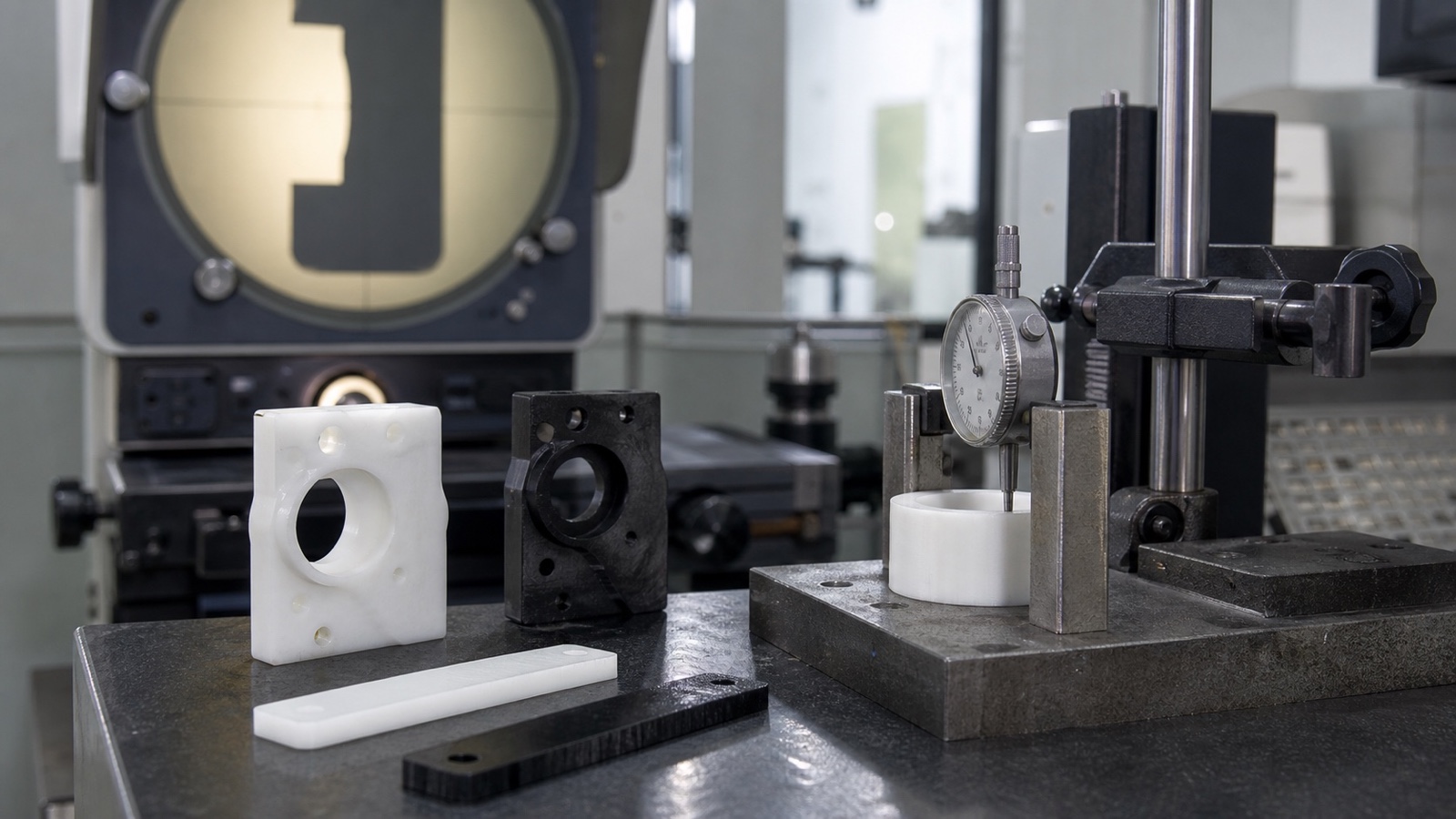
Bei Präzisionskunststoffkomponenten müssen thermische Leistung und Feuchteverhalten zusammen mit Geometrie, Toleranz und Belastung betrachtet werden.
Chemische Beständigkeit und Umwelteinflüsse
Temperatur wirkt selten allein. Öle, Kraftstoffe, Reinigungsmittel, Lösungsmittel, UV-Belastung, Heißwasser und Dampf können den Eigenschaftsverlust beschleunigen oder die Reaktion eines Polymers auf Wärme verändern. Wir prüfen die Daten zur chemischen Beständigkeit stets bei der tatsächlichen Betriebstemperatur und Konzentration.
Beständigkeit gegen Öle, Kraftstoffe und Industriechemikalien
POM has strong resistance to many oils, fuels, and solvents, making it useful in numerous mechanical and fluid-handling applications. Nylon’s resistance depends more heavily on the chemical type, concentration, temperature, exposure time, and moisture state of the polymer.
A chemical that is harmless at room temperature may cause swelling, stress cracking, hydrolysis, or accelerated aging at elevated temperature. A resistance chart is a starting point, not a universal approval for every grade or geometry.
Hydrolyse sowie Einwirkung von Heißwasser und Dampf
Hot, wet environments can be especially demanding for nylon. Hydrolysis-resistant nylon grades are available for applications involving heat and moisture, but the grade must be selected for the actual exposure conditions.
Neither POM nor nylon should be assumed suitable for high-temperature steam or aggressive hot chemical exposure without grade-specific validation. Pressure, cycle duration, sterilization method, and mechanical load can all change the result.
UV- und Außenwärmebelastung
Both POM and nylon may require UV stabilizers, suitable pigments, or protective design features for outdoor use. Black, UV-stabilized grades are common for outdoor components, but color alone does not prove long-term UV performance.
Outdoor parts also experience daily thermal cycling, rain, humidity, and contamination. We consider all of these factors when reviewing material selection for exposed mechanisms or replacement components.
Verarbeitungstemperatur: Überlegungen zum Spritzgießen und zur Extrusion
Die Verarbeitungstemperatur entspricht nicht dem Schmelzpunkt. Ein Polymer muss heiß genug sein, um zu fließen und eine Form oder Extrusionsdüse zu füllen, doch übermäßige Wärme oder Verweilzeit kann es abbauen. Die Verarbeitungsbedingungen beeinflussen zudem Kristallinität, Schwindung, innere Spannung, Verzug und Endabmessungen.
Typisches Verarbeitungsfenster für POM
POM has a relatively narrow safe processing window. Excessive residence time, overheating, poor venting, or contamination can cause thermal degradation. Temperature control, proper handling, and process monitoring are important because severe degradation can generate formaldehyde-containing fumes.
For machined POM stock, we still consider heat buildup during cutting. Sharp tooling, suitable feeds and speeds, chip evacuation, and controlled clamping help prevent local melting or distortion.
Typisches Verarbeitungsfenster für Nylon
Nylon generally requires higher melt temperatures than POM, particularly PA66. Its processing window is also strongly affected by moisture. If wet resin is processed, hydrolytic degradation can reduce molecular weight and lead to surface defects, reduced mechanical properties, and inconsistent results.
In CNC machining, nylon can be machined successfully, but heat buildup and moisture-conditioned dimensions require more attention than POM. We confirm stock condition and allow the material to stabilize when tight tolerances are required.
Trocknungsanforderungen: Nylon vs. POM
Nylon requires careful pre-drying because it readily absorbs moisture from the air. Drying temperature, time, storage, and transfer to the molding machine must follow the supplier’s recommendations. Inadequate drying can cause splay, bubbles, reduced molecular weight, and inconsistent mechanical properties.
POM is less moisture-sensitive and normally has less demanding drying requirements, but it should still be stored and processed according to the supplier’s instructions. Surface defects, dimensional variation, and contamination can still affect the finished part.
Werkzeugtemperatur, Schwindung und Verzug
Both POM and nylon are semi-crystalline and can experience meaningful shrinkage. Mold temperature, wall thickness, cooling rate, fiber reinforcement, gate design, flow direction, and part geometry influence crystallinity and final dimensions.
For CNC-machined parts, the equivalent concerns include stock stress, thermal expansion during cutting, orientation in extruded or molded plate, and stabilization after machining. These factors are important when a buyer requires tight tolerances across a large part or a complex geometry.
Mechanische Eigenschaften bei erhöhter Temperatur
Die Zugfestigkeit bei Raumtemperatur reicht nicht aus, um einen Kunststoff für ein heißes Bauteil auszuwählen. Wir vergleichen die Erhaltung von Zugfestigkeit, Modul, Schlagzähigkeit, Reibungsverhalten, Verschleiß, Kriechen und Maßstabilität unter der erwarteten Kombination aus Temperatur, Belastung, Feuchtigkeit und Chemikalien.
Festigkeit und Steifigkeit
Nylon can provide high strength, especially in PA66 and glass-filled grades. However, stiffness may decline with absorbed moisture and elevated temperature. The dry-as-molded value may therefore overstate the performance of a nylon part operating in a humid environment.
POM offers strong stiffness and consistent dimensions across dry-to-humid conditions within its recommended temperature range. For precision mechanisms, that consistency can outweigh nylon’s higher nominal strength.
Verschleißbeständigkeit und Reibung
Both materials are widely used for low-wear components. POM is recognized for low friction and strong dry-running suitability, making it a common choice for bushings, rollers, gears, guides, and sliding components.
Nylon can also be highly wear resistant and impact tolerant, especially in bearing or gear applications where toughness is important. Lubrication, counterface material, pressure, speed, surface finish, and temperature all influence actual wear life.
Tragfähigkeit
Nylon, particularly reinforced PA66, often performs better in high-load, high-heat structural applications. Glass fiber can increase stiffness, HDT, and creep resistance, although the resulting material may be more anisotropic and less impact-tolerant.
POM is frequently selected for moderate-load precision mechanisms, sliding components, and parts where dimensional repeatability and low friction are essential. We check bearing pressure, speed, duty cycle, support conditions, and temperature before finalizing the material.
Vergleichstabelle POM vs. Nylon zur Werkstoffauswahl
Dieser entscheidungsorientierte Vergleich ist ein nützliches Screening-Werkzeug. Das tatsächliche Ergebnis hängt von Typ, Verstärkung, Konditionierungszustand, Geometrie und Einsatzumgebung ab.
| Eigenschaft | POM (Acetal) | Nylon (PA6/PA66) |
|---|---|---|
| Schmelzpunkt | Niedriger als PA6 und PA66 | Höher, insbesondere PA66 |
| Hochtemperaturfähigkeit | Mittel | Im Allgemeinen besser, insbesondere PA66 |
| Feuchtigkeitsaufnahme | Sehr gering | Mittel bis hoch, abhängig vom Typ |
| Maßstabilität bei Feuchtigkeit | Ausgezeichnet | Kann sich nach Feuchtigkeitsaufnahme ändern |
| Reibungsarme Leistung | Ausgezeichnet | Je nach Typ gut bis ausgezeichnet |
| Schlagzähigkeit | Gut | Oft besser, insbesondere konditioniertes Nylon |
| Tragfähigkeit bei hohen Lasten | Gut innerhalb mittlerer thermischer Grenzen | Hoch, insbesondere verstärkte Typen |
| Trocknung vor dem Formen | In der Regel weniger anspruchsvoll | Kritisch |
| Präzisionsteile unter feuchten Bedingungen | Häufig bevorzugt | Erfordert Feuchtezugaben |
| Strukturkomponenten bei hoher Wärmebelastung | Im Vergleich zu PA66 begrenzt | Häufig bevorzugt |
Wann POM statt Nylon wählen?
POM ist ein starker Kandidat, wenn das Teil bei mittleren Temperaturen arbeitet und beim Bewegen, Gleiten, Drehen oder Fördern von Fluiden eine präzise Passung behalten muss. Seine geringe Feuchtigkeitsaufnahme und niedrige Reibung sind oft entscheidend.
POM für Präzisions- und reibungsarme Teile wählen
We commonly recommend POM for gears, bushings, rollers, clips, latches, valve components, conveyor parts, guides, and fluid-handling components. It is also highly machinable, with predictable chip formation and good dimensional stability.
- Low friction and good dry-running behavior are required.
- Tight tolerances must remain stable through normal humidity changes.
- The application involves moderate temperatures rather than sustained high heat.
POM für feuchte oder Reinigungsumgebungen wählen
POM is often preferable when dimensional stability after water exposure is critical. Examples include appliance mechanisms, plumbing components, food-equipment parts, conveyor components, and outdoor mechanical assemblies, subject to regulatory and chemical requirements.
Wann Nylon statt POM wählen?
Nylon ist in der Regel die stärkere Wahl, wenn Wärme, Schlagbeanspruchung, strukturelle Belastung oder Verstärkungsoptionen das Design bestimmen. Wir achten besonders auf die Feuchtekonditionierung und die Eigenschaftsänderung zwischen trockenem und feuchtem Zustand.
Nylon für Anwendungen bei höheren Temperaturen wählen
PA66 or a heat-stabilized nylon is a logical starting point when service temperatures exceed POM’s practical range. Typical examples include automotive under-hood components, electrical housings, fan components, cable-management parts, brackets, and high-temperature mechanical assemblies.
Verstärktes Nylon für hohe Lasten und Kriechbeständigkeit wählen
Glass-filled nylon is appropriate for brackets, housings, structural parts, and heavily loaded gears that need improved stiffness, HDT, and creep resistance. The tradeoffs include increased warpage risk, fiber-direction effects, abrasive wear on tooling, and potentially reduced impact resistance.
For CNC-machined reinforced nylon, we also consider tool wear, edge quality, fiber exposure, and the effect of material orientation on the final part.
Kann Nylon Anwendungen mit hoher Schlagbeanspruchung bewältigen?
Yes. Nylon is commonly selected for impact-loaded components because of its toughness, particularly in properly conditioned or impact-modified grades. Actual performance changes with temperature, moisture content, reinforcement level, notch sensitivity, and part geometry.
Kosten, Bearbeitbarkeit und langfristiger Wert
Der Werkstoffpreis ist nur ein Teil der Gesamtkosten. Werkzeuge, Ausschuss, Trocknungsenergie, Prozesskontrollen, Bearbeitungszeit, Prüfung, Feldleistung, Wartung und Austauschhäufigkeit können das wirtschaftliche Ergebnis verändern.
Ist POM leichter zu bearbeiten als Nylon?
POM is generally regarded as highly machinable because of its dimensional stability, predictable chip formation, and low moisture uptake. It is a practical material for prototypes, low-volume production, replacement parts, and complex precision components.
Nylon can also be machined successfully, but moisture conditioning and heat buildup need greater attention. A nylon part may require more careful stabilization and tolerance planning, particularly when the finished component will operate in a different humidity environment from the machine shop.
Überlegungen zu Werkstoff- und Fertigungskosten
Commodity PA6 may be cost-competitive, while PA66, heat-stabilized grades, reinforced grades, and specialty POM formulations can cost more. Nylon’s drying, storage, and processing requirements should be included in the manufacturing estimate.
For custom CNC parts, we also consider stock availability, machining time, tool wear, inspection requirements, and whether the selected grade is readily available in the required plate, rod, or tube size.
Langfristige Wartungs- und Ersatzkosten
The lowest resin price may not produce the lowest lifecycle cost. A POM part may last longer when moisture-driven tolerance changes would cause a nylon mechanism to bind. Conversely, nylon may offer better value in a high-temperature, high-load application where POM would creep or lose stiffness.
We recommend comparing wear life, maintenance intervals, field replacement difficulty, downtime, and expected service life rather than comparing only the initial unit price.
Typische Anwendungen: POM vs. Nylon
Die beste Werkstoffwahl wird klarer, wenn die thermischen und umgebungsbedingten Anforderungen der Anwendung ausdrücklich definiert werden.
Automobil und Transport
POM is used for fuel-system-adjacent precision mechanisms, latches, clips, guides, and interior moving parts where low friction and dimensional stability are useful. Nylon, especially heat-stabilized or reinforced PA66, is commonly considered for under-hood structural and heat-exposed components.
Zahnräder, Lager und Verschleißteile
POM is often preferred for quiet, precise, low-friction gears, bushings, rollers, and wear strips. Nylon may be better for higher-impact, higher-load, or higher-temperature gear systems, especially when a reinforced grade can improve stiffness and creep resistance.
Elektrotechnik und Elektronik
Nylon is common in connectors, cable ties, housings, brackets, and electrical components requiring toughness and thermal resistance. Flame-retardant and electrical grades require separate evaluation because base-resin melting point does not establish the complete electrical or regulatory performance of the finished part.
Konsumgüter, Haushaltsgeräte und Industrieanlagen
Both materials appear in pumps, valves, fastening systems, conveyor components, appliance mechanisms, tool parts, machine housings, robotics, fixtures, and jigs. We match the grade to heat, moisture, chemical exposure, friction, wear, structural loading, and tolerance requirements.
Häufig gestellte Fragen zur thermischen Leistung von POM und Nylon
Ist POM hitzebeständiger als Nylon?
Generally, no. Standard PA6 and especially PA66 usually have higher melting points and better high-temperature capability than POM. POM may still outperform nylon where humidity-driven dimensional stability and low friction are more important than maximum heat resistance.
Welcher Werkstoff hat einen höheren Schmelzpunkt: POM oder Nylon?
Nylon has the higher melting point in common comparisons, with PA66 typically highest among widely used nylon grades. PA12 is the key exception because its melting range is closer to POM than to PA6 or PA66.
Kann POM Nylon ersetzen?
POM can replace nylon in certain low-friction, precision, moisture-exposed, moderate-temperature applications. It is not a direct replacement for high-temperature, high-impact, or heavily reinforced nylon applications without engineering review.
Ist Nylon oder Acetal besser für Zahnräder?
Acetal or POM is often better for precision, low-moisture, low-friction gears. Nylon can be better for high-impact, higher-load, or elevated-temperature gear systems. Evaluate torque, speed, lubrication, backlash tolerance, humidity, and continuous operating temperature.
Welcher Werkstoff ist wasserbeständiger?
POM is substantially more water resistant in terms of moisture absorption and dimensional stability. Low-moisture nylons such as PA12 improve water resistance, but they generally do not match POM’s low uptake.
Welcher Werkstoff ist langfristig kosteneffizienter?
POM may offer better lifecycle value for precision parts in humid environments, while nylon may offer better value in high-temperature or high-load applications where POM would deform or lose performance. Compare total cost, not resin price alone.
Abschließende Empfehlung: Auswahl zwischen POM und Nylon
Wählen Sie POM für Präzisionsteile mit mittlerer Wärmebelastung und geringer Reibung, die ihre Abmessungen unter feuchten Bedingungen beibehalten müssen. Wählen Sie Nylon, insbesondere PA66, wärmebeständiges Nylon oder glasfasergefülltes Nylon, für höhere Temperaturen, Stöße, strukturelle Lasten und Anwendungen mit erforderlicher höherer Kriechbeständigkeit.
Vor der Freigabe einer Zeichnung oder Angebotsanfrage empfehlen wir die Prüfung dieser Checkliste:
Kontinuierliche Betriebstemperatur und Spitzentemperatur
Dauer und Häufigkeit der Wärmebelastung
Mechanische Belastung, Stoß, Kriechen und Einschaltdauer
Luftfeuchtigkeit, Wassereinwirkung und Konditionierungszustand
Einwirkung von Chemikalien, Öl, Kraftstoff, Reinigungsmitteln, UV und Dampf
Toleranzanforderungen, Verstärkung und Validierung des Lieferanten-Datenblatts
Verarbeitungsfähigkeit, Prüfbedarf und regulatorische Anforderungen
Bei PlasticCNCPro fertigen wir kundenspezifische POM-, Nylon- und andere technische Polymerteile für Prototypen, Kleinserien und Serienwiederholungen. Vor der Produktion prüfen wir Zeichnungen, CAD-Dateien, Muster, Toleranzen, Werkstofftypen und Einsatzbedingungen, damit der ausgewählte Kunststoff sowohl leistungs- als auch fertigungstechnisch geeignet ist.
Besprechen Sie Ihre Werkstoffauswahl
Benötigen Sie ein zuverlässiges CNC-bearbeitetes POM- oder Nylonteil?
Senden Sie uns Ihre 2D-Zeichnung, Ihr 3D-Modell, die Werkstoffanforderung, Menge, Toleranz und Anwendungsdetails. Wir unterstützen Sie bei der Prüfung von Anforderungen an Wärme, Feuchtigkeit, Chemikalien, Reibung, Verschleiß und Herstellbarkeit für Ihre kundenspezifische Kunststoffkomponente.
Angebot anfordernPlasticCNCPro-Anfrage