工程材料指南
POM 與尼龍:熔點與熱穩定性比較
POM 與尼龍皆為半結晶工程熱塑性塑料,但在溫度、濕氣、機械負載及尺寸公差變得關鍵時,兩者的表現差異很大。我們比較其熔融行為、熱穩定性、加工要求,以及精密塑膠零件的實際應用情境。
我們的工程摘要: 尼龍,尤其是 PA66 及耐熱穩定或玻璃纖維填充等級,通常具有更高的耐溫能力。對於需要低摩擦、低吸濕性及尺寸穩定性的中溫精密零件,POM 往往是更好的選擇。
快速解答:POM 或尼龍何者更適合高溫?
對於持續高溫使用,尼龍通常是更強的候選材料。PA66 的熔點明顯高於 POM,而經耐熱穩定處理或玻璃纖維增強的尼龍,可在嚴苛熱條件下保持實用的強度與剛性。PA6 的熔點也高於 POM,但設計時必須納入其吸濕反應。
POM,也稱為縮醛,在中溫環境中仍極具價值。它具有極低吸濕性、優異尺寸穩定性、低摩擦及可預測的加工行為。這些特性可使 POM 在精密齒輪、襯套、閥件及暴露於濕氣或沖洗環境的機構中,比尼龍更可靠。
在以下情況選擇尼龍
若主要關注耐熱暴露、衝擊、結構負載或高溫抗蠕變性。
在以下情況選擇 POM
若低摩擦、嚴格公差、耐濕性及可重複的尺寸比最高耐熱能力更重要。
因此,「更好」取決於應用。我們會在核准材料前,評估連續使用溫度、短期高溫峰值、機械負載、濕度調節、增強材料、化學暴露及確切的供應商牌號。
POM 與尼龍概覽
POM 是聚甲醛,通常稱為縮醛。尼龍是聚醯胺或 PA 的常用工程名稱。兩者皆為半結晶熱塑性塑料,亦即同時含有提供強度、耐磨性及耐化學性能的有序結晶區域,以及影響韌性與加工性的較無序區域。
The thermal comparison is not between two single materials. Relevant grades include POM 均聚物, POM 共聚物, PA6, PA66, PA12, impact-modified nylon, heat-stabilized nylon, and glass-fiber-reinforced nylon. Resin grade, additives, fillers, pigments, molding history, and conditioning state can all change the values published on a technical data sheet.
POM family
POM 均聚物 and POM 共聚物 are used for low-friction, dimensionally stable mechanisms.
Nylon family
PA6, PA66, and PA12 offer different balances of heat resistance, toughness, flexibility, and moisture uptake.
Modified grades
Glass fiber, heat stabilizers, lubricants, flame retardants, and impact modifiers change design behavior.
什麼是 POM(聚甲醛/縮醛)?
POM 是一種半結晶工程熱塑性塑料,以低摩擦、良好耐磨性、低吸濕性及精密成型性能著稱。其廣泛用於齒輪、襯套、滾輪、閥組件、夾扣、鎖扣、輸送設備組件及滑動零件。
Its low water uptake is a major practical advantage. A machined or molded POM component usually changes less after exposure to humidity or water than a comparable nylon component. This helps us maintain fits and clearances in mechanisms where backlash, shaft alignment, or sealing geometry matters.
什麼是尼龍(聚醯胺)?
尼龍是半結晶聚醯胺的廣泛材料系列,具有優異韌性、耐磨性及實用的結構性能。PA6、PA66 與 PA12 為常用牌號;玻璃纖維填充、耐熱穩定、耐衝擊改質、阻燃及耐水解牌號,則將此材料系列延伸至要求更高的應用。
Nylon is used in automotive under-hood parts, bearings, gears, cable ties, electrical housings, brackets, structural components, and industrial wear parts. Its principal design complication is moisture absorption: absorbed water can significantly change stiffness, strength, dimensions, impact performance, and electrical behavior.
POM 與尼龍熔點比較
以下範圍可供初步比較,但不能取代所選牌號的技術資料表。熔點不等同於建議使用溫度、熱變形溫度或射出成型溫度。
| 材料 | 典型熔點範圍 | 一般熱性能重點 |
|---|---|---|
| POM 共聚物 | 約 160–175°C | 良好的中溫工程塑料;通常低於 PA6 與 PA66。 |
| POM 均聚物 | 約 175–180°C | 結晶度、剛性及熔點略高於共聚物 POM。 |
| 尼龍 6(PA6) | 約 215–225°C | 熔點高於 POM;性能受濕氣顯著影響。 |
| 尼龍 66(PA66) | 約 255–265°C | 常見未填充尼龍中熔點最高;適合較高溫用途。 |
| 尼龍 12(PA12) | 約 175–180°C | 熔點較接近 POM,吸濕性較低且柔韌性良好。 |
這些是典型的業界範圍。確切數值會因供應商、分子結構、填料含量及測試方法而異。我們會在加工或核准設計前確認所選材料牌號。
為何尼龍 66 的熔點高於 POM
PA66 含有能形成強分子間氫鍵的醯胺基。這些鍵結使相鄰聚合物鏈結合在一起,並需要更多熱能才能破壞。因此,PA66 具有更高的熔點,且在合適牌號中,相較標準 POM 具有更大的高溫性能裕度。
POM also has a highly crystalline structure, which gives it stiffness, dimensional precision, and low-friction behavior. However, its molecular interactions do not provide the same hydrogen-bonding network found in PA66. POM can therefore lose useful stiffness and creep resistance at temperatures where PA66 remains serviceable.
POM 均聚物與 POM 共聚物的熔融行為
POM 均聚物 generally has slightly higher crystallinity, stiffness, and melting point than POM 共聚物. It can be attractive when maximum rigidity and wear performance are important. POM 共聚物 commonly offers better chemical resistance and improved thermal-processing stability, which can be valuable where residence time, complex molding, or processing consistency is a concern.
The choice is not simply “higher melting point equals better.” Copolymer POM is frequently preferred because controlling thermal degradation during processing and service is just as important as the nominal melting point.
尼龍 6、尼龍 66 與尼龍 12: Which Nylon Grade Is Most Heat Resistant?
PA66 is usually the preferred standard nylon for elevated temperatures because it has the highest melting point among these common unfilled grades. PA6 provides a useful balance of toughness, processability, availability, and mechanical performance. PA12 has lower moisture uptake and good flexibility, but it prioritizes those benefits over maximum heat resistance.
For an automotive, electrical, or industrial part, we normally compare the supplier’s heat-stabilized versions as well as the base resin. A glass-filled PA66 may provide a much higher heat deflection temperature than an unfilled grade, although reinforcement introduces its own design tradeoffs.
熔點與熱穩定性:有何差異?
熔點是半結晶聚合物的結晶結構轉變為熔融狀態時的溫度範圍。它有助於理解加工及固態結構的上限,但無法說明零件何時開始變形或失去性能。
熱穩定性描述材料在加工及使用過程中抵抗降解、氧化、性能損失、蠕變、應力鬆弛、翹曲、變色及分子分解的能力。零件可能在達到熔點之前很久,就因變形或強度損失而失效。
玻璃轉移溫度與軟化行為
The glass transition temperature, or Tg, marks a major change in the mobility of the amorphous portions of a polymer. Above Tg, a polymer may become less rigid even though its crystalline regions remain intact. This is why a part may soften, relax, or deflect well below its melting point.
For nylon, moisture acts as a plasticizer and can lower effective stiffness, particularly around the glass transition range. When we design a nylon part, we consider whether the test data represent dry-as-molded material or moisture-conditioned material. Heat deflection temperature and continuous-use temperature are often more useful design references than melting point alone.
熱變形溫度與連續使用溫度
Heat deflection temperature, or HDT, is a load-dependent test. It indicates the temperature at which a specimen reaches a specified deformation under a specified stress. A high HDT can be helpful for a bracket or housing, but it should not be interpreted as a universal maximum operating temperature.
Continuous-use temperature is an application-oriented guideline for long-term exposure. Reinforced grades can improve HDT and stiffness substantially, but reinforcement does not necessarily increase the base polymer’s melting point. We still evaluate creep, oxidation, thermal cycling, and the actual stress level in the part.
熱降解與抗氧化性
Prolonged overheating can degrade POM chains and, under severe overheating or poor processing control, generate formaldehyde-containing fumes. This is one reason POM requires controlled melt temperatures, sensible residence time, good venting, and careful process monitoring.
Nylon can oxidize during prolonged exposure to heat and oxygen. Typical signs include discoloration, embrittlement, lower impact strength, and loss of molecular weight. Heat-stabilized grades are recommended for automotive, electrical, and continuous elevated-temperature applications, but the selected grade still needs validation under the real thermal and chemical conditions.
實際工況下 POM 與尼龍的熱穩定性
實際零件很少只經歷單一恆定溫度。它們可能承受連續操作溫度、短暫高溫峰值、反覆熱循環、機械負載、濕氣、油品、清潔劑或戶外暴露。我們評估的是綜合環境,而非僅根據熔點表選擇材料。
Performance in 連續高溫使用
PA66, especially heat-stabilized or glass-filled PA66, generally provides the better option for sustained high-temperature environments. It is commonly considered for under-hood automotive components, electrical housings, fan components, brackets, and high-temperature mechanisms where structural performance must be retained.
POM is often suitable for moderate-temperature precision components where low moisture absorption, low friction, and dimensional consistency are more important than maximum heat capability. A POM gear in a humid mechanism may maintain its backlash more reliably than a nylon gear, even though nylon has the higher melting point.
Performance During 短期高溫峰值
A short exposure above a normal service temperature may be tolerable, particularly when the component is lightly loaded. However, repeated spikes accelerate oxidation, creep, stress relaxation, and dimensional change. A part that survives one thermal event may still fail after many cycles.
Design note
Use application-specific thermal cycling and load testing when peak temperature, dwell time, or the number of cycles is uncertain. Selecting the material with the highest melting point is not a substitute for validation.
熱循環與尺寸穩定性
Repeated heating and cooling can produce creep, stress relaxation, warpage, and tolerance drift. Semi-crystalline materials can also develop different levels of crystallinity depending on cooling rate and processing history. Wall thickness, gate location, fiber orientation, and cooling design all affect final dimensions.
POM’s low moisture uptake gives it an advantage where dimensional stability must remain consistent through changing humidity. Nylon requires moisture-conditioned design allowances because its dimensions and modulus can change after it absorbs water.
受熱及機械負載下的蠕變
A component often fails from deformation before it melts. Under a constant load, elevated temperature increases molecular movement and can cause a shaft, bracket, gear tooth, or sealing surface to gradually change shape.
Glass-fiber-reinforced nylon can improve stiffness and creep resistance at elevated temperatures, making it useful for brackets, housings, and structural parts. POM remains a strong option for low-friction, precision-loaded parts within its recommended temperature limits, particularly where excessive moisture uptake would create tolerance problems.
吸濕性:熱設計的主要差異
尼龍的吸濕量遠高於 POM。水分會改變尼龍的尺寸、剛性、強度、衝擊性能、電氣性能及熱相關行為。對精密零件而言,這項差異往往比標稱熔點差距更重要。
濕度如何改變尼龍的特性
Absorbed water plasticizes nylon. In practical terms, conditioned nylon is usually less stiff and less strong than dry-as-molded nylon, although its toughness and impact resistance may improve. Dimensional growth can also affect fits, clearances, gear backlash, and electrical creepage distances.
Dry-as-molded and moisture-conditioned nylon can show materially different test results. For a nylon part used in a humid environment, we specify the expected conditioning state, tolerance allowance, and any required preconditioning or validation procedure.
為何 POM 在潮濕環境中具有更佳尺寸穩定性
POM takes up very little moisture compared with most nylons. As a result, it generally maintains dimensions, stiffness, and fit more consistently after exposure to water, oils, humidity, washdown conditions, or changing climates.
This makes POM attractive for tight-tolerance machined parts, fluid-handling components, appliance mechanisms, and outdoor mechanical assemblies. Chemical compatibility and regulatory requirements still need to be reviewed for the exact application.
暴露於濕氣的齒輪應選擇哪種材料?
POM is often the preferred choice for precision gears exposed to moisture because it absorbs little water and maintains tooth geometry and backlash well. Its low friction and good dry-running behavior are additional advantages.
A reinforced or specially formulated nylon may still be selected when the gear needs higher temperature capability, impact resistance, or load capacity. We evaluate torque, speed, lubrication, tooth geometry, humidity, and continuous operating temperature before recommending a grade.
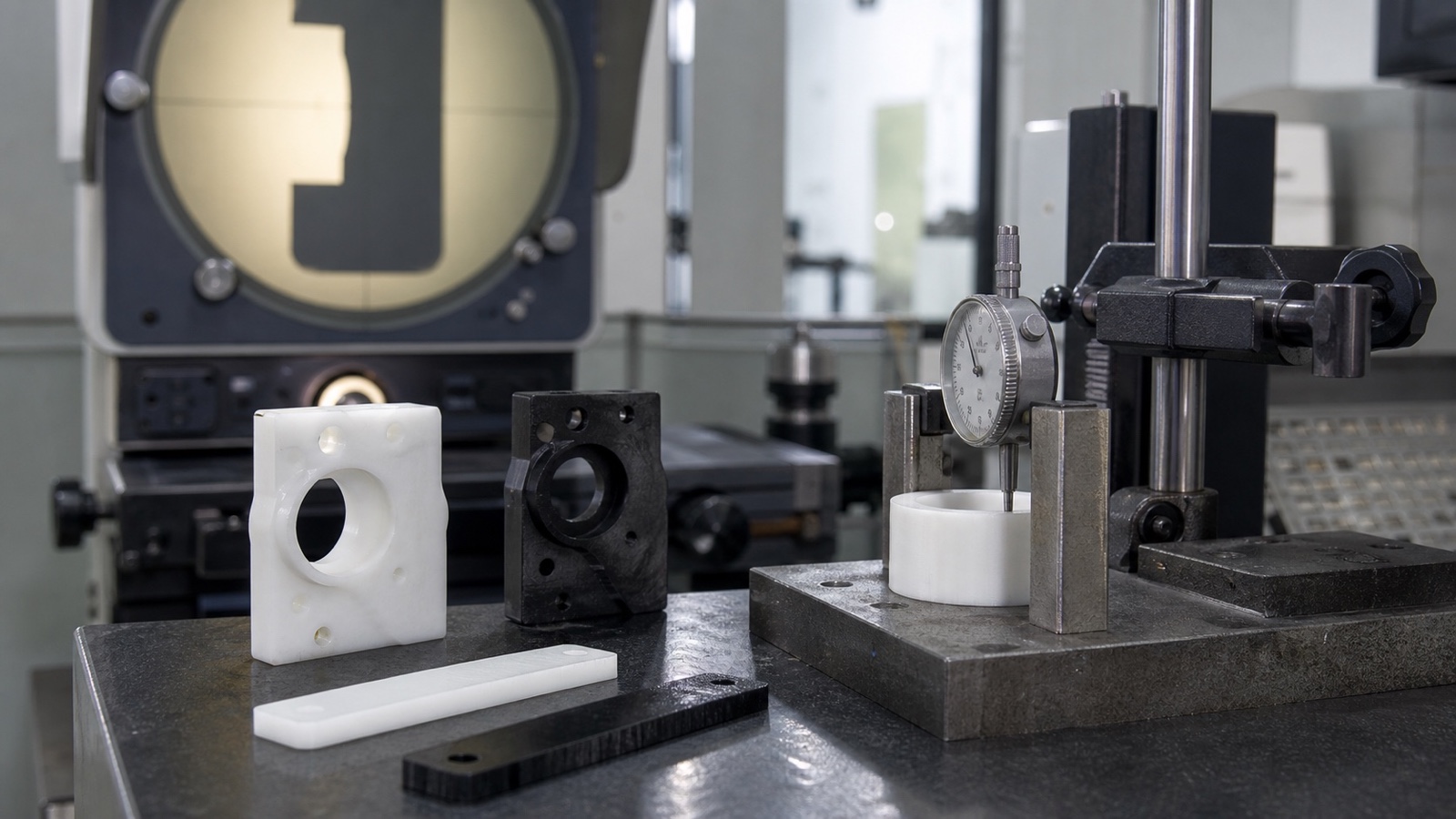
對於精密塑膠零件,必須將熱性能和吸濕反應與幾何形狀、公差及負載一併考量。
耐化學性與環境因素
溫度很少單獨作用。油品、燃料、清潔劑、溶劑、UV 暴露、熱水與蒸汽,均可能加速性能損失或改變聚合物對熱的反應方式。我們始終在實際操作溫度與濃度下檢查耐化學性資料。
對油品、燃料及工業化學品的耐受性
POM has strong resistance to many oils, fuels, and solvents, making it useful in numerous mechanical and fluid-handling applications. Nylon’s resistance depends more heavily on the chemical type, concentration, temperature, exposure time, and moisture state of the polymer.
A chemical that is harmless at room temperature may cause swelling, stress cracking, hydrolysis, or accelerated aging at elevated temperature. A resistance chart is a starting point, not a universal approval for every grade or geometry.
水解、熱水與蒸汽暴露
Hot, wet environments can be especially demanding for nylon. Hydrolysis-resistant nylon grades are available for applications involving heat and moisture, but the grade must be selected for the actual exposure conditions.
Neither POM nor nylon should be assumed suitable for high-temperature steam or aggressive hot chemical exposure without grade-specific validation. Pressure, cycle duration, sterilization method, and mechanical load can all change the result.
UV 與戶外高溫暴露
Both POM and nylon may require UV stabilizers, suitable pigments, or protective design features for outdoor use. Black, UV-stabilized grades are common for outdoor components, but color alone does not prove long-term UV performance.
Outdoor parts also experience daily thermal cycling, rain, humidity, and contamination. We consider all of these factors when reviewing material selection for exposed mechanisms or replacement components.
加工溫度:射出成型與擠出考量
加工溫度不等於熔點。聚合物必須達到足夠溫度才能流動並填滿模具或擠出模頭,但過高溫度或過長停留時間都可能導致降解。加工條件也會影響結晶度、收縮、內應力、翹曲及最終尺寸。
POM 的典型加工範圍
POM has a relatively narrow safe processing window. Excessive residence time, overheating, poor venting, or contamination can cause thermal degradation. Temperature control, proper handling, and process monitoring are important because severe degradation can generate formaldehyde-containing fumes.
For machined POM stock, we still consider heat buildup during cutting. Sharp tooling, suitable feeds and speeds, chip evacuation, and controlled clamping help prevent local melting or distortion.
尼龍的典型加工範圍
Nylon generally requires higher melt temperatures than POM, particularly PA66. Its processing window is also strongly affected by moisture. If wet resin is processed, hydrolytic degradation can reduce molecular weight and lead to surface defects, reduced mechanical properties, and inconsistent results.
In CNC machining, nylon can be machined successfully, but heat buildup and moisture-conditioned dimensions require more attention than POM. We confirm stock condition and allow the material to stabilize when tight tolerances are required.
乾燥要求:尼龍與 POM
Nylon requires careful pre-drying because it readily absorbs moisture from the air. Drying temperature, time, storage, and transfer to the molding machine must follow the supplier’s recommendations. Inadequate drying can cause splay, bubbles, reduced molecular weight, and inconsistent mechanical properties.
POM is less moisture-sensitive and normally has less demanding drying requirements, but it should still be stored and processed according to the supplier’s instructions. Surface defects, dimensional variation, and contamination can still affect the finished part.
模具溫度、收縮與翹曲
Both POM and nylon are semi-crystalline and can experience meaningful shrinkage. Mold temperature, wall thickness, cooling rate, fiber reinforcement, gate design, flow direction, and part geometry influence crystallinity and final dimensions.
For CNC-machined parts, the equivalent concerns include stock stress, thermal expansion during cutting, orientation in extruded or molded plate, and stabilization after machining. These factors are important when a buyer requires tight tolerances across a large part or a complex geometry.
高溫下的機械性能
室溫拉伸強度不足以用於選擇高溫零件的聚合物。我們會比較在預期溫度、負載、濕氣與化學品組合下的拉伸強度保持率、模數、衝擊強度、摩擦行為、磨耗、蠕變及尺寸穩定性。
強度與剛性
Nylon can provide high strength, especially in PA66 and glass-filled grades. However, stiffness may decline with absorbed moisture and elevated temperature. The dry-as-molded value may therefore overstate the performance of a nylon part operating in a humid environment.
POM offers strong stiffness and consistent dimensions across dry-to-humid conditions within its recommended temperature range. For precision mechanisms, that consistency can outweigh nylon’s higher nominal strength.
耐磨性與摩擦
Both materials are widely used for low-wear components. POM is recognized for low friction and strong dry-running suitability, making it a common choice for bushings, rollers, gears, guides, and sliding components.
Nylon can also be highly wear resistant and impact tolerant, especially in bearing or gear applications where toughness is important. Lubrication, counterface material, pressure, speed, surface finish, and temperature all influence actual wear life.
承載能力
Nylon, particularly reinforced PA66, often performs better in high-load, high-heat structural applications. Glass fiber can increase stiffness, HDT, and creep resistance, although the resulting material may be more anisotropic and less impact-tolerant.
POM is frequently selected for moderate-load precision mechanisms, sliding components, and parts where dimensional repeatability and low friction are essential. We check bearing pressure, speed, duty cycle, support conditions, and temperature before finalizing the material.
材料選擇用 POM 與尼龍比較表
此以決策為導向的比較是一項實用篩選工具。實際結果取決於牌號、增強方式、調節狀態、幾何形狀及操作環境。
| 特性 | POM(縮醛) | 尼龍(PA6/PA66) |
|---|---|---|
| 熔點 | 低於 PA6 與 PA66 | 較高,尤其是 PA66 |
| 高溫能力 | 中等 | 通常較強,尤其是 PA66 |
| 吸濕性 | 極低 | 中等至高,取決於牌號 |
| 潮濕環境中的尺寸穩定性 | 優異 | 吸濕後可能改變 |
| 低摩擦性能 | 優異 | 依牌號為良好至優異 |
| 耐衝擊性 | 良好 | 通常更佳,尤其是調節後的尼龍 |
| 高負載能力 | 在中等熱限制內表現良好 | 優異,尤其是增強牌號 |
| 成型前乾燥 | 通常要求較低 | 關鍵要求 |
| 潮濕條件下的精密零件 | 通常優先選用 | 需要預留吸濕裕量 |
| 高溫結構零件 | 相較 PA66 受到限制 | 通常優先選用 |
何時應選擇 POM 而非尼龍
當零件在中等溫度下運作,且在移動、滑動、旋轉或處理流體時必須維持精確配合時,POM 是有力的候選材料。其低吸濕性與低摩擦性通常具有決定性。
為精密、低摩擦零件選擇 POM
We commonly recommend POM for gears, bushings, rollers, clips, latches, valve components, conveyor parts, guides, and fluid-handling components. It is also highly machinable, with predictable chip formation and good dimensional stability.
- Low friction and good dry-running behavior are required.
- Tight tolerances must remain stable through normal humidity changes.
- The application involves moderate temperatures rather than sustained high heat.
為潮濕或沖洗環境選擇 POM
POM is often preferable when dimensional stability after water exposure is critical. Examples include appliance mechanisms, plumbing components, food-equipment parts, conveyor components, and outdoor mechanical assemblies, subject to regulatory and chemical requirements.
何時應選擇尼龍而非 POM
當耐熱、抗衝擊、結構負載或增強選項主導設計時,尼龍通常是更強的選擇。我們特別重視濕度調節,以及材料在乾燥與潮濕狀態間的性能變化。
為較高溫應用選擇尼龍
PA66 or a heat-stabilized nylon is a logical starting point when service temperatures exceed POM’s practical range. Typical examples include automotive under-hood components, electrical housings, fan components, cable-management parts, brackets, and high-temperature mechanical assemblies.
為高負載與抗蠕變選擇強化尼龍
Glass-filled nylon is appropriate for brackets, housings, structural parts, and heavily loaded gears that need improved stiffness, HDT, and creep resistance. The tradeoffs include increased warpage risk, fiber-direction effects, abrasive wear on tooling, and potentially reduced impact resistance.
For CNC-machined reinforced nylon, we also consider tool wear, edge quality, fiber exposure, and the effect of material orientation on the final part.
尼龍能應用於高衝擊工況嗎?
Yes. Nylon is commonly selected for impact-loaded components because of its toughness, particularly in properly conditioned or impact-modified grades. Actual performance changes with temperature, moisture content, reinforcement level, notch sensitivity, and part geometry.
成本、可加工性與長期價值
材料價格僅是總成本的一部分。工裝、廢料、乾燥能耗、製程控制、加工時間、檢驗、現場性能、維護及更換頻率,都可能改變經濟結果。
POM 是否比尼龍更容易加工?
POM is generally regarded as highly machinable because of its dimensional stability, predictable chip formation, and low moisture uptake. It is a practical material for prototypes, low-volume production, replacement parts, and complex precision components.
Nylon can also be machined successfully, but moisture conditioning and heat buildup need greater attention. A nylon part may require more careful stabilization and tolerance planning, particularly when the finished component will operate in a different humidity environment from the machine shop.
材料與製造成本考量
Commodity PA6 may be cost-competitive, while PA66, heat-stabilized grades, reinforced grades, and specialty POM formulations can cost more. Nylon’s drying, storage, and processing requirements should be included in the manufacturing estimate.
For custom CNC parts, we also consider stock availability, machining time, tool wear, inspection requirements, and whether the selected grade is readily available in the required plate, rod, or tube size.
長期維護與更換成本
The lowest resin price may not produce the lowest lifecycle cost. A POM part may last longer when moisture-driven tolerance changes would cause a nylon mechanism to bind. Conversely, nylon may offer better value in a high-temperature, high-load application where POM would creep or lose stiffness.
We recommend comparing wear life, maintenance intervals, field replacement difficulty, downtime, and expected service life rather than comparing only the initial unit price.
常見應用:POM 與尼龍
在明確說明應用的熱與環境需求後,最佳材料選擇會更清楚。
汽車與運輸
POM is used for fuel-system-adjacent precision mechanisms, latches, clips, guides, and interior moving parts where low friction and dimensional stability are useful. Nylon, especially heat-stabilized or reinforced PA66, is commonly considered for under-hood structural and heat-exposed components.
齒輪、軸承與耐磨零件
POM is often preferred for quiet, precise, low-friction gears, bushings, rollers, and wear strips. Nylon may be better for higher-impact, higher-load, or higher-temperature gear systems, especially when a reinforced grade can improve stiffness and creep resistance.
電氣與電子
Nylon is common in connectors, cable ties, housings, brackets, and electrical components requiring toughness and thermal resistance. Flame-retardant and electrical grades require separate evaluation because base-resin melting point does not establish the complete electrical or regulatory performance of the finished part.
消費品、家電與工業設備
Both materials appear in pumps, valves, fastening systems, conveyor components, appliance mechanisms, tool parts, machine housings, robotics, fixtures, and jigs. We match the grade to heat, moisture, chemical exposure, friction, wear, structural loading, and tolerance requirements.
POM 與尼龍熱性能常見問題
POM 的耐熱性是否優於尼龍?
Generally, no. Standard PA6 and especially PA66 usually have higher melting points and better high-temperature capability than POM. POM may still outperform nylon where humidity-driven dimensional stability and low friction are more important than maximum heat resistance.
POM 與尼龍何者熔點較高?
Nylon has the higher melting point in common comparisons, with PA66 typically highest among widely used nylon grades. PA12 is the key exception because its melting range is closer to POM than to PA6 or PA66.
POM 可以取代尼龍嗎?
POM can replace nylon in certain low-friction, precision, moisture-exposed, moderate-temperature applications. It is not a direct replacement for high-temperature, high-impact, or heavily reinforced nylon applications without engineering review.
尼龍或縮醛哪種更適合齒輪?
Acetal or POM is often better for precision, low-moisture, low-friction gears. Nylon can be better for high-impact, higher-load, or elevated-temperature gear systems. Evaluate torque, speed, lubrication, backlash tolerance, humidity, and continuous operating temperature.
哪種材料的耐水性更佳?
POM is substantially more water resistant in terms of moisture absorption and dimensional stability. Low-moisture nylons such as PA12 improve water resistance, but they generally do not match POM’s low uptake.
哪種材料的長期成本效益更高?
POM may offer better lifecycle value for precision parts in humid environments, while nylon may offer better value in high-temperature or high-load applications where POM would deform or lose performance. Compare total cost, not resin price alone.
最終建議:在 POM 與尼龍之間進行選擇
對於必須在潮濕條件下保持尺寸的中溫、低摩擦精密零件,請選擇 POM。對於較高溫度、衝擊、結構負載,以及需要更佳抗蠕變性的應用,請選擇尼龍,尤其是 PA66、耐熱穩定尼龍或玻璃纖維填充尼龍。
在發布圖面或請求報價前,我們建議檢查以下項目:
連續操作溫度與峰值溫度
熱暴露的持續時間與頻率
機械負載、衝擊、蠕變與工作循環
濕度、水分暴露與調節狀態
化學品、油品、燃料、清潔劑、UV 與蒸汽暴露
公差要求、增強材料及供應商資料表驗證
加工能力、檢驗需求與法規要求
PlasticCNCPro 為原型、少量生產及重複製造提供客製化 POM、尼龍及其他工程聚合物零件。我們會在生產前審查圖面、CAD 檔案、樣品、公差、材料牌號及應用條件,確保所選塑膠在性能與製造方面均具實用性。
討論您的材料選擇
需要可靠的 POM 或尼龍 CNC 加工零件嗎?
請將您的 2D 圖面、3D 模型、材料要求、數量、公差及應用詳情發送給我們。我們可協助審查客製化塑膠零件的耐熱、濕氣、化學性、摩擦、磨耗及可製造性要求。
請求報價PlasticCNCPro 詢價