
Custom Plastic Dead Plates CNC Machined to Specification
Plastic dead plates serve as fixed transition surfaces between conveyor sections where products must pause or change direction without driven rollers. In packaging, sorting, and assembly systems, these plates must maintain flatness, resist wear from sliding loads, and match the surrounding conveyor height exactly.
- Max Plate Size
- 1200 × 800 mm
- Flatness
- 0.1 mm / 300 mm
- Hole Tolerance
- ±0.1 mm
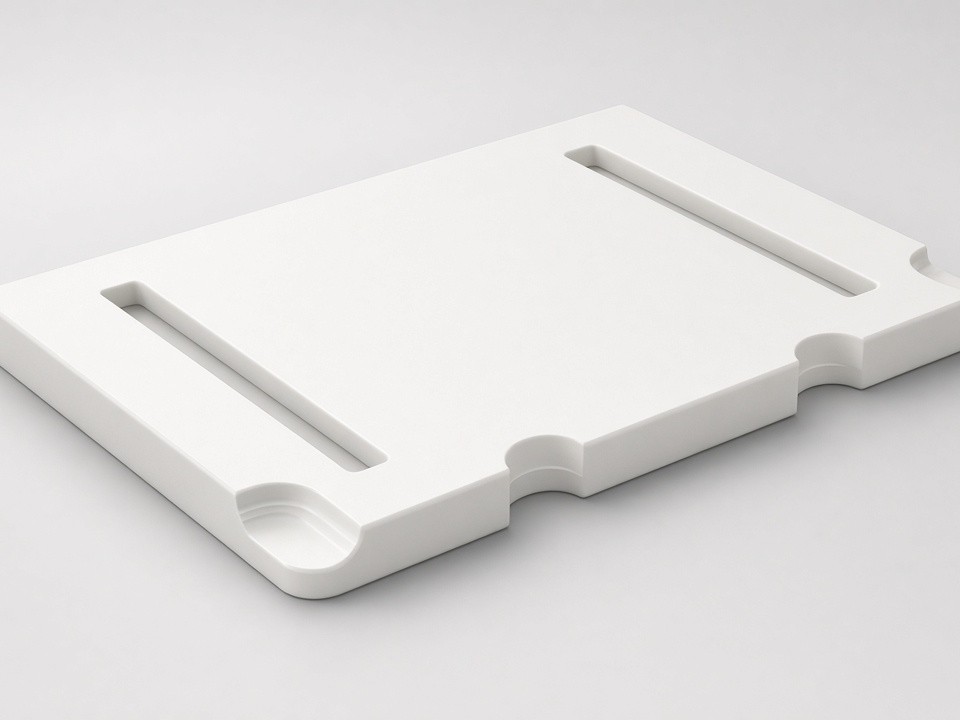
Common Material Choices for Dead Plates
Selection starts with the operating conditions. We review each application for moisture absorption, static buildup, and load requirements before recommending a grade.
POM (Acetal)
Low friction and good dimensional stability for most dry goods handling.
UHMW-PE
Superior abrasion resistance for abrasive products and high-speed slides.
PPS
Maintains performance under chemical exposure or elevated temperatures.
PEEK
High-temperature grades where acetal would distort under service loads.
CNC Machining Capabilities Applied to Dead Plates
We produce dead plates through a sequence of milling, facing, and edge finishing on multi-axis equipment. Flatness is held across the full length by machining in a single setup where possible.
-
1
Single-Setup Milling & Facing
Flatness held across the full plate length with minimal re-fixturing.
-
2
Holes, Slots & Counterbores
Added in the same operation to keep positional accuracy within the stated tolerance.
-
3
Surface Finish Control
Controlled to reduce product marking; optional polishing or light texturing available.
-
4
Edge Finishing
Deburred and finished edges for safe handling and clean product transfer.
Typical Specification Ranges
Standard capabilities below. Tighter tolerances and larger sizes are quoted case-by-case.
| Parameter | Standard Capability | Notes |
|---|---|---|
| Length / Width | Up to 1200 × 800 mm | Larger sizes quoted case-by-case |
| Thickness | 6–50 mm | Thinner sheets available on request |
| Flatness | 0.1 mm per 300 mm | Tighter on request |
| Hole Position Tolerance | ±0.1 mm | ±0.05 mm for critical locations |
| Surface Roughness | Ra 1.6 µm standard | Ra 0.8 µm or polished options |
| Material Thickness Variation | ±0.2 mm | Measured at multiple points |
Project Types That Fit This Process
Dead plates are frequently required in low-to-medium volumes where molded parts are uneconomical or where dimensions change between machine builds.
- Replacement plates for legacy equipment
- Prototype sections for new line layouts
- Custom shapes with non-standard hole patterns
- Molded-to-machined conversions when volumes drop
When a molded part must be machined instead because volumes dropped, the same drawing data is used to produce the first batch quickly.
How to Submit Requirements for Quotation
Send the 2D drawing or 3D model along with material preference, annual quantity estimate, and any surface or marking requirements. We return a fixed quotation that includes material certification options and packaging details.
1. Share Your Data
2D drawing or 3D model with material preference and annual quantity estimate.
2. Receive a Fixed Quote
Includes material certification options, packaging details, and sample lead time.
3. Repeat with Consistency
We keep material stock and fixture records to maintain consistency across batches.
Request a Quotation
For repeat orders, we keep material stock and fixture records to maintain consistency across batches. Share your requirements and we will respond with a fixed quotation.
- info@plasticcncpro.com
- Location
- 29 Fuxing Road, Dongguan City, Guangdong Province, China