
Custom Plastic Adapter Plates
Plastic adapter plates connect dissimilar components in machinery where metal interfaces would introduce corrosion, weight, or electrical issues. They are produced by removing material from solid polymer stock rather than molding — ideal for complex hole patterns, mounting slots, and non-standard thicknesses.
- Linear tolerance
- ±0.1 mm
- Critical features
- ±0.05 mm
- Circular plate turning
- 600 mm
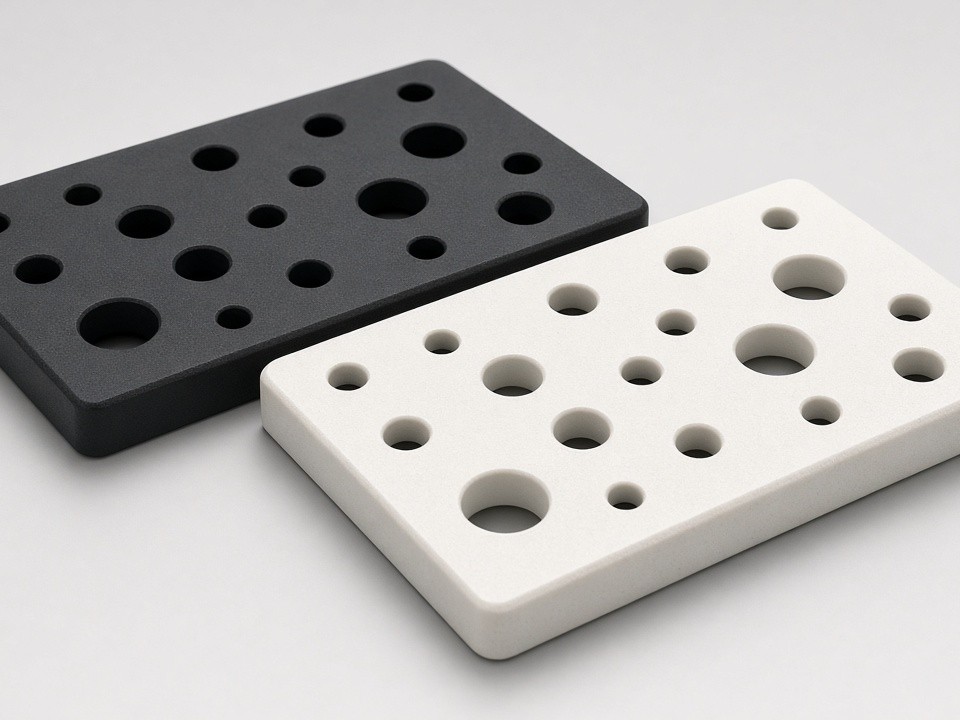
Machined polymer adapter plate — profiled, drilled, and counterbored from solid stock.
Material Options for Adapter Plates
Selection starts with the operating environment. Each grade below is chosen for a specific combination of load, friction, chemical exposure, or temperature demand.
POM & Acetal
Dimensional stability for load-bearing mounts and precision locating interfaces.
Nylon & Glass-Filled Grades
Handle higher mechanical stress where stiffness and toughness are both required.
UHMW-PE
Reduces friction in sliding interfaces and wear-prone guide surfaces.
PVDF & PTFE
Resist most acids and solvents for chemically exposed mounting applications.
PEEK & PEI
Serve elevated-temperature zones above 150 °C with retained mechanical strength.
Filled Compounds
Add conductivity, flame retardance, or wear resistance when the application requires it.
CNC Machining Process at PlasticCNCPro
Plates begin as sheet or block stock and are machined to drawing. All programs are verified against customer drawings before first-article production.
Drawing verification
First-article inspection precedes every production run.
-
Milling
Outer profiles, pocketed recesses, and through-features produced in a single setup.
-
Drilling & Tapping
Mounting holes produced to specified thread forms.
-
Counterbores & Counter-Sinks
Finished with form tools to maintain concentricity.
-
Slotting & Keyways
Cut with carbide cutters for repeatable widths.
-
Turning
Applied to larger circular plates to maintain flatness across diameters up to 600 mm.
Tolerances and Inspection
Standard tolerance on linear dimensions is ±0.1 mm, with capability to ±0.05 mm on critical features. Each batch receives dimensional reports and material traceability documentation.
Dimensional control
- Linear dimensions: ±0.1 mm standard, ±0.05 mm on critical features
- Flatness held to 0.1 mm per 100 mm unless otherwise specified
- Hole positions verified with CMM equipment
Surface & documentation
- Surface finish typically 1.6 µm Ra as-machined
- Polishing or bead-blasting available for sealing faces
- Dimensional reports and material traceability supplied per batch
Typical Project Types
Adapter plates replace metal plates where weight reduction or electrical isolation is required. Low-volume runs of 10–500 pieces are common when the geometry cannot be molded economically or when design iterations are still underway.
Semiconductor wafer handlers
Isolating and non-contaminating interfaces.
Robotic end-effectors
Lightweight mounting with electrical isolation.
Pump mounting interfaces
Corrosion-resistant connection between dissimilar components.
Laboratory instrument frames
Chemical-resistant structural plates.
Legacy equipment & reverse engineering
Replacement plates for legacy equipment often arrive as drawings or worn samples for reverse engineering — we rebuild the geometry and reproduce the interface.
When Machining Is Preferred Over Molding
Machining becomes the economical route in several recurring scenarios. Customers supply STEP, IGES, or PDF files along with material callouts and annual volume estimates.
Below mold break-even
Quantities under injection-mold break-even points.
Complex geometry
Parts with undercuts or variable wall sections.
Non-standard grades
Material properties differ from standard molding grades.
Fast design changes
Iterations supported without tooling cost.
Request a Quotation
Send drawings, material requirements, quantity, and tolerance specifications. Include any special packaging or marking instructions. PlasticCNCPro reviews the package and returns a firm quotation with lead time. Production begins after sample approval.
- info@plasticcncpro.com
- Address
- 29 Fuxing Road, Dongguan City, Guangdong Province, China