
Custom Plastic Vacuum Components via CNC Machining
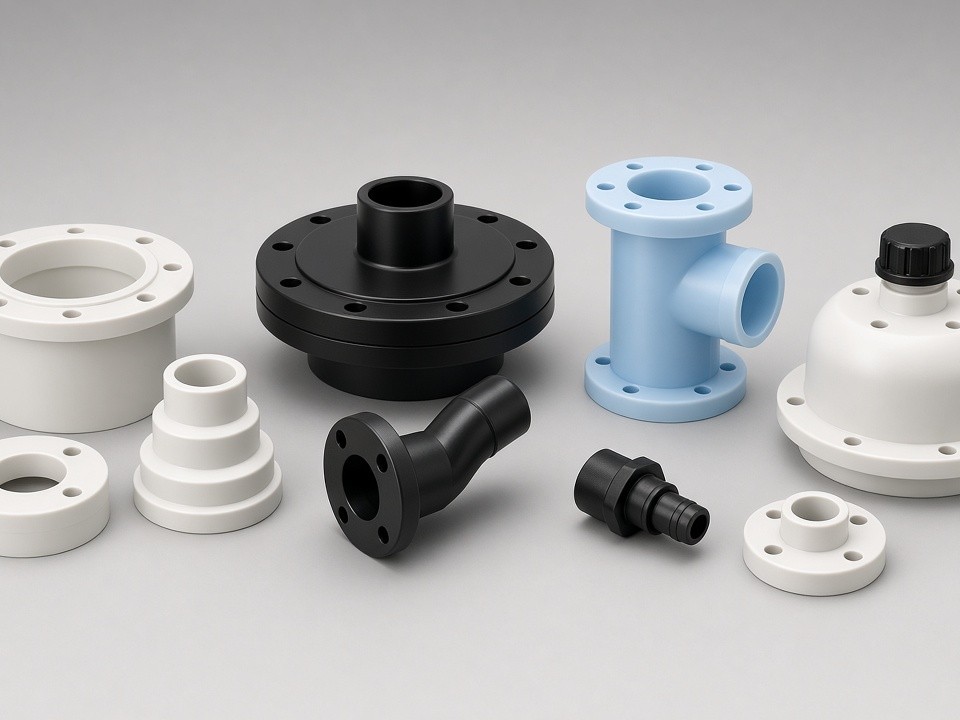
PlasticCNCPro produces plastic vacuum components through direct CNC milling and turning. These parts support vacuum chambers, manifolds, insulators, and sealing interfaces where metal alternatives introduce contamination or weight issues.
- Turning Concentricity
- < 0.02 mm
- Critical Tolerance
- ± 0.05 mm
- Surface Finish
- Ra 0.8 µm
Material Behavior Under Vacuum Conditions
Plastics selected for vacuum service must limit outgassing, maintain dimensional stability, and resist creep under low pressure. Material selection begins with review of operating temperature, chemical exposure, and required dielectric strength.
PEEK
Low outgassing with high strength and thermal stability for demanding vacuum interfaces.
PTFE
Excellent chemical resistance and low friction for seals and sealing faces.
PVDF
Rigid and dimensionally stable with good dielectric strength for insulators.
PAI
High-temperature performance with low volatile release for critical assemblies.
Filled variants with glass or carbon improve rigidity without adding moisture absorption.
CNC Processes Applied to Vacuum Parts
All operations run on machines calibrated for polymer thermal expansion to hold tolerances across batch runs.
-
CNC Milling
Creates complex internal channels and mounting faces on vacuum manifolds.
-
Turning
Produces cylindrical insulators and valve seats with concentricity under 0.02 mm.
-
Drilling & Tapping
Generates port threads that accept standard vacuum fittings.
-
Slotting & Contouring
Forms custom seals or wear strips that fit existing equipment envelopes.
Tolerances and Surface Requirements
Vacuum applications often specify ±0.05 mm on critical sealing surfaces and Ra 0.8 µm or better on mating faces. PlasticCNCPro verifies these dimensions with CMM and surface profilometers before shipment.
- — Solvent cleaning removes machining residues that could affect vacuum integrity.
- — Optional helium leak testing documentation.
- — Traceability records for semiconductor or medical customers.
Project Types Commonly Handled
Legacy Replacement Insulators
Replacement insulators for legacy pumps arrive as samples or 2D drawings.
Prototype Manifolds
New product development teams request prototype manifolds machined from PEEK to test gas flow before committing to molded tooling.
Low-Volume Runs (50–200 pcs)
Covers custom jigs used in cleanroom assembly.
Repeat Standardized Orders
Repeat orders for standardized valve seats maintain the same material lot and process parameters across multiple deliveries.
Matching Process to Part Geometry
Engineers review wall thickness and feature access early to recommend the most stable machining sequence.
Simple Cylindrical Components
Move to turning centers for faster cycle times.
Intersecting Ports or Thin Walls
Require 5-axis milling to avoid secondary setups.
Tight Flatness on Large Faces
Fixtures incorporate vacuum hold-down to prevent distortion.
Inspection and Documentation Practices
- First-article reports with measured dimensions against drawing callouts for each batch.
- Material certificates listing resin grade and lot number.
- Export shipments with protective wrapping, desiccant packs, and labeled cartons meeting international freight standards.
- Digital photos of finished parts sent prior to release.
Submit Project Details for Quotation
Send 2D drawings, 3D models, material specifications, and annual quantity estimates to info@plasticcncpro.com. Include target tolerances and any vacuum performance criteria. PlasticCNCPro reviews files and returns a fixed quotation with lead time within two business days.
Address: 29 Fuxing Road, Dongguan City, Guangdong Province, China