
Custom CNC Machined Plastic Diffusers
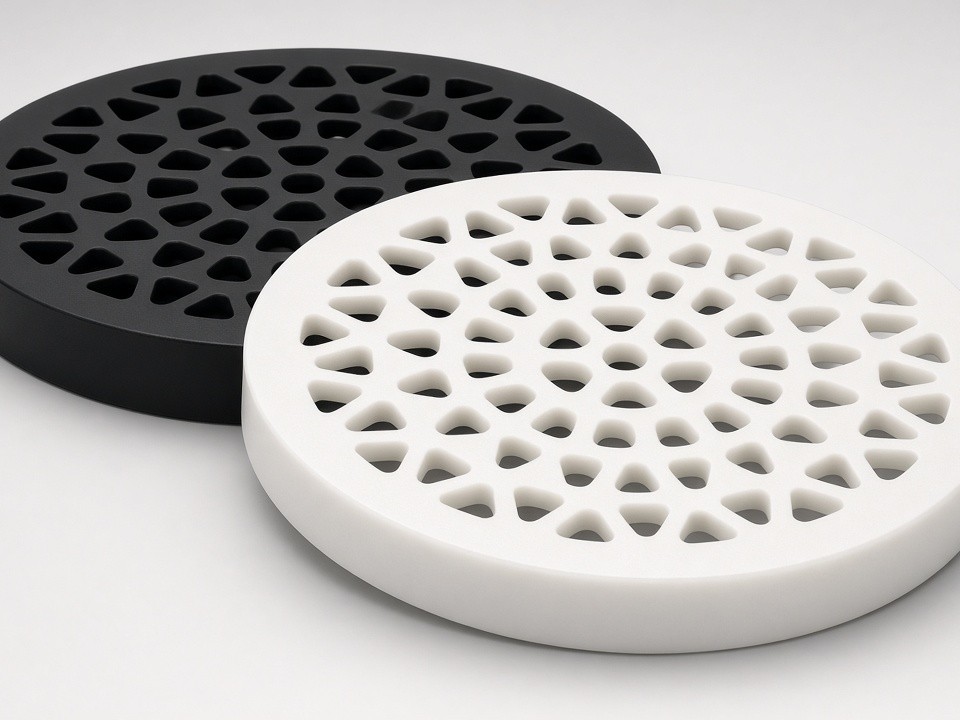
Plastic diffusers control light distribution, airflow, or fluid dispersion in equipment housings, panels, and enclosures. Most designs require tight flatness, consistent wall thickness, and clean edge profiles that molding cannot deliver economically at prototype or low volumes.
- Tolerance
- ±0.05 mm
- Plate Flatness
- Up to 600 mm
- Wall Sections
- Down to 1.5 mm
Common Materials for Plastic Diffusers
Buyers typically select materials based on optical clarity, chemical exposure, and temperature range. The grade you choose drives machinability, finish quality, and long-term stability in service.
POM & Acrylic
Good light transmission for visible applications, with clean machining and stable flatness on thin plates.
PTFE & PVDF
Suited to chemical processing diffusers where corrosion resistance and chemical inertness matter most.
PEEK & PPS
Handle higher continuous temperatures in semiconductor and automotive environments.
Filled Grades
Add wear resistance or static dissipation when the diffuser also serves as a guide or insulator.
CNC Processes Applied to Diffuser Components
Each diffuser geometry maps to a specific machining strategy. We combine operations in a single setup where possible to protect flatness and wall consistency.
- Milling — pockets, slots, and mounting features on flat diffuser plates.
- Turning — cylindrical or conical diffusers for fluid and air systems.
- Drilling & tapping — mounting holes and threaded ports.
- 5-axis milling — uniform thickness across curved surfaces while holding ±0.05 mm on critical faces.
PlasticCNCPro Production Capabilities
PlasticCNCPro machines plastic diffusers from customer drawings or 3D models in single pieces through low-volume runs.
Flatness on plates
Up to 600 mm
Wall sections
Down to 1.5 mm
Surface finishes
As-machined to polished optical grades
Standard documentation
Inspection reports, material certificates, export packaging
Export packaging includes foam separators and desiccant as standard.
Project Types That Fit Our Process
Equipment builders order plastic diffusers when they need functional prototypes before committing to tooling, or when annual volumes stay below 500 units. Replacement diffusers for legacy machinery often require reverse engineering from samples.
Functional Prototypes
Pre-tooling validation of fit, flatness, and light or airflow behavior.
Low-Volume Production
Annual volumes below 500 units where tooling cost is not justified.
Legacy Replacement
Reverse engineering from samples for obsolete or discontinued diffusers.
Typical Applications
- Light panels in laboratory instruments
- Air distribution plates in automation cabinets
- Chemical-resistant baffles in pump assemblies
Material and Geometry Guidance
Our engineers review each diffuser drawing for thin-wall stability, boss locations, and mounting features. We recommend material swaps when the original grade shows excessive moisture absorption or insufficient heat resistance.
Customers receive a written assessment covering machinability, expected lead time, and cost drivers before any purchase order.
01
Drawing Review
Thin-wall stability, bosses, and mounting features assessed.
02
Material Advice
Grade swaps recommended for moisture or heat limits.
03
Written Assessment
Machinability, lead time, and cost drivers documented.
Request a Quote for Plastic Diffusers
Send your 2D drawing or 3D file, material specification, annual quantity, and tolerance requirements. Include the application environment so we can confirm the best polymer grade.
- Email: info@plasticcncpro.com
- Address: 29 Fuxing Road, Dongguan City, Guangdong Province, China
- WhatsApp:
PlasticCNCPro operates from 29 Fuxing Road, Dongguan City, Guangdong Province, China and ships finished diffuser components worldwide with full export documentation.