
Custom Plastic Sensor Housings
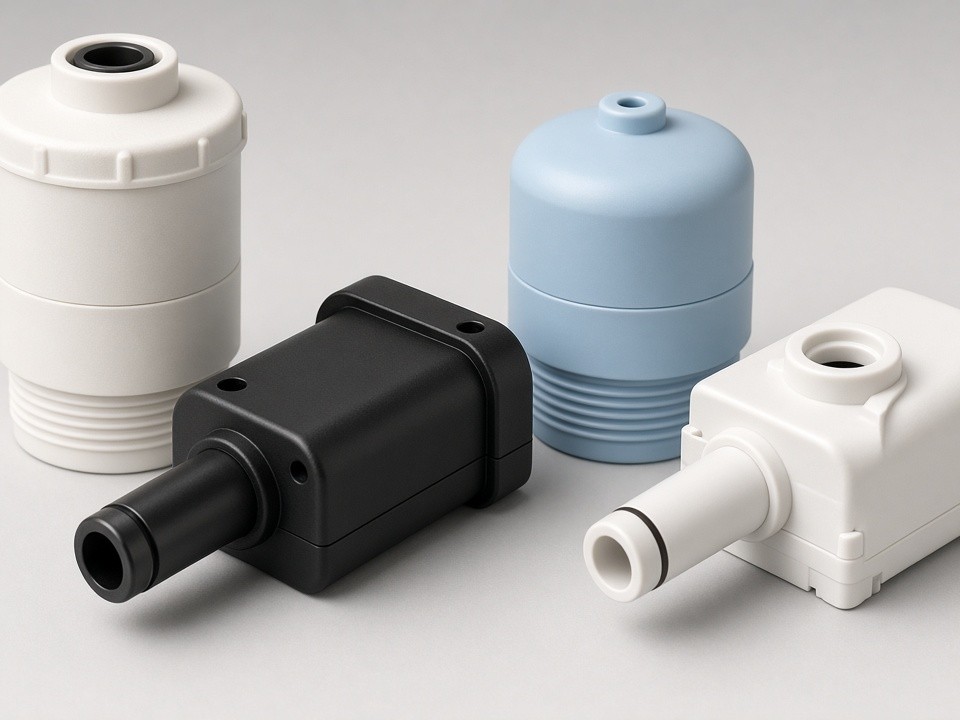
PlasticCNCPro produces machined plastic sensor housings for equipment manufacturers that need consistent dimensional accuracy and reliable material performance. These enclosures protect sensors from environmental exposure while maintaining signal integrity and mounting precision.
- Critical Tolerance
- ±0.05 mm
- Sealing Surface
- Ra 1.6 µm
- Run Size
- 10–2000 pcs
Material Options for Sensor Protection
Sensor housings often operate near heat sources, chemicals, or moving parts. Material selection balances dimensional stability, thermal range, chemical exposure, and electrostatic discharge requirements.
POM
Dimensional stability for precision locating features.
PEEK
Elevated temperature performance for hot-zone sensor mounting.
PTFE
Chemical resistance against aggressive media contact.
Antistatic ABS / PC
Dissipative grades where electrostatic discharge is a concern.
Glass-Reinforced PPS
Added stiffness and corrosion resistance without significant weight.
Carbon-Fiber PEEK
High stiffness for demanding structural housing geometry.
CNC Processes Applied to Housing Geometry
All operations run on the same set of fixtures when possible to maintain positional accuracy across batches.
- Milling — flat mounting faces, O-ring grooves, and cable entry ports.
- Turning — cylindrical bodies and threaded interfaces.
- Drilling & tapping — mounting holes and sensor retention features.
- Slotting & contouring — irregular shapes for specific sensor footprints.
Tolerance & Finish
Typical housings call for ±0.05 mm on critical locating surfaces and ±0.1 mm on non-critical features. Sealing faces receive additional passes to reach Ra 1.6 µm or better.
Verification
Threaded ports are checked with go/no-go gauges. Parts receive inspection reports listing measured dimensions against drawing limits before packing.
From Prototype Quantities to Repeat Orders
The same CNC programs and inspection fixtures remain in use as volumes scale, eliminating the need for new tooling.
-
Stage 01
Prototype
Initial orders frequently start at 10–50 pieces for fit and function testing.
-
Stage 02
Stabilization
Design is validated and fixtures are locked in for repeatable production.
-
Stage 03
Production
200–2000 pieces per run, with updated lead times and material certificates each release.
Application Fit Across Equipment Types
Housing material and geometry are matched to the operating environment of each sensor platform.
| Equipment Type | Key Requirement | Typical Material |
|---|---|---|
| Industrial automation | Coolant and vibration resistance | POM, glass-reinforced PPS |
| Semiconductor equipment | Low outgassing, tight flatness | PEEK, carbon-fiber PEEK |
| Medical devices | USP Class VI or ISO 10993 compliant grades | Medical-grade PEEK, PC |
| Fluid-handling sensors | Corrosion resistance | PVDF, PPS |
| Legacy machinery replacement parts | Reverse-engineered geometry from samples | Matched to original specification |
Packaging and Documentation for Export
Global shipments are prepared to protect machined surfaces and satisfy import documentation requirements.
- Parts ship in custom foam inserts or partitioned cartons to prevent surface damage.
- Labels include part number, material grade, and batch code.
- Documentation covers material certificates, dimensional reports, and RoHS/REACH statements when requested.
What to Include in Your RFQ
- 2D drawings or 3D models
- Material preference and grade
- Quantity and target lead time
- Tolerance notes on critical features
- Special marking, packaging, or inspection requirements
Submit Project Details for Quotation
Send 2D drawings or 3D models, material preference, quantity, and tolerance notes. Include any special marking, packaging, or inspection requirements. PlasticCNCPro reviews files and returns a quotation with estimated lead time within two working days.
Prefer email? Reach our engineering team at
info@plasticcncpro.com