
Engineering Materials Guide
Glass-Filled Nylon vs Carbon-Filled Nylon: Which Reinforced Plastic Is Better?
Both materials start from the same nylon base and add a fiber to raise stiffness, strength, and heat resistance. They behave differently in electrical performance, cost, and machining, so the better choice depends on the load, the environment, and the budget. Here is how our engineering team at PlasticCNCPro compares them.
The filler decides the stiffness, the heat behavior, and whether the part conducts electricity. The matrix stays nylon in both cases.
What Is Glass-Filled Nylon?
Glass-filled nylon is a polyamide matrix, most often PA6 or PA66, compounded with short glass fibers. The fibers are typically a few hundred micrometers long and are aligned during molding or extrusion, so the polymer carries load through the fiber network rather than through the resin alone. The most common commercial loading is around 30% glass by weight, which is why grades are often labelled GF30.
Compared with unfilled nylon, a glass-filled grade is noticeably stiffer, holds its shape at higher temperatures, and creeps less under sustained load. The trade-off is a darker, less tough surface finish on some parts and higher abrasiveness during machining and processing.
Key Point
Glass-filled nylon is an electrically insulating material. The glass fibers do not add conductivity, which makes it a common choice for insulating structural parts.
What Is Carbon-Filled Nylon?
Carbon-filled nylon uses short carbon fibers dispersed in a nylon matrix. Common loading levels are in the range of 15% to 30% by weight, with many engineering and printing grades landing near the middle of that band. As with glass, the reinforcement is short fiber rather than continuous fiber, so it is not comparable to a laminated carbon composite panel.
The structural benefit over standard nylon is a large gain in stiffness and dimensional control at a lower density than glass-filled equivalents. Carbon fibers are also stiffer than glass fibers, so a carbon-filled grade can reach high modulus with a smaller fiber loading. The fibers also make the material electrically conductive to a degree that depends on loading and dispersion.
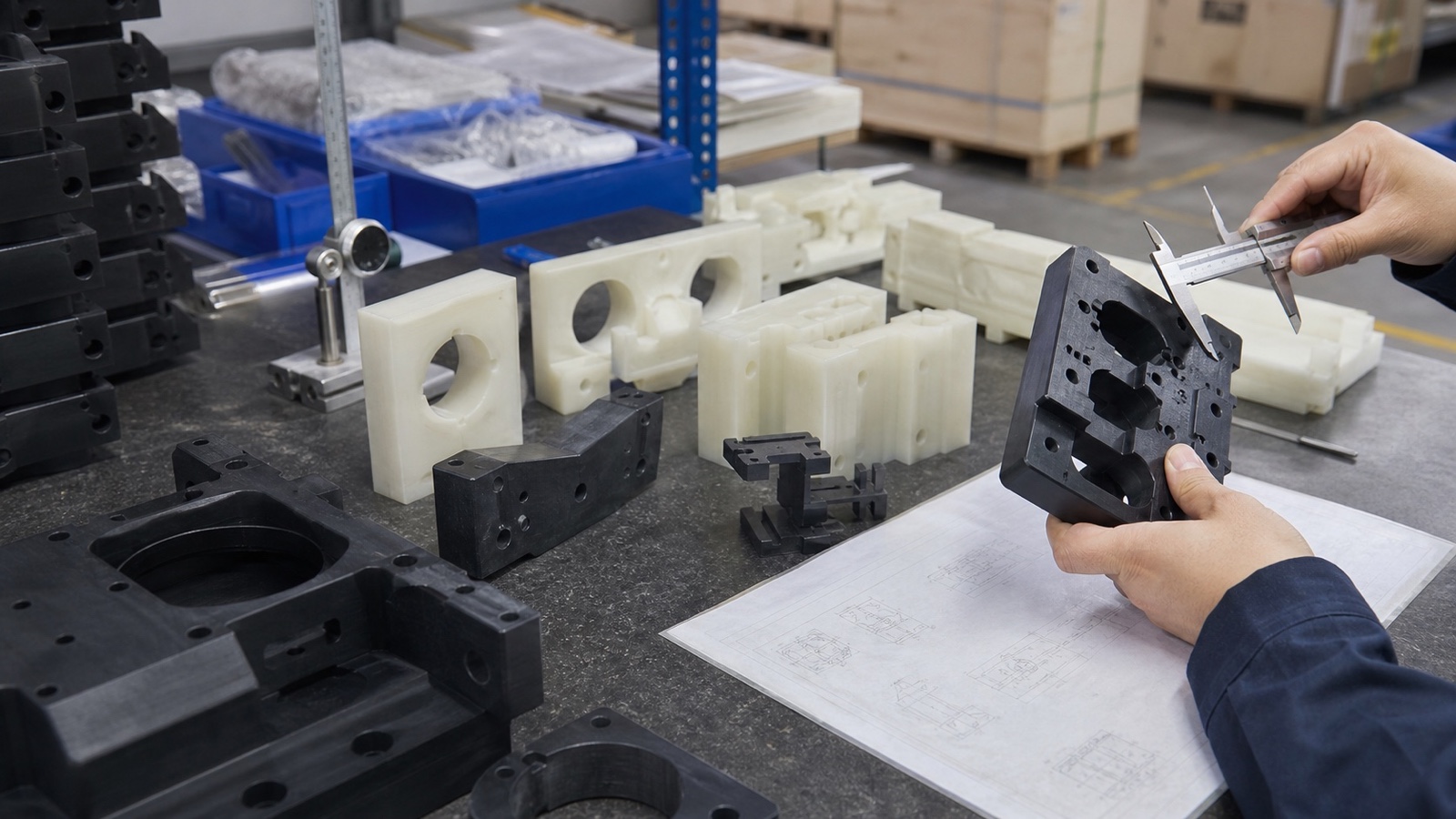
Is Glass-Filled Nylon Strong?
Yes, for most structural duties. A typical 30% glass-filled PA6 or PA66 grade is roughly double the tensile strength of unfilled nylon in datasheet terms, and its stiffness rises substantially. Exact numbers depend on the base polymer, the fiber length, the moisture state, and the test standard, so always compare values from the same datasheet method.
Tensile strength, stiffness, and impact
Glass fiber increases tensile strength and modulus, which keeps parts from bending under load. The main compromise is impact. Glass reinforcement makes the material less ductile, so a 30% glass grade can break in a brittle way where unfilled nylon would flex and recover. For housings or brackets that see sharp impacts, we often recommend checking notched impact values before committing.
How Strong Is Carbon Fiber Reinforced Nylon?
Carbon-filled nylon is generally stiffer than a glass-filled grade at comparable loading, and it often holds higher flexural properties. Its tensile strength is competitive with glass-filled nylon, but the bigger difference shows up in stiffness per unit weight and in how the part behaves under repeated stress.
Tensile modulus, flexural strength, and fatigue
Tensile modulus is where carbon reinforcement earns its premium. For jigs, fixtures, and rigid frames, the higher modulus means less deflection under the same load. Flexural strength follows a similar pattern, which helps thin ribs and cantilevered features hold position. Fatigue resistance is good for a short-fiber composite, but it depends heavily on fiber orientation and surface finish. Sharp corners and machining marks concentrate stress, so the design details matter as much as the filler choice.
Key Mechanical Differences Between Glass and Carbon Fillers
When we review a drawing, we compare the two materials on three axes: strength-to-weight, stiffness, and dimensional stability. The table below summarizes the general direction of each difference. Actual values must come from the specific grade datasheet.
| Property | Glass-Filled Nylon | Carbon-Filled Nylon |
|---|---|---|
| Strength-to-weight | Good; higher density than carbon grades | Very good; lower density at similar stiffness |
| Stiffness | High for structural parts | Higher at comparable loading |
| Dimensional stability | Strong; reduces creep and shrinkage | Strong; often the tighter option for precision |
| Impact behavior | Can be brittle; check notched impact | Typically less ductile than unfilled nylon |
| Electrical behavior | Insulating | Conductive to a degree; dispersion-dependent |
Engineering Note
Do not compare a carbon grade at 15% loading with a glass grade at 50%. Compare grades at similar loading, similar base polymer, and the same conditioning state.
How Fillers Affect Dimensional Stability and Tolerances
Both fillers reduce the amount of shrinkage and warpage that a nylon part experiences, because the fibers restrict the polymer from moving as it cools or absorbs moisture. For molded parts, this means more predictable wall-to-wall dimensions. For machined parts, it means the stock stays flatter and holds a tolerance more reliably through the cut.
In molding, fiber orientation drives shrinkage differences. Flow direction shrinks less than cross-flow, which can cause warpage on large, thin parts. In 3D printing, the same anisotropy shows up between layers and along the extrusion path. Carbon-filled grades are frequently selected when the tightest dimensional control is required, but gate location, wall thickness, and cooling still matter more than the filler name on the datasheet.
Shrinkage
Fibers limit contraction, but the direction of flow still dictates final size.
Warpage
Thin, asymmetric, or large flat parts still move unless wall thickness is balanced.
Precision
Machined reinforced parts hold tight tolerances when stock is stress-relieved and clamped properly.
Electrical and Thermal Performance Under Stress
Heat deflection temperature, or HDT, is one of the most useful numbers for a reinforced nylon. Both glass and carbon fibers raise HDT well above unfilled nylon, so either material can hold shape in warm housings, motor-adjacent brackets, and hot-fluid fixtures. Always confirm the test load used on the datasheet, because HDT at 0.45 MPa and at 1.8 MPa describe very different conditions.
Electrically, the picture splits. Glass-filled nylon is an insulator, which suits cable clamps, connector bodies, and insulating standoffs. Carbon-filled nylon can dissipate static charge and in some loadings becomes conductive, which is useful for ESD-sensitive fixtures and trays. It is not a substitute for a metal conductor, and conductivity should be verified on your actual part.
Warning
If a part is both load-bearing and must be insulating, do not assume a carbon grade is safe. Its conductivity can compromise isolation. Specify glass or a verified insulating grade instead.
Cost Comparison and When Carbon-Filled Nylon Justifies the Premium
Carbon-filled nylon is generally priced above glass-filled nylon, because carbon fiber itself costs more to produce and the grades are less common in bulk. Glass-filled nylon is widely available in many forms and is usually the economical choice for structural parts. The right comparison is not material price alone, but total cost per working part, including scrap, machining time, and failure risk.
Carbon-filled nylon tends to pay for itself in these situations:
-
1
Stiffness-limited fixtures
A stiffer jig holds tolerance during repeated use, which can cost less than rework or downtime.
-
2
Weight-sensitive moving parts
Lower density with high stiffness reduces inertia on arms, guides, and carriers.
-
3
ESD-sensitive handling
Static dissipation can protect electronics where glass would simply insulate.
-
4
Low-volume precision parts
When part count is small, the cost of one dimensional failure outweighs the material premium.
3D Printing Considerations for Both Materials
Both reinforced nylons can be printed, but they are not forgiving filaments. The fibers are abrasive, the material absorbs moisture readily, and both need a stable, warm build environment. Treat them as engineering materials, not as general-purpose filaments.
Nozzle wear
Both fillers wear brass nozzles. Use a hardened nozzle for carbon and glass grades.
Moisture control
Dry spools before printing and store them sealed. Wet nylon prints with weak layer bonds and surface defects.
Bed adhesion
Nylon warps on cooling. Use a heated bed, an adhesion aid suited to the bed surface, and an enclosure where practical.
Post-processing
Support removal and surface finishing leave fiber-rich edges. Deburr and sand carefully and wear protection.
Tip
Start from the filament maker's recommended profile, then adjust one variable at a time. Changing temperature, speed, and cooling together makes failures hard to diagnose.
Design Guidelines and Post-Processing Tips
The same design habits help both materials perform. For machined parts, we recommend the following sequence when preparing a drawing.
-
1
Round internal corners
Generous radii reduce stress concentration, especially in brittle glass-filled pockets.
-
2
Keep wall thickness consistent
Uniform sections reduce residual stress and distortion during and after machining.
-
3
Specify tolerances where they matter
Tight tolerances on mating features only, with looser values elsewhere, keeps cost in check.
-
4
Plan the finish
Reinforced grades show fiber texture. Define whether a matte, machined, or deburred finish is acceptable.
What Are the Disadvantages of Glass Fiber Reinforced Plastic?
Glass-filled nylon is a workhorse, but it has real drawbacks that buyers should weigh before specifying it.
Abrasiveness
Glass fibers wear cutting tools and nozzles faster than unfilled plastics, raising tooling costs.
Brittleness
Impact and notch sensitivity can be lower than unfilled nylon, so sharp features are risky.
Moisture absorption
Nylon absorbs water, which changes dimensions and stiffness in service. Condition the material and design for it.
Best Applications for Each Material
The fastest way to choose is to match the filler to the dominant requirement. The cards below summarize the strongest fit for each material.
Glass-Filled Nylon
Structural and insulating parts
Good for brackets, housings, gears, and cable management parts where insulation and cost matter. It is a dependable default for industrial machinery.
Carbon-Filled Nylon
Stiff, light, static-aware parts
Well suited to jigs, fixtures, robot arm components, and ESD-sensitive handling where stiffness per gram and static dissipation are key.
Industrial and automation
Glass-filled nylon handles most guides, spacers, and structural brackets in machinery. Carbon-filled nylon is the better fit for end-of-arm tooling and precision fixtures.
Automotive and transportation
Glass-filled grades are common for under-hood and housing applications where heat and stiffness matter. Carbon-filled grades suit lightweight brackets and prototypes where weight reduction is the priority.
Consumer and functional prototyping
For prototypes that must behave like production parts, reinforced nylon gives realistic stiffness. Choose glass for insulating test housings and carbon when the prototype needs to dissipate static or resist flex.
What Is the Most Durable Plastic for 3D Printing?
There is no single winner. Durability depends on load type, chemical exposure, and temperature. Reinforced nylons are among the most durable printable options for stiffness and heat, but they are harder to print than PETG or ASA and they absorb moisture. For chemically aggressive or very high-temperature service, machined engineering plastics often outperform printed parts, because they have consistent internal structure.
In our experience, the most durable outcome comes from matching the filler to the service condition and then choosing the manufacturing route that delivers the part's properties reliably. Printing suits fast iteration. CNC machining of the final grade suits production-quality consistency.
Frequently Asked Questions
Do I need a hardened nozzle for carbon fiber filament?
Yes, in practice. Carbon fibers wear brass nozzles quickly. A hardened steel nozzle is the standard recommendation, and it applies to glass-filled grades as well.
Can glass-filled or carbon-filled nylon run on a Bambu Lab printer?
Many Bambu Lab printers can run these materials when configured with a hardened nozzle and suitable temperature settings. Confirm the printer's temperature limits, enclosure needs, and the filament maker's recommended profile before printing.
Is carbon fiber filament the same as real carbon fiber?
No. Carbon fiber filament uses short chopped fibers in a nylon or other polymer matrix. Continuous carbon fiber composites, such as laminated panels, have far higher strength and stiffness in the fiber direction.
How much does carbon fiber filament cost compared with glass fiber?
Carbon fiber filament is typically priced at a premium over glass fiber filament. Exact prices vary by brand, spool size, and loading, so compare cost per usable part rather than cost per spool.
Project Inquiry
Not sure which reinforced nylon fits your part?
PlasticCNCPro is a Dongguan-based precision CNC machining partner for custom plastic and engineering polymer parts, from prototypes to repeat production. Send us your 2D drawing, 3D model, material requirement, quantity, tolerance, and application details. Our engineers will review the design and material options with you and return a quotation and production recommendation.
- 1Share your drawing, model, or sample.
- 2We review material, tolerances, and manufacturability.
- 3You receive a quotation and production recommendation.