
Materials Engineering Guide
PCTFE vs PVDF: Which Plastic Is Better for Low-Temperature Sealing Parts?
Choosing between PCTFE and PVDF for cryogenic or low-temperature seals comes down to temperature, media, leakage targets and load. Here is how we compare the two from the machining bench to the seal face.
Introduction
In cryogenic and low-temperature sealing, the material is often the first thing to fail and the last thing anyone checks. A seat that seals well at room temperature can shrink, harden or crack when the line drops toward liquid nitrogen or liquid oxygen temperatures. Sealing faces lose their recovery, clearances change, and small leaks become expensive problems.
Two fluoropolymers come up again and again in this discussion. PCTFE (polychlorotrifluoroethylene) is the material most engineers reach for when the temperature goes deep and leakage must be near zero. PVDF (polyvinylidene fluoride) is a high-strength, chemically resistant thermoplastic that is widely used in piping, valves and structural components, and it is often proposed as a cost-conscious alternative.
This article is written to help you choose between them. We compare temperature behavior, chemical resistance, mechanical properties and sealing-specific issues, then finish with a decision matrix you can take into your next design review.
For cryogenic seals, the question is rarely "which plastic is strongest?" It is "which plastic will still behave like a seal at the coldest point in the system?"
Understanding the Materials: What are PCTFE and PVDF?
Both materials belong to the fluoropolymer family, but they are not interchangeable. Their molecular structure is the root of most of the performance differences you will see on a datasheet or on a test bench.
Material A
What is PCTFE?
PCTFE is a chlorofluoropolymer with a high fluorine content. That fluorine-rich backbone gives it chemical inertness and a stable structure at very low temperatures, which is why it is regarded as the gold standard for extreme cold.
Material B
What is PVDF?
PVDF is a high-strength, chemical-resistant thermoplastic. It is commonly specified for piping, valve bodies and other structural parts in chemical processing, where its toughness and mechanical stability matter as much as its chemical resistance.
Core difference
The core difference is molecular: PCTFE's chlorine-and-fluorine backbone and high fluorine content favor cold stability and low permeability, while PVDF's structure is tuned for strength, toughness and broad chemical resistance at moderate temperatures. Those two design goals show up directly in how each material seals.
Low-Temperature Performance: The Cryogenic Comparison
Temperature is where the two materials separate most clearly. Many plastics become brittle as they cool, and a brittle seal can crack under the first pressure or thermal cycle. The question is how far down a material stays usable.
PCTFE at Cryogenic Temperatures
PCTFE remains stable down to -240°C. Where many engineering plastics lose toughness, PCTFE stays ductile, so it can be compressed, deformed and recovered without the sudden cracking that ruins cryogenic seats. In our experience, this ductility is the property that makes PCTFE credible for seal faces rather than just housings.
PVDF at Low Temperatures
PVDF is a capable material at moderate temperatures, but it is not a cryogenic material. Its performance threshold sits well above the range where PCTFE is qualified, so PVDF should not be specified for deep-cold sealing on the strength of its room-temperature toughness. Always confirm the low-temperature limit against the specific grade datasheet and your own test data.
Quick check
-
1
Lowest service temperature
Define the coldest point the seal sees, including upset and startup conditions.
-
2
Ductility at that temperature
Check whether the grade is documented as ductile there, not just rated for it at room temperature.
-
3
Thermal cycling
Repeated cooling and warming is where marginal materials fail first.
Verdict
For liquid oxygen and liquid nitrogen handling and for cryogenic valve seats, PCTFE is the industry choice. It is the material that engineers trust when the temperature goes down and the leak rate must stay low. PVDF has a useful role elsewhere in the fluid path, but it is not the seat material for deep-cold duty.
Side-by-Side Property Comparison
The table below summarizes how the two materials compare on the properties that matter most for sealing. Treat it as a screening tool; final values always depend on grade, processing and the test standard you use.
| Property | PCTFE | PVDF |
|---|---|---|
| Cryogenic suitability | Stable down to -240°C; remains ductile | Not a cryogenic material |
| Stiffness and dimensional stability under load | Superior dimensional stability under load | Strong structural performance at moderate temperatures |
| Chemical resistance | Broadly inert to aggressive media | Broad, but grade-specific compatibility checks needed |
| Gas permeability | Low; suited to hermetic sealing | Higher than PCTFE for hermetic duty |
| Typical cost position | Premium specialty material | More cost-efficient for general structural parts |
Mechanical Strength
PVDF is the tougher structural plastic in most moderate-temperature applications, and it is a sensible choice for load-bearing housings and piping. PCTFE is valued for a different kind of strength: it holds its shape under sealing load. That dimensional stability is what keeps a seat in contact with the closure element over time.
Chemical Resistance
Both materials handle many aggressive acids, solvents and fuels. PCTFE is the more broadly inert of the two and is a common choice where the medium is both aggressive and cold. PVDF also resists many chemicals, but it is not universally compatible; strong bases and certain polar organic solvents require checking against the grade and the temperature in your system.
Warning
Chemical resistance is temperature-dependent. A medium that is harmless at 20°C can attack a polymer at elevated temperature or under sustained stress. Run immersion or media tests at your real operating conditions.
Permeability
PCTFE's low gas permeability is one of its strongest sealing advantages. When a seal must prevent gas migration rather than just liquid leakage, PCTFE is the better fit. This is why it appears so often in hermetic and vacuum-related sealing duties.
Radiation Resistance
Aerospace and nuclear projects put both materials under radiation exposure questions. The honest answer is that performance depends on dose, grade and environment. We recommend confirming radiation behavior with the specific grade data and your qualification requirements rather than assuming either material is suitable.
Key Differences for Sealing Applications
Beyond the datasheet, sealing performance depends on how a material behaves under pressure and how well it can be machined into a precise part. These are the areas where we see the most differences in real projects.
Deformation Under Load
Every fluoropolymer seal is vulnerable to cold flow, the slow deformation under sustained load. In a high-pressure seat, this shows up as gradual loss of sealing force. PCTFE's dimensional stability under load helps it resist this drift, which is why it is preferred where the seat must keep its geometry over long service intervals.
Ease of Machining
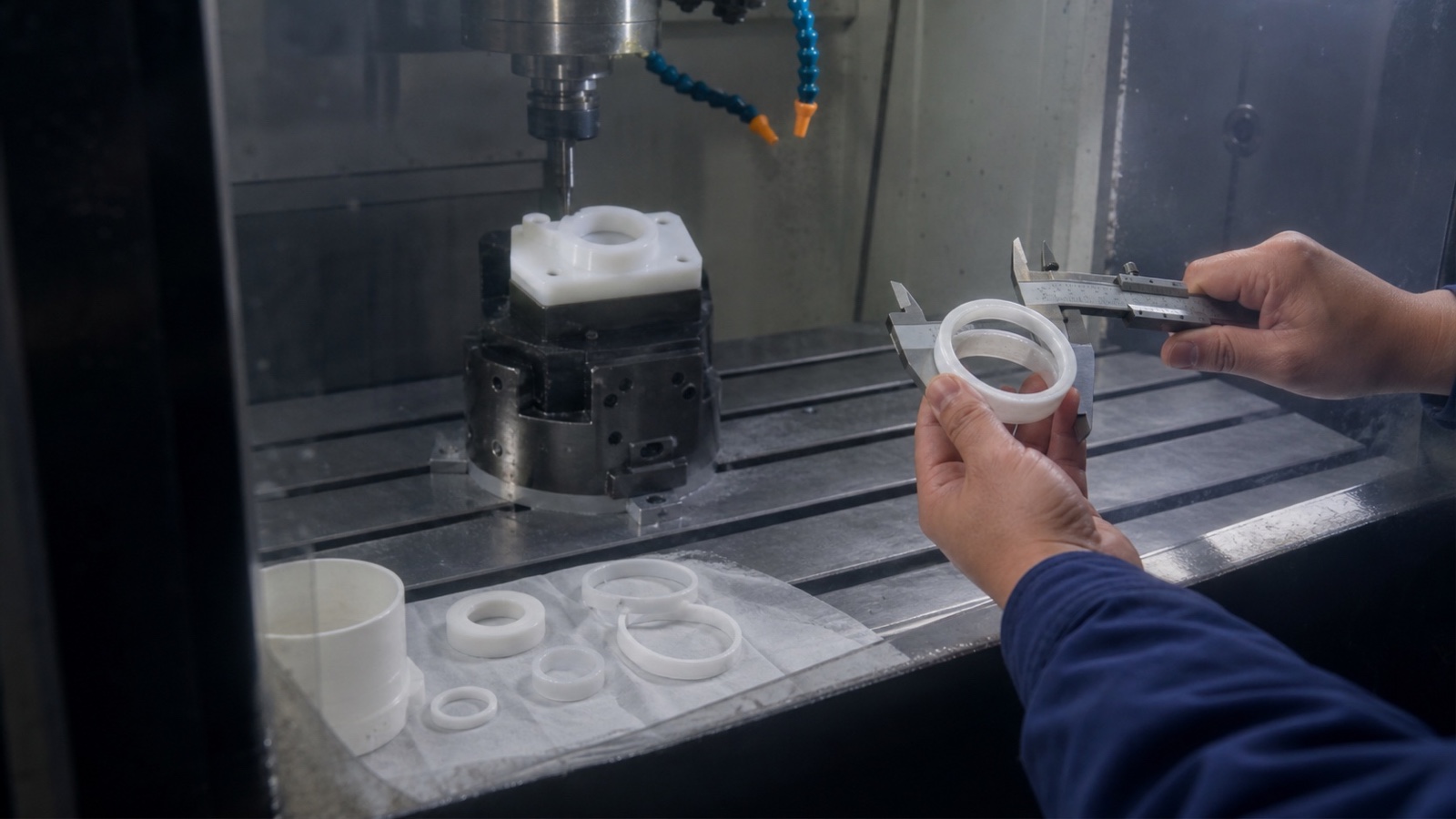
Both materials can be CNC machined to tight tolerances, but they do not behave identically. PCTFE is harder than PTFE, which helps with edge definition on fine seal features. Fluoropolymers in general require sharp tooling, controlled feeds and careful clamping so that the part does not distort after release. We machine PVDF and PTFE regularly; for PCTFE, send us your grade requirement early so we can confirm material sourcing before quoting.
Machining guidance
-
Sharp tooling
Dull tools smear fluoropolymers and leave surfaces that seal poorly.
-
Support during cutting
Thin walls and seal lips need fixturing that avoids crushing the part.
-
Measure after relaxation
Inspect critical diameters after the part has stabilized, not straight off the machine.
Cost Considerations
PCTFE is a specialty material and its sourcing and processing costs reflect that. PVDF is generally the more cost-efficient choice for structural and moderate-temperature parts. The real comparison is total cost: a cheaper seat that leaks at minus 150°C is far more expensive than the material it replaced. Price the failure mode, not just the stock.
When to Choose Which? Decision Matrix
Use the two guidelines below as a starting point in your design review. If your application sits between them, that is the moment to request sample testing rather than guess.
Choose PCTFE if
- Your application involves cryogenic media such as liquid oxygen or liquid nitrogen.
- The seal supports vacuum service.
- The design requires zero gas leakage or hermetic performance.
Choose PVDF if
- The application is primarily chemical processing at moderate temperatures.
- Cost-efficiency and mechanical toughness are the main priorities.
- The part is structural, such as piping or valve components, rather than a deep-cold seat.
Frequently Asked Questions (FAQ)
What is the temperature range of PCTFE material?
PCTFE is used across a range from -240°C up to +200°C. Its cryogenic stability and ductility at the low end are the reasons it is chosen for extreme-cold sealing.
What is the difference between PCTFE and PTFE?
Both are fluoropolymers, but PCTFE is harder and is better suited to structural seals where dimensional control under load matters.
Which is better, PTFE or PVDF?
It depends on the job. PVDF is better for structural integrity, while PTFE is superior for low friction and chemical inertness.
What are the disadvantages of PTFE and PCTFE?
The main drawbacks are high material cost and sensitivity to certain specialized solvents. Confirm media compatibility for your exact fluid and temperature before committing to a design.
Conclusion
The primary takeaway is simple. PCTFE is the specialized choice for extreme cold and cryogenic seals, where ductility, dimensional stability and low permeability are required. PVDF is a versatile engineering plastic for chemical piping and structural components at moderate temperatures.
Before you release a design, we recommend material testing at your real temperature, pressure and media, and a conversation with a precision machining team. Machining method, fixturing and inspection plan all influence whether a fluoropolymer seal performs as the datasheet promises.
Request a quotation
Send us your sealing drawing and operating conditions
PlasticCNCPro machines custom plastic and engineering polymer parts for prototypes, low-volume and repeat production. Share your 2D drawing or 3D model, material requirement, quantity, tolerance and application details, including the lowest temperature and media the seal will see, and our engineering team will review manufacturability and material suitability with you.
Request a Quote