
PEI vs PEEK: Which High-Temperature Plastic Is Right for Your Project?
You’ve probably been here before: a critical component fails in service — maybe it softened under sustained heat, crazed after exposure to a cleaning solvent, or simply wore out faster than expected. You start searching for a replacement material that can take more punishment. Almost immediately, two acronyms dominate the conversation: PEI and PEEK. Both are high-performance thermoplastics that sit at the top of most engineering polymer charts. Both are specified in demanding industries like aerospace, semiconductor, medical, and chemical processing. And both are frequently confused — or treated as interchangeable when they absolutely are not.
At PlasticCNCPro, we machine both materials daily in our Dongguan facility, and I’ve lost count of how many customers have asked which one they should use. The honest answer is: it depends on your operating temperature, chemical environment, mechanical loading, and — let’s be realistic — your budget. PEI (often known by SABIC’s brand ULTEM) and PEEK deliver different performance tiers. Choosing wrong means you either overpay for capabilities you never needed, or you end up with premature part failure because you saved a few dollars per kilogram.
This guide gives you a practical, engineer-to-engineer comparison of PEI vs PEEK: their chemistry, properties, machining behavior, processing constraints, and application fit. We’ll finish with a clear decision framework you can use on your next project. No fluff, no marketing—just the technical reality.
Why the PEI vs PEEK Decision Matters
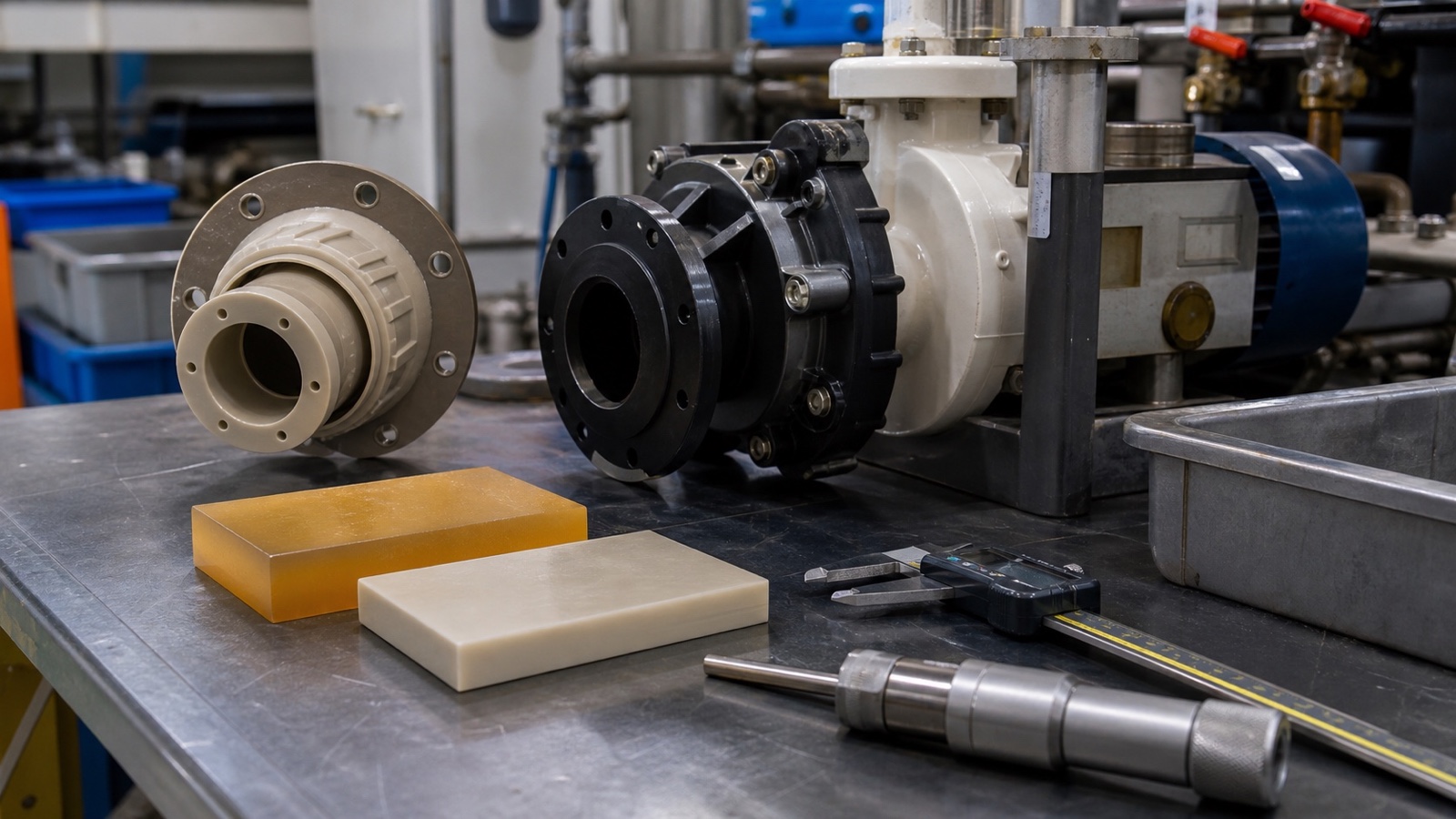
Let’s set the stakes. PEI (polyetherimide) and PEEK (polyether ether ketone) are the two most specified high-temperature thermoplastics in engineering. But they were never designed to compete in the same sandbox. PEI is an amorphous polymer with exceptional stiffness, inherent flame retardancy, and a reasonable price point compared with PEEK. PEEK is a semi-crystalline polymer with outstanding chemical resistance, wear performance, and the ability to operate continuously at temperatures that would anneal PEI.
The decision between them is rarely about "which is better" in absolute terms. It’s about matching the polymer’s strengths to your application’s most punishing conditions. For example:
- If you need a part that sits near a hot motor and must not creep at 180°C, PEI may be enough — and it will save you money.
- If that same part is also continuously doused in hot gear oil or aggressive solvents, PEI will crack in weeks. PEEK will outlast the machine.
Understanding the difference between glass transition temperature, continuous service temperature, and chemical compatibility is crucial. I’ll break all of that down in the sections ahead. By the end, you’ll have a practical criterion checklist you can use to spec your next material — and you’ll know when to call us for a machining quote.
---
What Is PEI (Polyetherimide)?
PEI is an amorphous, amber-translucent high-performance thermoplastic. The most widely known commercial grade is ULTEM, manufactured by SABIC, but PEI is also produced by other suppliers under different trade names. Chemically, PEI is built from aromatic imide units linked by ether groups. That backbone is what gives PEI its remarkable rigidity, high heat deflection, and natural resistance to burning.
Key properties of PEI:
- Glass transition temperature (Tg): ~217°C. This is unusually high for an amorphous polymer.
- Flame retardancy: Inherently UL94 V-0 rated at thin wall thicknesses. Low smoke generation makes it a staple in aircraft interior components.
- Electrical insulation: Excellent dielectric strength and stable dielectric constant across a wide frequency range.
- Dimensional stability: Low creep and high modulus, especially in glass-filled grades.
- Appearance: Natural translucent amber that can be pigmented to many colors.
Limitations of PEI:
- Chemical resistance: Poor against chlorinated solvents (chloroform, methylene chloride), strong acids, and bases. It can stress-crack when exposed to certain hydrocarbons while under load.
- Moisture absorption: Absorbs ~0.25–0.4% when immersed for 24 hours, which can affect tight tolerances in humid service.
- Brittleness: Unfilled PEI is more brittle than PEEK, particularly under impact or at sharp notches.
Common PEI grades:
- Unfilled (ULTEM 1000): General-purpose, high strength, good dielectric properties.
- Glass-reinforced (ULTEM 2300, 2400): Higher stiffness and lower thermal expansion; common for structural brackets and housings.
- Mineral-filled: Improved dimensional stability and lower cost for specific applications.
- Flame-retardant/low-smoke variants: Meet aerospace and rail interior flammability requirements such as FAR 25.853.
At PlasticCNCPro, we machine PEI regularly for semiconductor test fixtures, electrical insulators, valve components, and aircraft interior parts. It cuts cleanly, holds tight tolerances, and gives a good surface finish when tooling is correct.
---
What Is PEEK (Polyether Ether Ketone)?
PEEK is a semi-crystalline high-performance thermoplastic made by alternating ether and ketone groups in a rigid aromatic backbone. Key manufacturers include Victrex (the original developer), Solvay (KetaSpire), and Evonik (Vestakeep). Its crystallinity — typically 30–35% in a properly annealed part — gives PEEK a unique combination of toughness, chemical resistance, and retention of mechanical properties at high temperatures.
Key properties of PEEK:
- Continuous service temperature: Up to ~260°C for unfilled grades, though mechanical loads reduce that figure.
- Melting point: ~343°C. PEEK does not simply soften; it melts, so it can be used well above its glass transition.
- Chemical resistance: Exceptional. PEEK resists almost all organic solvents, dilute acids, bases, and steam. Concentrated sulfuric acid is one of the few chemicals that attacks it.
- Wear and friction: Outstanding tribological performance, especially with carbon fiber, graphite, or PTFE fillers. PEEK bearings and bushings outlive many metals in unlubricated sliding.
- Mechanical strength: High tensile and flexural strength with excellent elongation before break — far more ductile than PEI.
- Hydrolysis and radiation resistance: Withstands repeated autoclaving and high-energy radiation, making it popular in medical and nuclear applications.
Limitations of PEEK:
- Cost: Significantly more expensive than PEI — often 3–5 times the price per kilogram, depending on grade.
- Processing temperatures: Melt temperatures of 350–400°C require specialized injection molding and extrusion equipment. CNC machining also demands rigid setups and sharp tooling.
- UV sensitivity: Unfilled PEEK degrades under prolonged UV exposure unless protected with fillers or paint.
- Bonding: PEEK’s chemical resistance makes adhesive bonding difficult. Surface treatments like plasma or etching are usually required.
Common PEEK grades:
- Unfilled (e.g., Victrex 450G): High toughness, excellent for structural parts and medical implants.
- 30% glass-filled: Increased stiffness and reduced thermal expansion; common for pump housings and compressor components.
- 30% carbon-fiber-filled: Enhanced strength, lower friction, and better thermal conductivity; used for dynamic parts.
- Bearing grades with PTFE/graphite: For bushings, thrust washers, and sliding applications.
- Medical/implantable grades: USP Class VI and ISO 10993 compliant for surgical and implant devices.
PEEK is the material we reach for when a customer tells us their part is failing due to heat and chemicals at the same time. It costs more, but it often eliminates the entire class of failure. For more context, see this related material comparison.
---
PEI vs PEEK: Head-to-Head Property Comparison
The easiest way to compare these polymers is side by side. The table below summarizes typical values for unfilled grades. Keep in mind that filled grades shift these numbers significantly.
| Property | PEI (Ultem 1000) | PEEK (unfilled 450G) |
|---|---|---|
| Glass transition temperature | ~217°C | ~143°C |
| Melting point | None (amorphous) | ~343°C |
| Continuous service temperature (UL) | ~170–200°C | ~250°C |
| Tensile strength (23°C) | ~105 MPa | ~95–100 MPa |
| Flexural modulus | ~3.3 GPa | ~3.6 GPa |
| Elongation at break | ~60% | ~30–50% |
| Chemical resistance | Poor to solvents | Excellent |
| Moisture absorption (24h immersion) | ~0.25–0.4% | ~0.1–0.14% |
| Coefficient of friction | Moderate | Low |
| UL94 flammability | V-0 (inherent) | V-0 (often at 1.6 mm) |
| Relative cost | High | Very high |
| Appearance | Translucent amber | Opaque tan/gray |
Now let’s unpack the meaningful differences.
Mechanical Strength and Stiffness
At room temperature, PEI and PEEK are surprisingly close in tensile strength and flexural modulus. PEI is inherently stiff and maintains its shape well under static loads. PEEK is also stiff but has greater toughness — it absorbs impact energy without cracking. If you drop a PEI part on a concrete floor, you might see a crack. A PEEK part will likely bounce. That ductility difference matters for snap fits, press-fit inserts, and any component subjected to shock loading.
More importantly, the two diverge as temperature rises. PEI loses mechanical properties rapidly above its glass transition of 217°C because amorphous polymers rely on chain entanglements rather than crystalline order. PEEK, by contrast, retains a significant fraction of its room-temperature strength up to its melting point — the crystalline regions hold the structure together. In a 200°C environment under load, PEEK is the clear winner.
Thermal Performance and Continuous Operating Temperature
This is where engineers often trip up. PEI has a higher glass transition temperature (217°C) than PEEK (143°C). It seems logical that PEI should resist heat better. But that logic ignores crystallinity.
- Tg is the temperature at which an amorphous polymer transitions from glassy to rubbery. For PEEK, Tg is only 143°C, but because PEEK is semi-crystalline, the crystalline regions do not soften until the melting point at 343°C. PEEK effectively remains a load-bearing solid well beyond its Tg.
- PEI has no melting point because it is fully amorphous. Above Tg, it simply becomes progressively softer and more prone to creep. Its practical continuous service ceiling is roughly 170–200°C, depending on load.
This is a counterintuitive but critical conclusion: PEI has a higher Tg, but PEEK wins on long-term heat resistance because its crystalline structure resists deformation far above PEI’s service ceiling. If you need a part that runs at 220°C for thousands of hours, choose PEEK. If your part only sees 150°C intermittently, PEI is often sufficient and far more affordable.
Chemical Resistance and Environmental Stability
PEEK is one of the most chemically resistant thermoplastics known. It withstands acids, bases, hydrocarbons, ketones, alcohols, and hot water. It survives steam autoclaving hundreds of cycles. Concentrated sulfuric acid is essentially the only common chemical that attacks it. That is why PEEK dominates sealing and fluid-handling applications in the oil, chemical, and semiconductor industries.
PEI is much more sensitive. It has good resistance to aliphatic hydrocarbons and diluted acids, but it cracks or dissolves in chlorinated solvents like methylene chloride. Strong bases cause hydrolysis. Even some cleaning agents used on circuit boards can induce stress cracking if the PEI part is under residual stress. For chemical-exposure applications, PEEK is inherently safer.
Both materials withstand steam autoclaving, but PEEK’s hydrolysis resistance is superior over repeated hot-water cycles. If you are designing a medical device that requires thousands of steam sterilizations, PEI will eventually lose mechanical integrity; PEEK will not.
Wear Resistance and Friction Performance
If your application involves dynamic sliding contact, PEEK is the material to beat. Unfilled PEEK already has a lower coefficient of friction than most engineering plastics, but its real strength appears in carbon-fiber or PTFE-filled grades. These compounds achieve low wear rates against steel and aluminum, even at high surface velocities and PV (pressure × velocity) values. We machine PEEK bearing cages, seal rings, and bushings for pumps and automotive systems, and they routinely outlast acetal and nylon by an order of magnitude.
PEI is adequate for static or low-wear applications, but it is not designed for unlubricated sliding. It tends to generate higher friction and can gall or smear against mating surfaces. For housing, structural brackets, and electrical components, PEI is fine. For bushings, thrust washers, wear strips, or any moving part, choose PEEK — or a fiber-reinforced grade of PEI if cost is the primary constraint and wear rates are modest. For more context, see a related polymer comparison.
Electrical Properties and Flame Retardancy
Both PEI and PEEK are excellent electrical insulators. They offer high dielectric strength, high volume resistivity, and stable performance at elevated temperatures. PEI has a slight edge in dielectric constant stability across a wide frequency range, which is why it is used in radar radomes, antenna components, and high-frequency connectors.
When it comes to fire safety, PEI has a well-earned reputation. It is inherently flame retardant with a UL94 V-0 rating at very thin walls and produces low smoke and low heat release. That is why PEI dominates aircraft interior panels, seat components, and air-ducting systems that must pass FAA FAR 25.853 flammability tests.
PEEK also achieves V-0 rating, but sometimes requires thicker cross-sections or additives to meet the same test. For most industrial applications, both materials are safely flame retardant. If you are selling into aerospace interiors, PEI is often the easier path to certification. If you are selling into medical devices, PEEK’s USP Class VI and ISO 10993 compliance may be more valuable than flammability.
Dimensional Stability and Moisture Absorption
Few things frustrate a design engineer more than a precision plastic part that shrinks or swells when exposed to humidity. PEI absorbs a small but meaningful amount of water — about 0.25–0.4% at 24-hour immersion. That may not sound like much, but on a part with a 100 mm nominal dimension, even 0.2% growth is 0.2 mm — enough to ruin a precision fit.
PEEK absorbs roughly one-third as much water. With proper annealing, PEEK parts maintain dimensions to exceptionally tight tolerances even after weeks in wet environments. For semiconductor wafer-handling components, valve seats, and medical instruments that undergo wet sterilization, PEEK’s dimensional stability is a major advantage.
That said, machined PEI parts can also hold tight tolerances if they are stress-relieved before machining and dried appropriately. We always recommend annealing PEI stock before final machining to stabilize the material.
---
Processing and Manufacturing: PEI vs PEEK
Both materials are considered "high-temperature" plastics, which means they require more discipline in machining and molding than standard engineering plastics like acetal or nylon. But there is a meaningful difference in difficulty — PEEK demands more.
CNC Machining PEI vs PEEK
At PlasticCNCPro, we machine both PEI and PEEK in standard and filled grades. From our experience, PEI is the more forgiving of the two.
- PEI machining: PEI produces clean, brittle chips that break away easily. It yields excellent surface finishes and holds tight tolerances without significant tool wear. The main risk is cracking or stress crazing if the tool is dull, feed is too heavy, or coolant is insufficient. We use sharp carbide tooling and always run PEI with adequate coolant to prevent localized heat buildup. For best results, we machine from annealed stock.
- PEEK machining: PEEK is tough and slightly gummy. Long, stringy chips can wrap around the cutter and cause smearing on the machined surface. We use sharp carbide or PCD tools, rigid machine setups, and high-pressure coolant to break chips. Deburring requires extra care because the material tends to smear rather than fracture cleanly. Annealed PEEK stock is also recommended to minimize internal-stress warpage, especially in thin-wall components.
The bottom line: both materials are machinable, but PEEK requires more expertise and slower cutting speeds. We price PEEK machining accordingly, and we always verify surface finish and dimensional stability with the customer before running production.
Injection Molding and Processing Temperatures
If you are considering injection molding rather than machining, be prepared for elevated process conditions. For more context, see the companion guide on pai density vs pei density.
- PEEK injection molding: Melt temperatures of 350–400°C with mold temperatures of 150–200°C. PEEK is processed at temperatures that would destroy most tooling materials. Mold steels must be properly hardened and heat-treated. Because PEEK is semi-crystalline, mold temperature and cooling rate directly influence crystallinity and the final mechanical properties. Inconsistent cooling can produce warped parts with poor chemical resistance.
- PEI injection molding: Melt temperatures of 340–410°C (grade-dependent) with mold temperatures of 120–180°C. PEI is amorphous, so it is less sensitive to cooling rate, but it still requires a hot mold and a hot runner system to avoid frozen flow lines. Drying is critical for both materials: PEI should be dried to below 0.02% moisture, and PEEK below 0.05% moisture. If moisture is present, you get bubbles, surface splay, and a catastrophic drop in mechanical properties.
Because both materials require expensive tooling and high-temperature processing, CNC machining is often the most economical route for prototypes, low-volume production, or complex geometries. That’s where we step in — we can machine a few parts or a few hundred parts without forcing you to pay for an injection mold.
---
Choosing the Right Material: A Practical Decision Framework
By now, you have a clear picture of how PEI and PEEK differ. Here is how I guide my own customers through the decision:
- Define the maximum service temperature under load. If continuous operating temperature exceeds 200°C, choose PEEK. If it stays below 170°C, PEI is a strong candidate.
- Evaluate the chemical environment. If the part contacts solvents, strong acids, steam, or hot water, choose PEEK. If it only sees mild chemicals or dry air, PEI is fine.
- Assess the mechanical demand. If the part is subject to impact, fatigue, or dynamic sliding wear, choose PEEK. If it is primarily a structural or insulating component with static loads, PEI is adequate.
- Check tolerances and humidity. For precision fits in humid or wet environments, PEEK’s low moisture absorption wins. For dry indoor applications, PEI holds tolerances reliably.
- Consider regulatory requirements. Aerospace interiors rely on PEI’s flammability performance. Medical implants rely on PEEK’s biocompatibility and sterilization resistance.
- Finally, weigh cost. PEEK is dramatically more expensive. If your application does not demand PEEK’s chemical or wear resistance, you are better off spending your budget on additional parts or better finishing.
At PlasticCNCPro, we frequently help customers who are switching to PEI or PEEK from lower-cost plastics that failed too early. We also help customers who initially specified PEEK and then downgraded to PEI once they saw the cost. Both are valid strategies — when you know the real requirements.
---
Get the Right Material Machined for Your Project
Whether you need a single prototype, a small batch of precision bushings, or a repeat order of complex housings, we have the experience to machine PEI, PEEK, and dozens of other engineering polymers to your exact specifications. From material selection guidance to tight-tolerance CNC milling and turning, we are your partner for high-performance plastic components.
Send us your 2D drawing, 3D model, or simply describe your application. We will review the design, recommend the best material, and give you a clear quotation — in English, with export-ready packaging and dependable support.
Contact PlasticCNCPro today for a quick quote and a material recommendation you can trust.
Frequently Asked Questions
Does PEI or PEEK handle autoclave cycles better for reusable tools?
PEEK generally tolerates aggressive thermal cycling and chemical cleaners used around reusable tools, while PEI can be excellent for high-heat dry or less hydrolytic duty. Validate against your exact sterilizer recipe and detergent set rather than assuming either polymer is universally autoclave-proof.
Which is more cost-effective for low-volume CNC prototypes?
PEI stock is usually cheaper than PEEK for similar blank sizes, so PEI often wins early prototypes if the temperature/chemical envelope allows. Move to PEEK when prototype testing shows PEI lacking creep, wear, or chemical margin.
Can I bond or insert-mold fasteners into these materials?
Both can take mechanical inserts designed for plastics; adhesive bonding is process-sensitive and often weaker than a redesigned clamp or insert. For CNC housings, prefer captured inserts or through-hardware over relying on glue alone.