
Materials Engineering Guide
PSU vs PEI: Which High-Temperature Plastic Is Better for Electrical Insulation?
We compare polysulfone (PSU) and polyetherimide (PEI) for electrical insulation, including heat, dielectric behavior, moisture exposure, strength, machining, cost, and application fit. The right choice depends on the exact grade and the conditions your finished component must withstand.
Quick Answer: PSU or PEI for Electrical Insulation?
We often consider PEI when a design calls for greater heat capability, stiffness, dimensional stability, or a particular flame-performance classification. PSU can be a strong candidate when toughness, transparency in selected grades, and repeated hot-water or steam exposure matter. Neither resin is automatically the better electrical insulator for every design.
Selection should account for operating temperature, voltage and frequency, humidity, mechanical loading, part geometry, grade, and applicable standards. The comparison below is a screening guide—not a substitute for matched supplier datasheets and validation of the actual component.
| Design factor | PSU | PEI |
|---|---|---|
| Continuous-use temperature | Common unfilled grades are often listed around 150°C; confirm grade-specific thermal ratings. | Common unfilled grades are often listed around 170°C; the exact rating depends on grade and criteria. |
| Dielectric behavior | Used for electrical insulation; compare dielectric and resistivity data at the relevant conditions. | Also used for electrical insulation; no universal advantage without matched test data. |
| Moisture and hot water | Known for useful hydrolytic stability and service in hot-water or steam environments, subject to grade verification. | Can suit demanding environments, but check the exact grade and exposure conditions. |
| Mechanical profile | A useful balance of toughness, strength, and dimensional stability. | Often selected for stiffness, strength, and dimensional stability at elevated temperatures. |
| Relative cost | Can be the more economical option in some markets and grades. | Can carry a higher material cost in some markets; total part cost depends on the full process and service life. |
Temperature figures are broad screening references only. Confirm the supplier’s datasheet, test basis, grade, and end-use requirements before specifying a material.
What Are PSU and PEI Plastics?
PSU, or polysulfone, and PEI, or polyetherimide, are amorphous high-performance thermoplastics used where ordinary engineering plastics may not provide enough heat resistance, dimensional stability, or electrical performance. Both can be supplied as stock shapes for machining as well as in grades intended for molding.
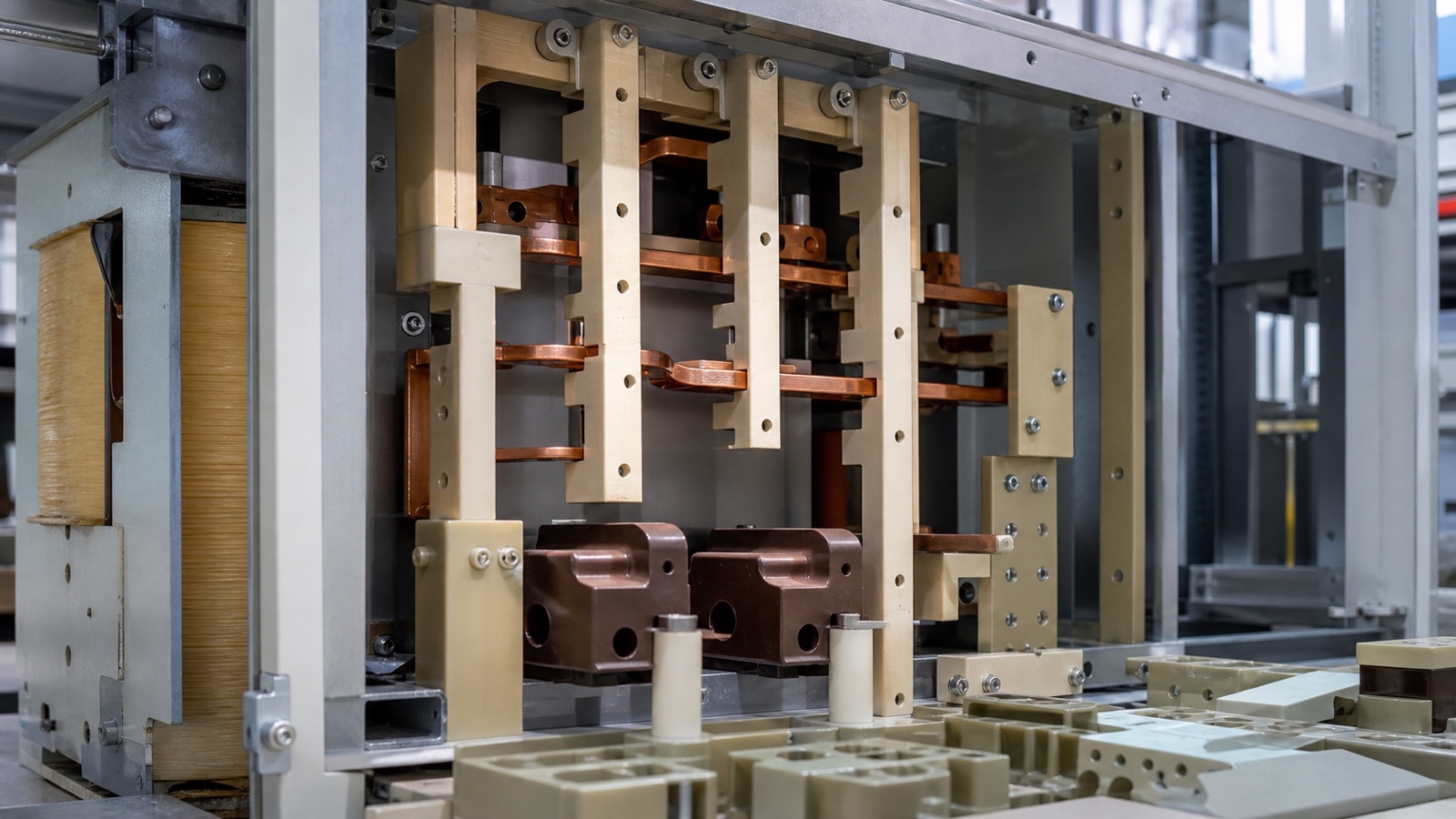
Engineering note
Resin formulation, additives, reinforcement, manufacturing route, conditioning, and processing can all affect reported properties. When we review a machined component, we work from the identified grade and its data rather than assuming all PSU or PEI behaves identically.
What Is PSU?
PSU combines heat resistance with toughness and dimensional stability. Some grades are transparent, and PSU is known for useful resistance to hot water and steam. These qualities make it worth evaluating for electrical components that also face repeated washdown, hot-fluid contact, or mechanical handling.
For insulation parts, we still check the specific grade’s dielectric, resistivity, thermal-aging, and mechanical data under the intended conditions. A property measured on a dry, room-temperature test specimen does not automatically describe a thin wall or a stressed part in a humid enclosure.
What Is PEI?
PEI is valued for its high glass-transition temperature, stiffness, dimensional stability, and inherent flame-retardant characteristics. It is used in electrical and electronic applications where the combination of mechanical rigidity and elevated-temperature capability is useful.
ULTEM is a commercial brand associated with PEI materials, but the name should not be treated as a single universal specification. Commercial grades can differ in formulation, approvals, reinforcement, and measured properties, so we recommend checking the datasheet for the exact grade being purchased or machined.
PSU: toughness and hot-fluid capability
Consider PSU when impact tolerance, hot-water or steam exposure, or transparency in a suitable grade is important. Confirm the insulation performance after conditioning and exposure.
PEI: heat, stiffness, and flame considerations
Consider PEI when higher heat capability, stiffness, and the required flame behavior are central to the design. Verify ratings and electrical data for the exact material and finished-part geometry.
PSU vs PEI: Electrical Insulation Properties
For electrical design, we look beyond a single dielectric-strength number. Relevant properties can include dielectric strength, dielectric constant, dissipation factor, volume resistivity, surface resistivity, and resistance to tracking. The importance of each depends on whether the part is a barrier, a support, a connector body, or part of a high-frequency or high-voltage assembly.
Published values are tied to test conditions: method, frequency, temperature, specimen thickness, humidity, and conditioning can all change the result. Compare datasheets using the same test standard and comparable conditions, then validate the component in its actual design.
Dielectric Strength and Breakdown Risk
Dielectric strength is useful for comparing materials under a defined test, but it is not a direct guarantee against breakdown in a finished part. Wall thickness, voids, machining damage, sharp edges, contamination, stress concentration, and elevated temperature can all affect local electric field and failure risk.
Both resins may be candidates for insulating housings, connector bodies, supports, coil forms, and components near heat sources. In a machined support, for example, a thin section around a fastener or a sharp internal corner may be more consequential than a small difference in a headline material value. We review the geometry and service conditions alongside the material choice.
Electrical Properties in Heat and Humidity
Heat and moisture can change insulation behavior over time. Humidity may affect surface resistance, while hot water or steam exposure can influence dimensions and mechanical properties depending on the grade, exposure cycle, and component design. A short-duration test at room conditions may not represent repeated thermal or moisture cycling.
For a design exposed to condensation, washdown, or steam, identify the complete exposure profile: temperature, duration, frequency, drying intervals, and any cleaning agents. We recommend testing representative parts after conditioning, particularly when clearance, creepage distance, or a tight fit is critical.
Tracking, Arcing, and Flame Performance
Dielectric strength, electrical tracking resistance, arc resistance, and flame-retardancy ratings describe different behaviors. A material’s dielectric test result does not establish its tracking performance, and a flame classification does not certify an electrical design or finished component.
For specification review
Check the required UL 94 classification, CTI or other applicable tracking data, and the standards that govern the end product. Confirm that the specific grade and finished part meet the requirement; do not assume a resin family name alone establishes approval.
Heat Resistance and Long-Term Temperature Stability
PEI generally offers a higher glass-transition temperature than PSU, and common unfilled PEI grades are often assigned higher continuous-use temperature figures than common PSU grades. These are useful distinctions, but glass-transition temperature and recommended continuous-use temperature are not interchangeable. Each comes from a different property or rating context and should be interpreted using the supplier’s definitions.
A practical service limit depends on load, duration, thermal cycling, airflow, nearby heat sources, chemical environment, and the part’s geometry. A small connector support under low load may behave differently from a thin cantilevered bracket carrying a sustained force at the same temperature. We therefore recommend checking the supplier’s thermal-aging guidance and testing the actual design when the margin is narrow.
A note on “the strongest heat-resistant plastic”
There is no single winner for every use. The answer depends on whether “strongest” means retaining tensile strength, stiffness, load capacity, dimensional stability, chemical resistance, or electrical performance at temperature. PSU and PEI are not the only candidates; compare the materials that meet the full application requirements.
Mechanical Strength and Dimensional Stability
PEI is commonly selected for stiffness and strength, while PSU offers a useful balance of toughness, strength, and dimensional stability. The comparison should include tensile strength, modulus, impact behavior, creep, and deformation under sustained loading—not just a single tensile value. Temperature, specimen thickness, grade, and conditioning can change the result.
For a precision-machined insulator, consider how the part will be fixed and loaded. A component clamped too tightly may experience stress around a hole; a long, thin support may deflect over time; and a tight-tolerance fit may shift after thermal cycling. These are design and material interactions that we review when assessing a custom plastic part.
How strong is PEI plastic?
PEI is generally regarded as a strong, stiff engineering thermoplastic, particularly where dimensional stability at elevated temperature matters. Its actual strength in service varies by grade, temperature, thickness, loading direction, and how the part is supported. Use grade-specific mechanical data and include a suitable design margin rather than relying on a generic description of PEI.
Reinforced grades
Reinforcement can increase stiffness, but may also alter electrical, thermal, dimensional, and processing behavior. Check the filled grade’s own data and suitability for the insulation requirement; do not transfer unfilled-resin values to a reinforced formulation.
Moisture, Steam, and Chemical Resistance
PSU has established use in applications involving hot water and steam, which can make it attractive for equipment exposed to repeated cleaning or fluid contact. Confirm the chosen grade’s limits and inspect the complete design conditions, including temperature, cycle count, pressure where relevant, and mechanical stress.
PEI may also be suitable for demanding environments, but selection should be based on the exact grade and exposure rather than an assumption that one resin is universally more moisture-resistant. In humid electrical assemblies, moisture performance should be considered together with surface condition, geometry, and post-exposure insulation requirements.
Chemical compatibility is exposure-specific for both polymers. When assessing cleaners, lubricants, process fluids, or solvents, include concentration, temperature, contact time, repeated exposure, and stress in the part. If a machined component is loaded while in contact with a chemical, validate that combination rather than relying only on a general compatibility chart.
PSU vs PEI: Processing, Machining, and Cost
Both materials can be injection molded or machined from suitable stock shapes. Molding is often considered for established, higher-volume part designs, while CNC machining can be practical for prototypes, low-volume production, replacement parts, or complex components where tooling is not justified. The better route depends on quantity, tolerances, geometry, finish, and the material form available.
Processing controls matter. Resin drying requirements, processing temperatures for molding, and machining practices should follow the grade supplier’s guidance. For machined parts, tool selection, heat management, clamping, and stress-sensitive geometry can influence dimensional consistency and surface quality. We review drawings and application details before recommending a manufacturing approach.
Why is PEI plastic so expensive?
PEI can cost more than more common plastics because it is a high-performance resin with specialized properties and grade options. Specialty-grade availability, supply conditions, processing requirements, and machining or scrap costs can also affect the finished part. Pricing varies by market and specification, so we avoid treating resin price alone as the full cost comparison.
For a buyer, the useful comparison is total lifecycle value: material, manufacturing route, tolerances, inspection, expected service life, and the cost of failure or replacement. A higher-cost grade may be justified when it meets a difficult requirement; otherwise, a suitable PSU grade or a different material may be more economical.
Applications: Where PSU and PEI Are Used
Both polymers appear in electrical and electronic assemblies as insulating supports, connector bodies, housings, coil forms, and parts positioned near heat sources. The design decides which characteristics matter most: dielectric behavior, mechanical support, flame classification, fluid exposure, transparency, or dimensional stability.
PSU may be considered for components where toughness, selected transparent grades, or repeated hot-water and steam exposure are useful. PEI may be considered where elevated-temperature capability, stiffness, dimensional stability, or a particular flame-performance requirement is central. These examples are starting points for evaluation, not blanket material approvals.
Approval reminder
Verify regulatory, electrical-safety, and industry approvals for the exact grade and end use. If the component is safety-critical or part of a certified system, involve the responsible design and compliance teams before changing material or manufacturing route.
How to Choose Between PSU and PEI for Electrical Insulation
We recommend working through the conditions in which the component will actually operate, then comparing specific grades against those conditions. This avoids choosing on resin name, a single datasheet value, or an assumed temperature limit.
-
1
Set the thermal envelope
Document maximum and typical operating temperature, duration, cycling, and nearby heat sources.
-
2
Define electrical conditions
Record voltage, frequency, likely transients, clearances, creepage paths, and the relevant electrical test requirements.
-
3
Map moisture and chemical exposure
Include humidity, condensation, steam, washdown, cleaning agents, concentration, and exposure duration.
-
4
Review loads and geometry
Check clamping forces, sustained loads, thin sections, sharp corners, holes, tolerances, and possible stress concentrations.
-
5
Confirm standards and commercial fit
Specify required flame, tracking, regulatory, and industry criteria, then compare material, processing, scrap, and service-life costs.
-
6
Validate the representative part
Use matched-grade datasheets, then test representative components under realistic electrical, thermal, mechanical, and environmental conditions.
For high-voltage or safety-critical designs, consult the resin supplier and an electrical-materials engineer. At PlasticCNCPro, we can review a drawing, sample, or CAD model for material suitability and CNC manufacturability, but the system designer remains responsible for validating electrical safety and end-use compliance.
Frequently Asked Questions
Is plastic a good electrical insulator?
Many plastics can be effective electrical insulators, but performance depends on the resin, grade, material condition, temperature, moisture, contamination, and part design. Use data relevant to the actual electrical and environmental conditions rather than assuming every plastic or grade performs the same way.
Is PEI a better electrical insulator than PSU?
Not universally. Compare the specific grades’ dielectric strength, dielectric constant, dissipation factor, resistivity, tracking data, and behavior after heat or moisture exposure. The geometry and operating conditions can matter as much as the material comparison.
What is the strongest heat-resistant plastic?
There is no one answer across every application. Compare candidate materials by continuous-use temperature, retained strength under load, chemical exposure, dimensional stability, and required electrical properties. PSU and PEI are only two options among high-performance plastics.
How strong is PEI plastic?
PEI is generally strong and stiff for a thermoplastic and can retain useful dimensional stability at elevated temperatures. Strength varies with grade, temperature, thickness, loading direction, and support conditions. Consult grade-specific mechanical data for design decisions.
Why is PEI plastic so expensive?
PEI is a specialty high-performance resin, and material grade, availability, supply conditions, and manufacturing requirements can affect its price. For machined parts, tolerances, material utilization, scrap, inspection, and expected service life also contribute to total cost.
Conclusion: Match the Material to the Electrical and Thermal Conditions
PEI may be preferable when higher heat capability, stiffness, dimensional stability, or flame performance is a priority. PSU may be attractive when toughness and service in hot-water or steam environments are important. For electrical insulation, neither is a universal winner: the right material is the grade that meets the electrical, thermal, mechanical, and environmental requirements in the finished design.
We recommend comparing matched-grade datasheets and validating representative parts in their real operating environment. If you are developing a custom insulator, support, housing, or other precision plastic component, PlasticCNCPro can review your drawing, sample, or CAD model and discuss material suitability, tolerances, and CNC machining for prototypes or repeat production.
Discuss a custom plastic partProject inquiry
Need a machined PSU or PEI component?
Send us your drawing, 3D model, sample, quantity, tolerance requirements, and application details. We will review the material and manufacturability requirements for your custom plastic part.