
Materials Engineering Guide
Specific Gravity vs Density in Plastics: Key Differences Engineers Should Know
Density and specific gravity look interchangeable on a datasheet, and for most plastics they are numerically close. The difference matters when you compare materials across suppliers, interpret ASTM D792 results, or calculate part weight for a machined component. This guide explains both properties from a machining shop's point of view.
"Density tells you how heavy a volume of material is. Specific gravity tells you how it compares with water. Both are useful, but only one is dimensionless."
What Are Density and Specific Gravity in Plastics?
When we quote a machined part, we often receive a material callout from the customer's drawing or a datasheet from their supplier. Both usually include a density or specific gravity value. They describe the same underlying physical property, but they are expressed differently, and mixing them up is a common source of confusion in purchasing and engineering reviews.
Density: mass per unit volume
Density is the mass of a material divided by its volume. For plastics it is typically reported in g/cm³ or kg/m³. A polymer's density depends on how tightly its chains pack together, how much of the structure is crystalline versus amorphous, and what has been compounded into it.
Specific gravity: a ratio to water
Specific gravity is the ratio of the material's density to the density of water at a specified reference temperature. Because it is a ratio, it has no units. A material with a specific gravity of 1.4 is 1.4 times as dense as water under the stated conditions.
How structure and additives shift the numbers
Polyethylene is a clear example of structure at work. Higher crystallinity packs chains more tightly, which raises density; this is why HDPE sits well above LDPE. Fillers and reinforcements push density up. Glass fiber, mineral fillers, and metal-containing grades can add significant weight relative to the base resin, while foamed or cellular grades reduce it.
Engineering note
A filled grade and an unfilled grade of the same polymer can differ noticeably in density. Always confirm which grade your datasheet describes before comparing values.
Specific Gravity vs Density: Core Differences
The two properties are related by a simple relationship, and for plastics the numerical gap is small. Still, the differences in units, reference conditions, and reporting conventions affect how you should use each value in design and quality control.
Units and reporting
Density carries units such as g/cm³ or kg/m³, so values must be converted when documents use different systems. Specific gravity is dimensionless, which makes it a convenient comparison figure across unit systems and between suppliers.
Temperature reference
Both values change with temperature because thermal expansion alters volume. Specific gravity is reported against a stated water reference temperature, so the test condition must be read alongside the number, not assumed.
Practical implications for design and quality control
In day-to-day work, the choice between the two matters less than consistency. Use one convention across the project, record the test temperature, and make sure your estimating and inspection sheets use the same basis.
-
1
Estimate weight with density
Multiply volume by density to predict part mass before machining.
-
2
Compare materials with specific gravity
Use the dimensionless ratio when reviewing alternative grades on a shortlist.
-
3
Record the test condition
Note the reference temperature and method on every inspection record.
Why Engineers Use Specific Gravity Instead of Density
Specific gravity is widely used in plastics datasheets and quality documents because it is a ratio. It is independent of the unit system, so a value written in a US, European, or Chinese specification reads the same way. For international B2B buyers comparing quotations from several suppliers, that neutrality removes a layer of conversion error.
Material identification
A quick specific gravity check can help confirm that incoming stock matches the expected family. A polypropylene bar floats in water, while a PVC or acetal bar sinks. That is not a substitute for proper certification, but it is a fast sanity check at receiving.
Cost calculations
Plastic stock is often priced by weight, while machining time depends on volume removed. Specific gravity, converted to density, links those two worlds. When we estimate material cost for a block or rod, we calculate the volume, apply density, and then multiply by the price per kilogram.
Batch consistency
Because specific gravity is a stable reference value, a drift between batches can signal a change in filler content, colorant loading, or processing history. Tracking it over repeat orders is a simple way to spot a supplier change before it affects dimensions or performance.
Warning
Do not substitute a specific gravity value into a density formula without converting it. Multiplying by the wrong factor can shift a weight estimate enough to affect freight, fixturing, or handling decisions.
ASTM D792: Standard Test Method Explained
ASTM D792 is the standard test method for density and specific gravity (relative density) of plastics by displacement. Its most common procedure, Method A, uses the Archimedes principle: a specimen is weighed in air, then weighed while fully immersed in water. The loss of apparent weight in water equals the weight of the displaced water, which gives the specimen's volume and therefore its specific gravity.
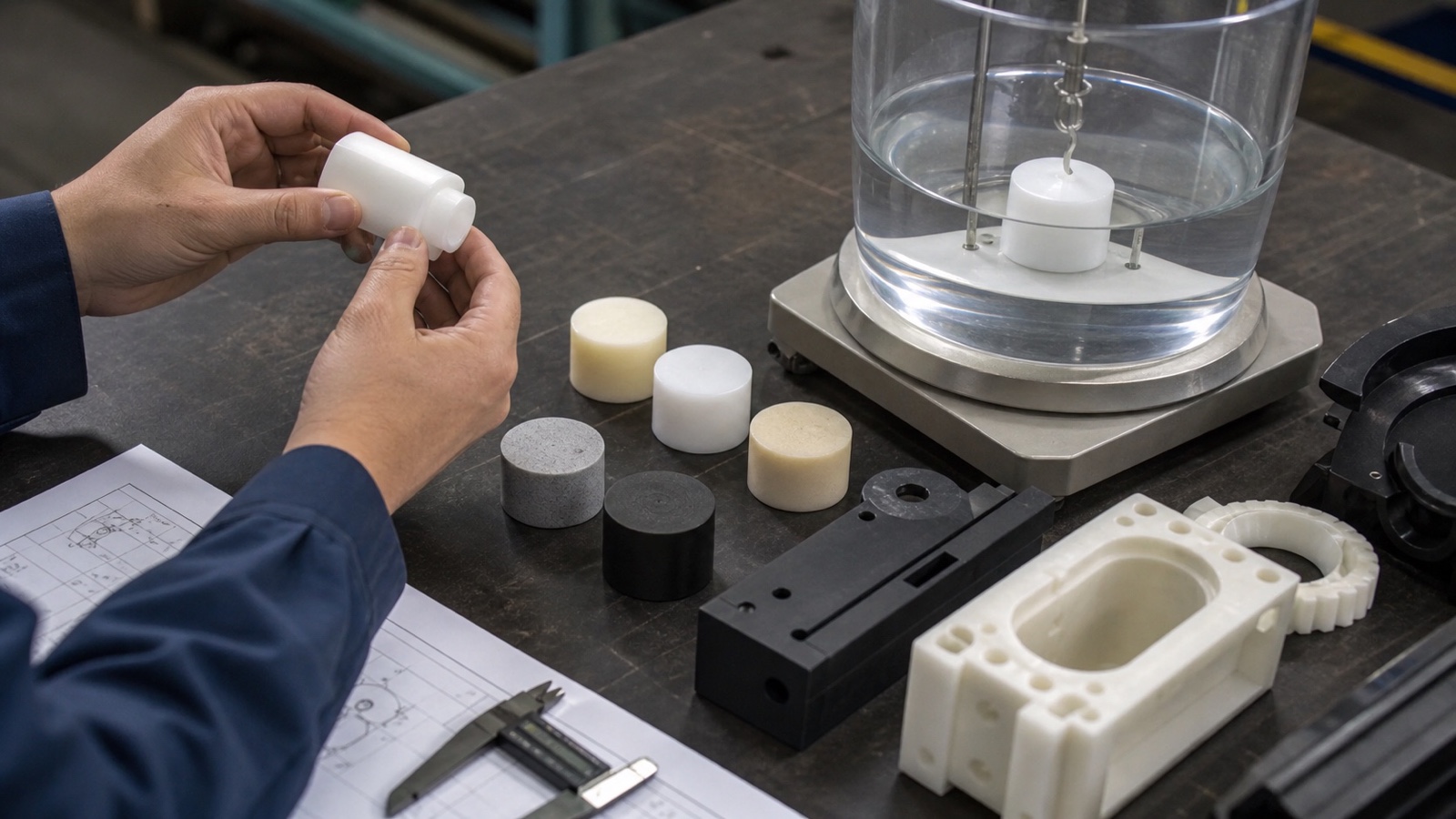
Specimen preparation
The quality of the result starts with the specimen. Surfaces should be free of contamination and loose particles, edges should not carry burrs that trap air or add mass, and the sample should be conditioned as the standard requires before testing. Machined specimens need particular care because cutting heat and dust can affect both surface and weight.
Procedure sequence
-
1
Condition the specimen
Bring the specimen to the standard laboratory conditions specified for the test.
-
2
Weigh in air
Record the dry mass of the specimen; this is the value labelled A.
-
3
Weigh while immersed
Suspend the specimen in water at the specified temperature, remove any air bubbles, and record the apparent mass, labelled B.
-
4
Calculate and report
Apply the formula below and report the result with the temperature and method used.
Calculating the result
With A as the mass in air and B as the apparent mass in water, the specific gravity follows directly from the ratio. Density is then obtained by multiplying by the density of water at the test temperature, which is approximately 0.9975 g/cm³ at 23 °C.
Specific gravity = A / (A − B)
Density (g/cm³) ≈ Specific gravity × 0.9975
Tip
Trapped air bubbles on the specimen surface are a frequent cause of low results, because they add buoyancy. Wetting the surface and checking visually before each reading saves rework.
Other Common Testing Standards for Plastics
ASTM D792 is not the only route. Two other standards appear frequently in supplier documentation and customer specifications, and each suits a different situation.
ASTM D1505: density gradient column
This method places small specimens in a liquid column with a density gradient and compares where each specimen settles against calibrated reference floats. It is well suited to small pieces and to checking density to a fine resolution.
Advantages
Good resolution for small samples and useful for comparing near-identical grades.
Limitations
Requires a prepared gradient column and calibrated floats, and is less practical for large parts.
ISO 1183 methods
ISO 1183 is the international family of methods for determining density of plastics. It includes immersion, pycnometer, gradient column, and titration approaches, letting laboratories select the method that suits the material form and the required accuracy. Customers working with European or Asian supply chains often reference it directly.
Advantages
Several methods cover a wide range of specimen forms, and it aligns with international specifications.
Limitations
Method choice must be stated clearly, since results from different ISO 1183 methods are not always interchangeable at fine resolution.
Typical Specific Gravity and Density Values for Common Plastics
The values below are typical ranges for unfilled base grades at room temperature. They are for quick reference during early material screening only. Filled, reinforced, foamed, or colored grades can differ, so always confirm against the supplier's datasheet for the exact grade.
| Material | Typical density (g/cm³) | Typical specific gravity | Machining note |
|---|---|---|---|
| HDPE | 0.94–0.96 | 0.94–0.96 | Floats in water; soft and easy to cut |
| PP (homopolymer) | 0.90–0.91 | 0.90–0.91 | Lowest density of the group; watch for heat in machining |
| ABS | 1.04–1.06 | 1.04–1.06 | Sinks slightly; stable for dimensional parts |
| PVC (rigid) | 1.30–1.45 | 1.30–1.45 | Heavier than most commodity plastics; dust control matters |
| Nylon 6 | 1.13–1.15 | 1.13–1.15 | Moisture affects dimensions; condition before final checks |
| POM / Acetal (homopolymer) | 1.41–1.43 | 1.41–1.43 | Good dimensional stability for precision parts |
| PEEK (unfilled) | 1.30–1.32 | 1.30–1.32 | High-performance grade; density close to filled PVC |
| PTFE | 2.14–2.20 | 2.14–2.20 | Among the densest common plastics; soft and low-friction |
Because density and specific gravity are numerically almost identical for these materials at room temperature, the same range applies to both columns.
Industrial Applications and Material Selection
In real projects, density and specific gravity influence far more than a single number on a page. They shape how heavy an assembly becomes, how a component behaves in a fluid, and what documentation a regulated customer may ask for.
Part weight and dimensional stability
For automotive sensor housings, robotics arms, and semiconductor handling fixtures, a lighter material can reduce inertia and simplify mounting. Density is the property that tells you the weight before a part is machined. Dimensional stability is a separate property, but it is often evaluated alongside density when choosing between a lighter and a heavier engineering polymer.
Flotation behavior
Specific gravity relative to water determines whether a plastic floats or sinks. This matters for floating or submerged equipment, for sink-float separation in recycling streams, and for fluid-handling components that may sit in liquid. A polyolefin part with a specific gravity below 1 behaves very differently from a PVC or PTFE part in the same tank.
Regulatory compliance in automotive, medical, and packaging
Many regulated sectors ask for documented material properties as part of supplier qualification. Density or specific gravity may appear in material specifications, incoming inspection plans, or design reviews. Requirements differ by customer and by application, so confirm them early rather than assuming a single standard applies everywhere.
Material selection checklist
-
Confirm the grade
Check whether the value applies to a filled, unfilled, or colored grade.
-
Match the test method
Compare ASTM D792, ASTM D1505, and ISO 1183 results only when the basis is known.
-
Check weight impact
Estimate part mass from volume and density before committing to a material.
-
Review other properties together
Balance density with strength, moisture uptake, chemical resistance, and temperature limits.
At PlasticCNCPro, we review these properties with customers during quotation, particularly when a molded part is being converted to a machined low-volume or prototype component. Our team machines a wide range of thermoplastics and high-performance polymers, and we can discuss how density, stability, and cost interact for your specific design before any material is cut.
Frequently Asked Questions
What is the ASTM standard for specific gravity?
For plastics, the principal standard is ASTM D792, which covers density and specific gravity (relative density) by displacement. Method A uses water immersion and is the most common route for solid specimens.
What is the ASTM D792 test method and how does it work?
The specimen is weighed in air and then while submerged in water. The difference gives the displaced volume, from which specific gravity is calculated as A / (A − B). Density is obtained by multiplying by the density of water at the test temperature.
Why do we use specific gravity instead of density?
Specific gravity is dimensionless, so it does not depend on the unit system and is easy to compare across datasheets and suppliers. It is also widely used in plastics documentation. Density remains essential when you need mass estimates or cost calculations by weight.
Start a Quotation
Need help choosing a machinable plastic?
Send us your 2D drawing, 3D model, material requirement, quantity, tolerance, and application details. Our engineering team in Dongguan, China will review density, dimensional stability, and manufacturability with you before production.
- Prototype and low-volume CNC machining
- Export-ready packing and inspection support